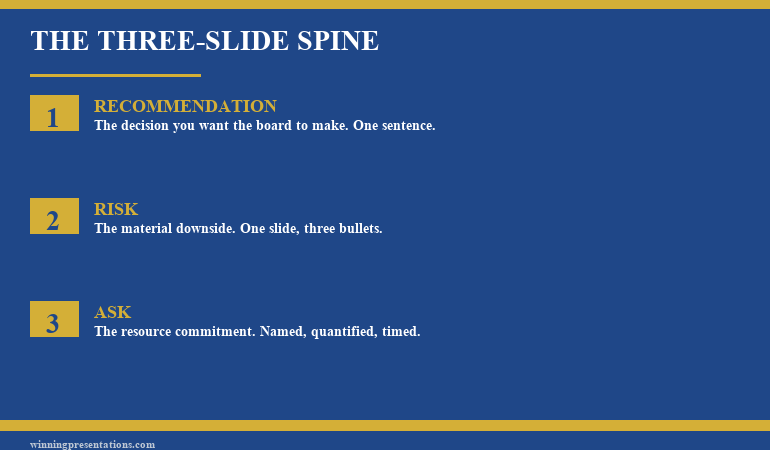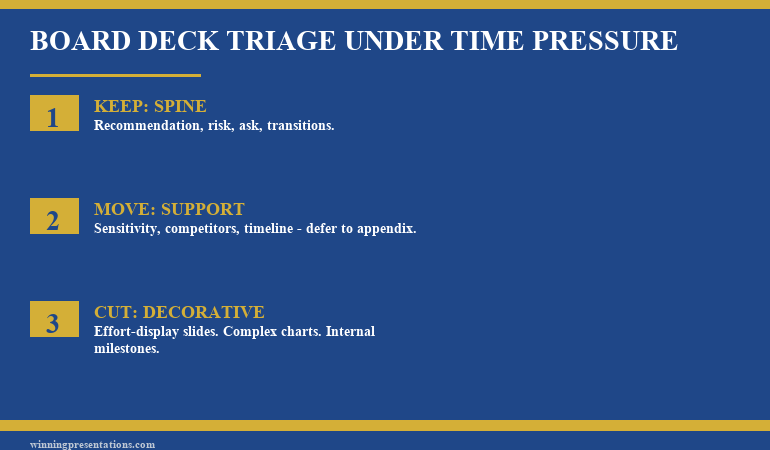
Quick answer: A board presentation appendix is not the place tired or weak slides go to be forgotten. Used well, it is where a senior presenter parks every piece of evidence a director might reach for — the detailed numbers, the sensitivity tables, the methodology, the second-order risks — so the live deck can stay short enough to carry a decision and the presenter can answer almost any challenge by turning to one labelled slide. The structural move is the front-deck/back-deck split: the front deck carries only the recommendation and the few slides that load-bear it, usually eight or fewer; the back deck holds everything that exists to answer “can you show me?” The test for which slide goes where is simple — if a slide makes the case, it is front; if it only defends the case when asked, it is appendix. The presenter who runs this split walks into the room with a deck a board can actually get through and an appendix that makes them close to unshakeable under questioning.
JUMP TO:
In 2009 I worked with a senior risk officer at one of the banks where I held a corporate banking role, preparing him for a lending proposition he was taking to the credit committee. The proposition was sound and he knew the file better than anyone in the building. To prove it, he had built a forty-four-slide pack — every covenant, every scenario, every counterparty exposure on its own slide, in the order he had analysed them. He walked in confident because he had left nothing out. Nine minutes in, the committee chair, a man in his sixties who had chaired that committee for the better part of a decade, stopped him on slide twelve, put his pen down on the printed pack, and said: “I have read the file. I do not need you to read it back to me. What are you actually asking us to approve, and where is the one number that tells me whether it is safe?” The number was on slide thirty-one. The risk officer flicked forward through nineteen slides to find it while the room waited, and by the time he reached it the chair had already lost confidence — not in the proposition, which was fine, but in the presenter’s grip on his own case.
I have now worked with somewhere around fifty senior leaders preparing decisions for boards, credit committees, investment committees, and executive committees across financial services, professional services, healthcare, and technology. The forty-four-slide pack is the single most common failure I see, and it is almost never a failure of preparation. It is a failure of sorting. The risk officer had done all the right analysis; he simply put all of it in front of the committee in one undifferentiated stream, on the theory that completeness was the same thing as rigour. A board does not experience a complete deck as rigorous. It experiences it as a presenter who has not decided what matters — which is the one impression that sinks an otherwise strong case.
(This article was created with AI assistance; all stories and insights are based on 35 years of real client work.)
The appendix is the tool that solves this, and almost nobody uses it as a tool. Most presenters treat the appendix as a dumping ground — the slides they could not bear to delete, shoved behind the last “thank you” slide where they assume no one will look. Used deliberately, the appendix is the opposite: it is the structural device that lets the front of the deck stay short enough to carry a decision while keeping every piece of supporting evidence one tap away. The framework I now teach every senior leader before a board presentation is a deliberate front-deck/back-deck split: the front deck makes the case in as few slides as the case allows; the back deck holds everything that exists only to answer a question. Get the split right and you walk in with a deck the board can finish and an appendix that makes you very hard to corner.
If you would rather not sort forty-four slides into front and back by hand the night before:
The Executive Slide System ships 26 executive templates built around the front-deck/back-deck shape — a short decision deck plus structured appendix layouts for sensitivities, methodology, and risk — along with 16 scenario playbooks covering board approval and committee review. It gives you the split as a starting structure rather than something you reverse-engineer from a bloated pack at midnight.
Why board decks bloat — and why the appendix is the cure, not the symptom
The instinct that produces a forty-four-slide pack is not laziness; it is fear, and the fear is specific. A senior leader presenting to a board is afraid of one thing above all others: being asked a question they cannot answer in the room, in front of people whose opinion of them shapes their career. The forty-four-slide pack is an attempt to insure against that fear by putting every possible answer somewhere in the deck. The logic is “if it is all in here, I can never be caught out.” The logic is sound about the evidence and wrong about the format. You do want every answer available. You do not want every answer in the path of the live presentation, because a board reading forty-four slides in sequence never reaches the decision before it runs out of patience, and a presenter walking the board through all of it signals that they could not tell the load-bearing slides from the supporting ones.
The appendix resolves the fear without paying the format cost. Everything the leader was afraid of being asked still lives in the deck — it simply lives in the back, sorted and labelled, ready to be pulled forward in seconds when a director asks for it. The front deck is freed to do the one thing a front deck is for: make the case and ask for the decision. This is why the appendix is the cure rather than the symptom. A long appendix is a sign of a well-prepared presenter. A long front deck is a sign of a presenter who has not finished thinking. The two look similar in a slide count and could not be more different in the room. A board that sees a six-slide front deck backed by a thirty-slide labelled appendix reads a presenter who has done all the work and then made the hard choices about what the meeting actually needs.
There is a second-order benefit that senior leaders consistently underrate until they have felt it. A short front deck changes how the presenter behaves. When you know the case rests on six slides, you rehearse those six slides until they are clean, you know exactly where you are at every moment, and you never lose your place — because there is so little place to lose. The forty-four-slide presenter is managing navigation the entire time, which is cognitive load spent on logistics rather than on reading the room. The split does not just shorten the deck; it frees the presenter’s attention to do the higher-value work of watching how the board is responding and adjusting. The same discipline of leading with the decision and parking the proof sits at the centre of how senior leaders are coached for board-level rooms.
The front-deck/back-deck split
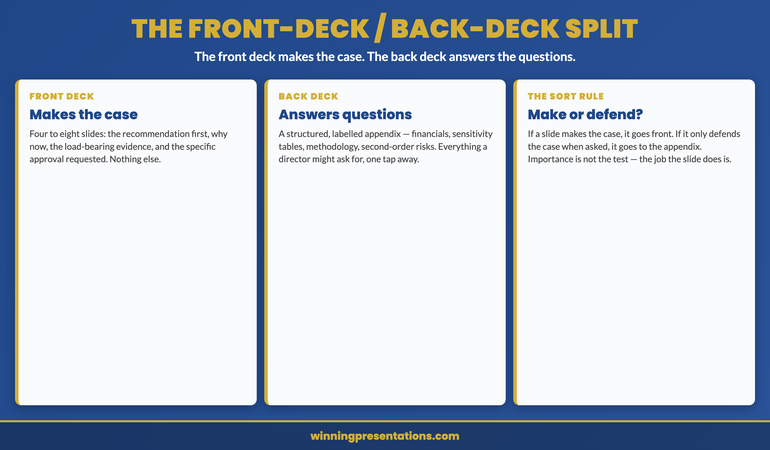
The front deck answers four questions and nothing else: what are you recommending, why now, what is the evidence that it is sound, and what specifically do you need the board to approve. In most cases that is between four and eight slides. The recommendation goes first — not the background, not the context, not the journey you went on to reach it. The board can hold the recommendation in mind and read everything after it as the case for that recommendation, which is far easier than holding twenty slides of context and waiting to find out where it is all heading. The evidence in the front deck is only the evidence that actually carries the decision: the one or two numbers, the single sensitivity that matters most, the one risk that would change the answer. Everything else — and there is always a great deal of everything else — goes to the back.
The back deck is structured, not dumped. This is the part presenters get wrong even when they have understood the principle. An appendix that is forty slides in the order you happened to build them is almost as useless as no appendix, because you cannot find anything in it under pressure. A working appendix is organised by the question it answers and labelled so you can navigate to it instantly: a tab for the detailed financials, a tab for the sensitivity tables, a tab for methodology and assumptions, a tab for the second-order risks and mitigations. When a director asks “what happens if the rate moves two hundred basis points,” you do not flick through nineteen slides. You say “that is in the appendix — here,” and you are on the sensitivity table in one move. The difference between flicking and turning straight to it is the difference between a presenter who looks caught out and one who looks like they anticipated the question.
Stop rebuilding the board deck from a blank page every time the proposition changes.
The Executive Slide System gives you the front-deck/back-deck split as a ready structure: a short decision deck plus appendix layouts for financials, sensitivities, methodology, and risk. It ships 26 executive templates, 93 AI prompts for populating slides from your own figures, 16 scenario playbooks covering board approval, credit and investment committee, and finance review, plus 7 checklists. Built for senior presenters who take a decision to a committee more than once a quarter. £39, instant download, lifetime access.
- 26 executive slide templates — short decision decks plus structured appendix layouts
- 93 AI prompts — for turning your raw analysis into a front deck and a sorted back deck
- 16 scenario playbooks — board approval, credit committee, investment committee, finance review
- 7 checklists — including the pre-meeting sort that decides which slides go front and which go back
The “will they ask?” test for sorting every slide
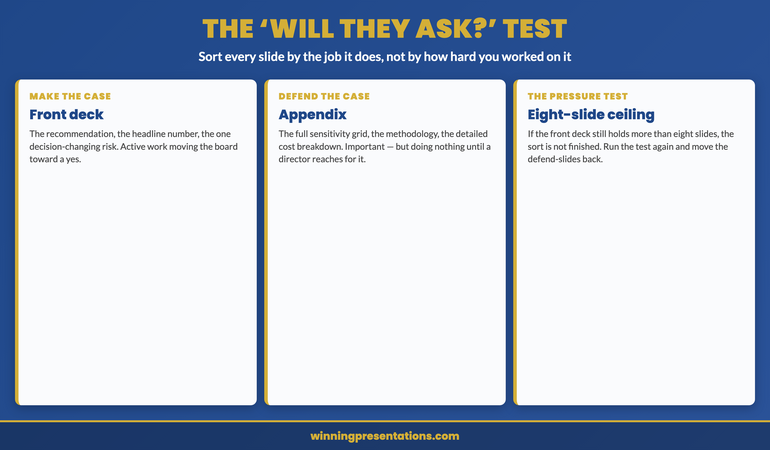
The split is only as good as the rule you use to sort slides into front and back, and most presenters do not have a rule — they sort by attachment, keeping the slides they worked hardest on regardless of whether the board needs them. The rule that works is a single question asked of every slide: does this slide make the case, or does it only defend the case if someone asks? A slide that makes the case — the recommendation, the headline number, the one risk that could change the decision — is doing active work to move the board toward a yes, and it belongs in the front deck. A slide that only defends the case — the full sensitivity grid, the methodology, the detailed cost breakdown — is doing nothing until a director reaches for it, and it belongs in the appendix. The test is not whether the slide is important. Most appendix slides are important. The test is whether the slide is doing work in the live narrative or waiting to be summoned.
I watched the value of this rule land for a different client, a divisional finance lead, in 2014. She had inherited the forty-slide habit from her predecessor and was sceptical that a board would tolerate a short deck. We ran the “will they ask?” test on her existing pack and it collapsed from thirty-eight slides to seven in front, with thirty-one sorted into a labelled appendix. She presented it to the divisional board the following month braced for them to demand the detail. They did the opposite. The board got through the decision in under twenty minutes, asked four questions, and she answered every one by turning straight to the relevant appendix tab without a single fumble. The chair’s comment afterward was the one every senior presenter wants: “That was the best-prepared pack we have seen from your division.” Same analysis, same numbers, same person. The only thing that had changed was that the evidence was sorted by the job each slide was doing. To take the test from your own deck tomorrow: open it, ask “make or defend?” of every slide, and move every defend-slide to the back. If your front deck still has more than eight slides, you have not finished sorting.
For the deeper framework behind building a board case that holds up under sustained questioning:
The Executive Buy-In Presentation System is a self-paced programme with 7 modules covering stakeholder analysis, case construction, and the presentation structures that hold up at board and executive committee level. Senior leaders use the case-construction and objection-handling modules to decide what carries a board decision and what belongs in reserve. Self-paced with monthly cohort enrolment; optional live Q&A sessions, fully recorded — watch back anytime. Lifetime access to materials. £499.
How a labelled appendix turns Q&A from a threat into a demonstration
The hidden return on the front-deck/back-deck split shows up in Q&A, which is the part of a board presentation most senior leaders quietly dread. When your evidence is sorted and labelled in the back, a hard question stops being a threat and becomes an opportunity to demonstrate command of the file. A director asks for the downside scenario; you turn to the labelled sensitivity tab and walk them through it; the board watches a presenter who anticipated the question and prepared the answer. That is a fundamentally different impression from the presenter flicking forward through nineteen slides hoping the number is where they think it is. The appendix lets you convert every “can you show me” into a small proof of preparation, and across a forty-minute Q&A those small proofs compound into the board’s overall read of whether this is someone they can trust with a bigger decision.
There is a discipline that makes the appendix work as a demonstration rather than a hiding place, and it is worth naming. You have to actually know your appendix. An appendix you built but never rehearsed is no better than no appendix, because you will still hunt for the slide under pressure. The senior leaders who use the split best spend their final preparation not re-reading the front deck — which by then they know cold — but rehearsing the jumps to the appendix tabs, so that “show me the sensitivity” produces an instant, confident move to exactly the right slide. The front deck wins the argument; the appendix wins the cross-examination; and the cross-examination is often where a board’s real decision is made. The same principle of pre-loading the room’s questions runs through the partner article on the dashboard slide that makes a board stop listening, and through the work on how senior presenters open.
One structure. Every committee. No subscription, no rebuild.
Instant download, lifetime access to the Executive Slide System — 26 templates, 93 AI prompts, 16 scenario playbooks, 7 checklists. No renewal, no licence to maintain. £39 once. Built for senior presenters who would rather start every board paper from a structure that already separates the decision deck from the appendix than rebuild the sort from a blank page each time.
Frequently asked questions
Won’t a board think a short front deck means I haven’t done the work?
It is the opposite, provided the appendix is there to prove it. A board reads a short, sharp front deck backed by a deep, labelled appendix as the clearest possible signal that the presenter has done all the work and then made the hard choices about what the meeting needs. The risk of looking underprepared comes not from a short deck but from a short deck with nothing behind it — a presenter who cannot produce the detail when asked. The split protects you from exactly that, because every piece of detail is one tap away. In practice the boards I have watched respond to the short-front-deep-back structure with more confidence in the presenter, not less, because it demonstrates the judgement to separate what carries the decision from what supports it.
How many slides should actually be in the front deck?
As few as the decision allows, which for most board propositions is between four and eight. The number matters less than the principle: the front deck contains only the slides that actively make the case — the recommendation, why now, the load-bearing evidence, and the specific approval requested. If you are above eight front slides, the usual cause is that defend-the-case slides have crept forward; run the “will they ask?” test again and move them back. Some genuinely complex propositions need ten or twelve front slides, and that is fine if every one is doing active work. What you are guarding against is not a slide count but the bloat of evidence that is only there in case someone asks, which belongs in the appendix regardless of how important it is.
What is the most common mistake senior leaders make with an appendix?
Building it in the order they did the analysis rather than the order the board will reach for it, and then never rehearsing the jumps. An appendix that is a chronological dump of your working is almost useless under pressure because you cannot find anything in it when a director asks. The fix is to organise the back deck by the question it answers — financials, sensitivities, methodology, risks — label each section so you can navigate to it in one move, and spend your final preparation rehearsing the jumps rather than re-reading the front deck. The appendix only becomes a strength in the room when you can turn to the right slide the instant it is requested.
Does this work if the board expects a detailed pre-read?
Yes, and the two reinforce each other. Send the full detail — front deck and appendix together, or a separate detailed pack — as a pre-read twenty-four to forty-eight hours ahead, clearly labelled as the supporting material. Then present the short front deck live. A board that asks for detail is usually asking to be able to check it in their own time, not to have it read aloud in the meeting. The pre-read reassures the directors who want to verify; the short live deck respects the time of the whole room; and the appendix is there in the live session for anyone who wants to go deeper on a specific point. Far from conflicting, the pre-read and the front-deck/back-deck split are the same instinct applied to two different moments.
The Winning Edge — weekly newsletter
The Winning Edge is a weekly newsletter for senior professionals who present at the executive level. One short email a week on the structural moves that separate decks boards approve from decks they merely receive. Subscribe to The Winning Edge →
For the wider library of presentation assets senior leaders draw on — slide system, storytelling primer, Q&A taxonomy, delivery references — the complete presenter library (£99) collects them in one place. See the wider set of board-readiness resources on the services page, and the partner article on the dashboard slide that loses the room.
About the author
Mary Beth Hazeldine is Owner & Managing Director of Winning Presentations Ltd. With 24 years of corporate banking experience at JPMorgan Chase, PwC, Royal Bank of Scotland, and Commerzbank, she advises executives across financial services, healthcare, technology, and government on structuring presentations for high-stakes funding rounds, board approvals, and strategic decisions.
The next time you build a board paper, do three things instead of putting everything you analysed in front of the room: lead the front deck with the recommendation and keep it to the four-to-eight slides that actively make the case; run the “will they ask?” test on every remaining slide and send each defend-the-case slide to a labelled appendix tab; and spend your final rehearsal not on the front deck you already know, but on the jumps to the appendix so any “show me” lands on the right slide in one move. The board does not reward the presenter who left nothing out. It rewards the presenter who knew exactly what to put in front of them and had everything else ready the instant it was asked for.