

Quick answer: A board approval training course online is worth its price only if it teaches the structural moves boards actually approve on — the recommendation-first opening, the case-construction that addresses board-level objections in advance, the slide structure that holds up under audit-grade scrutiny, and the Q&A discipline that lets the recommendation survive the first hostile question without unravelling. Confidence-only programmes leave senior leaders feeling more composed but no more likely to get the decision. The Executive Buy-In Presentation System is the self-paced programme senior professionals use to learn the structural method: seven modules covering stakeholder analysis, case construction, recommendation-led presentation structure, the psychology of board decision-making, and the post-presentation work that converts approval-in-principle into approval-on-paper. Self-paced with monthly cohort enrolment. Lifetime access to materials. £499.
JUMP TO:
- What separates a board approval training course that works from one that doesn’t
- The five structural components a board approval course must cover
- Why self-paced beats live-cohort for senior board work
- What you get in the Executive Buy-In Presentation System
- Who the programme is designed for
- Frequently asked questions
In April 2021 I was asked to coach a senior division head at a UK-listed industrial services group through a series of four board approvals over a twelve-month strategic redirect. The division had grown through three acquisitions in five years and the board, after a sceptical review by the new senior independent director, had begun pushing back on capital allocations the division had been receiving on essentially nodded approval. The division head was a competent operator with twenty-three years of operational experience. He had done two well-regarded executive education programmes in the previous five years and could speak fluently to communication strategy, stakeholder analysis, and slide design principles. His first board attempt at the strategic redirect, in May 2021, was deferred to a follow-up session. His second attempt, in July, was approved in principle but the capital allocation was reduced by forty per cent of his ask. The third attempt, in October, was approved cleanly. The fourth, in February 2022, was approved with an expanded mandate. The difference between attempts one and three was not increased confidence, broader communication training, or better slides. The difference was that he had stopped teaching the board his analysis and started building the case the board was actually going to evaluate, in the structural order the board evaluates cases in. The structural method is what the Executive Buy-In Presentation System teaches.
(This article was created with AI assistance; all stories and insights are based on 35 years of real client work.)
This piece walks through what separates a board approval training course that produces real decision outcomes from one that produces confidence without conversion, the five structural components a serious course has to cover, why self-paced delivery works better than live-cohort for senior board work, and what the Executive Buy-In Presentation System covers across its seven modules. Senior leaders considering a board approval training course should know exactly what they are buying before they commit — the next few sections describe what to look for, what to avoid, and what the programme actually contains.
Before your next board approval, a structural pre-board checklist is worth running.
The Executive Presentation Checklist walks through the structural moves senior leaders run before any high-stakes board approval — case construction, recommendation positioning, objection mapping, slide sequencing. Free download, no email gate.
What separates a board approval training course that works from one that doesn’t
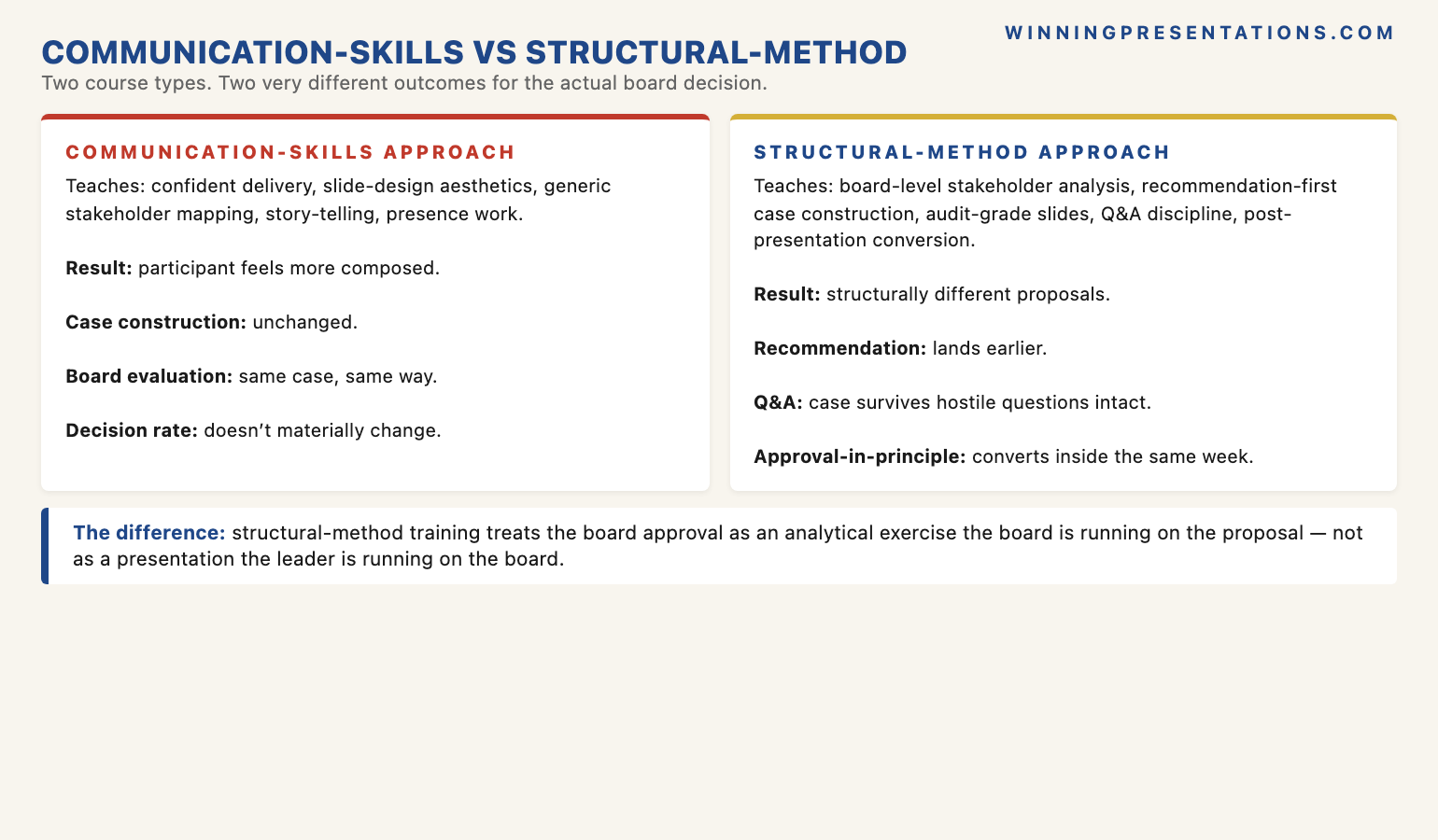
Most board approval training that senior leaders have completed by mid-career is structurally a communication-skills course relabelled for the boardroom audience. The course teaches confident delivery, slide design principles, the importance of stakeholder analysis, the value of telling a story, the need to anticipate questions, and the discipline of timing the session. The senior leader who completes the course feels more prepared and walks into the next board session with more composure. The board, however, is evaluating the same thing it has always evaluated — the case for the proposal — and the communication-skills improvements rarely translate into more approvals because the case construction itself has not changed.
The board approval training that produces decision outcomes is structurally different. It treats the board approval as an analytical exercise the board is running on the proposal, not as a presentation the senior leader is running on the board. The work the course teaches is the work of constructing a case the board can audit in real time and find structurally sound — with the recommendation positioned where the board is looking for it, with the supporting analysis sequenced in the order the board will evaluate it, with the objections anticipated and addressed in the structure of the case rather than left for the Q&A to surface, and with the post-presentation work the board needs to convert approval-in-principle into approval-on-paper already prepared. Communication-skills improvement is a side benefit of doing the structural work; it is not the point.
The April-to-October 2021 transition the UK industrial services division head went through was a transition from communication-improvement training to structural-method training. Attempts one and two failed not because his confidence was insufficient or his slides looked unprofessional. They failed because the recommendation was buried two-thirds of the way through the deck, the supporting analysis was sequenced in the order he had built it rather than the order the board would evaluate it, and the obvious board-level objections were not addressed until the Q&A — by which point the board had already constructed reasons to defer. Attempt three succeeded because the structural method had been applied: recommendation on slide one, audit-grade supporting analysis on slides two through six, the three predictable board objections addressed in the case structure itself, and the post-approval governance prepared in advance. The substance was the same. The structural method changed the outcome.
The five structural components a board approval course must cover
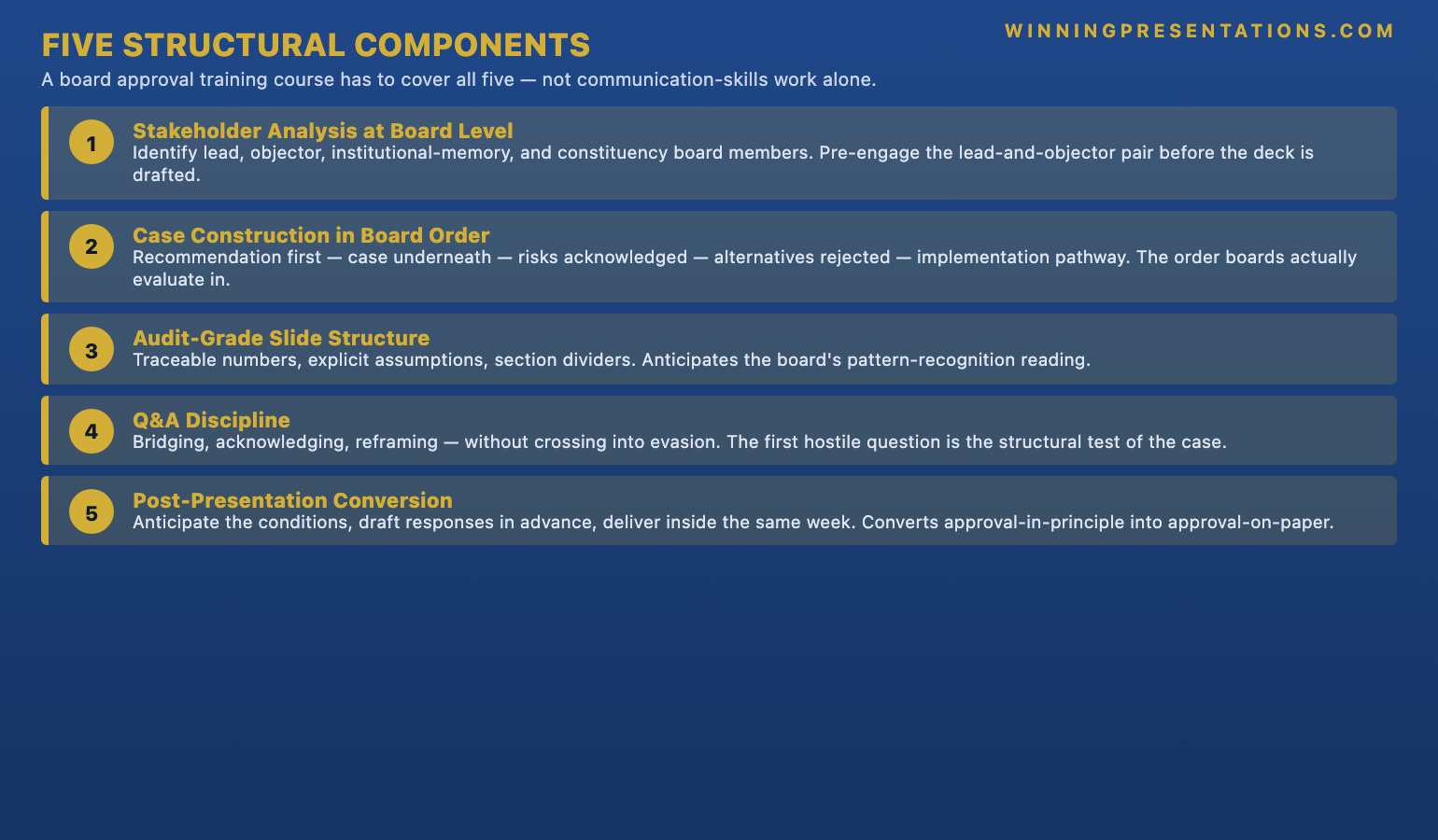
A board approval training course online that is worth its price has to cover five structural components. The components are not optional; missing any one of them is what produces the gap between “feels more prepared” and “gets the decision.”
One: stakeholder analysis at board level. Not generic stakeholder mapping. The specific work of identifying which board members will lead the decision discussion, which are likely to ask the hostile questions, which carry the institutional memory of similar past proposals (approved or rejected), and which represent constituencies on the board (executive, non-executive, audit committee, remuneration committee) whose perspectives will shape the conversation. The course should teach how to source this information in the weeks before the board session and how to pre-engage the most likely lead-and-objector pair before the deck is even drafted.
Two: case construction in the structural order boards evaluate. Boards evaluate proposals in a predictable order. The recommendation first — what is the board being asked to approve, in one sentence. The case underneath — why this recommendation, in three or four substantive points the board can audit. The risks acknowledged — what could go wrong and how the recommendation accommodates that. The alternatives considered and rejected — what else was on the table and why this option won. The implementation pathway — how the approval converts into action with governance the board can monitor. The course has to teach this ordering as the load-bearing structure, not as one option among many.
Three: slide structure that holds up under audit-grade scrutiny. Board members read decks the way auditors read management accounts — with pattern-recognition for inconsistencies, with cross-references between slides to test internal coherence, and with the assumption that anything missing was probably omitted deliberately. The course has to teach slide structures that anticipate this reading — clear labels, traceable numbers, explicit assumptions stated where they affect the conclusion, and section dividers that signal to the board where the case structure is moving. The slide-design-as-aesthetics frame most training uses is the wrong frame for board work.
Four: Q&A discipline that lets the recommendation survive the first hostile question. The first hostile question in a board session is a structural test of whether the case is sound. If the answer unravels under the question, the board reads the case as not having been thought through; if the answer holds, the board reads the case as analytically robust. The course has to teach the response patterns that work at board level — bridging, acknowledging, reframing — without crossing into the politician-deflection patterns boards read as evasive. The Q&A discipline is the moment the case construction earns or loses the decision.
Five: the post-presentation work that converts approval-in-principle into approval-on-paper. Board approvals frequently land as approval-in-principle subject to conditions, additional analysis, or governance arrangements the board wants finalised before the formal sign-off. The course has to teach the structural work of preparing the response to those conditions in advance — anticipating the likely conditions, drafting the response, and being ready to provide it in the same week as the approval rather than three weeks later when momentum has dissipated. This is the component most board approval training skips entirely. It is also the component that distinguishes “approved” from “approved and implemented at the originally requested scale.”
Walk into your next approval meeting prepared.
The Executive Buy-In Presentation System gives you the structural method for securing board-level approval — the seven modules cover stakeholder analysis, case construction, the recommendation-led presentation structure, the audit-grade slide work, the Q&A discipline, and the post-presentation conversion work. Self-paced with monthly cohort enrolment. Optional live Q&A calls, fully recorded. No deadlines. No mandatory session attendance. Lifetime access to all materials.
- 7 modules of self-paced course content
- Optional live Q&A / coaching calls (fully recorded — watch back anytime)
- No deadlines, no mandatory session attendance
- New cohort opens every month — enrol whenever suits you
- Lifetime access to all course materials — £499
Why self-paced beats live-cohort for senior board work
The conventional wisdom in executive education is that live-cohort programmes deliver better outcomes than self-paced ones because of the peer learning, the live discussion, and the discipline that fixed dates create. For senior board work, the conventional wisdom inverts. Senior leaders preparing for actual board approvals are not in a position to schedule four weeks of fixed live sessions around the timing of the board cycle; the work has to be available when the live board moment is approaching, in the specific sequence the upcoming board session requires, at the pace the senior leader’s diary actually allows.
Self-paced content with optional live calls solves this. The senior leader engages with the relevant module the week before the board session, applies the structural work to the actual proposal being prepared, attends or watches the relevant recorded coaching call for additional reps, and returns to the material as the board cycle requires across the year. The lifetime access matters because board approvals are not a one-off event — the same senior leader will be running similar approvals quarterly or semi-annually across many years, and the structural method becomes more useful with each application rather than diminishing returns. A four-week live cohort that locks senior diaries into a fixed schedule fights against the actual operating rhythm of senior board work. The self-paced architecture aligns with it.
The Executive Buy-In Presentation System is structured exactly this way: seven self-paced modules, monthly cohort enrolment so new cohorts open every month and senior leaders can begin whenever the operational moment arrives, optional live Q&A calls fully recorded so the live element is available without being mandatory, and lifetime access so the material remains available across the multiple board cycles a senior leader will run over the years that follow. The paradox that the most senior presenters are often the least prepared covers the related dynamic of why structured self-paced material works particularly well for the seniority level the board approval audience occupies.
What you get in the Executive Buy-In Presentation System
The Executive Buy-In Presentation System is a self-paced programme on the Maven platform. The programme is built for senior professionals who need board approval for budget proposals, strategic redirects, capital allocations, acquisition cases, organisational change, and other decisions that require active board endorsement rather than nodded acceptance. Each cohort enrols monthly — participants can begin whenever the next cohort opens, work through the seven modules at their own pace, and attend or watch optional recorded Q&A calls scheduled across the cohort window. There are no deadlines, no mandatory live attendance, and lifetime access to all materials.
The seven modules cover the five structural components described above (stakeholder analysis, case construction, slide structure, Q&A discipline, post-presentation conversion) plus the two additional structural areas senior leaders need for board work specifically: the psychology of board decision-making (what boards are actually doing when they evaluate a proposal, why deferrals are often a stronger signal than rejections, how board members coordinate their positions before the session), and the structural rehearsal protocol that converts the prepared case into a delivery the board reads as composed rather than coached. The bonus Q&A calls are optional and recorded; participants who cannot make a live call can watch the recording at any time. The programme is priced at £499 with lifetime access to all course materials.
If the board approval needs to land in slide structure as well as in case construction, the slide library matters.
The Executive Slide System ships the 26 templates, 93 AI prompts, 16 scenario playbooks, and 7 checklists senior professionals use to build the slide work the board approval programme’s case construction sits on top of. Designed for the recommendation-led, audit-grade slide structures boards actually engage with. £39, instant download, lifetime access.
Who the programme is designed for
The Executive Buy-In Presentation System is designed for senior professionals who present decisions to boards, investment committees, and executive sponsors — division heads, regional MDs, business-line leads, senior partners, function heads (CFOs, CIOs, CHROs, CTOs), and senior operators in regulated industries where board approval is a structural requirement rather than a formality. The programme assumes the participant has the substantive operational expertise their role requires; it teaches the structural presentation method that converts that expertise into board-readable cases the board can actually approve.
It is not designed for participants whose primary challenge is general public speaking anxiety, slide-design fundamentals, or basic communication skills — those participants will find the material assumes more baseline than they have and will benefit from a different starting point. It is also not designed for participants who are looking for a guaranteed-outcome programme — board approvals depend on many factors outside the structural method, and no course can guarantee that a specific proposal will be approved by a specific board on a specific date. What the structural method does is materially improve the odds, in the structural ways the five components describe. Participants who have completed the programme typically report that subsequent board sessions feel structurally different from the ones they ran before — the recommendation lands earlier, the case construction holds under scrutiny, the Q&A is less destabilising, and the post-approval conversion work moves faster. The decision outcomes follow from the structural work, not from the confidence improvement.
Frequently asked questions
Is £499 reasonable for a self-paced board approval training course?
For a senior leader who runs two or more board approvals per year, the price point is small relative to the value at stake in any single approval — capital allocations, strategic redirects, and budget proposals at board level frequently involve six- or seven-figure decisions where the structural difference between approval and deferral is significant. The pricing of self-paced senior executive education in this range typically sits between £300 and £800 for a programme of this depth, with the more expensive end usually adding mandatory live attendance the senior diary cannot reliably accommodate. The self-paced architecture and lifetime access make £499 a reasonable price point for the seniority level the programme serves.
How long does it take to work through the seven modules?
Most participants work through the seven modules across four to eight weeks at a pace that matches the run-up to a specific board approval they are preparing for. Each module is self-contained enough to engage with in a single sitting (roughly forty-five to ninety minutes per module depending on the participant’s prior experience with the structural method). The intent is not to complete all seven modules in a single sprint; the intent is to engage with the relevant module the week before the board work it applies to and to return to other modules as the board cycle requires across the year. Lifetime access supports this rhythm.
Will the programme guarantee my next board approval?
No course can guarantee that. Board approval depends on factors outside any presenter’s control — the board’s broader risk appetite at the time of the session, the macroeconomic context, the relative priority of competing proposals on the same agenda, the political dynamics between board members, and the specific institutional history with the type of proposal being put forward. What the structural method does is materially improve the odds in the structural ways the five components describe. Participants who apply the method typically find that subsequent board sessions feel structurally different from the ones they ran before, with the substance landing inside a frame the board engages with rather than fighting a frame the substance has to overcome.
Is this only useful for finance-sector board approvals, or does it work across sectors?
The structural method is sector-agnostic at the board level. The principles of stakeholder analysis, recommendation-led case construction, audit-grade slide structure, Q&A discipline, and post-presentation conversion work apply equally to board approvals in healthcare, technology, manufacturing, public sector, professional services, regulated industries, and finance. The specific examples and scenario playbooks draw from a range of sectors. The seniority level of the audience (board, executive committee, investment committee) and the structural nature of board decision-making is what the method calibrates to — not the specific industry context of the proposal.
What if I’m new to board-level presentations and don’t have a board approval coming up in the next few months?
The programme works well as preparation for the first board-level presentation you do have coming up, even if that is six or nine months away. The structural method is best learned in advance of a specific board session rather than under the time pressure of one already on the calendar, because the underlying frameworks (stakeholder analysis, case construction, audit-grade slide work) require analytical practice to internalise. Senior leaders who complete the programme three or six months before their first board session typically report that they walk into the session with the structural method already integrated into how they prepare, rather than trying to apply it under acute time pressure. Lifetime access means the material is also available for the second, third, and subsequent board sessions you will run in the years that follow.
The Winning Edge — weekly newsletter
The Winning Edge is a weekly (Thursday) newsletter for senior professionals who present at the executive level. One short email a week, focused on the structural moves that separate the board approvals that land cleanly from the ones that are deferred to follow-up sessions. Subscribe to The Winning Edge →
For the broader picture across slides, storytelling, Q&A, confidence, and delivery, the Complete Presenter library of seven products is the bundle most senior professionals find useful as a single resource — £99 for everything, lifetime access.
About the author
Mary Beth Hazeldine is Owner & Managing Director of Winning Presentations Ltd. With 24 years of corporate banking experience at JPMorgan Chase, PwC, Royal Bank of Scotland, and Commerzbank, she advises senior professionals across financial services, insurance, consulting, and technology on the structural method that separates the board approvals that land cleanly from the ones that are deferred to follow-up sessions. The Executive Buy-In Presentation System on Maven is the self-paced programme version of the structural method she teaches in 1:1 coaching engagements.