Quick Answer: Presentation anxiety after maternity leave is extremely common and follows a recognisable pattern: you step back into professional life expecting to feel capable, and instead feel like a stranger in your own expertise. The anxiety is rarely about forgetting how to present — it’s about re-establishing a relationship with your professional identity after an extended break in a different role. Rebuilding happens through graduated exposure, specific pre-presentation preparation, and learning to distinguish the nervousness of re-entry from the fear of incompetence.
Priya had been in senior leadership for nine years. She had presented to boards, managed investor calls, and delivered difficult news to large teams with composure. None of that prepared her for how she felt standing up to present six months after returning from maternity leave.
“I knew the material perfectly,” she told me. “I’d been the person who taught this framework to the rest of the team. But when I stood up, I couldn’t find my authority. I kept thinking: do they still see me the way they saw me before? Have I lost something I can’t get back?”
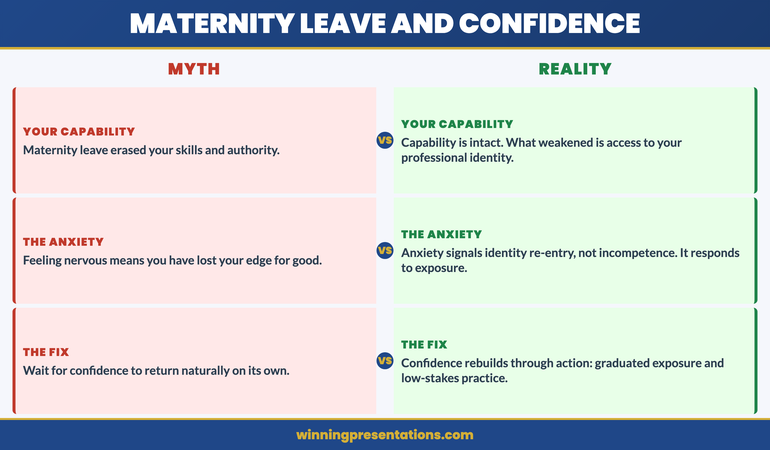
She hadn’t lost anything. But she had stepped out of a professional identity for fourteen months and found that re-entering it was not automatic. The confidence she had before her leave was not gone — it was temporarily inaccessible, buried under a layer of self-consciousness about her return. What she needed was not new skills. She needed a structured path back to the professional self she had temporarily vacated.
If presentation anxiety has intensified since returning to work
Conquer Speaking Fear is a structured 30-day programme that addresses the nervous system patterns behind presentation anxiety — including the type that re-emerges or intensifies after major life transitions. It is not about performing confidence. It is about rebuilding the underlying regulation that makes confidence possible.
Why Maternity Leave Changes Your Relationship With Presenting
Presentation confidence is not a fixed trait. It is a skill that is maintained through regular use, and it is grounded in a sense of professional identity — the clear internal sense of who you are at work, what you know, and what standing you have in the room.
Maternity leave temporarily suspends all three of these. You stop presenting regularly. Your professional identity shifts dramatically — you become a parent in a way that is all-encompassing, and the professional version of yourself recedes. And your sense of standing in the organisation becomes uncertain: Has the team dynamics changed? Has your profile with senior leadership faded? Has someone else filled the space you left?
These are not signs of weakness. They are predictable consequences of a major life transition that involves stepping out of a professional role for an extended period. The challenge on return is that colleagues don’t see the internal recalibration. They see the same capable person they knew before. This mismatch between external expectation and internal experience is what makes presenting feel so exposing in the first months back.
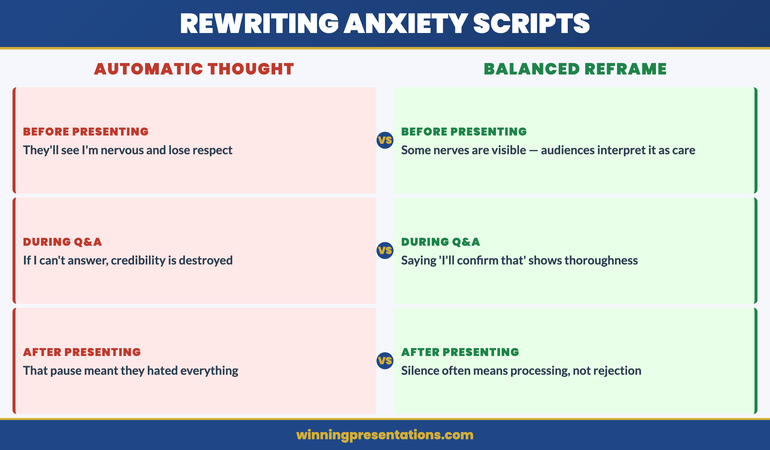
The anxiety is rarely about incompetence. It is about visibility at a moment when you feel uncertain about who you are in the professional context again. That distinction matters enormously, because the response to incompetence (learn new skills) is completely different from the response to identity re-entry (graduated re-engagement with professional roles).
Conquer Speaking Fear
A Structured Programme for Presentation Anxiety That Returns After a Break
Conquer Speaking Fear — £39, instant access — is a 30-day programme that works on the nervous system patterns underlying presentation anxiety. It includes clinical hypnotherapy techniques, nervous system regulation exercises, and a structured exposure sequence — designed for people whose anxiety has intensified after a significant life transition, not just everyday nerves.
- 30-day structured programme for sustained anxiety reduction
- Nervous system regulation techniques for use before and during presentations
- Clinical hypnotherapy audio sessions for deep-rooted fear patterns
- Graduated exposure framework for rebuilding confidence through low-stakes practice
Designed for presenters whose anxiety has deepened after a major life transition.
The Imposter Shift: What’s Actually Happening
Many women describe their post-maternity-leave presentation anxiety using imposter syndrome language: “I feel like I don’t belong here anymore,” or “I’m waiting for someone to notice that I’ve lost my edge.” This framing is understandable but not quite accurate — and the distinction has practical implications.
Classic imposter syndrome is the belief that you are not as competent as others perceive you to be, despite evidence of competence. Post-maternity return anxiety is something slightly different: the sense that your competence is real but your connection to your professional identity has weakened. You know you can do the job. You’re not sure that you still embody it the way you did before.
This distinction matters because it changes the response. Imposter syndrome responds to evidence of past performance — reviewing your achievements, recalling specific successes. Post-maternity confidence rebuilding responds to present performance — small recent wins that re-anchor your professional identity in the current context. Looking backward at what you did before your leave can sometimes reinforce the gap rather than closing it.
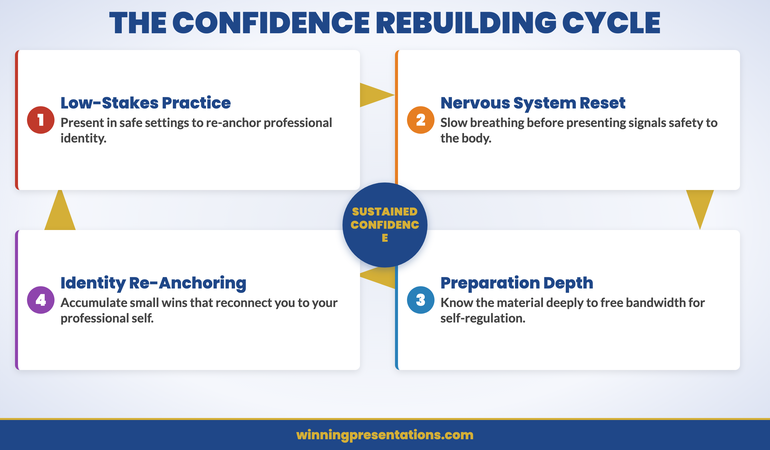
The most effective early step is to seek out low-stakes presenting opportunities in the first weeks back. Team meetings, internal briefings, small-group updates — contexts where the stakes are low enough that a less-than-perfect performance doesn’t feel catastrophic. These early presentations are not about impressing anyone. They are about re-establishing the neural pathways of professional presenting and beginning to rebuild your working identity. See also The Imposter Syndrome Paradox: Why Promotion Makes Presentation Anxiety Worse for related patterns.
Preparation Techniques That Rebuild Confidence Quickly
When confidence is fragile, thorough preparation is not a crutch — it is a legitimate strategy. Knowing your material in more depth than you need to, and having thought through likely questions in advance, reduces the cognitive load during the presentation itself. This frees up mental bandwidth for the self-regulation that anxious presenters need to manage their physical response.
Begin your preparation earlier than you normally would. If your previous standard was preparing the day before, extend this to two or three days. Not to over-rehearse — rehearsing the same material to the point of rigidity creates a different problem — but to give yourself time to let the material settle, add depth to the sections you feel least sure about, and simulate questions that might come up.
Identify the two or three moments in the presentation that feel most exposed. These are usually transitions — moving from one section to another — or moments where you anticipate being challenged. Prepare these moments with extra care. Know exactly what you will say and how you will manage the transition. Uncertainty at transitions is what causes the nervous system spike that triggers visible anxiety.
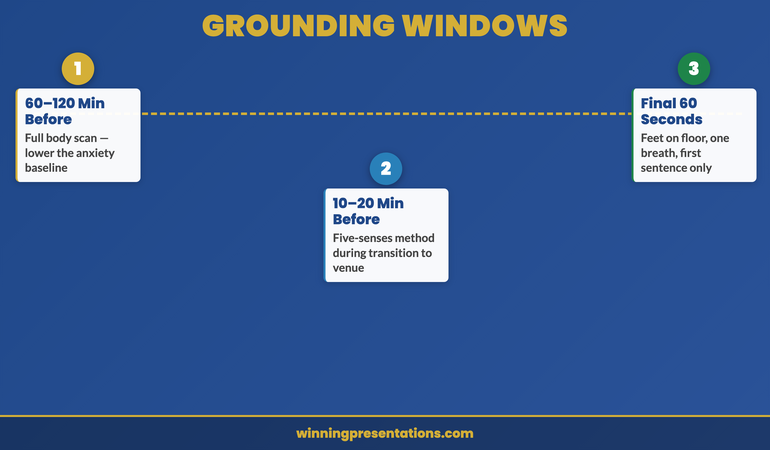
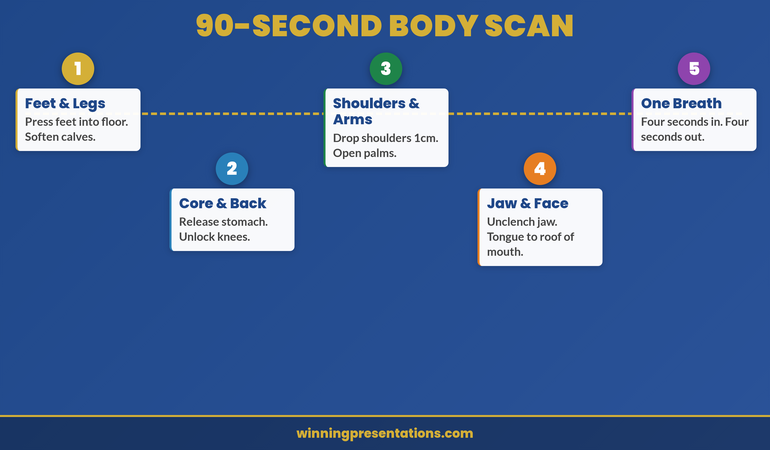
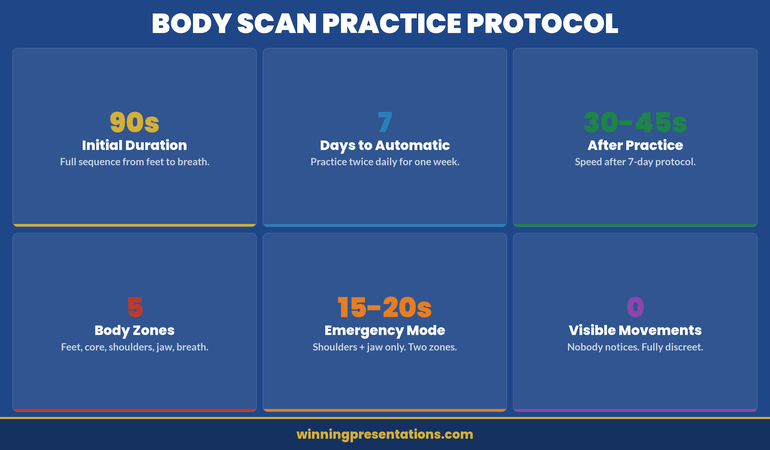
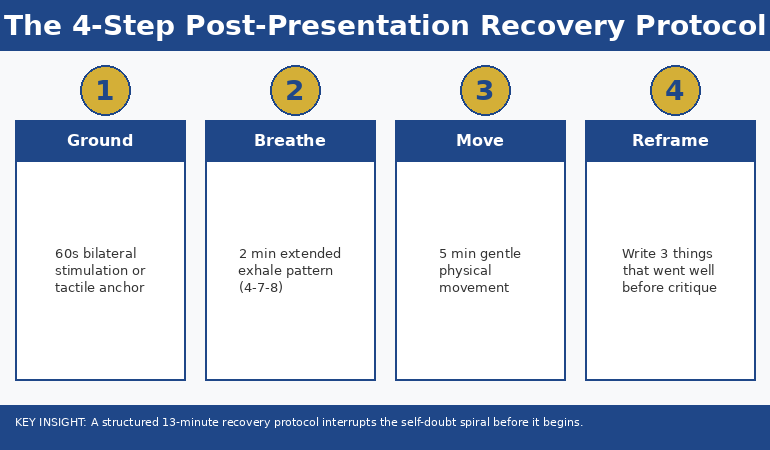
Before the presentation, use a brief pre-presentation routine to settle your nervous system. This does not have to be elaborate: two minutes of slow breathing (four counts in, six counts out) before entering the room has a measurable effect on the physiological response. Combined with a brief mental rehearsal of the opening — not the whole presentation, just the first ninety seconds — this gives your nervous system a clear signal that this is a manageable event.
If pre-presentation anxiety has become a pattern since returning from maternity leave, Conquer Speaking Fear provides a structured 30-day approach to nervous system regulation that addresses the deeper patterns, not just the surface symptoms.
Graduated Exposure: The Fastest Path Back
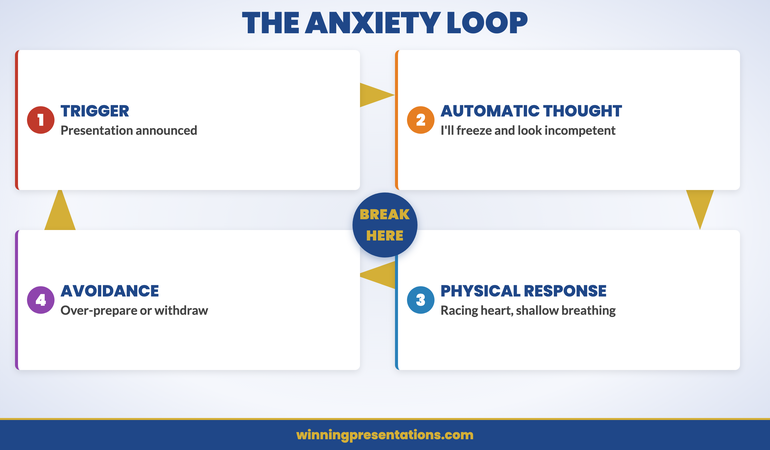
Avoidance is the most reliable way to make presentation anxiety worse. Every time you decline a presenting opportunity because the anxiety feels too high, you confirm to your nervous system that presenting is dangerous — and the threshold for triggering anxiety lowers slightly. This is why executives who avoid presenting for six months find that the anxiety on return is higher than it was before the avoidance began.
Graduated exposure — deliberately seeking out presenting situations in order from lower to higher stakes — is the most effective strategy for reversing this pattern. The principle is to present in conditions where the stakes are low enough that you can tolerate the discomfort, complete the presentation, and demonstrate to your nervous system that presenting is survivable. Over repeated exposures, the nervous system recalibrates its threat assessment.
A practical graduated exposure sequence for returning executives might look like this: Start with internal team meetings where you know everyone in the room well. Move to cross-functional updates with a slightly wider audience. Then to briefings for senior colleagues where some relationship exists. Then to formal presentations to a small leadership group. And eventually to the high-stakes board or committee presentations that were routine before your leave.
The progression should be gradual enough that each step is uncomfortable but manageable — not so gradual that you spend six months only presenting to people who already know you well. The goal is to rebuild tolerance for the discomfort of exposure, which requires actually being exposed. For more on this approach, see Presentation Anxiety Relapse: What to Do When Fear Comes Back.
On the Day: Managing the Physical Response
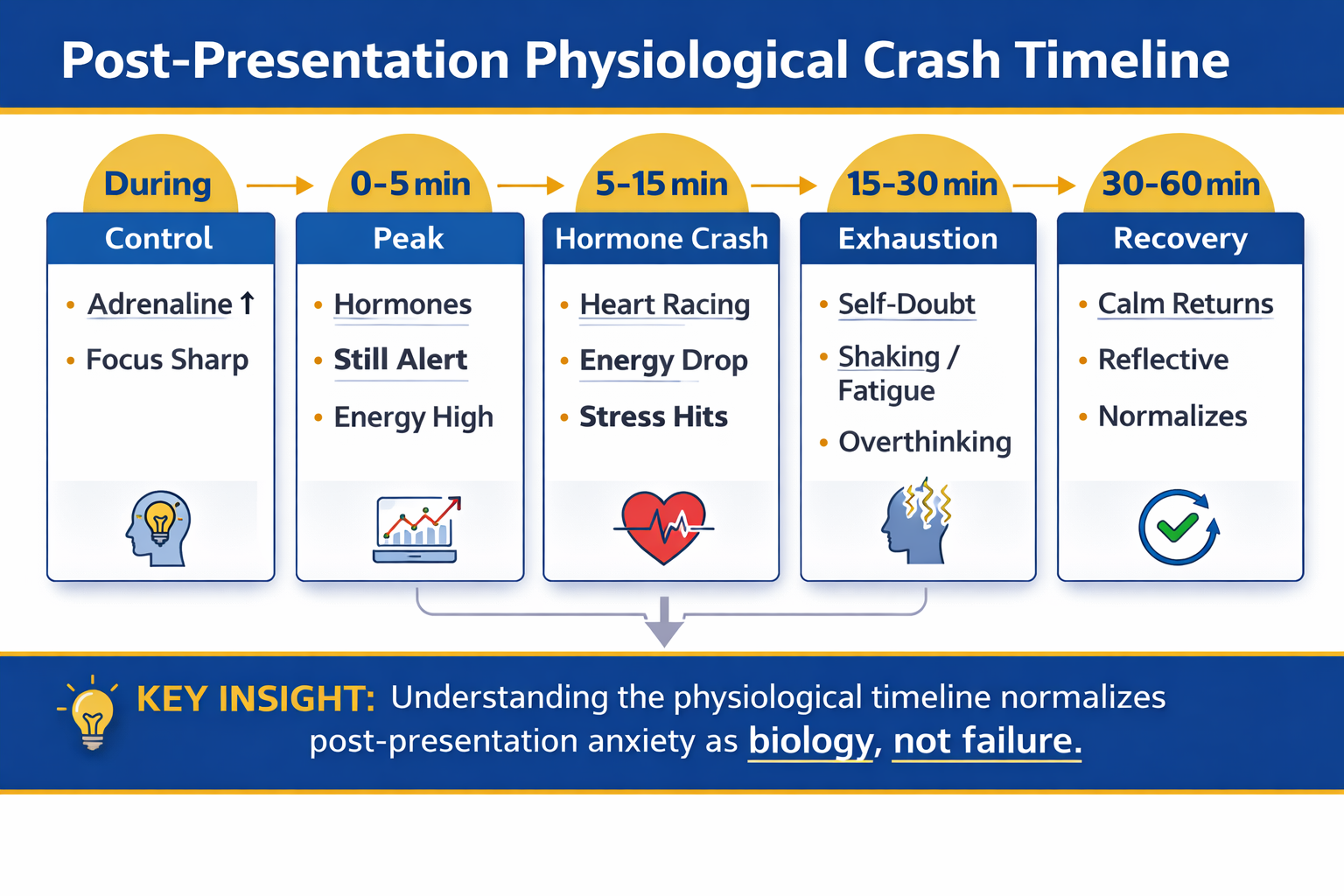
Presentation anxiety has a physical signature: elevated heart rate, shallow breathing, tension in the chest and throat, and for some people, a noticeable tremor in the hands or voice. These physical symptoms are caused by the activation of your sympathetic nervous system — the same system that produces the fight-or-flight response. They are involuntary, and they are not a sign that something has gone wrong. They are a sign that your body is preparing for something it perceives as high-stakes.
Managing the physical response on the day means working with the nervous system rather than against it. Trying to eliminate the physical response through willpower usually increases it — the effort of suppression adds an additional layer of self-consciousness. The more effective approach is to accept the physical response as information, regulate the breathing to signal safety to the nervous system, and redirect attention outward toward the audience and the material.
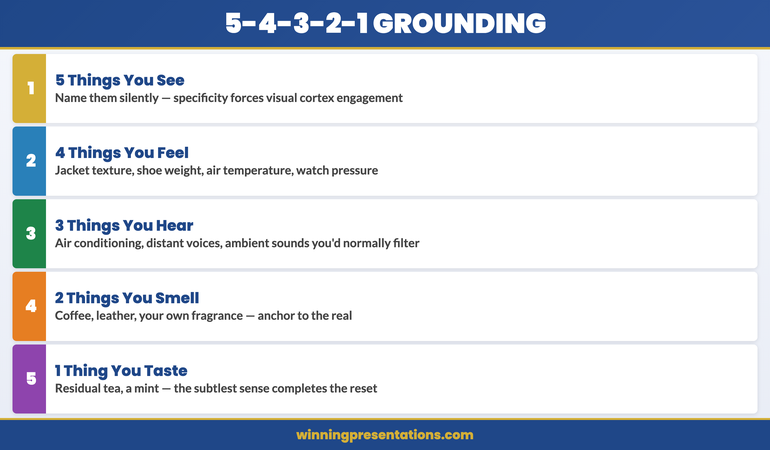
Before walking in, stand in a quiet space and take six slow, deliberate breaths — making the exhale slightly longer than the inhale. This activates the parasympathetic nervous system and begins to slow the physical arousal response. It does not eliminate the nerves, but it reduces their intensity enough to make the first thirty seconds of the presentation manageable. The first thirty seconds are the highest-risk moment. Once you are in the material, the presenting instincts that pre-date your maternity leave typically reassert themselves.
What Not to Do When Confidence Is Fragile
Several approaches that feel like they should help actually slow the rebuilding process. Understanding these is as important as knowing the techniques that work.
Don’t compare your current performance to your pre-leave performance. The executive you were before your leave was at the end of a long period of accumulated confidence. You are at the beginning of a rebuilding process. Comparing the two is like comparing a marathon runner at mile one to themselves at mile twenty-six — the comparison has no useful information in it. Measure progress against your current baseline, not your historical best.
Don’t over-explain your return. Some executives feel compelled to acknowledge their leave in every early presentation — to pre-empt any sense that they are rusty or less sharp. This draws attention to the uncertainty rather than projecting stability. Audiences take their cue from the presenter. If you behave as though you are fully returned, most colleagues will respond accordingly.
Don’t mistake thorough preparation for over-rehearsal. Rehearsing a presentation to the point where it is completely scripted removes the spontaneity that makes presenting feel natural. The goal of preparation is fluency with the material, not word-for-word memorisation. Over-rehearsed presentations sound mechanical and are harder to recover from when a question takes you off-script.
Don’t avoid asking for feedback. Trusted colleagues who can give you an honest read after a presentation are an important resource during the rebuilding period. Asking someone you respect for one or two specific observations is not a sign of insecurity — it is how experienced professionals continue to develop. The self-assessment of an anxious presenter is almost always harsher than the assessment of a neutral observer.
Ready for a Structured Approach?
30 Days to Calm Your Nervous System and Rebuild Presentation Confidence
Conquer Speaking Fear — £39, instant access — is a 30-day programme that works on the physiological and psychological roots of presentation anxiety. Includes nervous system regulation techniques, clinical hypnotherapy sessions, and a graduated exposure framework for presenters rebuilding confidence after a significant break.
Frequently Asked Questions
How long does it take to rebuild presentation confidence after maternity leave?
There is no universal timeline, but most executives find that with a structured graduated exposure approach, the gap between their current confidence and their pre-leave confidence closes meaningfully within three to four months of return. The key variable is the frequency and variety of presenting opportunities. Executives who actively seek out low-stakes presenting situations in their first weeks back rebuild significantly faster than those who wait for the confidence to return on its own. Confidence is built through action, not through readiness.
Is it normal for presentation anxiety to be worse after maternity leave than before?
Yes, and it is more common than most people discuss in professional settings. The combination of an extended break from presenting, a major identity transition, and heightened self-consciousness about returning to a senior role creates conditions where anxiety often intensifies rather than picking up where it left off. This does not reflect a permanent change in capability. It reflects the temporary disruption of a confidence that was built through sustained professional engagement — and that can be rebuilt through the same kind of sustained engagement.
My anxiety is affecting my willingness to take on visible projects. Should I be worried?
Avoidance of visibility is the most significant long-term risk of post-maternity presentation anxiety, because career progression at senior levels is closely tied to visibility with decision-makers. If the anxiety is leading you to systematically decline presenting opportunities, it is worth addressing directly rather than waiting for it to resolve on its own. A structured approach — either a programme like Conquer Speaking Fear or work with a coach experienced in presentation anxiety — addresses the underlying pattern more efficiently than time alone.
The Winning Edge — Free Weekly Newsletter
Practical frameworks for managing presentation anxiety and building executive confidence. Every Thursday.
About the Author
Mary Beth Hazeldine is Owner & Managing Director of Winning Presentations. With 25 years of corporate banking experience at JPMorgan Chase, PwC, Royal Bank of Scotland, and Commerzbank, she advises executives across financial services, healthcare, technology, and government on structuring presentations for high-stakes funding rounds and approvals.