

Quick answer: AI presentation training for business leaders is worth its price only if it teaches the structural method behind executive-grade AI-assisted output — not just a library of prompts. Prompt-only courses produce confidence without competence; business leaders walk away knowing the prompts but not the structural ordering that determines whether the AI output lands at senior level or fails at the first review. Useful AI presentation training for business leaders covers four things: the architect-role work that happens before AI is opened; the carrier-prompt method that builds structural decisions into the first request; the single editing loop that protects judgement on the output; and the rollout pattern for installing the method across a team. The AI-Enhanced Presentation Mastery course is the self-paced programme senior professionals use to learn this structural method. 8 modules, 83 lessons, no deadlines, no mandatory session attendance. 2 optional live coaching sessions, fully recorded. Self-paced with monthly cohort enrolment. Lifetime access to materials. £499.
JUMP TO:
In February 2025 I spoke with a director-level professional at a UK insurance broker who had just completed a two-day in-person AI-for-presentations training course run by a vendor she had found through a LinkedIn ad. She had spent six hundred pounds on the course and two days out of her working week. She arrived back at the office with a printed binder of seventy-two prompts organised by topic, a USB stick with example PowerPoint files, and a sense that she should now be able to produce AI-assisted decks faster. Three weeks later she called me because, in her own words, “something hasn’t clicked.” She had been running the prompts from the binder against her real client work and the output was usable but not noticeably different from what she had been producing before the course. The client decks she sent up for review were still being marked up the same way they had been before the training. The two days had taught her prompts; they had not taught her the structural method that determines whether AI-assisted output lands at senior level or gets returned for rework. She had bought confidence with the course; she had not bought competence.
(This article was created with AI assistance; all stories and insights are based on 35 years of real client work.)
This piece walks through what AI presentation training for business leaders should actually teach, why most courses on the market teach the wrong layer of the problem, and what to look for when evaluating a programme. The piece names a specific programme — AI-Enhanced Presentation Mastery — that is structured around the four things this article argues good training must cover. The argument is independent of the programme; if a different programme covers the same four structural elements, it would be a defensible alternative. The point of the article is not the specific course; the point is the structural test a senior professional should run on any AI presentation training course before paying for it.
Before deciding on a paid programme, a short reference card is worth keeping next to the keyboard.
The 10 Essential Copilot PowerPoint Prompts reference card covers the structural prompts senior leaders use most often — the same patterns the AI-Enhanced Mastery programme teaches in full. Use it for free to test whether the structural approach matches the way you want to work. Free download, no email gate.
What good AI presentation training actually teaches
Good AI presentation training for business leaders is built around a structural insight most courses on the market miss: the AI tool is a drafting layer, not a thinking layer. The thinking layer — what argument to make, who the audience is, what evidence supports the case, what structural order earns engagement — remains the senior professional’s work. AI changes the speed at which the drafting layer can be produced; it does not change the requirements of the thinking layer. A course that teaches prompts without teaching the thinking layer is teaching the cheap half of the work. A course that teaches the thinking layer alongside the prompts is teaching the part that determines whether the AI output lands at senior level.
The thinking layer is also the part that is hardest to learn from a binder of prompts. Prompts are easy to copy; thinking discipline is not. Good training teaches the thinking discipline first — the two-line recommendation, the audience-belief analysis, the case-construction order, the carrier-prompt method — and uses prompts as the carriers for the thinking, not as the substance of the work. The senior professional who leaves the training with sharper structural discipline and a library of carrier prompts is equipped to produce executive-grade AI-assisted output across years of varying work. The senior professional who leaves with prompts only has bought a binder that becomes obsolete the moment the AI models update or the work shifts to a domain the prompts were not written for. The broader principles behind using AI for senior-level presentation work covers the structural foundations any course should build on.
Why prompt-only courses fail business leaders
Prompt-only courses fail business leaders in three predictable ways. The first is that the prompts are written generically and the senior professional’s work is not generic. A prompt designed to “build a board deck on a finance topic” produces output that approximates a generic board deck on a generic finance topic. The senior professional’s actual board deck has specific stakeholders, specific case-construction requirements, specific audience beliefs that need to be addressed. The generic prompt cannot carry these specifics, and the output that comes back needs to be restructured into the actual shape the senior professional needed. The restructuring takes longer than producing the deck from scratch would have, because the restructuring is fighting against the AI’s default shape rather than designing fresh.
The second failure mode is that the prompts age out of date faster than the courses do. AI models update every three to six months. A prompt that worked well on one generation of a model produces noticeably different output on the next generation; the structural intent of the prompt may not translate. A course built around a specific prompt library becomes obsolete on the timeline of the model updates, and the senior professional ends up needing to retake or repurchase training every twelve to eighteen months. A course built around the structural method ages much more slowly, because the structural method — architect work before AI opens, carrier prompts that carry structural decisions, single editing loop — remains valid across model generations.
The third failure mode is that the courses do not address the team rollout dimension. A senior professional learns AI prompting and returns to a team that has not. The team continues producing AI-assisted work without structural discipline, and the senior professional remains responsible for the structural rework. The training has helped the senior professional’s own throughput marginally but has not changed the dynamic with the team. Useful training for business leaders covers both the personal workflow and the team rollout, because the senior professional’s job is to elevate the team’s output as much as it is to produce their own.
Build executive-grade presentations with AI assistance — the structural method senior professionals use to produce output that lands at senior level the first time.
The AI-Enhanced Presentation Mastery course teaches the structural ordering that distinguishes executive-grade AI-assisted work from generic AI output. Designed for senior professionals using AI (including Copilot) to build presentations — the architect-role work before AI opens, the carrier-prompt method, the single editing loop that protects judgement, and the team rollout sequence.
- Self-paced programme with monthly cohort enrolment — enrol with this month’s cohort, work through at your own pace
- 8 modules, 83 lessons covering the structural method end-to-end
- 2 optional live coaching sessions with Mary Beth, fully recorded — watch back anytime
- No deadlines, no mandatory session attendance — built around the working calendars of senior professionals
- Lifetime access to all course materials — usable across years of evolving AI tools and changing work — £499
The four things to look for in any AI presentation course
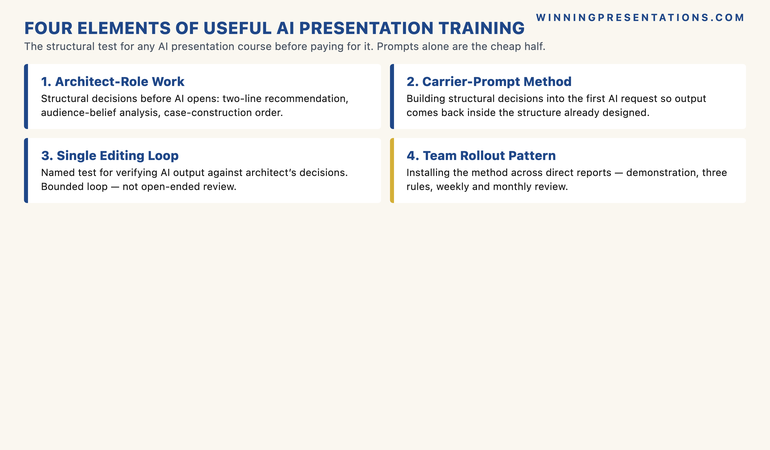
When evaluating an AI presentation course, four structural elements separate the useful programmes from the ones that produce confidence-without-competence. The first is whether the course teaches the architect-role work explicitly — the structural decisions a senior professional makes before any AI tool is opened. If the course goes straight to “here are the prompts to use” without first teaching the upstream structural thinking, it is teaching the wrong half of the problem. Look for a course that spends meaningful time on stakeholder analysis, case construction, and audience-belief mapping before any AI tool appears in the curriculum.
The second is whether the course teaches the carrier-prompt method or only the topic-prompt method. Topic prompts (“help me build a deck on X”) produce generic output; carrier prompts (which include the recommendation, audience, beliefs, and case-construction order in the first request) produce executive-grade output on the first pass. A course that demonstrates topic-prompting as the starting point and works upward toward carrier-prompting is teaching the right structural progression. A course that only shows topic prompts in different flavours is teaching the wrong starting point.
The third is whether the course teaches an editing loop with a named success criterion. AI output needs to be verified, but unbounded editing loops are where most senior professionals lose time. A useful course teaches a named test the senior professional runs on each section — does it match the architect’s upstream decisions? — and a procedure for rewriting sections that drift. If the course’s editing approach is “read it and improve it,” the editing loop is unbounded and the senior professional will spend more time than they should on the verification step. The structural workflow patterns that compress AI-assisted deck creation covers the editing loop in more depth.
The fourth is whether the course addresses the team rollout dimension. A senior professional who learns AI prompting in isolation returns to a team that has not, and the team’s structural drift becomes their problem. A useful programme covers the rollout pattern — the demonstration sequence, the three rules, the review loop — that lets the senior professional install the method across their direct reports. Courses that ignore the team rollout are training the senior professional in a way that limits the leverage of what they have learned.
If you want to test the structural method before committing to the full programme, the tactical prompt library is the cheapest entry point.
Stop running prompts that produce generic output you have to rewrite. The Executive Prompt Pack is the prompt library senior professionals use to apply the carrier-prompt method in their own work — 71 prompts organised by structural function, not by topic. Works with Copilot, ChatGPT, Claude, and Gemini. Use it to test whether the carrier-prompt method matches the way you want to work before joining the full Maven programme. Instant download, lifetime access. £19.99.
Why self-paced beats live cohort for senior professionals
The structural debate among AI presentation courses on the market is whether the training should be self-paced or live cohort-based. The argument for live cohorts is that the social pressure of a peer group keeps attendance high and the live calls drive engagement. The argument for self-paced is that senior professionals have working calendars that do not bend to a vendor’s scheduled call slots, and the cost of missing live calls in a cohort programme is high — recordings are sometimes available, sometimes not, and the social structure tends to collapse if the senior professional cannot make most of the sessions.
For senior professionals, self-paced wins for a specific reason: the work the training is intended to support is not generic. A senior professional learning the carrier-prompt method needs to apply it to their actual upcoming deck, their actual client briefing, their actual board paper. The application happens on the timetable of their work, not on the timetable of a course’s curriculum. A self-paced programme lets the senior professional work through a module on Monday evening, apply it to a real piece of work on Tuesday morning, and run the verification loop on the result by Tuesday afternoon. A live cohort programme schedules the application against the course calendar, which often does not match the senior professional’s real-work calendar.
Self-paced with optional recorded live coaching is the format that combines the durability of self-paced material with the engagement of live interaction when the senior professional’s calendar allows. The recordings ensure no value is lost when the senior professional cannot attend live, and the live calls are an option rather than an obligation. This is the format the AI-Enhanced Presentation Mastery programme uses — 8 modules and 83 lessons available on enrolment, with 2 optional live coaching sessions per cohort that are fully recorded for participants who cannot attend live. Lifetime access to materials means the programme remains usable for re-reference as AI tools and the senior professional’s work evolve. The structural patterns that work across different AI tools covers why the structural method has more durability than any specific tool or prompt library.
The AI-Enhanced Presentation Mastery programme
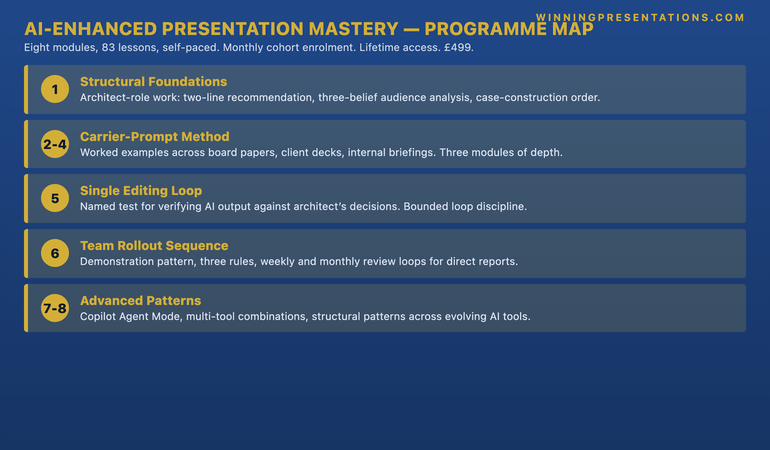
The AI-Enhanced Presentation Mastery course is structured around the four elements this article argues good AI presentation training must teach. Module 1 covers the structural foundations — the architect-role work, the two-line recommendation, the three-belief audience analysis, the case-construction order. Modules 2 to 4 cover the carrier-prompt method in depth, with worked examples across board papers, client decks, and internal briefings. Module 5 covers the single editing loop and the named test for verifying AI output against architect decisions. Module 6 covers the team rollout sequence — the demonstration pattern, the three rules, the weekly and monthly review loops. Modules 7 and 8 cover advanced patterns, including the Copilot Agent Mode workflows, multi-tool combinations, and the structural patterns that adapt across different AI tools as the model landscape evolves.
The programme is delivered through 83 lessons across the 8 modules, each lesson typically ten to twenty minutes of focused material. The pacing is designed for senior professionals to absorb one or two lessons per evening or weekend session, with the application happening against their real work between lessons. The 2 optional live coaching sessions with Mary Beth give the cohort an opportunity to bring real work to a group setting and have the structural method applied to it directly. Both sessions are fully recorded and available to all participants in the cohort and across future cohorts via lifetime access. The price of £499 covers all 8 modules, 83 lessons, both coaching sessions, and lifetime access to materials. There are no upsells, no add-on tiers, no “premium” version that holds back content. The full programme is available to every enrolled participant on day one.
Built on banking experience and senior coaching practice
The AI-Enhanced Presentation Mastery programme is built on a specific professional foundation — 24 years of corporate banking experience at JPMorgan Chase, PwC, Royal Bank of Scotland, and Commerzbank, followed by 16 years coaching senior professionals across financial services, insurance, consulting, and technology. The structural method the programme teaches is the method I have used personally on hundreds of board papers, client briefings, and senior presentations in those four institutions and across the coaching practice that followed. AI tools were not available for most of that career, which is part of why the structural method survives the introduction of AI — it was developed for the human-only context first and only translated into AI workflows as the tools matured. A method built originally for AI-assisted workflows would not have this foundation, and would not have the same durability across years as the AI tool landscape continues to evolve.
The programme is the closest available substitute for sitting in on the structural method as it has developed across the coaching practice. The 83 lessons cover the patterns I would teach in private coaching, organised in the order that produces the fastest adoption. The 2 optional live coaching sessions per cohort are the opportunity for participants to bring their own work to the group setting and have the method applied to it — the closest analogue to the private coaching context within a self-paced programme structure. Both are fully recorded, so participants who cannot attend live retain the value of the sessions through the cohort and across future cohorts via the lifetime-access model.
Frequently asked questions
Is this worth £499 if I already have Copilot or another AI tool I use regularly?
The price tests the answer to a specific question: how much of your current AI workflow is producing output you have to substantially rewrite before it can be used at senior level? If the answer is “most of it,” the programme will pay back its price across the next two or three board papers or client decks where the rework cycle is compressed by the structural method. If the answer is “none of it — my current AI workflow produces executive-grade output on the first pass,” the programme is probably not necessary for you. Most senior professionals who consider the programme do so because they are seeing the rework pattern in their own work and have not yet diagnosed the structural cause. The programme’s value is in the diagnosis as much as in the method itself.
How is this different from the free YouTube videos and LinkedIn posts on AI for presentations?
The free material on AI for presentations is mostly at the prompt layer — here is a clever prompt to try, here is a tool walkthrough, here is a productivity hack. The structural foundations layer — the architect-role work, the case-construction order, the carrier-prompt method, the editing loop with a named test — is largely absent from free material because it does not produce the short-form content that performs on social platforms. The structural foundations require sustained explanation, worked examples, and application to real senior work, which is the format of a paid programme rather than the format of a free video. If the question is about prompts, the free material covers most of the ground; if the question is about the structural method that determines whether AI output lands at senior level, the free material does not address it directly. The programme is the structural method, not the prompts.
What if I enrol and the live coaching sessions are inconvenient for my schedule?
Both live coaching sessions per cohort are fully recorded and available to all enrolled participants. There is no attendance requirement and no penalty for missing live sessions. The recordings are timestamped to the lessons they extend, so participants who watch them later can pick up the connections to the relevant material. Participants also have lifetime access to recordings from the cohort they enrolled in, which means a busy enrolment window can be supplemented later when calendar pressure eases. The format is intentionally designed for senior professionals whose calendars do not bend to a vendor’s scheduled slots.
Can I get a refund if the programme is not what I expected?
Maven’s standard refund policy applies to AI-Enhanced Presentation Mastery enrolments. Participants who decide the programme is not the right fit can request a refund within Maven’s published window. The lifetime-access model is intended to make the longer-term value test the relevant one rather than a first-week decision — many participants find that modules 4 to 6 produce the largest workflow shift, which means the programme’s value compounds across the first month rather than landing entirely in the first session. Participants whose first impression is mixed but who continue through the structural foundations modules tend to find the value lands in week two or three rather than week one.
When does the next cohort start?
New cohorts open every month. The Maven landing page always shows the current next-starting cohort and the enrolment window. Enrol any time and start with the next cohort. Self-paced means there is no penalty for joining a cohort late — all materials are available on enrolment and participants work through them at their own pace. The cohort structure is for the social setting around the optional live coaching sessions; it does not constrain when participants begin or finish the material.
The Winning Edge — weekly newsletter
The Winning Edge is a weekly (Thursday) newsletter for senior professionals who present at the executive level. One short email a week, focused on the structural moves that separate executive-grade AI-assisted work from generic AI output. A useful sample of the writing voice and analytical depth that runs through the AI-Enhanced Presentation Mastery programme. Subscribe to The Winning Edge →
For the broader picture across slides, storytelling, confidence, and delivery, the seven-product Complete Presenter library is the bundle most senior professionals find useful as a single resource — £99 for everything, lifetime access.
About the author
Mary Beth Hazeldine is Owner & Managing Director of Winning Presentations Ltd. With 24 years of corporate banking experience at JPMorgan Chase, PwC, Royal Bank of Scotland, and Commerzbank, she advises senior professionals across financial services, insurance, consulting, and technology on the structural method that distinguishes executive-grade AI-assisted presentations from the AI output that needs to be rewritten before senior review.