

Quick answer: Cohort and self-study presentation programmes look similar on paper. They differ on one variable that most buyers under-weight: completion. Senior professionals enrolled in self-study courses complete roughly one in four. Senior professionals enrolled in cohort programmes complete most. The peer pressure is structural, not motivational. The decision is not about content — it is about which format the buyer will actually finish.
Jump to:
Geraldine had bought three presentation courses in the previous five years. She was a senior partner at a professional services firm with thirty-plus years’ experience. She was also, by her own admission, a serial non-completer. Each course had felt like the right purchase at the time. Each had been opened, sampled across the first two modules, and then quietly abandoned three weeks later when something more urgent arrived. The fourth time, she enrolled in a cohort programme. She finished it.
The reason was not that the cohort programme was better. The reason was that the cohort programme had other people in it. On the second week she watched another participant present a draft to the group. On the fourth week she presented her own. By week six, the prospect of arriving at the next group session without having done the work was social, not just self-imposed. The accountability that her self-study courses had been unable to manufacture was simply present in the cohort by structural default.
This is the decision most senior buyers misframe. They compare cohort and self-study programmes on content. The content is usually similar. They compare on price. The price is usually similar. They compare on time commitment. The time commitment is usually similar. They almost never compare on the variable that determines outcome — which format produces completion.
If you have started a presentation course before and not finished it
The Executive Buy-In Presentation System uses a monthly cohort enrolment model — the structure that drives completion. 7 self-paced modules, optional live Q&A calls (fully recorded). Lifetime access to materials. £499.
The completion gap
Self-study completion rates for paid online courses, across categories, sit roughly between five and fifteen per cent depending on the course design. For senior professional buyers — who are time-poor, have unusually high competing demands, and tend to buy courses optimistically — the completion rate sits at the low end of that range. The buyer is sincere on purchase. The calendar is not.
Cohort completion rates, by comparison, sit much higher. The exact figure varies by programme, but well-designed cohorts routinely show completion rates of two-thirds or more. The differential is large enough that it dominates almost every other variable in the buying decision. A cohort that delivers seventy per cent of the content of a self-study course but is finished by seventy per cent of buyers will produce more aggregate skill development than a self-study course with one hundred per cent of the content and twelve per cent completion.
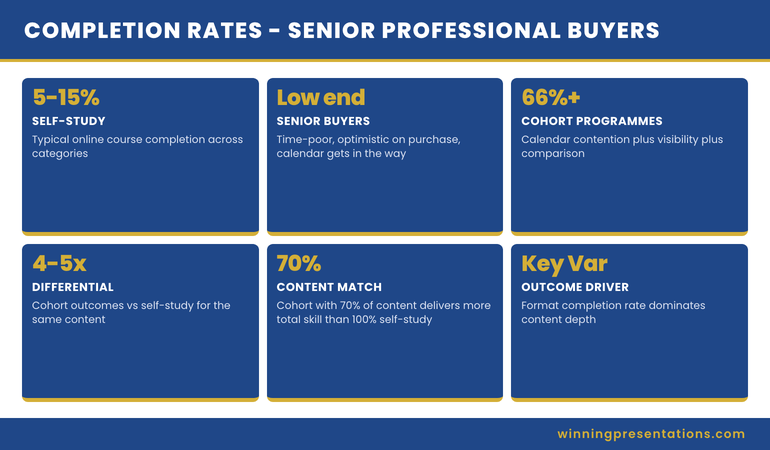
The completion gap is not a function of intelligence, motivation, or commitment. Senior professionals who do not complete self-study courses are not failing — they are running into a calendar problem. The work that competes with the course is genuinely urgent. Self-study has no mechanism to put the course back on the calendar when it gets pushed off. Cohort programmes do.
How cohort peer pressure actually works
Cohort accountability is often described as social pressure. That is the surface mechanism. The deeper mechanism is calendar contention. A cohort puts dates on the calendar. The dates are external commitments. External commitments are dramatically harder to skip than internal intentions. The cohort, in effect, borrows the buyer’s professional discipline — the same discipline that makes them reliably attend a board meeting they would never skip — and applies it to the course.
A second mechanism is visibility. Self-study courses are private. If the buyer falls behind, no one knows. Cohort courses are partially public. Other participants notice if work is not done. The visibility creates a small but persistent pull on attention. It is not sufficient on its own to drive completion. Combined with calendar contention, it usually is.
A third, less obvious mechanism is comparison. Cohort participants see other participants’ progress. If three other senior professionals at similar levels are working through module four, the buyer who is still on module two notices. The comparison is not punitive — it is informational. It updates the buyer’s sense of what is normal, and most buyers adjust upward.
A fourth mechanism is question seeding. In self-study, the buyer asks the questions they think to ask. In a cohort, the buyer hears the questions other participants are asking. Many of those questions are ones the buyer would not have asked themselves but benefits from hearing answered. The breadth of question coverage is materially higher in cohort formats than in self-study.
For senior professionals who have started courses and not finished them
The cohort programme designed for senior buyers who need completion structure
The Executive Buy-In Presentation System is a self-paced programme delivered through a monthly cohort enrolment model. 7 modules covering stakeholder analysis, case construction, and the structural patterns that secure board-level approval. Optional live Q&A calls are fully recorded — watch back any time you cannot attend. The cohort structure provides the completion-rate uplift; the self-paced format means there are no missed-session penalties.
- 7 self-paced modules — work through at your own pace, no deadlines
- Optional live Q&A / coaching calls — fully recorded, watch back any time
- No mandatory live attendance, no fixed-week schedule, no missed-session penalty
- Monthly cohort enrolment — enrol any time, start with the next cohort
- Lifetime access to all course materials
£499 · Self-paced · Lifetime access · Next cohort enrolment opens monthly
Where self-study still wins
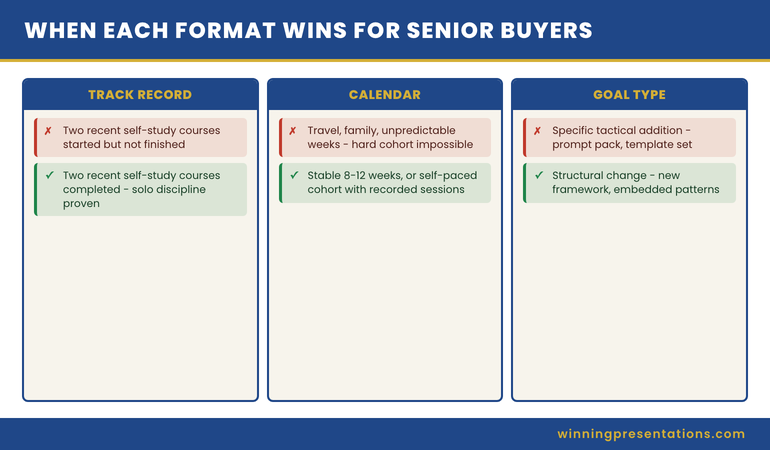
Self-study is the right format for three specific buyer profiles. The first is the senior professional who has demonstrated, over multiple completed courses, that they finish self-paced material. The pattern is observable. If the buyer’s bookshelf or course library shows three to four completed certificates from solo work, the structural completion problem does not apply. Self-study is faster, cheaper, and unrestricted by cohort calendars. Buy it.
The second profile is the senior professional with an unusual schedule — frequent international travel, irregular weeks, dependent care responsibilities — that makes any cohort calendar difficult to honour. A cohort with mandatory live sessions would be unfair to the buyer’s situation. A purely asynchronous self-study course is more honest. The trade-off is the lower completion rate, but the calendar fit makes the course possible at all.
The third profile is the senior professional who already has the structural framework — they have completed coaching, an MBA, a previous high-quality course — and is now looking for a specific tactical addition. A short self-study course on, say, AI prompts for presentations or one-page slide design is the right tool. The buyer does not need accountability for a small tactical addition. They need fast access to specific content.
Outside these three profiles, the case for self-study weakens. For the senior professional who is buying their first or second presentation programme and has not yet demonstrated a completion pattern, the cohort format produces dramatically better outcomes — even when the cohort and self-study courses are nominally similar in content.
The hybrid that solves both problems
There is a format that has emerged in the last two years which solves the structural trade-off. It is the self-paced cohort — a programme that uses cohort enrolment for the accountability structure but self-paced delivery for the calendar flexibility. The buyer enrols with a cohort, has access to optional live sessions that are fully recorded, but has no mandatory live attendance and no fixed-week deadlines.
The format works because the cohort delivers the visibility, comparison, and question-seeding benefits, while the self-paced delivery removes the calendar contention that makes hard-cohort formats feel exclusive to senior buyers with controllable schedules. The completion rate sits between the two extremes — lower than a hard cohort, dramatically higher than pure self-study. For most senior buyers, this is the highest-yield format available.
The format also resolves the secondary issue with hard cohorts: the missed-session penalty. In a four-week live cohort, missing one of the four sessions removes a quarter of the live experience. In a self-paced cohort with recorded sessions, missing the live moment costs nothing — the buyer watches the recording at the next available window. Senior professionals, who routinely have to miss meetings for unavoidable reasons, find this configuration much more compatible with their actual calendars. See the related discussion of presentation coaching due diligence for the questions buyers should ask before committing to either format.
A decision framework for senior buyers
Three questions resolve the cohort vs self-study decision for most senior buyers. First, what is the buyer’s completion track record on previous courses? If at least two recent self-study courses were finished, self-study is fine. If two or more were started and not finished, cohort or self-paced cohort.
Second, what is the buyer’s calendar profile in the next eight to twelve weeks? If the calendar is broadly stable, a hard cohort is feasible. If travel, family events, or unpredictable demands are likely, a self-paced cohort with recorded sessions is the right choice. A pure self-study course is the option of last resort, used only when the buyer can demonstrate the completion track record above.
Third, what is the buyer’s actual goal? If the goal is a specific tactical addition — a prompt library, a slide template pack, a one-day delivery refresh — self-study is fast and right. If the goal is structural change in how the buyer presents, the cohort element matters because structural change requires sustained attention across weeks rather than a one-evening reading.
A fourth, less common question is worth adding for buyers who have already engaged 1:1 coaching. If a coach is already working with the buyer on a specific high-stakes meeting, a self-study course often complements well — the coach handles delivery, the course handles the structural framework, and the two work in parallel without scheduling conflict. This is one of the few cases where pure self-study sits comfortably alongside other senior development work.
Frequently asked questions
Are cohort programmes always more expensive than self-study?
Not consistently. Some cohort programmes are priced similarly to high-quality self-study courses. The price differential, where it exists, is usually offset by the completion-rate uplift — paying twice for a course you will finish is better than paying once for a course you will not. The buyer should compare cost per completed module, not cost per enrolment.
Can I switch from a self-study course to a cohort if I am not finishing?
Often yes. Many cohort programmes accept buyers who have started self-study material elsewhere. The pattern is common enough that it is sometimes called a “rescue enrolment” — the buyer admits the self-study has stalled and joins a cohort to recover the investment. The cohort completion structure usually does the work the self-study could not.
Do cohorts work for senior people who do not want to be visible to other learners?
Self-paced cohort formats work well for buyers who prefer not to participate in live group discussion. The accountability structure is provided by enrolment, calendar markers, and optional sessions; the buyer can engage as much or as little as they wish in the visible elements. For buyers who actively dislike public participation, this format delivers most of the cohort benefit without the social discomfort.
Is the completion gap really as large as the article suggests?
The published research on online course completion rates is broadly consistent — single-digit to low-teens for self-study, well above fifty per cent for cohort or peer-supported formats. Senior professional buyers tend to skew towards the lower end on self-study because of competing time demands, and towards the higher end on cohorts because the same competing time demands respond to external scheduling cues. The gap is large and persistent.
Maven cohort enrolment — closing this week
The self-paced cohort format senior professionals use to actually finish
The Executive Buy-In Presentation System combines monthly cohort enrolment with a fully self-paced delivery model — the format that resolves the cohort vs self-study trade-off. 7 modules, optional live Q&A calls (fully recorded). The current cohort closes this week — enrolment then re-opens with the next monthly cohort.
- 7 self-paced modules covering stakeholder analysis and case construction
- Optional live Q&A calls — fully recorded, watch back any time
- No deadlines, no mandatory attendance, lifetime access
- Monthly cohort enrolment — enrol any time, start with the next cohort
£499 · Self-paced · Lifetime access · Next cohort enrolment opens monthly
The Winning Edge — weekly
One short note each Thursday on board-level presentation patterns, structural shortcuts, and the behaviours senior presenters use under scrutiny. Written for professionals who do not have time for newsletters that read like newsletters.
Want a starting point first? The free Executive Presentation Checklist covers the structural fundamentals you would internalise in either format.
For a wider view of how this fits into senior development decisions, see the related piece on board presentation templates — the artefact most cohort programmes converge on.
Next step: Look at the last two presentation or skill courses you bought. Did you finish them? If yes, you are likely a self-study buyer. If no, the cohort or self-paced cohort format is the more honest match for your calendar and completion pattern. Buy accordingly.
Mary Beth Hazeldine is the Owner & Managing Director of Winning Presentations. With 25 years of corporate banking experience at JPMorgan Chase, PwC, Royal Bank of Scotland, and Commerzbank, she advises senior professionals across financial services, healthcare, technology, and government on structuring presentations for high-stakes board meetings, investment committees, and executive sessions. She speaks German and works extensively with the German-speaking financial markets.