

Why British Understatement Reads as Weakness to American Boards
Quick answer: British understatement to American boards reads as weakness, evasion, or coded warning — not as the appropriate professional caution the British presenter is signalling. The same vocabulary that establishes British credibility (“reasonably pleased,” “broadly in line,” “one or two things to flag”) lands in an American boardroom as an admission that the headline result is in trouble and the presenter is hedging rather than naming the problem. The structural reset senior British presenters apply before the call is not to abandon their voice or to copy American directness uncritically. The reset is to lead with the unhedged headline result, qualify after, and reserve hedged language for the small number of items where the hedge is doing real analytical work rather than carrying the meaning of the whole presentation. British presenters who run the structural reset land their substance into engaged American boards. British presenters who don’t spend forty minutes fighting a perception frame their opening sentence installed in the first eight seconds.
JUMP TO:
- The translation gap between London-credibility and US-board-credibility
- What American boards actually hear when British presenters hedge
- The headline-first reset that lands the substance into the right frame
- How to do the reset without abandoning your own voice
- The ten-minute pre-call language diagnostic
- One thing to do before the next presentation to a US board
- Frequently asked questions
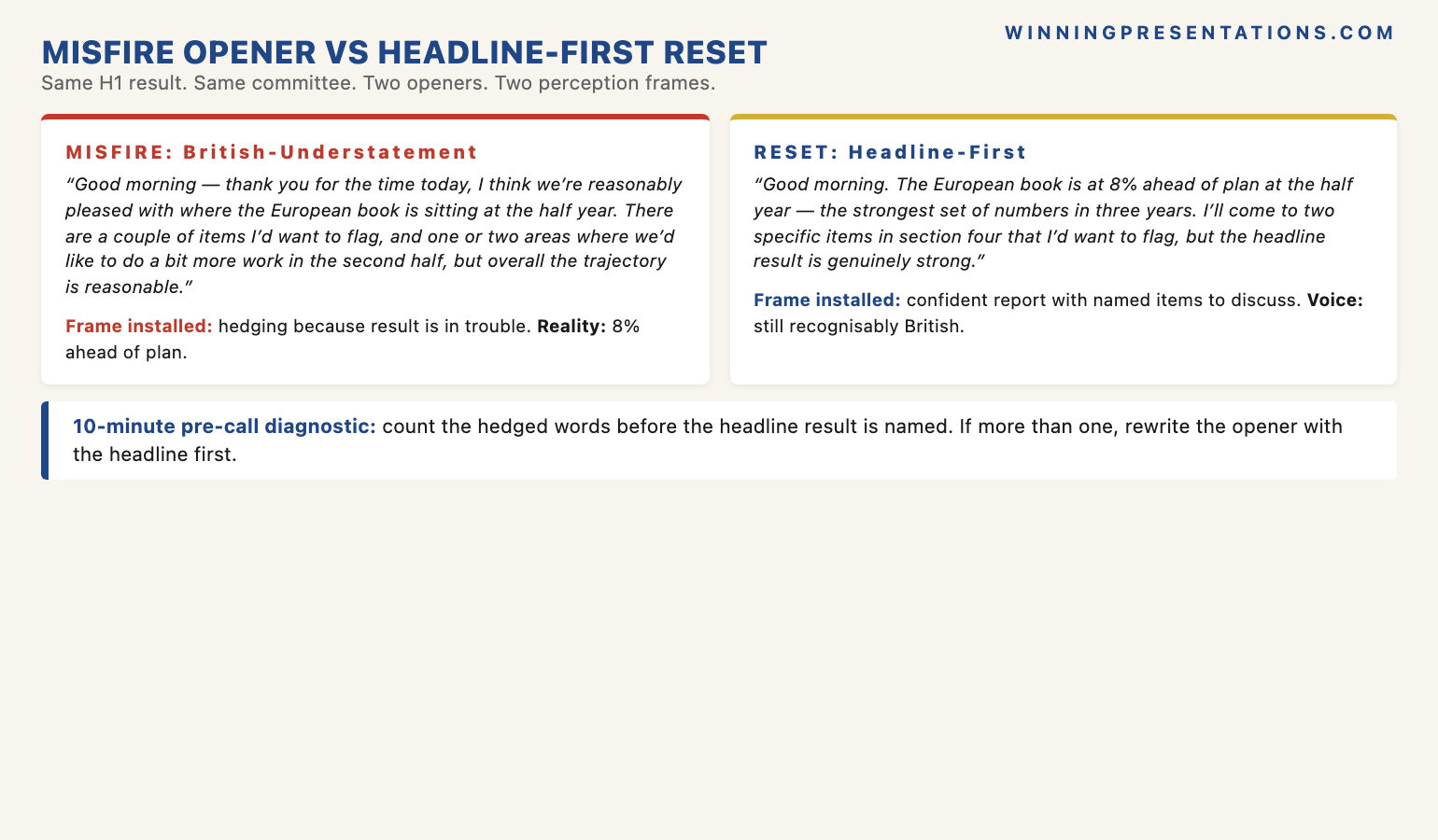
In June 2019 I observed a senior managing director at a UK-based financial-services group present the half-year update to the US executive committee of the parent company. The committee was eight: the parent CEO based in New York, two non-executive directors based in Boston and Atlanta, a CFO from headquarters, a chief risk officer, and three rotating regional heads dialled in from Chicago, San Francisco, and Dallas. The MD had spent fourteen years at the UK subsidiary, had built strong personal relationships with three of the eight committee members across previous quarterly cycles, and was widely regarded inside the UK business as one of the most capable senior operators in the European arm. The H1 result he was presenting was strong: revenue 8% ahead of plan, operating margin two points above the prior year, the credit book performing within expected parameters with one named exposure on watch. His opening words after the chair introduced him were: “Good morning everyone. Thank you for the time today. I think we’re fairly comfortable with where the European book is sitting at the half year. There are a couple of items I’d want to flag, and one or two areas where we’d like to do a bit more work in the second half, but overall the trajectory is reasonable.” The room read those forty-six words as a warning. The CEO leaned slightly toward the camera. The CFO opened a notepad. The two NEDs began the listening posture they reserved for presenters they had decided were under-delivering and trying not to say so. The MD spent the next forty minutes presenting strong numbers into a committee that had decided in the first ten seconds that the numbers were not actually strong, and the conditional approval the committee attached to the second-half plan was the rational response to a presentation it had read as concealing problems the substance did not contain.
(This article was created with AI assistance; all stories and insights are based on 35 years of real client work.)
This piece walks through why British professional understatement — the vocabulary that signals appropriate caution in a London committee — lands in an American boardroom as weakness, evasion, or coded warning, and the structural language reset senior British presenters apply before the call to land the same substance into the right perception frame. The reset is not a personality change. It is not asking the British presenter to abandon the voice that established their credibility in their home market. It is a mechanical recalibration of the opening sentence, the qualifier placement, and the hedged vocabulary so the perception frame the American committee constructs matches the substance the British presenter is actually delivering. Without the reset, the presenter spends forty minutes fighting a frame their opening installed in the first eight seconds. With the reset, the substance lands inside the frame the American committee is built to read.
Before your next presentation to an American board, a ten-minute language reset is worth running.
The Virtual Presentation Quick-Start Checklist includes the language-precision check senior British presenters run before high-stakes US-committee calls — the opening sentence rewrite that prevents the British-understatement misfire. Free download, no email gate.
The translation gap between London-credibility and US-board-credibility
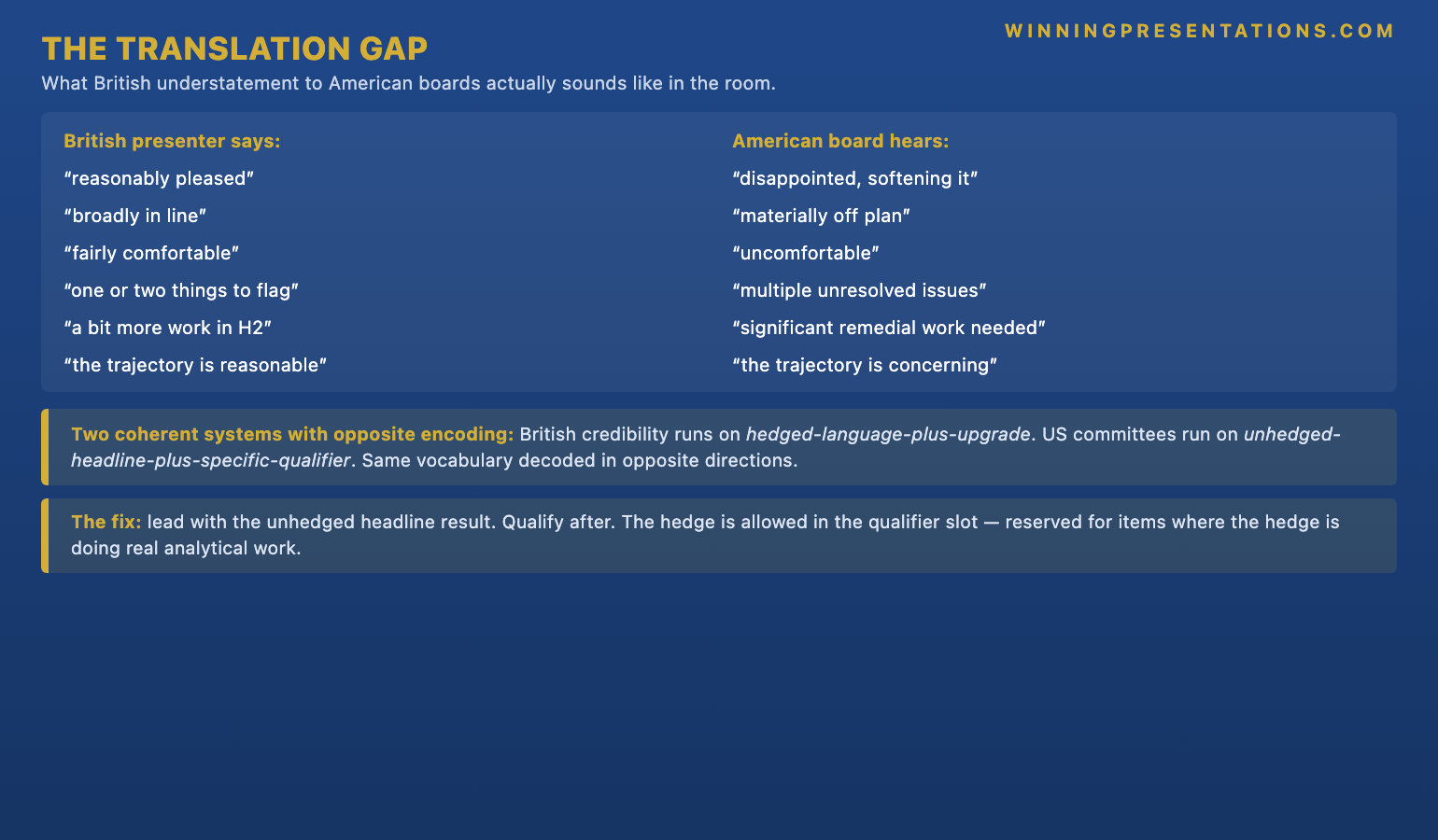
British professional understatement is a credibility vocabulary in its own home market. A London committee hears “reasonably pleased” from a senior MD and reads it as a confident report with proper professional restraint. The MD is not over-claiming, not posturing, not putting forward a stronger framing than the analytical work supports. The hedged vocabulary signals analytical seriousness; the absence of hedging would read as either inexperience or as a presenter who has not done the work to identify the legitimate qualifications a senior operator would always carry. The British committee’s default expectation is that a senior operator under-states by a meaningful margin, and the committee mentally upgrades the headline result accordingly. “Reasonably pleased” means “genuinely pleased.” “Broadly in line” means “materially in line, with the residual variance acknowledged.” “A couple of items to flag” means “the two named items in section four; the rest is fine.” The hedged vocabulary and the upgrade are the system. They run together.
The American boardroom does not run the upgrade. The US committee’s default expectation is that a senior operator presents the headline result in unhedged language and then qualifies the specific items that need qualifying. The hedged vocabulary, presented without the unhedged headline preceding it, reads as the presenter trying to soften a result they are not confident in. “Reasonably pleased” reads as “not actually pleased — what’s wrong?” “Broadly in line” reads as “not in line — how off?” “A couple of items to flag” reads as “there are problems the presenter is not yet ready to name — what are they?” The hedged vocabulary, in the US committee’s reading system, is the signal of concealment rather than the signal of professional restraint. The MD’s opening forty-six words in the 2019 New York call were heard as exactly that: concealment of underlying problems the substance was about to fail to fully explain.
This is not a deficit on either side. London-credibility and US-board-credibility are two coherent systems that happen to use the same vocabulary in opposite ways. The British system runs on hedged-language-plus-upgrade. The US system runs on unhedged-headline-plus-specific-qualifier. Both systems produce accurate readings inside their home market and both produce systematic misreadings of the other market’s vocabulary. The British MD presenting to a US board without running the language reset is delivering accurate words into a system that decodes them as inaccurate signals. The substance is unchanged. The perception cost is significant. The authenticity trap senior presenters fall into across cultural boundaries covers the parallel dynamic when senior leaders try to import their own home-market presentation style into a culturally different audience.
What American boards actually hear when British presenters hedge
The mechanical mapping between British hedged vocabulary and the American board’s reading is consistent enough to be predictable. “Reasonably pleased” lands as “disappointed but trying to soften it.” “Broadly in line” lands as “materially off plan.” “Fairly comfortable” lands as “uncomfortable.” “One or two things to flag” lands as “multiple unresolved issues.” “A bit more work in the second half” lands as “significant remedial work needed.” “The trajectory is reasonable” lands as “the trajectory is concerning.” The mapping is the same across most US Fortune-500 committees, US investment committees, US-headquartered investor groups, and US parent companies with overseas subsidiaries reporting in.
The cost of the misreading is not the misreading itself; it is the listening posture the committee adopts for the rest of the call. Once the opening forty seconds have installed the perception frame of “this presenter is hedging because the result is in trouble,” the committee’s remaining listening posture is constructed around that frame. Every subsequent slide is filtered through it. A strong revenue number on slide three is read as “the revenue is strong but something underneath it isn’t.” A clean margin number on slide five is read as “the margin is OK now but there’s pressure coming.” An on-track integration update on slide seven is read as “the integration is on track in the narrow definition but there must be a broader definition where it isn’t.” The committee is not malicious; the committee is doing exactly the analytical work the opening frame trained them to do. The presenter’s substance is being interpreted through the frame the presenter installed, and the presenter has very little control over that interpretation once the frame is set.
The 2019 New York committee called the MD’s session a “cautious report from the European book” in the chief-of-staff debrief that filtered back to London the following week. The actual H1 was 8% ahead of plan with a clean margin and a credit book within expected parameters. The committee’s post-call narrative was constructed from the perception frame the opening installed, not from the numbers the MD presented. The chief of staff at the parent company is not a hostile actor; she summarised what the committee’s listening posture had absorbed. The substance the MD delivered was, in the committee’s lived experience of the call, a cautious report from a European book in trouble. The substance the MD intended to deliver was a strong report from a European book performing well. The gap between those two things was the perception cost of the British-understatement opener into a US committee that does not run the upgrade.
Stop dreading the cross-cultural meeting before it starts.
Conquer Your Fear of Public Speaking is the structured programme senior British professionals use when the cross-cultural moment — the US parent call, the international investor presentation, the multi-region committee — is the part of the year their confidence drops despite the substance being strong. Replace last-minute panic with the structural preparation that lets your substance carry without your vocabulary undermining it. Built on the patterns Mary Beth has observed across senior banking, insurance, consulting, and technology professionals over sixteen years of coaching work.
- Structured techniques for managing the acute moments of cross-cultural presentation pressure
- The voice-and-pacing work senior professionals use to sound confident even when the cultural register feels foreign
- The preparation rhythms that replace ad-hoc rehearsal with structured pre-call routines
- Designed for senior professionals presenting to high-stakes audiences in cultural registers that aren’t their home register
- Instant download, lifetime access — usable across every high-stakes cross-cultural cycle — £39
The headline-first reset that lands the substance into the right frame
The structural reset is mechanical. The British presenter rewrites the opening sentence so the unhedged headline result leads, and the qualifier follows the headline rather than preceding it. The hedged vocabulary is allowed to appear in the qualifier slot, where it does its proper analytical work; it is not allowed to appear in the headline slot, where it carries the perception frame for the whole call. The 2019 New York opener would have run: “Good morning, everyone. The European book came in 8% ahead of plan at the half year. Margin is two points above the prior year. The credit book is performing within expected parameters with one named exposure on watch, which I’ll come to in section four. Otherwise, the H1 is the strongest set of numbers the European business has reported in three years.” Same substance. Forty-two words instead of forty-six. The opening installs a perception frame of confident report with one acknowledged item, which is what the underlying substance actually is.
The next reset move is to relocate the hedged vocabulary to the qualifier slots within each section. The hedge is not banned; the hedge is reserved for the items where the hedge is doing real work. On the named exposure in section four, the presenter can legitimately say: “On this exposure, we’re reasonably comfortable with the current position but watching for the Q4 refinancing window in case the borrower’s sector pressure increases.” Here “reasonably comfortable” carries actual analytical meaning — it signals a specific, bounded reservation about a specific, bounded exposure. The hedge is appropriate. The US committee reads it correctly because the headline frame for the whole call is already “strong H1 with one named item to watch,” and the hedge on the specific exposure fits inside that frame as the specific item.
The reset is structurally similar to the Pyramid-Principle move of stating the recommendation first and the supporting argumentation underneath. The British-understatement opener inverts the pyramid by leading with the qualifications and arriving at the headline (implied or stated) at the end. The headline-first reset puts the pyramid back the right way up for the American board reading system. The same data, the same supporting analysis, the same legitimate qualifications — sequenced in the order the US committee’s analytical reading system expects them. The structural moves senior leaders make before joining the virtual board call covers the broader structural preparation work this language reset sits inside.
How to do the reset without abandoning your own voice
The most common British objection to the headline-first reset is that it feels like adopting an American style that isn’t authentic. The objection is understandable and partially correct — trying to copy a stereotyped American directness style does feel inauthentic, and it lands as inauthentic to American committees too. The reset is not asking the British presenter to copy American directness. It is asking the British presenter to reorder the same sentence so the headline precedes the qualifier rather than following it. The vocabulary remains British. The voice remains British. The professional register remains British. The only structural change is the order in which the headline and the qualifier appear in the opening sentence.
The London-style opener — “Good morning everyone, thank you for the time today, I think we’re reasonably pleased with where the European book is sitting at the half year — there are a couple of items I’d want to flag — but overall the trajectory is reasonable” — can be rewritten in voice-preserving British form as: “Good morning everyone. The European book is at 8% ahead of plan at the half year — the strongest set of numbers in three years. I’ll come to two specific items in section four that I’d want to flag, but the headline result is genuinely strong.” The voice is still British. The vocabulary is still British. The hedged language is reserved for the specific items in section four. The headline leads. The frame the US committee constructs from this opener is “strong British report with named items to discuss,” which is what the substance is. The reset has done its work without the presenter having to import an American voice they don’t have.
If the cross-cultural presentation is the prelude to a board buy-in decision, the structural method matters even more.
The Executive Buy-In Presentation System is the self-paced framework senior professionals use when the cross-cultural call is the warm-up to a buy-in decision the committee is going to make in-session — budget reallocations, capital allocation asks, strategic redirects, parent-subsidiary alignment. Walk into the call knowing your opener won’t install the wrong frame. 7 modules. Self-paced with monthly cohort enrolment. Optional live Q&A calls, fully recorded. Lifetime access to materials. £499.
The ten-minute pre-call language diagnostic
The pre-call diagnostic takes ten minutes the day before the US-committee call. The procedure is mechanical. Write down the opening sentence as you would naturally deliver it to a British committee. Read it aloud. Identify every hedged word or phrase in the sentence: “reasonably,” “broadly,” “fairly,” “a bit,” “one or two,” “a couple of,” “more or less,” “largely,” “in the main.” Count them. If the sentence contains more than one hedged word or phrase before the headline result is named, the opener is in the British-understatement pattern and will misfire in the US committee.
Rewrite the sentence with the headline result first and the qualifier moved after it. Read the rewritten sentence aloud. Ask whether it still sounds like you — whether the British voice and register are intact — or whether the rewrite has gone too far and sounds like imitation American directness. If it sounds like imitation American directness, soften the headline slightly while keeping it unhedged: “the European book is at 8% ahead of plan” is better than “we crushed plan by eight points,” and is also better than “we’re reasonably pleased.” The middle register is the target. Run the same rewrite for each major section opener in the deck. Total cost: ten minutes. Output: a deck that opens each section with the headline result and the qualifier in the structural order the US committee reads correctly.
Why this matters more for senior British presenters than for junior ones
A junior British presenter to a US board is read as inexperienced and given a generous allowance. The committee notes the hedged opener, mentally adjusts, and engages with the substance anyway. The same pattern from a senior British MD is not given the allowance. The US committee’s expectation of a senior MD presenting half-year results is that the MD knows what their own committee culture reads as appropriate and would have led with an unhedged headline if the underlying result supported it. The senior MD who leads with hedged language is read as someone who is signalling, deliberately or not, that the result does not actually support an unhedged headline. The penalty is asymmetric: junior gets a pass; senior gets the perception cost in full.
The cost compounds across quarterly cycles in the same way the perception cost on a remote townhall compounds. A senior British MD who runs four quarters of British-understatement openers into a US parent committee is building a perception narrative that the European book is a chronically hedged report — not because the substance is hedged, but because the opening vocabulary signals it. The narrative becomes the lens through which the US committee reads every European update for the rest of the relationship. The conditional approvals attach to second-half plans, year-end reviews, and budget allocations the substance does not warrant. The compounded cost across two years of quarterly cycles is significant — it shows up as the European book consistently getting less capital, less attention, and more board scepticism than the underlying performance deserves. The ten minutes per call to run the diagnostic is the cheapest available insurance against the narrative.
One thing to do before the next presentation to a US board
Ten minutes before the next presentation to a US board, write your opening sentence the way you would naturally deliver it to a British committee. Count the hedged words and phrases that appear before the headline result is named. If there are more than one, the opener is in the British-understatement pattern and will misfire. Rewrite the sentence so the unhedged headline leads and the qualifier follows. Read the rewritten version aloud to check it still sounds like you. Repeat for each major section opener. Walk into the call with the headline-first openers prepared. The substance you are presenting deserves to land inside the perception frame the US committee is built to read — not inside the frame your opening vocabulary accidentally installs.
Frequently asked questions
What if my American committee includes one or two senior British members — doesn’t the headline-first reset alienate them?
It does not, because the British members are operating inside the same committee culture as the American members and have calibrated to it themselves. A British NED on a US parent committee has spent enough quarters watching American presenters and watching British presenters miscalibrate that the British NED reads the headline-first opener as the correct call. The opener that sounds slightly more direct than a London-default British opener will not register as inauthentic to the British NED; it will register as the British presenter having done the cultural preparation. The committee culture, not the nationality of the individual members, is what the opener calibrates to.
Isn’t this just British people having to talk like Americans — isn’t that a one-way concession?
It is not a concession; it is a recalibration to the specific committee’s reading system. American presenters into a German Aufsichtsrat have to make the equivalent recalibration in the other direction — less directness, more procedural framing, more deference to the chair — or they misfire in exactly the same way. The presenter calibrates to the room. Every cross-cultural presenter does this work or pays the perception cost of not doing it. The British MD calibrating to the US committee is doing the same structural preparation an American CFO calibrates to do when presenting to a Korean parent group, or a German MD calibrates to do when presenting to a French conseil d’administration. The work is symmetric across cultural directions even when the specific recalibration is asymmetric.
What about the rest of the presentation — do I have to reset every sentence?
No. The opener is load-bearing because it installs the perception frame for the whole call. The body of the presentation can run in a more natural British register because the frame the opener installed will absorb the British-vocabulary qualifiers correctly. The reset is structural at the opener and at each section opener; the body content can carry the British professional voice intact. The reset is targeted at the structural positions where the perception frame is most expensive to misfire: the opening sentence of the whole presentation, the opening sentence of each major section, and the closing sentence of the recommendation. Those four or five sentences are the leverage points. The other ninety sentences can run in their natural register.
My confidence drops when I think about presenting to a US board — is this just an anxiety problem dressed up as a cultural problem?
It is genuinely both. The cultural-translation gap is real and structural; the anxiety the gap produces is a rational response to repeatedly watching strong substance fail to land into committees that have read the opener as concealment. Confidence is harder to maintain when the presenter knows from experience that their natural voice gets systematically misread in this committee culture. The structural language reset is the part that addresses the cultural-translation gap; the work on the acute presentation moments — the voice, the pacing, the preparation rhythm — is the part that addresses the residual anxiety the gap produces. The two pieces of work reinforce each other. Doing the structural reset reduces the anxiety because the presenter has done the work that historically lets the substance land; the anxiety work itself produces the composure that lets the reset get delivered cleanly. Treating one without the other tends to under-perform.
The Winning Edge — weekly newsletter
The Winning Edge is a weekly (Thursday) newsletter for senior professionals who present at the executive level. One short email a week, focused on the structural moves that separate the cross-cultural presentations that land inside the right perception frame from the ones that fight an unintended frame for forty minutes. Subscribe to The Winning Edge →
For the broader picture across slides, storytelling, confidence, and delivery, the Complete Presenter library of seven products is the bundle most senior professionals find useful as a single resource — £99 for everything, lifetime access.
About the author
Mary Beth Hazeldine is Owner & Managing Director of Winning Presentations Ltd. With 24 years of corporate banking experience at JPMorgan Chase, PwC, Royal Bank of Scotland, and Commerzbank, she advises senior professionals across financial services, insurance, consulting, and technology on the structural language work that separates the cross-cultural presentations American boards engage with from the ones they politely tolerate as cautious reports from a European book in trouble that wasn’t actually in trouble.