Tag: executive Q&A

06 Mar 2026
Executive navigating political dynamics during high-stakes corporate committee presentation with stakeholders around a boardroom table

Political Questions in Presentations: When the Real Agenda Isn’t the Question Being Asked

Everyone said no to the £3M project. Then we discovered the real blocker wasn’t the CFO at all.

Political questions in presentations are questions designed to advance the questioner’s agenda rather than genuinely seek information. They disguise territorial disputes, power struggles, and personal grievances as legitimate inquiry. Recognising political questions requires understanding the difference between surface content (what’s being asked) and underlying intent (why it’s being asked). The framework for handling them involves three steps: identify the real agenda, acknowledge the surface question without being trapped by it, and redirect to the decision the room actually needs to make. Answering the literal question is almost always the wrong move—because the literal question was never the point.

🚨 Presenting to a politically complex room this week?

Quick diagnostic: Do you know which stakeholders in the room have competing interests? Can you name the one person most likely to ask a question that serves their agenda, not yours?

  • Map the room before you enter it—who gains and who loses from your proposal?
  • Prepare for “questions” that are actually statements disguised as inquiry
  • Have a bridge phrase ready: “That’s an important consideration. Here’s how it connects to the decision we’re making today…”

→ Need the complete Q&A preparation system? Get the Executive Q&A Handling System (£39)

The Stakeholder Map That Saved a £3M Project

A project director came to me after her third failed attempt to get a £3M technology investment approved. The steering committee kept rejecting it. She assumed the CFO was the blocker—he asked the toughest questions in every session.

We built a stakeholder map of the committee. Every member. Their stated position. Their likely real position. And crucially—what each person gained or lost if the project went ahead.

The real blocker wasn’t the CFO. He was actually neutral—his tough questions were genuine due diligence, the kind you’d expect from a finance leader evaluating a major investment. The real blocker was a VP of Operations who’d been asking seemingly reasonable questions in every meeting: “Have we considered the impact on the Leeds team?” “What’s the training burden for existing staff?” “Is this the right time given our current workload?”

Every question sounded operational. Every question was actually political. The VP felt bypassed in the project planning. Her team would absorb the implementation burden, but she hadn’t been consulted on the timeline or resource allocation. Her questions weren’t seeking information—they were signalling opposition through the acceptable language of operational concern.

One pre-meeting conversation fixed it. The project director met with the VP, acknowledged the implementation burden, adjusted the timeline to accommodate her team’s capacity, and gave her a formal role in the rollout governance. The VP’s questions in the next steering committee were supportive. The CFO’s due-diligence questions were answered. The £3M was approved.

Three presentations had failed because the project director was answering the literal questions instead of addressing the political dynamics behind them. The questions weren’t the problem. The hidden agendas were.

Walk Into Q&A Knowing the Political Landscape Before the First Question

  • Political Question Recognition: The framework for identifying when a question is serving the questioner’s agenda, not seeking genuine information
  • Stakeholder Mapping for Q&A: How to predict which questions will come from whom—and what they’re really asking—before you enter the room
  • Bridge Response Templates: Tested phrases for acknowledging political questions without being trapped by them
  • Hidden Agenda Playbook: Specific response strategies for territorial disputes, power positioning, and score-settling disguised as inquiry
  • Pre-Meeting Intelligence System: The preparation framework that lets you predict the political questions before they’re asked

Get the Executive Q&A Handling System → £39

Built from hundreds of executive presentations across banking, consulting, and corporate finance—where political Q&A is the norm, not the exception

How to Recognise a Political Question in Real Time

Political questions share characteristics that distinguish them from genuine inquiry. Learning to spot these patterns in real time is the first skill in navigating corporate Q&A:

The Question Contains Its Own Answer

“Don’t you think it’s risky to deploy this before we’ve resolved the integration issues with the Leeds team?” This isn’t a question—it’s a statement (“this is risky and premature”) wrapped in question form. If the questioner already has a position embedded in the question, they’re not seeking information. They’re making a case to the room.

The Question Addresses an Audience, Not the Presenter

Watch where the questioner looks when they ask. If they’re looking at you, they want an answer. If they’re looking at the committee chair, the CEO, or another stakeholder—they’re performing for that audience. The question is political theatre designed to signal their position to the decision maker.

The Question Raises Stakes Disproportionate to the Topic

“What happens to client confidence if this implementation fails?” This question escalates a routine project decision into a client-confidence conversation—a much higher-stakes frame than the actual risk warrants. Disproportionate escalation is a classic political move: it makes the decision feel more dangerous than it is, which benefits anyone who wants to delay or block it.

The Question References a Previous Decision or Conflict

“Is this going to be like the CRM migration that went over budget by 40%?” This isn’t about your project. It’s about a historical wound. The questioner is using your proposal as a vehicle to relitigate an old decision—perhaps one they opposed or were blamed for. The historical reference is the tell: they’re fighting a previous battle, not evaluating your proposal. Understanding the political stakeholder map is essential for predicting when these historical references will surface.

The Five Types of Political Questions

Political questions in presentations cluster into five categories. Recognising the type tells you both the hidden agenda and the correct response strategy:

1. The Territory Question

Surface: “How does this affect my team’s responsibilities?”

Hidden agenda: “Am I losing control, budget, or headcount?” Territory questions come from stakeholders who feel their domain is being encroached upon. The response must explicitly protect their territory or offer something in return.

2. The Credibility Test

Surface: “What’s your experience with implementations of this scale?”

Hidden agenda: “I don’t believe you can deliver this, and I want the room to doubt you too.” Credibility tests are designed to undermine your authority in front of decision makers. The response must demonstrate competence without being defensive. When someone contradicts your data in a presentation, it’s often a credibility test in disguise.

3. The Delay Tactic

Surface: “Shouldn’t we conduct a broader market review before committing?”

Hidden agenda: “I can’t openly oppose this, but I can slow it down until it loses momentum.” Delay tactics use reasonable-sounding process suggestions to kill momentum. They’re effective because saying “let’s do more research” sounds responsible—even when the real intent is obstruction.

4. The Score-Settler

Surface: “Is this similar to the approach that failed in Q3 last year?”

Hidden agenda: “I want to remind the room that your team / department / predecessor failed before.” Score-settlers use your presentation as an opportunity to rehash old grievances. The question isn’t about your proposal—it’s about establishing a narrative of past failure.

5. The Power Play

Surface: “I think we need to step back and consider whether this aligns with our strategic priorities.”

Hidden agenda: “I want to demonstrate that I operate at a higher strategic level than you.” Power plays reframe the conversation to assert the questioner’s seniority or strategic authority. They often come from people one or two levels above the presenter who want to remind the room of the hierarchy.

The Five Types of Political Questions infographic showing Territory Question, Credibility Test, Delay Tactic, Score-Settler, and Power Play—each with surface question and hidden agenda

Facing a politically complex Q&A session?

The Executive Q&A Handling System includes response templates for all five political question types—plus the pre-meeting intelligence framework that predicts them.

Get the Executive Q&A Handling System → £39

The Framework for Responding Without Taking the Bait

The natural response to a political question is to answer it literally. This is almost always wrong. Answering the surface question validates the hidden frame—you’re playing their game on their terms.

The three-step political question response framework:

Step 1: Acknowledge Without Validating

Show you’ve heard the question. Don’t dismiss it. But don’t accept the embedded premise either.

Instead of: “That’s a great question” (which validates the political frame)

Say: “That’s an important consideration” or “That touches on something we’ve built into the plan.”

The word “consideration” is powerful in political Q&A. It acknowledges the topic without agreeing it’s a problem. “Important question” implies the question is good. “Important consideration” implies you’ve already thought about it.

Step 2: Address the Hidden Agenda (Without Naming It)

Respond to what they actually care about, even though they didn’t explicitly state it.

Territory question (“How does this affect my team?”): “Your team’s role becomes more strategic in Phase 2. We’ve specifically designed the implementation to strengthen your team’s capabilities, not replace them.”

Delay tactic (“Shouldn’t we do more research?”): “We’ve completed the market review—findings are in the appendix. The risk of further delay is that [specific competitive or financial consequence]. The recommendation is to proceed with a controlled pilot that gives us real data within 8 weeks.”

Score-settler (“Is this like the CRM failure?”): “The CRM project taught us valuable lessons about phased rollout—which is exactly why this proposal includes built-in review gates at weeks 4, 8, and 12. We’ve incorporated those learnings into the governance structure.”

Step 3: Redirect to the Decision

After addressing the hidden concern, bring the room back to the actual decision. Political questions succeed when they derail the meeting into a tangent. Redirecting prevents this.

“The decision the committee needs to make today is [specific decision]. This proposal addresses [the concern raised] through [specific mechanism]. I’d recommend we focus on [the decision criteria] to make the best use of everyone’s time.”

The redirect isn’t aggressive. It’s professional. And it signals to the room that you understand the dynamics—which builds credibility with every other stakeholder watching. Understanding how executive questions function as trust tests helps you recognise when a question is genuine and when it’s political.

Stop Getting Ambushed by Political Questions You Didn’t See Coming

  • Question Prediction Framework: Anticipate the political dynamics and prepare responses before you enter the room
  • Bridge Response Library: Tested phrases for every type of political question—acknowledge, address, redirect

Get the Executive Q&A Handling System → £39

Walk into Q&A knowing the political questions before they’re asked

Navigating a high-stakes committee presentation?

The Executive Q&A Handling System includes the stakeholder mapping template—so you know who will ask what, and why, before the meeting starts.

Get the Executive Q&A Handling System → £39

Pre-Meeting Intelligence: Predicting Political Questions

The best response to a political question is one you’ve prepared before the meeting. Prediction is more valuable than reaction. Here’s the intelligence framework:

Map Who Gains and Who Loses

For every stakeholder in the room, answer two questions: “What does this person gain if my proposal is approved?” and “What does this person lose?” Anyone who loses—budget, headcount, influence, control, status—is a potential source of political questions.

Identify Historical Grievances

Has there been a failed project in this area before? Does your proposal resemble something that was previously rejected or went wrong? Historical grievances are the fuel for score-settling questions. Know the history and prepare to address it proactively.

Read the Pre-Meeting Signals

Before major presentations, stakeholders often signal their position through informal channels: corridor conversations, email tone, questions raised in pre-reads, last-minute attendee additions. These are intelligence signals. A stakeholder who asks detailed questions in the pre-read is either genuinely engaged or building their case for opposition. The tone and framing of those questions tells you which.

The Pre-Meeting Conversation

The most powerful tool for defusing political questions is a one-to-one conversation before the meeting. Meet with the stakeholder most likely to oppose. Ask directly: “What concerns do you have about this proposal?” In a private setting, most people will tell you the real issue—which they’d never state publicly in the meeting. That gives you the opportunity to address it privately, adjust your proposal, or prepare a specific response.

The £3M project I described earlier was approved not because the presentation got better. It was approved because a single pre-meeting conversation addressed the hidden political objection. The meeting itself became a formality.

Pre-Meeting Intelligence Framework infographic showing four steps: Map Who Gains and Loses, Identify Historical Grievances, Read Pre-Meeting Signals, and Have the Pre-Meeting Conversation

How do you handle a question designed to make you look bad?

Recognise it as a credibility test or score-settling attempt. Don’t become defensive—defensiveness confirms the narrative the questioner is trying to create. Instead, acknowledge the concern (“That’s an important consideration”), demonstrate competence with a specific, measured response, and redirect to the decision at hand. Your composure under the attack builds more credibility with the room than any verbal rebuttal could.

What if a senior stakeholder asks a political question and expects a direct answer?

Seniority doesn’t change the response framework—it changes the tone. With a senior stakeholder, acknowledge with more deference (“That’s exactly the kind of strategic consideration we need to address”), provide a concise response that addresses the hidden concern, and offer to discuss in more detail offline. The offline offer is powerful: it signals respect for their position while preventing the political dynamic from derailing the meeting.

Can you prevent political questions entirely through better preparation?

You can significantly reduce them through pre-meeting stakeholder conversations, but you can’t eliminate them entirely. Corporate politics exist in every organisation. The goal isn’t prevention—it’s preparation. When you’ve mapped the political landscape, predicted the likely questions, and prepared responses for each stakeholder’s concerns, political questions become manageable rather than ambush-like.

Is the Executive Q&A Handling System Right For You?

✓ This is for you if:

  • You present to senior committees where stakeholders have competing interests and political dynamics are significant
  • You’ve experienced Q&A sessions where questions felt designed to undermine your proposal rather than improve it
  • You want a systematic framework for predicting and preparing for political questions before major presentations
  • You’re tired of answering the literal question and realising afterwards that you missed the real agenda

✗ This is NOT for you if:

  • Your Q&A challenges are primarily about knowledge gaps (not knowing the answer) rather than political dynamics
  • You present primarily in collaborative settings where stakeholder alignment already exists

24 Years of Boardroom Q&A. Now a System You Can Use.

  • Political Question Recognition Guide: The five types of political questions with real examples, hidden agendas, and tested response strategies for each
  • Stakeholder Intelligence Template: The pre-meeting mapping tool that predicts who will ask what—and why—before you enter the room
  • Bridge Response Library: Dozens of tested phrases for acknowledging, addressing, and redirecting political questions without taking the bait
  • Pre-Meeting Conversation Scripts: How to have the one-to-one conversation that defuses political opposition before the presentation
  • Q&A Simulation Framework: Practice political Q&A scenarios with your team so nothing in the meeting feels unrehearsed

Get the Executive Q&A Handling System → £39

Built from hundreds of executive presentations at JPMorgan, PwC, RBS, and Commerzbank—where every Q&A is political

Frequently Asked Questions

Q: How do I tell the difference between a genuinely tough question and a political one?

A: Genuine questions seek specific information to improve decision quality. They ask “how” and “what”—”How does the implementation timeline account for Q4 capacity?” Political questions embed a position or agenda—”Don’t you think it’s premature to implement during Q4?” The test: if the question contains an implicit answer or conclusion, it’s political. If it’s genuinely open-ended, it’s authentic due diligence. Watch for embedded assumptions, historical references, and disproportionate escalation.

Q: Should I call out political questions directly?

A: Never publicly. Calling out a political question makes you look combative and embarrasses the questioner—who may have allies in the room. The goal is to address the hidden concern without naming it. “That’s an important consideration. We’ve built safeguards into the plan specifically for that scenario” addresses the concern without accusing anyone of political manoeuvring. If the dynamic is severe and recurring, address it privately after the meeting or through a pre-meeting conversation before the next one.

Q: What if the political question comes from the decision maker themselves?

A: Decision makers ask political questions for different reasons than other stakeholders. They may be testing whether you can navigate political complexity (a leadership competence test), gauging the room’s reaction to a provocative frame, or signalling their own concerns to the committee. The response framework remains the same—acknowledge, address the hidden concern, redirect—but add a closing question: “Would it be helpful if I addressed that in more detail offline, or does the committee have what it needs to proceed?” This gives the decision maker control while moving the meeting forward.

Get Strategic Q&A Insights Every Week

The Winning Edge newsletter shares Q&A frameworks, political navigation strategies, and real boardroom examples for executives who present in high-stakes environments. Subscribe for free.

Subscribe to The Winning Edge

🆓 Want to start free? Download the Executive Presentation Checklist first.

About the Author

Mary Beth Hazeldine is the Owner & Managing Director of Winning Presentations. With 24 years of corporate banking experience at JPMorgan Chase, PwC, Royal Bank of Scotland, and Commerzbank, she has delivered high-stakes presentations in boardrooms across three continents.

A qualified clinical hypnotherapist and NLP practitioner, Mary Beth combines executive communication expertise with evidence-based techniques for managing presentation anxiety. She has trained thousands of executives and supported presentations for high-stakes funding rounds and approvals.

Book a discovery call | View services

Your next committee presentation has political dynamics. Every room does. The question is whether you walk in blind or walk in prepared. Get the Executive Q&A Handling System and know the political questions before they’re asked. Because the presenter who reads the room wins the room.

05 Mar 2026
Executive reviewing structured Q&A briefing document at desk before high-stakes presentation

The Q&A Briefing Document: What to Prepare When Stakes Are Career-Defining

Most executives prepare for Q&A by guessing which questions might come up. That’s why most executives panic when something unexpected gets asked.

The difference between recovering gracefully and freezing for 47 seconds isn’t luck. It’s a briefing document.

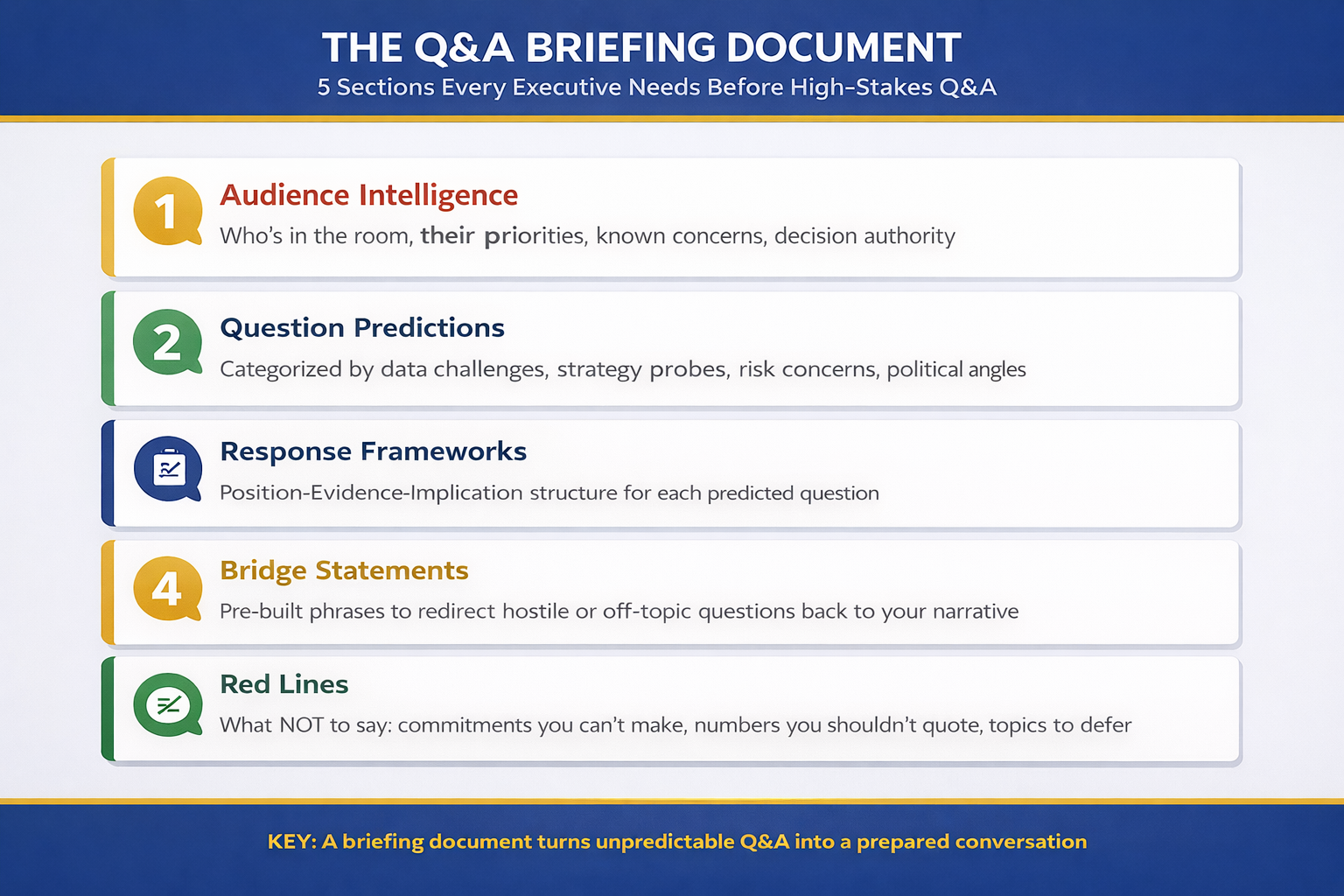
Quick answer: A Q&A briefing document is a structured, written preparation system that maps your audience’s concerns, predicts likely questions by category, and provides response frameworks rather than memorised answers. It’s the difference between defensive scrambling and confident, coherent replies. The five sections every briefing doc must contain are: Audience Intelligence, Question Predictions by Category, Response Frameworks, Bridge Statements, and Red Lines.

Feeling unprepared for upcoming Q&A? You’re not alone.

Most executives wing their Q&A preparation and hope they won’t be challenged on weak points. The Executive Q&A Handling System teaches you exactly how to build a briefing document that covers every angle—and gives you the confidence to handle anything.

Get the Executive Q&A Handling System → £39

The Executive Who Froze (And Recovered)

Sarah, a finance director presenting to the board, was mid-Q&A when a director asked something she hadn’t anticipated. Forty-seven seconds of silence. The room held its breath.

What nobody in that boardroom knew: she had prepared a briefing document for the first time.

That document didn’t contain the answer to that specific question. But it contained something more valuable—a response framework. A structure for how she approached difficult questions. Response frameworks don’t predict every question. They teach your mind how to think under pressure.

During those 47 seconds, Sarah wasn’t paralysed. She was using her framework. Acknowledging the question, taking a breath, then pivoting to what she knew. The board didn’t notice the pause was panic. They noticed she recovered with composure.

When she came back to the office, she said the same thing every executive says after their first briefing document: “Why didn’t anyone teach me to do this earlier?”

What the Q&A System Teaches You

  • How to build a briefing document that covers every category of question your specific audience might ask
  • The exact structure of response frameworks that work under pressure—not rigid answers, but thinking patterns
  • How to spot your dangerous gaps before the presentation, not during it
  • How to practise with your briefing document so you’re truly prepared, not just rehearsed
  • The psychology of boardroom Q&A: what questions executives really fear, and why

Get the Executive Q&A Handling System → £39

Used by finance directors, CEOs, and board-level executives facing career-defining presentations

What a Q&A Briefing Document Actually Is

A Q&A briefing document isn’t a script. It’s not a list of prepared answers you’ve memorised. It’s a working document—a physical or digital artifact you prepare before the presentation, and that you can reference if you need to.

Think of it as an intelligence file on your own presentation. It contains everything you need to know to answer questions confidently, but it’s structured in a way that your nervous system can actually use it under pressure.

The briefing document serves three purposes at once:

  • Diagnostic: It forces you to identify gaps in your own knowledge before the presentation starts.
  • Practical: It gives you a tool to reference if you blank on a detail during live Q&A.
  • Psychological: It transforms your internal state from “I hope they don’t ask about X” to “I’m prepared for X.”

The preparation process—building the document—matters as much as the document itself. The act of thinking through what your audience cares about, what they might challenge you on, and how you’ll respond, is what rewires your confidence.

The Five Sections Every Briefing Document Needs

Every effective Q&A briefing document contains five core sections. This isn’t arbitrary structure—it’s the sequence your mind needs to move through when preparing for high-stakes Q&A.

Section 1: Audience Intelligence

Start by documenting who is in the room. Not names—psychology. What are their concerns? What do they care about? What keeps them awake at night about your topic?

If you’re presenting to a board, the finance director cares about cash flow and risk. The HR director cares about people impact and retention. The CEO cares about competitive positioning. Write down what each stakeholder in the room actually wants to know.

Section 2: Question Predictions by Category

This isn’t fortune-telling. It’s categorisation. Break down likely questions into categories: Financial Impact, Implementation Risk, Competitive Response, Timeline Feasibility, Resource Requirements, and anything else specific to your situation.

Under each category, list 3-5 specific questions you predict. Not every possible question—just the ones that would genuinely challenge your presentation if asked.

Section 3: Response Frameworks

This is the core of the document. For each category of question, write a response framework—not a rigid answer, but a thinking structure.

A framework might look like: “For financial impact questions, I acknowledge the concern, present the three-year projection, address the worst-case scenario, then connect back to the strategic benefit.” That structure applies to multiple specific questions, but it’s not memorised dialogue.

Section 4: Bridge Statements

Write 4-6 bridge statements—sentences that pivot you from a difficult question back to your core message. These aren’t evasions. They’re authentic pivots that acknowledge the question while steering toward what matters.

Examples: “That’s a fair concern, and here’s how we’re mitigating that risk…” or “I understand where that concern comes from. What we’re focused on is…”

Section 5: Red Lines

This section identifies what you will not say. What topics are out of bounds? What commitments can’t you make? What doesn’t fall under your remit? Be explicit about your boundaries so you’re not caught off guard by a question that puts you in a difficult position.

Writing down your red lines in advance means you can answer “I can’t comment on that” or “That’s outside my brief, but here’s what I can tell you…” without hesitation or defensiveness.


The Q&A Briefing Document infographic showing five sections every executive needs before high-stakes Q&A: Audience Intelligence, Question Predictions, Response Frameworks, Bridge Statements, and Red Lines

How to Map Likely Questions to Your Specific Audience

The difference between a generic briefing document and a powerful one is specificity. You’re not preparing for every possible Q&A in existence. You’re preparing for this audience, in this room, on this topic.

Step 1: Identify stakeholder concerns. For each person in the room, write down their primary concern about your topic. If they’re the CFO, their concern is likely financial sustainability. If they’re the operations director, it’s feasibility. If they’re the compliance officer, it’s regulation and risk.

Step 2: Translate concerns into questions. Take each concern and turn it into specific questions that person might ask. The CFO doesn’t just care about “finances”—they care about cash flow impact in quarter one, impact on shareholder return, and whether you’ve modelled for recession. Each of those becomes a distinct predicted question.

Step 3: Identify the hard questions. Be honest: what would genuinely undermine your presentation if asked? What are the weak points in your argument? What aren’t you completely certain about? Those become your priority questions in the briefing document.

Step 4: Map to precedent. Have similar questions come up in previous presentations? Is there a pattern in how this organisation asks questions? Add those to your document.

The briefing document isn’t complete until you feel genuinely prepared for the questions that would most hurt you.

Building Response Frameworks Within the Document

The second your briefing document becomes a script, it stops working. The moment you’re trying to remember memorised answers under pressure, your nervous system takes over and you blank.

Response frameworks are different. A framework is a thinking structure—a sequence of moves your mind makes to answer a category of questions confidently.

Here’s a practical example. If your presentation is about expanding into a new market, you might predict several questions about market viability. Your framework might be:

Framework for Market Viability Questions:

1. Acknowledge the legitimate concern (“The viability question is the right first question”)

2. Present the three-part evidence (market research data, competitor analysis, customer validation)

3. Address the worst-case scenario explicitly

4. Close by connecting back to the strategic imperative

That framework applies to “Is the market actually big enough?”, “What if we’ve miscalculated demand?”, and “How confident are you in the research?” None of those are the same question, but the framework structures your thinking for all of them.

Build 3-5 core frameworks for your presentation. Each one should feel like a natural way of thinking about that category of question, not a trick or a memorised pattern. When you practice with your frameworks, they become instinctive.

Building a briefing document requires knowing what structure actually works under pressure.

The Executive Q&A Handling System walks you through the exact process, with templates and real examples so you know exactly what goes in each section.

Get the Executive Q&A Handling System → £39

Practising With the Document

A briefing document that sits unread until presentation day is paperwork. A briefing document you practice with becomes your confidence.

Practice doesn’t mean memorising. It means familiarising yourself with the thinking patterns until they’re automatic. Here’s how:

Read through once a day. For the three days before your presentation, read the entire briefing document once. Not to memorise it—just to let your mind absorb the structure and key points.

Practice with the predicted questions out loud. Have someone ask you the 8-10 predicted questions in random order. Answer them using your frameworks, not the document. The document is your safety net, not your script.

Record yourself. Hear what you actually sound like. Are you pausing too long? Hesitating on certain topics? Sounding defensive? The briefing document is your thinking structure, but you still need to hear yourself deliver it.

Add notes as you practice. If a question stumps you during practice, add it to the document. If a framework doesn’t feel natural when you say it out loud, rewrite it. Your briefing document is a living tool that evolves as you practice.

The goal of practice is not perfection. It’s familiarity. When you’re nervous in the boardroom, your brain retreats to what’s familiar. Practice makes your frameworks and response patterns familiar.


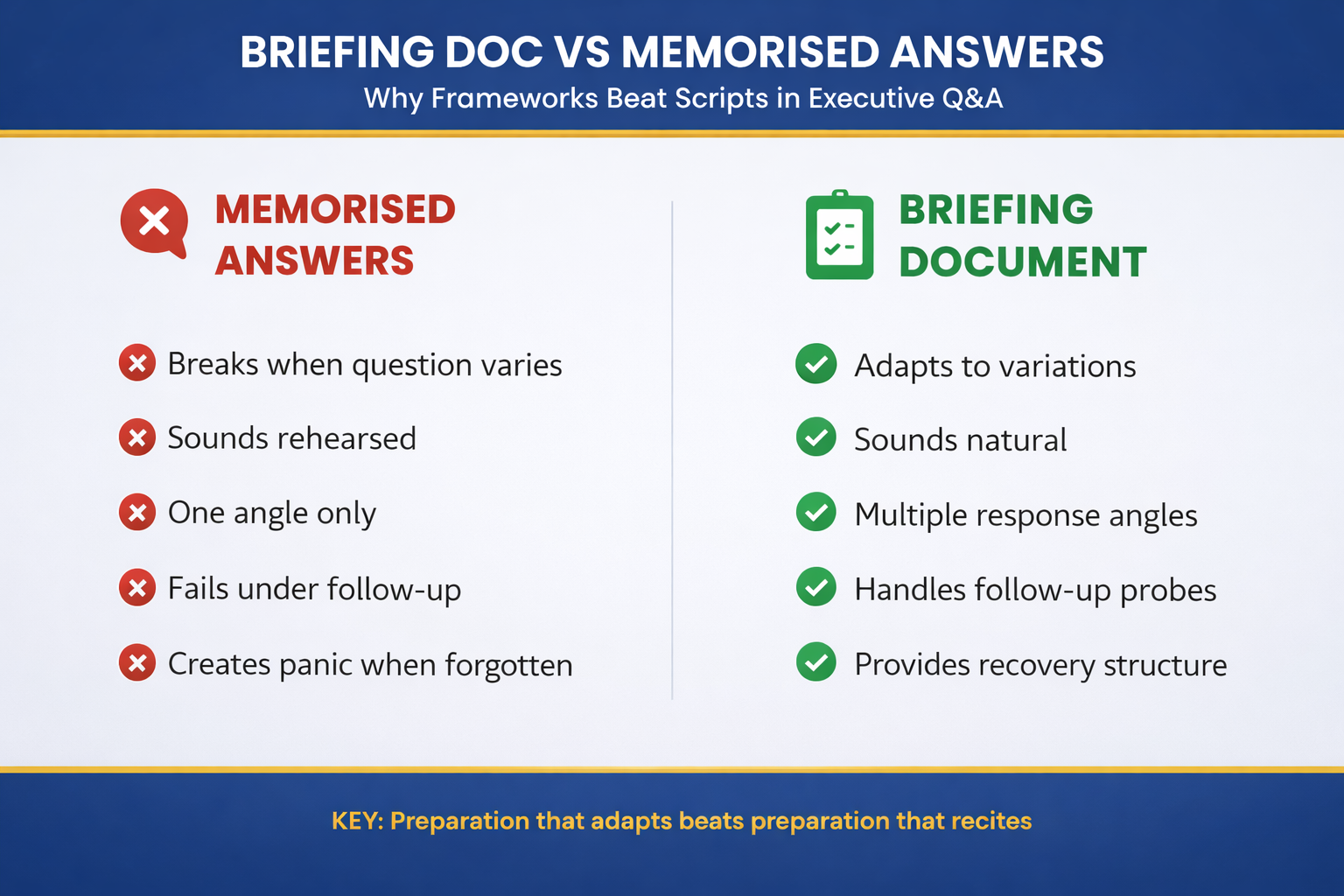
Briefing Doc vs Memorised Answers comparison infographic showing why frameworks beat scripts in executive Q&A: memorised answers break under variation while briefing documents adapt and provide recovery structure

Eliminate the Dread of Unprepared Q&A

  • Stop winging it. Start with a documented, structured approach that removes the panic from high-stakes Q&A.
  • Walk into your next presentation knowing you’ve prepared for the questions that matter most—not just hoped they won’t come up.

Get the Executive Q&A Handling System → £39

Join 300+ executives who’ve transformed their Q&A preparation

The Difference Between a Briefing Doc and Memorised Answers

This distinction matters. It’s the difference between appearing prepared and actually being prepared.

Memorised answers are rigid. You prepare specific dialogue for specific questions. If the question comes out slightly differently than expected, you’re thrown off. Worse, you sound rehearsed. Your audience can hear the script.

Response frameworks are flexible. You’re not memorising words. You’re internalising a structure for thinking. When the question comes in a slightly different form, the framework still applies. When something unexpected gets asked, you can adapt your framework to address it.

Memorised answers fail under pressure. When your nervous system kicks in during a difficult moment, detailed memory retrieval is one of the first things that goes. You blank on word choice, phrasing, exact details. You start backtracking and clarifying, which makes you sound uncertain.

Response frameworks survive pressure. Frameworks are thinking patterns, not memory tasks. Even when you’re nervous, your brain can follow a sequence. “Acknowledge, explain, address the worst case, pivot” is a mental process, not dialogue to retrieve.

The briefing document supports frameworks, not scripts. It’s a reference tool that contains your key points, data, and bridge statements, but it trains you to think, not to recite.

That’s why executives who use briefing documents recover gracefully when challenged. They’re not searching their memory for a prepared answer. They’re following a thinking pattern they’ve internalised. It looks like presence and composure because it actually is.

The Executive Q&A Handling System teaches you the entire process: how to build a briefing document, how to develop response frameworks that work, and how to practice so it all feels natural.

Track C is specifically designed for executives facing career-defining presentations where the Q&A matters as much as the slides.

Get the Executive Q&A Handling System → £39

Is the Q&A Briefing Document Right for You?

A briefing document approach makes sense when the stakes are real. When you’re presenting to a board, to investors, to a sceptical audience, when one weak answer could undermine your entire presentation.

If you’re giving an internal update to your team, you probably don’t need this level of preparation. But if you’re a finance director presenting new strategy, a COO defending an operational change, a CEO pitching to the board, or any executive where the Q&A could be career-defining—yes. This is exactly for you.

Your nervous system doesn’t distinguish between “this is important” and “this could be career-changing.” It just knows you’re about to be questioned. A well-constructed briefing document tells your nervous system: you’re prepared. Which means your conscious mind can stay present instead of panicking.

24 Years of Boardroom Q&A, Distilled Into System

  • The exact five-section structure that executives use to prepare for the highest-stakes presentations
  • How to identify which questions will actually determine whether your audience trusts you
  • Response frameworks that work regardless of which variation of a question gets asked
  • The psychology of staying composed when challenged—and how a briefing document rewires that response
  • Real templates and examples you can adapt for your specific presentation, role, and audience

Get the Executive Q&A Handling System → £39

The same system used by board members, CFOs, and executives preparing for career-defining Q&A

Frequently Asked Questions About Q&A Briefing Documents

How long should a Q&A briefing document be?

Most effective briefing documents are 4-8 pages. Long enough to be comprehensive, short enough that you can scan it quickly. It’s not a white paper—it’s a working reference. If you need 20 pages, you’re documenting too much. Simplify to the core frameworks and key points.

Should I bring the briefing document to the presentation itself?

Depends on the format. If you’re seated at a table, it’s fine to have it in front of you (though you’ll rarely need to reference it if you’ve prepared well). If you’re standing and presenting, you’re probably not referencing it live. The real value is the preparation process. You’ve internalised the structure. The document stays with you mentally, not physically.

What if they ask something that isn’t in my predicted questions?

That’s the point of frameworks. Your response frameworks teach you how to think, not just how to answer specific questions. When something unexpected gets asked, you fall back on the framework. Acknowledge, think, respond—the structure holds you even when the specific question wasn’t predicted. That’s what Sarah did in the boardroom. The question wasn’t on her list, but her framework was strong enough to carry her.

How much time does building a briefing document take?

First time: 4-6 hours. You’re thinking through audience concerns, predicting questions, building frameworks from scratch. Once you’ve done it once, the second document takes 3-4 hours because you know the process. It’s focused work, not continuous. Most executives build it over a few days leading up to the presentation.

Get executive Q&A insights every week.

The Winning Edge newsletter delivers real strategies for the presentation moments that matter. Techniques, frameworks, psychology. Once a week, practical. No fluff.

Subscribe to The Winning Edge

Also grab the CFO Questions Cheatsheet—the 12 questions every finance executive should be ready to answer. Download free: CFO Questions Cheatsheet

Explore related articles in Q&A Mastery:

About the Author

Mary Beth Hazeldine has spent 24 years helping executives and boards navigate high-stakes presentations and Q&A. She’s worked with finance directors, CEOs, board members, and leaders facing career-defining moments. She created the Executive Q&A Handling System after realising that most executives prepare for Q&A backwards—hoping questions won’t come instead of systematically preparing for them. Now she teaches the preparation framework that separates executives who panic from those who handle anything the board throws at them.

Next step: If you have a high-stakes presentation coming up, start building your briefing document this week. Spend 30 minutes mapping your audience’s concerns. That alone will change how you approach the Q&A. Then, if you want the complete system, the Executive Q&A Handling System walks you through every section and teaches you the frameworks that work under real boardroom pressure.

01 Mar 2026
Executive preparation desk with structured Q&A checklist and stakeholder notes

The Q&A Preparation Checklist Senior Executives Use

One question. Eleven words. £4 million gone. He hadn’t prepared for it.

A CFO looked at slide 38 of a proposal presentation and asked a question so simple it shouldn’t have been difficult: “What happens to the timeline if procurement takes 12 weeks?” The presenter — a senior director who’d spent two weeks building the deck — didn’t have an answer. The room went quiet. The deal was deferred. It never came back.

The question wasn’t obscure. It wasn’t hostile. It was entirely predictable. And that’s the point: most Q&A failures aren’t caused by impossible questions. They’re caused by predictable questions that nobody prepared for.

Quick Answer: Senior executives prepare for Q&A using a structured checklist that covers five categories: decision questions, financial questions, risk questions, stakeholder questions, and timeline questions. By preparing answers in these five areas, you can anticipate the majority of questions before they’re asked — and walk into Q&A with confidence instead of dread.

🚨 High-stakes Q&A session coming up this week?

Quick diagnostic — can you answer these right now?

  • What’s the one question that would derail your recommendation?
  • Which stakeholder in the room is most likely to challenge you — and on what point?
  • If someone asks “what happens if this fails?” — do you have a specific answer?

→ Need the complete Q&A preparation system? Get the Executive Q&A Handling System (£39)

I worked with a VP at a technology company who was preparing for a budget review with the executive committee. She’d built a strong deck. Her numbers were solid. Her recommendation was clear.

But when I asked her what questions she expected, she said: “I don’t know. That’s what scares me.”

We spent 45 minutes building a question map — categorising every likely question by stakeholder, topic, and intent. By the end, she had prepared answers for 14 specific questions. In the actual meeting, 11 of them came up almost exactly as we’d predicted.

She didn’t need to be smarter. She needed a system.

That system is what I’m sharing here.

Executive reviewing preparation notes at a desk with a structured checklist document

Why Most Q&A Preparation Fails (The “Think of Everything” Trap)

Most professionals prepare for Q&A by trying to anticipate every possible question. They brainstorm a list of 30-40 questions, write rough answers for half of them, and hope for the best.

This doesn’t work for three reasons.

First, it creates false confidence. Having a long list feels like preparation. But if the questions aren’t organised by category, you can’t spot the gaps. You end up over-prepared for easy questions and under-prepared for the ones that actually matter.

Second, it overwhelms working memory. In the moment, you can’t search through 30 prepared answers. You need a mental framework that tells you which category a question belongs to — so you can retrieve the right response structure, even if you haven’t prepared for that exact question.

Third, it ignores the questioner. The same question from the CFO and the Head of Operations means different things. “What’s the ROI?” from Finance means “show me the numbers.” “What’s the ROI?” from Operations means “is this worth the disruption to my team?” Same words. Different answers needed.

The checklist below solves all three problems. It organises preparation by category, limits the total number of prepared answers to a manageable set, and maps questions to the people most likely to ask them.

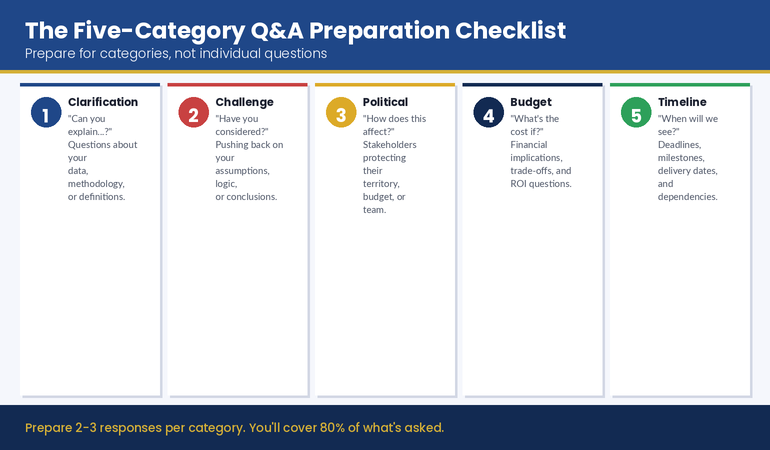
The Five-Category Q&A Preparation Checklist

Every executive Q&A question falls into one of five categories. Prepare two strong answers in each category, and you’ll walk in ready for the majority of what’s coming.

Category 1: Decision Questions

“Why this? Why now? Why not the alternative?” These are the questions that test your recommendation. Your answers need to include the specific trigger (why now), the comparison (why this option over others), and the cost of delay (what happens if they say no).

Category 2: Financial Questions

“What’s the total cost? What’s the payback period? What’s the impact on this quarter’s numbers?” Financial questions come in two varieties: the headline number and the hidden cost. Prepare for both. Know the total budget. Know the phasing. Know what’s not included.

Category 3: Risk Questions

“What could go wrong? What’s your contingency? What’s the worst-case scenario?” Risk questions test whether you’ve thought beyond the optimistic path. The best answers name a specific risk, a specific mitigation, and a specific trigger that would activate the contingency plan.

Category 4: Stakeholder Questions

“Who else has signed off on this? Does the CFO agree? What does the Head of [X] think?” These questions test alignment. If you haven’t consulted key stakeholders, say so honestly — but explain what you’ve done and what’s planned. “I’ve briefed the CFO’s team; formal sign-off is scheduled for Thursday” is infinitely better than “I haven’t spoken to Finance yet.”

Category 5: Timeline and Implementation Questions

“When does this start? What are the milestones? What resources do you need from us?” Timeline questions are the most commonly under-prepared category. Know your key dates. Know the dependencies. Know which milestones require board-level updates.

Infographic showing the five-category Q&A preparation checklist covering clarification, challenge, political, budget, and timeline questions

Walk Into Q&A Knowing What’s Coming

The Executive Q&A Handling System gives you the complete preparation framework — so you predict the questions before they’re asked, not after.

  • The five-category question prediction system used by senior executives at global companies
  • Stakeholder-question mapping templates — know who asks what, and why
  • Response frameworks for the six most common Q&A traps (hostile questions, compound questions, “I don’t know” moments)
  • Rehearsal protocols that build delivery confidence, not just content knowledge

Get the Executive Q&A Handling System → £39

Built from 24 years of executive Q&A across boardrooms at JPMorgan, PwC, RBS, and Commerzbank.

The Stakeholder-Question Matrix (Who Asks What — And Why)

The most effective Q&A preparation doesn’t just predict what will be asked. It predicts who will ask it — and what they’re really testing.

Here’s the pattern I’ve seen across hundreds of executive Q&A sessions:

The CFO asks financial questions. But not the ones you expect. They rarely ask about the headline number (they’ve read the pre-read). They ask about the assumptions beneath it. “What happens to the ROI if adoption is 60% instead of 80%?” Prepare for the sensitivity analysis, not the summary.

The COO asks operational questions. They want to know about disruption, dependencies, and resource requirements. “Which teams are affected?” and “What does this do to Q3 deliverables?” are their standard openings.

The CEO asks strategic questions. They’re less interested in detail and more interested in fit. “How does this align with the three-year plan?” and “What happens to this if we pivot on [strategy X]?” Prepare for the strategic context, not just the project detail.

The board chair asks governance questions. “Is there a conflict of interest?” “Has legal reviewed this?” “What’s the reporting cadence?” These are process questions, not content questions. Have the governance answers ready.

Before your next presentation, write each attendee’s name on a card. Under each name, write the two questions they’re most likely to ask based on their role and priorities. Then prepare your answers. This takes 20 minutes and transforms your readiness.

Want the stakeholder-question mapping template ready to fill in?

The Executive Q&A Handling System includes the complete stakeholder mapping framework — pre-built for board, executive committee, and client presentations.

Get the Executive Q&A Handling System → £39

How to Rehearse for Q&A (Not Just Answers — Delivery)

Knowing the answer and delivering it well are different skills. Here’s the rehearsal method I recommend:

Step 1: Write your top 10 predicted questions. Two per category. Write the full question as the stakeholder would phrase it.

Step 2: Write your answer in two sentences maximum. If you can’t answer a board-level question in two sentences, you don’t understand it well enough. The detail comes in the follow-up — the initial response must be concise.

Step 3: Say your answers out loud. Not in your head. Out loud. The first time you speak an answer aloud should not be in front of the board. Written answers sound different from spoken answers. You’ll find that some written responses feel stilted when you actually say them.

Step 4: Practise the “bridge.” After your two-sentence answer, practise bridging to your key message. “The short answer is [X]. The important thing to note is [bridge to your strategic point].” This technique ensures that even challenging questions serve your narrative rather than derailing it.

Step 5: Practise the pause. When you hear a question, pause for two seconds before responding. This isn’t hesitation — it’s composure. It signals that you’re considering the question seriously, not reacting defensively. In practice, most nervous presenters answer too quickly. The pause is a trust signal.

Structured preparation document with question categories and stakeholder mapping grid

Presenting to a board or executive committee soon?

Today’s partner article covers the exact structure for your first board presentation as a new director — including the five questions every board asks.

When You Don’t Know: The Response Framework That Protects Credibility

No amount of preparation covers every question. There will be moments when you genuinely don’t know the answer. What matters is how you handle them.

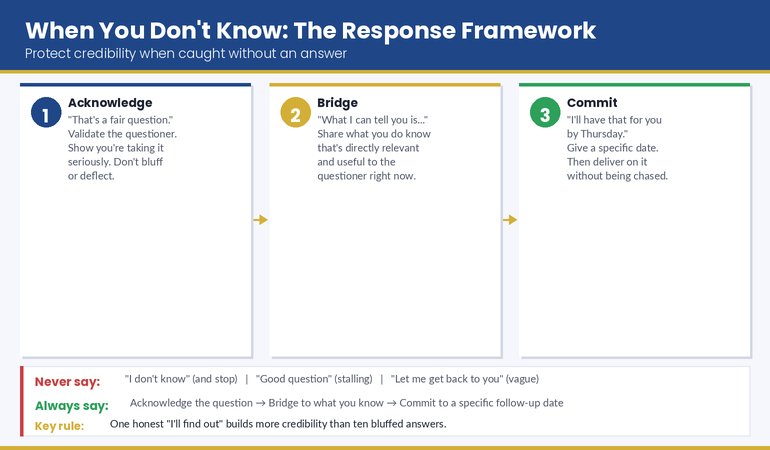
The credibility-preserving response has three parts:

Acknowledge: “That’s a fair question, and I don’t have the exact figure in front of me.” Don’t waffle. Don’t guess. Don’t hedge with “I think it’s roughly around…”

Commit: “I’ll confirm the number and send it to you by end of day.” Be specific about when and how you’ll follow up. Vague promises (“I’ll look into that”) signal that the question will be forgotten.

Bridge: “What I can tell you is [related information you do know].” This demonstrates that you understand the territory, even if you don’t have the specific data point. It prevents the silence from becoming an impression of incompetence.

Used well, this framework actually builds trust. Directors respect honesty over improvisation. What they don’t respect is guessing — because they can always tell. (For more on this, see what to say when you don’t know the answer.)

Infographic showing the acknowledge-bridge-commit response framework for when you don't know the answer

People Also Ask:

How many questions should you prepare for before a presentation?
Prepare for 10 specific questions: two per category (decision, financial, risk, stakeholder, timeline). This is manageable to rehearse and covers the majority of what you’ll face. Add 2-3 wildcard questions specific to your topic for a total of 12-13 prepared answers.

How do you handle hostile questions in a presentation?
First, pause. A hostile question often sounds worse than it is. Second, restate the question neutrally — a technique I cover in executive questions as trust tests: “If I understand correctly, you’re asking whether…” This removes the hostility and gives you control of the framing. Third, answer the restated version. Most hostile questions are legitimate concerns wrapped in frustrated delivery.

What’s the difference between Q&A preparation and presentation rehearsal?
Presentation rehearsal is about perfecting your delivery of prepared content. Q&A preparation is about building the judgement and framework to respond to unprepared content. They require different skills. Rehearsal builds fluency. Q&A preparation builds adaptability. You need both.

Stop Walking Into Q&A Hoping for the Best

The Executive Q&A Handling System replaces hope with a system — the same structured approach used by executives who handle boardroom questions with visible confidence.

Get the Executive Q&A Handling System → £39

Used across board meetings, executive committees, and client presentations at global financial institutions.

Is the Executive Q&A Handling System Right For You?

This is for you if:

  • You present to boards, executive committees, or senior stakeholders and the Q&A is the part you dread most
  • You’ve been caught off guard by a question in a meeting and it affected the outcome
  • You want a systematic way to predict and prepare for questions rather than hoping for the best
  • You need the stakeholder-question mapping templates, response frameworks, and rehearsal protocols ready to use

This is NOT for you if:

  • You present to small team meetings where Q&A is informal and low-stakes
  • Your challenge is the presentation itself, not the questions after (consider the Executive Slide System instead)
  • Your primary issue is anxiety rather than preparation (consider Conquer Speaking Fear for nervous system regulation)

24 Years of Executive Q&A. Now a System You Can Use.

The Executive Q&A Handling System was built from real boardroom Q&A sessions at JPMorgan Chase, PwC, Royal Bank of Scotland, and Commerzbank. Every framework reflects how senior executives actually prepare — not how training courses say they should.

  • The five-category question prediction checklist (decision, financial, risk, stakeholder, timeline)
  • Stakeholder-question mapping templates for board, ExCo, and client presentations
  • Response frameworks for hostile questions, compound questions, and “don’t know” moments
  • The rehearsal protocol that builds delivery confidence in under 30 minutes

Get the Executive Q&A Handling System → £39

Walk into Q&A knowing what’s coming. Trusted by thousands of executives across banking, consulting, and corporate finance.

Frequently Asked Questions

How far in advance should I start preparing for Q&A?

Start Q&A preparation at least three days before the presentation — ideally at the same time you begin building your slides. Many presenters treat Q&A as an afterthought, spending days on the deck and 30 minutes on Q&A prep. Invert the ratio: spend as much time on Q&A preparation as you do on the slides themselves. The presentation gets you to the table. The Q&A determines the outcome.

Should I prepare written answers or just bullet points?

Write the first sentence of each answer in full — this is your opening response and needs to be crisp. After that, bullet points are sufficient. The first sentence is what you’ll deliver under pressure, so it needs to be rehearsed. The supporting detail can be more loosely prepared, as you’ll adapt it based on the follow-up questions.

What if the same person keeps asking follow-up questions?

Persistent questioning usually signals that your initial answer didn’t address the questioner’s real concern. After the second follow-up, try: “I want to make sure I’m answering the right question — is your concern specifically about [X]?” This resets the exchange and often reveals what they’re actually testing. Once you identify the real concern, you can address it directly rather than circling around it.

📬 The Winning Edge Newsletter

Weekly boardroom-tested techniques for executives who present under pressure. Q&A strategies, slide structures, and confidence techniques. One actionable insight every week.

Subscribe Free →

🆓 Want to start free? Download the CFO Questions Cheatsheet first.

Read next: If the presentation itself needs work before you worry about Q&A, read how to structure your first board presentation as a new director. And if it’s the nerves around Q&A that concern you most, see why even confident presenters still get nervous — it’s more universal than you think.

About the Author

Mary Beth Hazeldine is the Owner & Managing Director of Winning Presentations. With 24 years of corporate banking experience at JPMorgan Chase, PwC, Royal Bank of Scotland, and Commerzbank, she has delivered high-stakes presentations in boardrooms across three continents.

A qualified clinical hypnotherapist and NLP practitioner, Mary Beth combines executive communication expertise with evidence-based techniques for managing presentation anxiety. She has trained thousands of executives and supported presentations for high-stakes funding rounds and approvals.

Book a discovery call | View services

Your next Q&A is on the calendar. Twenty minutes of structured preparation — two questions per category, mapped to the people in the room — will transform how you walk into it.

Get the Executive Q&A Handling System (£39) and walk in knowing what they’ll ask before they ask it.

28 Feb 2026
Executive preparing for presentation Q&A at desk with laptop and data tablet in corporate office

Most Executives Don’t Prep for Q&A. Here’s the AI Workflow That Changes That in 10 Minutes.

She’d spent 14 hours on the deck. Every slide was polished. The data was bulletproof. The recommendation was clear. Then the CFO asked one question — “What happens to the margin if we delay by a quarter?” — and she froze. Not because she didn’t know the answer. Because she’d never thought about it. Fourteen hours on slides. Zero minutes on Q&A preparation.

Quick Answer: Most executives prepare extensively for their presentation and not at all for the Q&A that follows it. Yet Q&A is where decisions actually get made or killed. AI changes this equation dramatically: in 10 minutes, you can feed your presentation to ChatGPT or Claude, ask it to role-play as your toughest stakeholder, and generate 15-20 likely challenge questions with concise answers. The executives who do this have a structural advantage over everyone else in the room — because almost nobody does.

🚨 Presenting this week? Quick check: Can you name the three hardest questions your audience might ask? Can you answer each in under 15 seconds? If not, you’ve found your preparation gap — and AI can close it in 10 minutes.

→ Need the complete Q&A handling frameworks? Get the Executive Q&A Handling System (£39)

In 24 years of corporate banking — at JPMorgan, PwC, RBS, and Commerzbank — I never once saw a presentation succeed or fail because of the slides. The slides got people to the table. The Q&A determined whether they left with a yes or a “let’s revisit.”

But here’s what I also noticed: even the most senior executives spent almost all their preparation time on the deck and almost none on the questions that would follow it. It wasn’t laziness. It was that Q&A prep felt impossible — how do you prepare for questions you can’t predict?

That changed when AI became genuinely useful. I started asking clients to feed their presentations to ChatGPT or Claude before presenting, with a simple instruction: “You are a sceptical CFO reviewing this proposal. What are your top 10 concerns?” The quality of the questions was startling. Not perfect — but 70-80% overlap with what actually got asked.

Now I recommend this to every executive I work with. It takes 10 minutes. It costs nothing. And it gives you the one advantage that almost nobody in the room has: you’ve already rehearsed the hard questions.

The Q&A Preparation Gap: Why Smart Executives Get Caught Off Guard

How do executives prepare for tough questions? The honest answer, from two decades of watching them: most don’t. They prepare the presentation. They rehearse the delivery. They might anticipate one or two obvious questions. But systematic Q&A preparation — the kind where you map every likely question, draft concise answers, and stress-test for follow-ups — almost never happens.

There’s a structural reason for this. Slide preparation feels productive. You can see the deck taking shape. You can measure progress. Q&A preparation feels abstract and unbounded — there are infinite possible questions, so where do you even start?

This is exactly where AI changes the equation. AI can’t predict every question. But it can do something humans struggle with: it can systematically assume different perspectives and generate questions from each one. A sceptical CFO asks different questions than a supportive COO. A technical architect challenges different assumptions than a commercial director. AI can role-play all of them in minutes.

The result isn’t perfect prediction. It’s coverage. Instead of walking in having thought about 2-3 obvious questions, you walk in having considered 15-20 questions across multiple stakeholder perspectives. That’s the difference between hoping you won’t be caught off guard and knowing you’re prepared for most of what’s coming.

If you’re new to predicting questions systematically, the Question Map method gives you the manual framework. What this article adds is the AI acceleration layer that makes it practical even when you’re short on time.

The 10-Minute AI Q&A Preparation Workflow

This workflow works with ChatGPT, Claude, Copilot, or any capable AI assistant. The principle is the same across tools — you’re using AI as a sceptical audience simulator.

Step 1: Feed it your context (2 minutes). You don’t need to upload your entire deck. Give the AI a brief: “I’m presenting a proposal to [audience] requesting [decision]. The key points are [3-4 bullet points]. The budget is [amount]. The timeline is [duration].” The more specific you are about the audience and the ask, the better the questions will be.

Step 2: Assign a stakeholder role (1 minute). This is the step most people skip, and it’s the one that transforms the output. Don’t just ask “What questions might they ask?” Instead: “You are a sceptical CFO who has seen three similar proposals fail. What are your top concerns about this proposal?” The role-play instruction generates questions that sound like the people in your actual room.

Step 3: Generate questions by role (3 minutes). Run the prompt for 2-3 different stakeholder types. The CFO asks about cost and ROI. The COO asks about implementation and resources. The CTO asks about technical feasibility. Each role generates 5-7 unique questions, giving you 15-20 total.

Step 4: Draft 15-second answers (3 minutes). For each question, ask the AI to help you draft a concise answer using your actual data. “Draft a 2-sentence answer to this CFO question using these facts: [your data].” The 15-second constraint is critical — long answers in Q&A signal uncertainty. Short, structured answers signal confidence.

Step 5: Stress-test with follow-ups (1 minute). Pick the 3 hardest questions and ask the AI: “If I gave this answer, what would the follow-up question be?” This catches the second-level challenges that most people are completely unprepared for.

The AI Q&A preparation workflow showing five steps: feed AI your deck, assign stakeholder roles, generate challenge questions, draft 15-second answers, and stress-test with follow-ups

Walk Into Q&A Having Already Rehearsed the Hard Questions

AI generates the questions. The Executive Q&A Handling System gives you the frameworks for answering them — so every response sounds confident, concise, and credible:

  • The structured response frameworks that turn any question into a 15-second confident answer — including the PREP, Bridge, and Redirect techniques
  • Stakeholder-specific question banks — the actual questions CFOs, COOs, and board members ask, mapped by scenario
  • The follow-up question defence — how to handle “but what about…” without losing composure
  • Recovery scripts for the questions you genuinely didn’t anticipate

Get the Executive Q&A Handling System → £39

Built from thousands of executive Q&A sessions across global banking and consulting — including the questions that derail proposals and the answers that save them.

The Role-Play Prompts That Generate Real Questions (Not Generic Ones)

The quality of AI-generated questions depends entirely on how you prompt. “What questions might be asked about this proposal?” gives you generic questions. Role-play prompting gives you questions that sound like they’re coming from the actual person who’ll be in the room.

Here are the prompt structures that consistently produce the most realistic questions:

The Sceptical Finance Prompt: “You are the CFO of a £500M company. You’ve seen proposals like this before and most have underdelivered on ROI. You are friendly but rigorous. Review this proposal and give me your top 7 concerns, phrased as questions you would ask in the meeting.”

The Political Challenger Prompt: “You are a senior VP whose own project competes for the same budget as this proposal. You need to look supportive in public but you want this proposal deferred. What questions would you ask that sound reasonable but are designed to create doubt?”

The Technically Sceptical Prompt: “You are the CTO. You’ve been burned by projects with unrealistic technical timelines. You want to support innovation but you won’t approve anything that your team can’t actually deliver. What are your concerns?”

Can ChatGPT help with presentation questions? Absolutely — and it’s most useful when you give it a specific persona rather than asking for generic questions. The persona instruction forces the AI to generate questions from a particular perspective, which is far more realistic than a neutral “what might they ask?” approach.

The political challenger prompt is the one most executives never think to use — but it generates the most dangerous questions. The ones that sound supportive on the surface but are designed to stall your proposal. If you understand why executives ask questions they already know the answer to, you’ll recognise these patterns immediately.

AI generates the questions, but you need frameworks for answering them under pressure. The Executive Q&A Handling System gives you the response structures that work when you’re standing in front of the room and need to sound confident in 15 seconds.

Drafting 15-Second Answers: The Structure That Sounds Confident

Here’s a pattern I’ve observed across thousands of executive Q&A sessions: the length of your answer is inversely correlated with how confident you sound. Short, structured answers signal “I’ve thought about this.” Long, wandering answers signal “I’m figuring this out as I speak.”

The 15-second answer structure is: Position → Evidence → Implication.

Position: A one-sentence direct answer. “Yes, the margin impact is approximately 3% in Q1, recovering to baseline by Q3.”

Evidence: One supporting fact. “That’s based on the ramp-up cost curve we modelled using last year’s implementation data.”

Implication: One sentence connecting back to the decision. “The 12-month ROI is still 2.4x, which is above our threshold.”

That’s a complete answer in three sentences. Under 15 seconds. The questioner feels heard, the room feels informed, and you sound like someone who has done the work.

Where AI helps: after generating your list of likely questions, ask the AI to draft a Position-Evidence-Implication answer for each one using your actual data. Then review and adjust for accuracy. You’re not reading these answers verbatim in the meeting — you’re rehearsing the structure so it comes naturally when you’re under pressure.

For more on what happens when Q&A goes wrong and how to recover, see the 4-part executive system for handling difficult questions.

The Stress-Test: Follow-Up Questions That Break Weak Answers

The first question rarely kills a proposal. It’s the follow-up that does. The CFO asks about margin impact — you answer well. Then she asks: “And what happens to that margin if adoption is 30% below your projection?” That’s where unprepared presenters crumble.

AI is exceptionally good at generating follow-up questions because you can give it your answer and ask: “What would a sceptical questioner say next?”

Here’s the stress-test workflow:

Pick your 3-5 hardest questions from the role-play exercise. These are the ones where your answer feels weakest or where the data is softest.

Give the AI your draft answer and ask: “I gave this answer to a sceptical CFO. What is her next question?” The AI will typically probe the weakest assumption in your answer.

Prepare a second-level answer for each follow-up. If you can survive two rounds of questioning on your hardest topics, you can survive the actual Q&A. Most challenges don’t go deeper than two levels.

How do you use AI to prepare for presentation Q&A? Use it as a role-playing partner. Feed it your presentation context, assign it stakeholder roles, generate questions, draft structured answers, then stress-test the weakest ones with follow-up prompts. The entire process takes 10-15 minutes and covers more ground than hours of solo preparation.

The AI generates the questions and helps draft answers. The Executive Q&A Handling System gives you the proven frameworks for when you’re in the room and need to respond with confidence — including recovery techniques for the questions AI didn’t predict.

Stop Dreading the Questions More Than the Presentation

The presentation is the easy part — you control the content. Q&A is where proposals live or die. The Executive Q&A Handling System gives you control of Q&A too:

  • Structured response frameworks — PREP, Bridge, and Redirect techniques that make any answer sound confident and concise
  • The follow-up defence system — how to handle persistent questioning without losing composure or credibility
  • Stakeholder question banks — the actual patterns CFOs, board members, and sceptical executives use when they challenge proposals
  • Recovery scripts for genuinely unexpected questions — so you never freeze, even when caught off guard

Get the Executive Q&A Handling System → £39

Created by a presentation specialist who has coached thousands of executives through the Q&A moments that decide careers and budgets.

Why Q&A Prep Is the Fastest Competitive Advantage in Any Room

Think about the last meeting where someone got asked a hard question and answered it immediately, calmly, with specific data. How did that person look? Prepared. Credible. In command of the material. Now think about the last time someone stumbled — paused too long, gave a vague answer, or said “I’ll get back to you on that.” How did that land?

The difference between those two outcomes is almost never intelligence or expertise. It’s preparation. And what makes Q&A prep such a powerful advantage is that hardly anyone does it. Your colleagues are spending hours perfecting slides that everyone will forget. You’re spending 10 minutes preparing for the questions that will determine the outcome.

In banking, I watched this dynamic play out hundreds of times. Two equally qualified directors presenting to the same committee. One had anticipated the CFO’s margin question. One hadn’t. The one who had prepared didn’t just answer the question — she revealed that she’d modelled three scenarios. That single moment of preparation changed the committee’s confidence in her entire proposal.

AI makes this preparation accessible to everyone. You don’t need a coach or a colleague willing to role-play as a hostile questioner. You need 10 minutes and a prompt. The question is whether you’ll use those 10 minutes — because most of your competitors won’t.

Is the Executive Q&A Handling System Right for You?

This is for you if:

  • You prepare thoroughly for presentations but rarely prepare for Q&A — and you know it’s a gap
  • You’ve been caught off guard by a question that derailed your proposal or killed your confidence
  • You present to senior executives, board members, or finance leaders who ask challenging questions
  • You want structured frameworks for answering ANY question confidently, not just the ones AI predicts

This is NOT for you if:

  • You’re looking for AI prompt templates (this article covers that — the product covers the answering frameworks)
  • You never face Q&A in your presentations
  • You already have a systematic Q&A preparation process you’re happy with

From 24 Years of Executive Q&A at JPMorgan, PwC, RBS, and Commerzbank. Now a System You Can Use Before Every Presentation.

I’ve watched Q&A sessions save proposals and destroy them. The Executive Q&A Handling System is built from the patterns that separate the executives who command the room from the ones who lose it:

  • Every response framework, stakeholder question bank, and recovery technique — refined from thousands of real executive presentations
  • The answer structures that consistently sound confident under pressure
  • Works alongside the AI preparation workflow in this article — AI predicts the questions, the system gives you the frameworks for answering them

Get the Executive Q&A Handling System → £39

Instant download. Prepare for your next Q&A today.

Frequently Asked Questions

Which AI tool is best for Q&A preparation?

ChatGPT (GPT-4), Claude, and Copilot all work well for this. The key isn’t the tool — it’s the prompting technique. Role-play prompts with specific stakeholder personas produce significantly better questions than generic “what might they ask?” prompts. Use whichever AI tool you’re most comfortable with and focus on the quality of your instructions.

What if the AI generates questions nobody actually asks?

Expect about 70-80% relevance from well-prompted AI. The remaining 20-30% might be unlikely questions, but they’re rarely useless — they often reveal assumptions in your proposal you hadn’t examined. The point isn’t perfect prediction. It’s coverage. Even if 5 of your 20 generated questions never get asked, you’ve still prepared for 15 more questions than you would have otherwise.

How do I prepare for truly unexpected questions?

You can’t predict every question, but you can prepare a universal response structure. The Position-Evidence-Implication framework works for ANY question, even unexpected ones. If you’ve practised structured responses to 15 predicted questions, the muscle memory carries over to the unpredicted ones. You won’t have the perfect answer, but you’ll have the right structure — and that’s what sounds confident.

Does this work for technical Q&A or only executive-level questions?

The AI role-play approach works for any audience type. For technical Q&A, assign the AI a technical role: “You are a senior architect who has implemented three similar systems and two of them failed. What are your concerns about this technical approach?” The principle is identical — persona-based prompting generates more realistic questions than generic prompting, regardless of the domain.

The Winning Edge Newsletter

Weekly strategies for executive presentations that get decisions, approvals, and buy-in. Trusted by thousands of executives.

Subscribe free →

Optional free resource: CFO Questions Cheatsheet — the 10 questions finance leaders always ask, with structured response templates.

Also today: If your company is going through a restructure and you’re preparing to present your team’s case, read the reorg presentation structure that protects your department — then use the AI Q&A workflow above to prepare for leadership’s follow-up questions.

Your next presentation has a Q&A at the end. Your colleagues won’t prepare for it. You can — in 10 minutes. Use the AI workflow above to predict the questions, then use the frameworks to answer them with confidence.

→ Get the Executive Q&A Handling System (£39) and walk into your next Q&A fully prepared.

About the Author

Mary Beth Hazeldine is the Owner & Managing Director of Winning Presentations. With 24 years of corporate banking experience at JPMorgan Chase, PwC, Royal Bank of Scotland, and Commerzbank, she has delivered high-stakes presentations in boardrooms across three continents.

A qualified clinical hypnotherapist and NLP practitioner, Mary Beth combines executive communication expertise with evidence-based techniques for managing presentation anxiety. She has trained thousands of executives and supported presentations for high-stakes funding rounds and approvals.

Book a discovery call | View services

25 Feb 2026
Executive pausing with raised finger during boardroom Q&A, composing a structured response to a question he wasn't expecting, presentation screen visible behind him

When You Don’t Know the Answer: The 3 Responses That Save You in Executive Q&A

Quick Answer: When you don’t know the answer in a presentation, the worst response is a rambling attempt to fill the silence. The best response is one of three scripts: the Honest Redirect (“I don’t have that number — I’ll confirm by end of day”), the Bridge (“That’s an important question — here’s what the data does show”), or the Scope Shift (“That falls outside what we analysed, but here’s what’s relevant to today’s decision”). Each takes under 15 seconds and preserves your credibility completely.

If you’ve ever hit the “don’t know the answer” presentation moment in executive Q&A, these three scripts solve it fast.

⏰ Presenting in the Next 24 Hours?

☐ Memorise the 3 response scripts below — pick one as your default

☐ Pre-write one follow-up sentence you can paste after the meeting (“Following up from today — [data point] is…”)

☐ Write “I will send by ___” on your notes so you never miss a commitment made in Q&A

At JPMorgan, I was presenting a risk assessment to the credit committee — twelve senior people, two managing directors, one question that changed how I handle Q&A forever.

“What’s the correlation between the counterparty’s default probability and the sector exposure in our current portfolio?”

I didn’t know. I had the counterparty analysis. I had the sector exposure data. But I hadn’t calculated the correlation between the two. It wasn’t in my model.

My mind went blank. Twelve faces waiting. The silence felt like it lasted a minute — it was probably four seconds.

What I wanted to say: “I don’t know.” What I almost said: a rambling attempt to sound knowledgeable that would have made everything worse.

What I actually said: “I don’t have that specific correlation calculated. I’ll run it and have it to you by end of day. What I can tell you is the sector exposure is concentrated in three counterparties representing 68% of the book — which is the more immediate risk.”

The managing director nodded. “That’s the number I actually need. Send me the correlation when you have it.”

I’d admitted I didn’t know — and answered the question they actually cared about. My credibility went up, not down.

🚨 Presenting to leadership this week and dreading Q&A? The question you can’t answer isn’t the problem — not having a response script is.

→ Need the exact response frameworks? Get the Executive Q&A Handling System → £39

Why Going Blank in Q&A Destroys More Credibility Than a Wrong Answer

Here’s the counterintuitive truth about Q&A: a wrong answer delivered confidently is recoverable. Going blank is not.

When you give a wrong answer, you can correct it later — “I misspoke on the margin figure; it’s 23%, not 28%.” The room accepts this. You’re human. You corrected it. Trust maintained.

When you go blank — the visible freeze, the “um,” the rambling non-answer that everyone in the room recognises as a stall — something different happens. The room doesn’t just question your knowledge of that specific topic. They question your competence. “If they didn’t know this, what else don’t they know?”

This is why the stakes of not knowing the answer in a presentation feel so disproportionate. It’s not about one question. It’s about the credibility cascade — the room’s trust in everything you’ve already said starts to erode.

But here’s the thing: it’s not the not-knowing that causes the damage. It’s the response to not knowing. The right response actually builds credibility. The wrong response destroys it.

What should you say when you don’t know the answer in a presentation?

Use one of three scripts depending on the situation: the Honest Redirect (admit + commit + bridge), the Bridge (acknowledge + pivot to what you do know), or the Scope Shift (reframe the question within your presentation’s scope). Each takes under 15 seconds, each preserves credibility, and each gives the room a substantive response instead of silence. The key is having the script ready before Q&A begins — so you’re choosing a response, not searching for one.

The 3 Responses That Preserve Credibility

In 24 years of presenting in banking — and in training thousands of executives since — I’ve found that every “don’t know” moment falls into one of three categories. Each has a specific response that works. The scripts are short, specific, and designed to be memorised before you walk into the room.

For handling difficult questions in presentation Q&A, the 4-part response system (Headline → Reason → Proof → Close) works. But “don’t know” moments are a specific subset — and they need specific scripts.

Response 1: The Honest Redirect

When to use it: You genuinely don’t have the data, but you can get it.

The script: “I don’t have [specific data point] in front of me. I’ll [specific action] and have it to you by [specific time]. What I can tell you is [the related data point that IS relevant to their decision].”

Why it works: Three things happen in this response. First, you demonstrate honesty (which builds trust). Second, you commit to a specific follow-up (which demonstrates reliability). Third, you bridge to something you DO know that’s relevant (which demonstrates competence). The room gets honesty, a commitment, and a useful answer — all in under 15 seconds.

Example: “I don’t have the year-on-year comparison for Q3 specifically. I’ll pull it from the dashboard and send it to you by 3pm. What I can tell you is the Q3 absolute figure was £2.1M, which is above the threshold we set in the business case.”

Critical rule: The follow-up must happen. If you say “by end of day,” it arrives by end of day. If you say “by 3pm,” it arrives by 3pm. One missed follow-up after an “I don’t know” moment erases the credibility you preserved in the room.

⭐ Walk Into Q&A With Response Scripts Ready — Not Just Slides

The Executive Q&A Handling System gives you the complete framework for handling every type of question — including the ones you can’t answer. Pre-built response scripts, bridging phrases, and the Headline → Reason → Proof → Close structure that keeps you in control for 20-45 seconds per answer.

Your Q&A toolkit:

  • “I Don’t Know” response frameworks — three scripts for three situations, ready to memorise
  • Bridging phrases — exact language for pivoting from unknown to known
  • Question forecasting framework — predict 80% of questions before you walk in
  • 7 question type handlers — ROI, Risk, Trade-off, Timing, Capability, Evidence, Political

Get the Executive Q&A Handling System → £39

Built from 24 years of high-stakes executive Q&A in banking and consulting environments.

Response 2: The Bridge

When to use it: You don’t have the specific answer they asked for, but you have related information that addresses their underlying concern.

The script: “That’s an important question. The specific [metric/data/detail] isn’t in this analysis, but what the data does show is [the related finding that addresses the concern behind their question].”

Why it works: Most questions aren’t about the literal data point. They’re about the concern the data point represents. When the CFO asks “What’s the ROI timeline?” they’re really asking “Is this a safe investment?” If you don’t have the exact ROI timeline but you have the payback period, the cost savings, or the comparable benchmark — that answers the real question.

Example: “The specific ROI timeline isn’t calculated in this model. What the data does show is a payback period of 14 months at current volumes, which compares to an 18-month average for similar implementations in the sector.”

When NOT to use it: Don’t bridge when the specific data point is clearly what they need and nothing else will do. If the CFO asks “What’s the exact spend to date?” and you don’t know, that’s an Honest Redirect, not a Bridge. Bridging away from a number they genuinely need reads as evasion.

Response 3: The Scope Shift

When to use it: The question falls outside the scope of your presentation — they’re asking about something you weren’t tasked with analysing.

The script: “That falls outside the scope of this analysis — we focused specifically on [your scope]. But the relevant finding for today’s decision is [the data point that connects their question to the decision at hand].”

Why it works: It sets a boundary without sounding defensive, and it redirects to the decision the room is there to make. Not every question needs an answer — some need a scope clarification.

Example: “The competitive analysis falls outside this review — we focused on internal process efficiency. But the relevant finding is that the current process costs £380K more than our internal benchmark, regardless of what competitors are doing.”

When NOT to use it: If the question IS relevant to the decision and you simply didn’t include it. In that case, use the Honest Redirect. Scope Shifting a legitimate question reads as deflection.

Knowing which response to use — and having the exact language ready before Q&A starts — is the difference between a 4-second freeze and a 15-second answer that builds credibility. The Executive Q&A Handling System includes all three scripts plus the bridging phrases that connect them. Get the Executive Q&A Handling System → £39

The 4 Responses That Make It Worse

“Great question.” This is a stall tactic that every executive recognises. The moment you say “great question,” the room knows you’re buying time. It adds nothing and signals that you’re struggling.

The ramble. Talking without direction in the hope that something relevant emerges. This is the most common response to not knowing — and the most damaging. Every second of unfocused talking erodes the structured credibility your presentation built.

“I think…” followed by a guess. If you’re guessing, the room is guessing too — about whether everything else in your presentation was also a guess. A confident “I don’t have that number” is worth ten uncertain “I think it’s roughly…”

The deflection. “That’s really more of a question for the finance team.” Unless it genuinely is outside your scope, redirecting to another team reads as finger-pointing. If you presented the data, you own the Q&A on that data.

For a comprehensive view of the common Q&A mistakes that destroy deals, see the full breakdown of executive Q&A errors.

Three response scripts for when you don't know the answer in a presentation showing Honest Redirect, Bridge, and Scope Shift with exact language

⭐ Stop Dreading the Question You Can’t Answer

The Executive Q&A Handling System was built for the 4-second moment when your mind goes blank and twelve faces are waiting. Pre-loaded response scripts, bridging language, and the Forecast → Build → Control → Protect framework that handles every question type.

Your “I don’t know” recovery toolkit:

  • Three “don’t know” response scripts — Honest Redirect, Bridge, and Scope Shift with exact language
  • Bridging phrase library — pivoting from unknown to known without sounding evasive
  • Executive response structure — Headline → Reason → Proof → Close for every answer type
  • Decision capture sheet — tracking commitments you make during Q&A so follow-ups happen

Get the Executive Q&A Handling System → £39

Built from 24 years of high-stakes executive Q&A — where “I don’t know” had to become an asset, not a liability.

The question forecasting framework in the Executive Q&A Handling System helps you predict 80% of questions before you present — which means fewer “don’t know” moments in the first place. Get the Executive Q&A Handling System → £39

How to Reduce “Don’t Know” Moments by 80%

The three response scripts handle the moment. But the best strategy is reducing how often that moment happens.

Most “don’t know” moments are predictable — because most executive questions fall into predictable patterns. In my experience, 80% of Q&A questions fall into four categories: challenge questions (questioning your data or assumptions), clarification questions (wanting more detail), scope creep questions (asking about things beyond your presentation), and political questions (testing your alignment with someone in the room).

Before any presentation, take 20 minutes and map the four question types against each major section of your deck. For each section, ask: “What would a sceptic challenge? What would need clarification? What adjacent topic might someone raise? What political angle could this trigger?”

Write two-sentence answers for the top five predicted questions. The ones you can’t answer in two sentences — those are your “don’t know” candidates. Now you can prepare for them specifically: either get the data, or pre-load the appropriate response script (Honest Redirect, Bridge, or Scope Shift).

Is This Right For You?

✓ This is for you if:

  • You’ve experienced the “blank mind” moment in Q&A and want it never to happen again
  • You want specific language to use when you don’t know the answer — not just “be honest”
  • You present to senior leadership and the stakes of fumbling a question are career-level

✗ This is NOT for you if:

  • Your presentations don’t include Q&A (rare in executive settings, but possible)
  • You’re looking for slide templates rather than Q&A frameworks (see the Executive Slide System)

⭐ The System I Built After Going Blank in Front of JPMorgan’s Credit Committee

That 4-second silence in front of twelve managing directors changed how I prepare for every Q&A. The Executive Q&A Handling System is the complete framework — question forecasting, response scripts, bridging phrases, and the 4-part structure that handles every question type in 20-45 seconds.

Inside:

  • Question forecasting framework — predict 80% of questions in 20 minutes
  • Three “don’t know” response scripts with exact language
  • 7 question type handlers — ROI, Risk, Trade-off, Timing, Capability, Evidence, Political
  • Executive response structure: Headline → Reason → Proof → Close
  • Decision capture sheet — never miss a follow-up commitment

Get the Executive Q&A Handling System → £39

Instant download. 30-day money-back guarantee. Used by executives, directors, and consultants who present to rooms where Q&A determines outcomes.

Frequently Asked Questions

Is it ever okay to say “I don’t know” in a presentation?

Yes — but never as a standalone answer. “I don’t know” followed by silence is a credibility killer. “I don’t have that specific figure — I’ll confirm by 3pm, and here’s what the data does show” is a credibility builder. The admission of not knowing isn’t the problem. The absence of a follow-up, a bridge, or a next step IS the problem. Executives respect honesty. They don’t respect uncertainty that offers nothing in return.

What if the question is deliberately hostile?

Hostile questions and “don’t know” moments require different responses. If someone is testing you or trying to expose a weakness publicly, the Bridge response works best — acknowledge the question, then pivot to the strongest data point you have. For hostile questions specifically, the Executive Q&A Handling System includes a full section on managing politically motivated questions. For a broader overview, see the guide to handling difficult questions in presentations.

How do I follow up after admitting I don’t know?

Same day, without exception. If you committed to “by end of day,” it arrives before close of business. The follow-up should be brief: “Following up from today’s presentation — the Q3 year-on-year comparison is 12.4%, in line with the trend I described. Let me know if you need any additional detail.” Short, specific, and it demonstrates that you were listening, that you committed, and that you delivered. This single follow-up repairs any credibility gap from the moment itself.

What if I genuinely have no related information to bridge to?

Use the Honest Redirect without the bridge. “I don’t have that data. I’ll get it to you by [specific time].” Then move to the next question. A clean, confident admission with a specific follow-up commitment is always better than a forced bridge to something irrelevant. The room can tell when you’re bridging to unrelated data, and it looks worse than a simple “I’ll get back to you.”

📬 The Winning Edge — Weekly Newsletter

One executive presentation insight per week. Real Q&A scenarios, real response scripts, no filler. Written for professionals who present to people who ask hard questions.

Subscribe Free →

Read next: Q&A is only half the battle. If the slides themselves need work, read The Sandwich Feedback Trap: Why It Fails When You Critique Up (And the Mirror Structure That Works).

Read next: If AI is helping you build slides but the structure isn’t landing, read AI Can Write Your Slides. It Can’t Structure Your Argument.

Your next Q&A is coming. The question you can’t answer is coming too. Get the response scripts that turn “I don’t know” from a career risk into a credibility moment.

About the Author

Mary Beth Hazeldine is the Owner & Managing Director of Winning Presentations. With 24 years of corporate banking experience at JPMorgan Chase, PwC, Royal Bank of Scotland, and Commerzbank, she has delivered high-stakes presentations in boardrooms across three continents.

A qualified clinical hypnotherapist and NLP practitioner, Mary Beth combines executive communication expertise with evidence-based techniques for managing presentation anxiety. She has trained thousands of executives and supported presentations for high-stakes funding rounds and approvals.

Read more articles at winningpresentations.com

22 Feb 2026

How to Predict 80% of Presentation Questions Before You Walk Into the Room

Quick answer: You can predict presentation questions systematically using the Question Map — a 20-minute preparation framework that maps four question types against each slide in your deck. Roughly 80% of Q&A questions fall into four predictable patterns: challenge, clarification, scope creep, and politics. When you map these against your content before presenting, you walk into Q&A knowing what’s coming instead of hoping for the best.

⚡ Presenting tomorrow? Here’s your 20-minute system to predict presentation questions:

Step 1: List each slide’s core claim. Step 2: Map the four question types (challenge, clarification, scope creep, politics) against each one. Step 3: Write two-sentence answers for the top 5 predicted questions. Step 4: Pre-load the two most dangerous questions into your slides so they’re answered before Q&A begins. Full framework below.

Walk Into Q&A Knowing What They’ll Ask — Before They Ask It

The Executive Q&A Handling System gives you the Question Map framework, prepared response structures for all four question types, and the bridging techniques that turn predicted questions into opportunities to reinforce your recommendation.

Get the Executive Q&A Handling System → £39

Built from 24 years of corporate experience in boardrooms, steering committees, and budget approval meetings.

The £2M Budget Lost Because Nobody Predicted the Obvious Question

A programme director I worked with at a major UK bank had spent three weeks preparing a budget approval deck. Twelve slides. Clear structure. Strong recommendation. The CFO was nodding through the presentation.

Then came the first question: “What happens to the Phase 2 timeline if the vendor misses the April milestone?”

It was entirely predictable. Anyone who’d mapped the four question types against his timeline slide would have flagged it in two minutes. But he hadn’t mapped anything. He’d spent three weeks on slides and zero time trying to predict presentation questions.

He stumbled through a vague answer about contingency plans. The CFO’s expression changed. A follow-up about contract protections — another vague answer. Within four minutes, the committee deferred the £2M approval to the next quarter.

After 24 years in corporate environments, this is the pattern I see constantly. Professionals spend days on slides and zero time predicting the questions those slides will trigger. The fix isn’t better answers under pressure — it’s better prediction before you enter the room.

The Four Question Types That Predict 80% of Q&A

After years of sitting in boardrooms, steering committees, and budget approval meetings, I’ve identified four question types that account for roughly 80% of all Q&A questions. Every audience asks some version of these — the only thing that changes is the specific topic. Once you know these patterns, you can predict presentation questions with surprising accuracy.

1. The Challenge Question. “Have you considered…?” / “What about…?” / “What if this fails?” These test your judgement. The questioner isn’t asking for information — they’re testing whether you’ve thought beyond your recommendation. If you’ve predicted it and have a prepared answer, you look thorough. If you haven’t, you look naïve.

2. The Clarification Question. “Can you walk me through the numbers on slide 4?” / “What exactly do you mean by…?” These aren’t hostile — they signal genuine interest. But if you can’t explain your own data clearly and quickly, you lose credibility just as fast as with a challenge question.

3. The Scope Creep Question. “Could this also apply to…?” / “What about the impact on the other project?” / “Have you spoken to [other department]?” These try to expand the decision beyond what you’re asking for. Without prediction and preparation, you get pulled into territory you haven’t analysed and start guessing — which is where “I’ll get back to you” lives.

4. The Politics Question. “Does [senior person] support this?” / “How does this align with the strategy we agreed last quarter?” These aren’t about your content — they’re about organisational alignment. They require preparation that goes beyond your slides into stakeholder mapping and political context.

If you’ve ever been caught off guard in Q&A, it was almost certainly one of these four types. The techniques for handling difficult questions in the moment help — but predicting them in advance is what separates executives who get decisions from those who get deferrals. Executive questions follow predictable patterns — which means they’re predictable before you present.

Question Map framework showing four question types mapped against presentation slides: challenge, clarification, scope creep, and politics questions

The Executive Q&A Handling System includes the Question Map template, prepared response structures for all four question types, and bridging techniques that turn predicted questions into credibility.

Get the Executive Q&A Handling System → £39

How to Build a Question Map and Predict Presentation Questions in 20 Minutes

The Question Map is a preparation exercise, not a document you present. It takes 20 minutes and predicts the majority of questions your audience will ask.

Step 1: List your slides (5 minutes). Write down each slide’s core claim or recommendation. Not the title — the actual point. “Slide 3: I’m recommending Vendor B over Vendor A.” “Slide 5: Budget is £480K over 18 months.” “Slide 7: Go-live date is September.”

Step 2: Map the four question types against each claim (10 minutes). For each slide’s core claim, ask yourself:

Challenge: “What’s the weakest part of this claim? What would a sceptic attack?” Clarification: “Which number or term might someone ask me to explain?” Scope creep: “What adjacent topic could this pull me into?” Politics: “Who might feel threatened by this, or who should I have consulted?”

You won’t have answers for every cell. That’s fine. The map reveals your blind spots — the three or four questions you don’t have answers for yet.

Step 3: Prepare your top 5 answers (5 minutes). From the map, identify the five most likely questions. Write a two-sentence answer for each. Not a script — just the core response so you don’t have to think on your feet.

The common executive Q&A mistakes almost all come from lack of prediction, not lack of intelligence. The Question Map fixes the prediction gap.

The Executive Q&A Handling System (£39) includes the Question Map template, prepared response structures, and bridging techniques for all four question types.

Pre-Loading: Address Predicted Questions Inside Your Slides

The most effective Q&A technique isn’t a response framework — it’s addressing predicted questions inside your presentation before they’re asked.

Once you’ve built your Question Map, identify the two or three most likely challenge questions. Then add one sentence in your presentation that pre-answers them. Not a full slide — just a line that neutralises the question before it’s raised.

Example: Your Question Map predicts the committee will ask “What if the vendor misses the April deadline?” Instead of waiting for Q&A, add one line to your timeline slide: “If the vendor misses April, we invoke clause 7.2 — the fallback adds three weeks, not three months. I’ve already agreed this with procurement.”

When the committee reaches Q&A, that question is already answered. They either skip it or say “You mentioned the fallback plan — can you expand?” which is a completely different conversation from being blindsided by a question you could have predicted.

Pre-loading looks like confidence. It looks like you’ve anticipated their concerns. It looks like executive-level preparation. In reality, it’s 20 minutes with the Question Map.

Pre-loading technique showing a question predicted in the Question Map being addressed inside the presentation before Q&A begins

The Executive Q&A Handling System (£39) includes the pre-loading technique, the Question Map template, and response structures for challenge, clarification, scope creep, and politics questions.

Common Questions About Predicting Presentation Questions

How do you predict what questions an audience will ask?

Roughly 80% of Q&A questions fall into four types: challenges to your judgement, requests for clarification on your data, attempts to expand scope beyond your recommendation, and political alignment questions. By mapping these four types against each slide in your presentation, you can predict the majority of questions before you walk into the room. The Question Map framework takes 20 minutes and reveals your blind spots before the audience does.

How do you prepare for questions after a presentation?

Build a Question Map: list each slide’s core claim, then map the four question types against each one. This reveals the three to five questions your audience is most likely to ask. Prepare two-sentence answers for each, and pre-load the most critical answers inside your presentation itself so they’re addressed before Q&A begins.

What should you do when you don’t know the answer to a Q&A question?

If a question genuinely falls outside your predictions, say “I don’t have that specific data with me, but I’ll confirm by [specific date] and send it to the group.” Then immediately bridge back to something you do know: “What I can tell you is…” One “I’ll get back to you” is fine. Three in the same Q&A session signals you didn’t predict well enough — which is what the Question Map prevents.

Predict What They’ll Ask. Walk In Prepared. Get the Decision.

The Executive Q&A Handling System gives you the Question Map, pre-loading techniques, response structures for all four question types, and bridging frameworks — so nothing in Q&A catches you off guard again.

Get the Executive Q&A Handling System → £39

Built from 24 years of corporate experience in boardrooms, steering committees, and executive approval meetings.

Frequently Asked Questions

How long does the Question Map take?

Twenty minutes. Five to list your slides’ core claims, ten to map the four question types against each claim, and five to prepare two-sentence answers for the top five predicted questions. Most professionals spend days on slides and zero minutes trying to predict presentation questions — twenty minutes changes the entire dynamic.

What if my audience asks something completely unexpected?

The Question Map predicts roughly 80% of questions. For the remaining 20%, the key is having a response structure rather than a specific answer. Acknowledge the question, bridge to what you do know, and commit to a specific follow-up date. One unexpected question handled well is fine. It’s the pattern of repeatedly being caught off guard that damages credibility — and the Question Map eliminates that pattern.

Should I predict different questions for different audiences?

Yes. The four question types remain the same, but the specific predicted questions change based on who’s in the room. A CFO will challenge your numbers. A COO will challenge your timeline. An HR director will ask about people impact. The Question Map should be rebuilt for each new audience, even if you’re presenting the same content — because different audiences ask different versions of the same four question types.

Get Weekly Presentation Intelligence

Q&A prediction frameworks, slide structures, and the executive communication strategies that work in real boardrooms — delivered every week.

Join the Newsletter

Related: If your slides need the same level of preparation as your Q&A, read I Audited a Real Executive Deck: 15 Slides Became 7 (Here’s What I Cut) — a full before/after deck transformation.

Your next step: Before your next presentation, spend 20 minutes building a Question Map. List your slides’ core claims, map the four question types against each one, and prepare answers for the top five. You’ll walk into Q&A knowing what’s coming — and that changes everything.

Want the complete Question Map template, pre-loading techniques, and response structures for every question type?

Get the Executive Q&A Handling System → £39

About the Author

Mary Beth Hazeldine is the Owner & Managing Director of Winning Presentations. With 24 years of corporate banking experience at JPMorgan Chase, PwC, Royal Bank of Scotland, and Commerzbank, she specialises in executive-level presentation skills and high-stakes Q&A preparation.

A qualified clinical hypnotherapist and NLP practitioner, Mary Beth combines executive communication expertise with evidence-based techniques. She has spent 15 years training executives for board presentations, steering committee approvals, and the Q&A sessions that follow them.

Read more articles at winningpresentations.com

18 Feb 2026
Executive woman standing and gesturing confidently while answering questions from colleagues seated around a boardroom table, demonstrating composed Q&A handling during a high-stakes presentation

5 Executive Q&A Mistakes I See Every Week — With the 15-Second Fixes

The presentation was fine. The five minutes of Q&A afterwards undid all of it.

Quick answer: After 24 years in corporate banking and consulting — and now coaching executives who present for a living — I see the same five Q&A mistakes every single week. Not from junior staff. From directors, VPs, and partners who present beautifully and then lose the room the moment questions start. Each mistake has a specific fix, and every fix follows the same structure: answer in 15 seconds using Headline → Reason → Proof, then stop talking. Below are the five mistakes, the real scenarios where I see them, and the exact rewrites that work.

At Commerzbank, I once watched a managing director lose a syndication deal during Q&A. Not because he didn’t know his numbers — he knew them cold. Because the lead investor asked a straightforward question about covenant flexibility, and instead of giving a 15-second answer, he gave a four-minute masterclass on covenant structures across European credit markets. By the time he finished, the investor had mentally moved on. The deal went to a competitor who answered the same question in two sentences.

I’ve now seen some version of that moment hundreds of times. Different industries, different stakes, same five patterns. The executives who win in Q&A aren’t smarter or better prepared. They’ve learned to answer the question that was asked — in 15 seconds — and then stop.

Mistake #1: The Knowledge Dump

What it looks like: Someone asks a focused question. The presenter answers the question — and then keeps going. They add context. Then caveats. Then the methodology behind the number. Then the alternative they considered. What started as a clear answer becomes a four-minute monologue that buries the actual point under layers of unnecessary detail.

Where I see it: Budget reviews. Quarterly updates. Any situation where the presenter has spent days preparing and unconsciously wants to demonstrate the depth of their preparation. The more homework you’ve done, the more tempting the knowledge dump becomes — which is why it’s disproportionately a problem for the most diligent presenters.

The real scenario: A VP at a technology firm presented a platform migration proposal. The CTO asked: “What’s the downtime risk during cutover?” The VP answered the question correctly in his first sentence (two hours, with a rollback plan). Then he spent three more minutes explaining the technical architecture of the rollback, the testing protocol, the vendor SLA, and two edge cases they’d modelled. The CTO had his answer in the first ten seconds. The next three minutes made him wonder what the VP was overcompensating for.

The 15-second fix:

Headline: “Maximum two hours, with a full rollback plan.”
Reason: “We’ve tested the rollback three times in staging — average recovery is 40 minutes.”
Proof: “The vendor SLA guarantees four-hour resolution, but our internal testing hasn’t exceeded ninety minutes.”
Then stop.

If the CTO wants the technical architecture, the testing protocol, or the edge cases — he’ll ask. And that follow-up question is a buying signal, not a threat. The knowledge dump kills buying signals because it answers questions nobody asked.

Stop Losing the Room After Slide 12

The Executive Q&A Handling System includes the Headline → Reason → Proof response framework, question mapping templates by stakeholder type, and the preparation system that means you walk into Q&A knowing what they’ll ask and exactly how you’ll answer. Built from real boardroom situations where Q&A decided whether budgets got approved and deals got funded.

Get the Executive Q&A Handling System → £39

Instant download. Question mapping + response frameworks + recovery scripts. Built from 24 years in banking and consulting where Q&A decided most major budgets, deals, and approvals.

Mistake #2: The Defensive Deflection

What it looks like: Someone asks a question that implies a weakness in the proposal. Instead of addressing the weakness, the presenter pivots to a strength. “What about the implementation risk?” gets answered with “Well, the ROI projections are very strong.” The question was about risk. The answer was about return. The panel notices.

Where I see it: Investment committees. Client pitches. Promotion panels. Any situation where the presenter feels their competence is being questioned — which activates a defensive instinct to redirect toward what they’re confident about. I’ve written extensively about this dynamic in the context of handling difficult presentation questions.

The real scenario: A programme director presented a change management initiative to the executive committee. A board member asked: “What’s the fallback if adoption rates don’t hit 60% in the first quarter?” The director answered: “Our stakeholder engagement plan is comprehensive — we’ve mapped every business unit and we have champions in each region.” That’s not a fallback plan. That’s a prevention plan. The board member asked what happens if it fails. The director told him why it won’t. Those are different conversations.

The 15-second fix:

Headline: “If adoption is below 60% at the end of Q1, we move to targeted intervention.”
Reason: “That means intensive support for the three lowest-adoption business units rather than broad engagement.”
Proof: “We used this approach on the last programme — pulled two units from 35% to 70% in six weeks.”
Then stop.

The fix answers the question that was asked (what’s the fallback), names it specifically (targeted intervention), and provides evidence it works (last programme). The board member now knows the presenter has thought about failure — which, paradoxically, increases their confidence in the plan succeeding.

PAA: Why do experienced presenters deflect tough questions?
Because the brain processes tough questions as threats before it processes them as requests for information. The amygdala fires before the prefrontal cortex engages, which means the first instinct is defensive — redirect to safe ground. This happens faster and more intensely the higher the stakes and the more senior the audience. The fix isn’t willpower (you can’t override the amygdala with intention). The fix is preparation: if you’ve already written a 15-second answer for the tough questions, your brain retrieves a structure instead of improvising a defence.


Table showing five executive Q&A mistakes — Knowledge Dump, Defensive Deflection, Premature Concession, Good Question Stall, and Unfinished Answer — with what it sounds like and what the room hears for each

Mistake #3: The Premature Concession

What it looks like: Someone challenges the recommendation, and the presenter immediately folds. “Have you considered doing this in two phases instead of three?” gets answered with “Yes, we could definitely do that. We could also look at a four-phase model. We’re flexible on the approach.” The presenter thinks they’re being collaborative. The panel hears: “I’m not committed to my own recommendation.”

Where I see it: Everywhere. This is the most common mistake among presenters who’ve been told to “read the room” and “be flexible.” They’ve overcorrected from rigid to spineless. The result is that the panel doesn’t know what the presenter actually recommends — and a committee that doesn’t know what you recommend will always defer the decision.

The real scenario: A finance director presented a restructuring proposal to the CEO and COO. The COO asked: “Could we achieve the same cost savings with voluntary redundancies only?” The finance director said: “That’s something we could explore. There are definitely scenarios where voluntary approaches work well.” The correct answer was no — the modelling showed voluntary-only achieved 40% of the target savings. But the finance director didn’t want to disagree with the COO directly. The result: the decision was deferred six weeks while they “explored” an option the finance director already knew wouldn’t work.

The 15-second fix:

Headline: “Voluntary-only achieves roughly 40% of the target savings.”
Reason: “The gap is in the operational restructuring, which requires role changes that voluntary programmes can’t address.”
Proof: “We modelled both scenarios — I can share the comparison if that would be helpful.”
Then stop.

This doesn’t dismiss the COO’s suggestion. It respects it by giving a factual answer with evidence. “I can share the comparison” invites further discussion without surrendering the recommendation. The presenter maintains their professional position while remaining genuinely flexible on the method.

📋 The Q&A Handling System includes question mapping templates that help you predict these challenges before the meeting — so you’ve already written the 15-second answer before the question lands.

Get the Executive Q&A Handling System → £39

Walk Into Q&A Knowing What They’ll Ask

The Executive Q&A Handling System gives you the question mapping method (predict 80% of questions before the meeting), the Headline → Reason → Proof response structure, “I don’t know” recovery scripts, and hostile question deflection techniques. Stop improvising. Start preparing the part that actually decides outcomes.

Get the Executive Q&A Handling System → £39

Instant download. Built from real boardroom, investment committee, and client pitch situations across 24 years in banking and consulting.

Mistake #4: The “Good Question” Stall

What it looks like: “That’s a great question.” Pause. Visible thinking. Then an answer that starts slowly and gains momentum — because the presenter was buying time to formulate a response. Everyone in the room knows it. The “good question” opener is the most widely recognised stall tactic in corporate communication, and using it signals exactly one thing: you weren’t prepared for that question.

Where I see it: Panel interviews. Board Q&A. Client discovery sessions. The more senior the audience, the more they notice it — because they’ve all used it themselves, and they know what it means. It’s the executive equivalent of “um.”

The real scenario: A head of strategy presented the annual plan to the investment committee. The chair asked: “What’s the biggest risk you haven’t addressed in this plan?” The head of strategy said: “That’s a really good question. Let me think about that.” Pause. “I think the biggest unaddressed risk is probably market volatility in Q3.” The answer was fine. The delivery — the stall, the visible improvisation, the “probably” — told the room he hadn’t considered unaddressed risks before being asked. For a head of strategy. That’s a credibility problem.

The 15-second fix:

Headline: “The biggest unaddressed risk is regulatory change in the APAC region.”
Reason: “We’ve modelled market volatility — that’s on slide nine. But the regulatory environment in Southeast Asia is moving faster than our planning cycle.”
Proof: “I’ve flagged this with the risk committee and we’re building a scenario analysis for Q2 review.”
Then stop.

No stall. No “good question.” Straight into the headline. The answer is honest (yes, there’s a risk I haven’t fully addressed), specific (regulatory change in APAC), and shows action (flagged with risk committee, scenario analysis in progress). This is what the committee wanted to hear: not perfection, but awareness.

PAA: What should you say instead of “good question” during Q&A?
Nothing. Just answer. If you need a beat to think, use a silent pause — two seconds of silence is less damaging to your credibility than “good question” followed by visible improvisation. If you genuinely need more time, use a bridging phrase that adds value: “The short answer is [headline]. The longer answer involves [one specific factor] — let me walk you through it.” This buys time while already delivering content, rather than advertising that you’re thinking.

Mistake #5: The Unfinished Answer

What it looks like: The presenter gives 80% of an answer and then trails off, ends with “…so yeah,” or gets interrupted before landing the point. The question was answered in substance but not in structure — so the panel isn’t sure whether the answer is complete, whether there’s more coming, or whether the presenter ran out of things to say. The room fills the silence with their own interpretation, which is rarely favourable.

Where I see it: Town halls. All-hands meetings. Any situation with a large audience where the presenter feels the pressure of silence and either rushes the ending or leaves it hanging. It’s also common in executive Q&A sessions where follow-up questions come fast and the presenter abandons their current answer to address the next one.

The real scenario: A regional director presented expansion plans to the group CEO. The CEO asked: “What happens to margin if the exchange rate moves 5% against us?” The director started strong: “A 5% adverse move impacts margin by approximately 1.2 points. We’ve modelled this and the business case remains positive down to a 7% move…” Then someone’s phone buzzed. The director lost focus, said “…so we’ve got some buffer there,” and stopped. “Some buffer” is not a landing. “Remains positive down to 7%” is a landing — but he didn’t get there cleanly.

The 15-second fix:

Headline: “A 5% adverse move impacts margin by 1.2 points.”
Reason: “The business case stays positive down to a 7% move — so we’ve got meaningful buffer.”
Proof: “We’ve stress-tested three scenarios. The breakeven point is an 8.3% move, which hasn’t happened in this corridor in a decade.”
Landing: “The short version: the exchange rate risk is real but manageable.”

The landing matters. It tells the room: “My answer is complete. I’ve finished. You have what you need.” Without it, the panel is left constructing their own conclusion — and under uncertainty, human brains default to the negative interpretation. A clean landing controls the narrative. A trailing answer surrenders it.


The Headline Reason Proof framework for answering executive Q&A questions in 15 seconds showing three steps with timing and example response for each

📋 The Q&A Handling System includes the complete Headline → Reason → Proof framework with practice templates for every question type.

Plus hostile question deflection and “I don’t know” recovery scripts for the questions you can’t predict.

Get the Executive Q&A Handling System → £39

Why All 5 Mistakes Have the Same Root Cause

The knowledge dump, the defensive deflection, the premature concession, the “good question” stall, and the unfinished answer all come from the same place: the presenter is responding to their emotional state, not to the question.

The knowledge dump is driven by the need to prove competence. The deflection is driven by the instinct to avoid vulnerability. The concession is driven by the desire to avoid conflict. The stall is driven by the fear of looking unprepared. The unfinished answer is driven by the anxiety of silence.

All five emotions are normal. All five are present in every high-stakes Q&A. And all five produce answers that are worse than the answer you’d give if you simply followed a structure: Headline → Reason → Proof → Stop.

The structure doesn’t eliminate the emotion. It gives you something to do instead of following the emotion. When your brain wants to dump knowledge, the structure says: “Headline first.” When your brain wants to deflect, the structure says: “Answer the actual question.” When your brain wants to concede, the structure says: “State your position with evidence.” When your brain wants to stall, the structure says: “Skip the preamble.” When your brain wants to trail off, the structure says: “Land it.”

That’s why the best Q&A performers aren’t necessarily the smartest people in the room. They’re the ones who’ve practised a structure until it’s automatic. I’ve seen this dynamic in every high-stakes Q&A that went wrong — the content was there, the structure wasn’t.

If the anxiety component of Q&A is the bigger problem for you — if the emotional state is so strong that even a good structure gets overwhelmed — the cognitive and physiological techniques in breaking the audience judgment anxiety loop work alongside the structural approach here.

One Structure. Every Question. Every Time.

The Executive Q&A Handling System gives you question mapping by stakeholder type, the Headline → Reason → Proof framework with practice templates, “I don’t know” recovery scripts, defensive-to-directive answer rewrites, and hostile question deflection techniques. One system for every Q&A scenario — budget reviews, board presentations, client pitches, and the questions you didn’t see coming.

Get the Executive Q&A Handling System → £39

Instant download. Built from 24 years in banking and consulting where most major decisions were shaped during Q&A, not during the slides.

Frequently Asked Questions

How many questions should I prepare for before a high-stakes presentation?

Map 8-12 questions across four categories: cost/budget, risk/contingency, timeline/feasibility, and credibility/capability. For each one, write a 15-second answer using Headline → Reason → Proof. This covers roughly 80% of what you’ll actually be asked. The remaining 20% will be variations — and because you’ve practised the structure, you’ll handle variations more cleanly even without specific preparation. The goal isn’t to predict every question. It’s to build a response muscle that fires automatically under pressure.

What do you do when someone asks a question you genuinely don’t know the answer to?

Never bluff and never say just “I’ll get back to you.” The recovery structure is: acknowledge what you do know, name the specific thing you’d need to verify, and commit to a concrete deadline. For example: “The two-phase model is feasible — I know the dependency structure supports it. What I’d need to confirm is the risk impact on the migration timeline. I can have that analysis to you by Thursday.” This shows competence, honesty, and reliability — which is exactly what a senior audience evaluates during Q&A.

Is the Headline → Reason → Proof structure too formulaic for senior audiences?

Senior audiences don’t notice the structure — they notice the clarity. A formulaic-feeling answer is one where the presenter robotically recites a prepared script. A structured answer is one where the presenter gives a clear headline, supports it with a specific reason, and closes with evidence. The difference is delivery, not framework. Practise the structure until it becomes natural rather than mechanical. Most executives find that after 5-10 practice rounds, the structure disappears into their communication style and what remains is simply clearer, more confident Q&A performance.

📬 The Winning Edge Newsletter

Weekly strategies for executive presentations, Q&A preparation, and career-critical communication. No fluff.

Subscribe free →

Related: These five mistakes become even more damaging in transition scenarios where there’s no follow-up meeting to correct the record — see the full before/after breakdown in how exit presentation Q&A damages careers. And if the anxiety itself is driving these patterns, the cognitive intervention in breaking the audience judgment thought loop works alongside the structural approach here.

Five mistakes. One root cause. One structure that fixes all of them. Headline → Reason → Proof → Stop. Practise it for your next five presentations and notice what changes. The questions won’t get easier. Your answers will get shorter, clearer, and more credible — which, in executive Q&A, is the same thing as getting better.

📋 Get the question mapping templates + response frameworks + recovery scripts.

Get the Executive Q&A Handling System → £39

About the Author

Mary Beth Hazeldine is the Owner & Managing Director of Winning Presentations. With a 24-year career in banking and consulting at JPMorgan Chase, PwC, Royal Bank of Scotland, and Commerzbank, she spent most of those years in rooms where Q&A decided outcomes — budget approvals, deal mandates, strategic pivots, career-defining moments.

She now helps executives prepare for the part of their presentation that actually determines results.

Book a discovery call | View services

Optional: Get Q&A, slides, confidence, storytelling, and delivery in one package — The Complete Presenter (£99). Save over 50%.

17 Feb 2026
Split-screen of executive in boardroom — left side stressed with hand on forehead, right side composed and confident with glasses, warm golden lighting

I Audited a Real Q&A Disaster: 3 Answers That Killed a £2M Budget

The slides were good. The Q&A destroyed everything in four minutes.

Quick answer: A client sent me the recording of a budget approval meeting that went wrong. The presentation was solid — clear structure, clean slides, strong recommendation. Then three questions landed during Q&A, and all three answers made the same fundamental mistake: they defended instead of directing. I’ve broken down each answer below — the exact words used, what the panel heard, and the rewritten version that would have saved the decision. If you’ve ever walked out of a meeting thinking “the presentation went well but something went wrong at the end,” this audit will show you exactly what happened.

Last October, a senior programme manager I’d been coaching sent me a Teams recording with one message: “What happened?”

He’d presented a £2.1M infrastructure modernisation programme to the investment committee. Eight stakeholders. Forty-minute slot. He’d spent three weeks building the deck — and it was genuinely good. Clear problem statement, credible solution, phased implementation, realistic ROI projections. He delivered it with confidence. The room was engaged.

Then Q&A started. Three questions. Three answers. The committee chair said, “Let’s table this and reconvene when the team has had more time to think through the details.” The project was delayed five months. By the time he got back in the room, half the budget had been reallocated to a different initiative. I watched the recording three times. The problem wasn’t what he knew — it was how he answered.

The Setup: What Happened in the Room

Before I break down each answer, here’s what the panel was thinking. They’d just watched a competent 25-minute presentation. They understood the problem. They understood the proposed solution. They were leaning toward approval — I could see it in the body language. Nodding. Eye contact with each other. One member was already looking at the implementation timeline slide.

Then the committee chair asked the first question. And from that point, the energy in the room changed completely in under four minutes.

I’ve anonymised the details, but the question types, the answer structures, and the panel dynamics are exactly as they happened. These are the three most common Q&A failure patterns I see in executive presentation Q&A — and they’re all fixable.

Stop Losing Decisions in Q&A

The Executive Q&A Handling System gives you the preparation framework, response structures, and recovery scripts for the part of your presentation that actually decides outcomes. Question mapping templates, the 3-part executive response structure, and hostile question deflection techniques — built from real boardroom situations.

Get the Executive Q&A Handling System → £39

Instant download. Built from 24 years in corporate banking environments where Q&A was where every decision was actually made.

Answer #1: The Two-Minute Ramble (Cost Question)

The question:

“The implementation costs seem front-loaded. What’s driving that?”

What he said (before):

“Yeah, so the front-loading is because we need to procure the hardware in Q1 before the vendor pricing changes in April. And there’s also the licensing costs which are annual so they hit in year one. Plus we need to bring in two contractors for the migration phase because the internal team doesn’t have the capacity, and we looked at whether we could phase that differently but the dependencies mean the migration has to happen before we can start the optimisation workstream. We did model a scenario where we spread it over two years but the total cost actually increases by about 15% because of the vendor pricing changes and the contractor day rates going up. So it’s actually more cost-effective to front-load even though it looks like a bigger commitment upfront. I can share the detailed cost model if that would help.”

Duration: 1 minute 48 seconds.

What the panel heard:

Noise. They stopped listening after twenty seconds. The chair asked a simple “what’s driving the front-loading?” question — she wanted a headline, not a dissertation. By the time he got to the useful part (15% cheaper to front-load), the panel had already checked out. The “I can share the detailed cost model” at the end sounded like an admission that he hadn’t presented the full picture. It created doubt where none existed before.

What he should have said (after):

“Two things drive the front-loading: hardware procurement before April pricing changes, and annual licensing that hits in year one. We modelled a two-year spread — it costs 15% more. Front-loading is the cheaper option.”

Duration: 12 seconds.

Same information. One-tenth of the time. The panel gets the headline (it’s cheaper this way), the reason (two specific factors), and the proof (we modelled the alternative). No rambling. No defensive over-explaining. No invitation to question the completeness of his analysis.


Before and after comparison of cost question answer showing two-minute ramble versus twelve-second executive response with structure breakdown

PAA: Why do executives give long rambling answers in Q&A?
The instinct when challenged is to prove you know your material — so you give every detail, every caveat, every alternative you considered. This is the opposite of what senior decision-makers want. They asked a question to test whether you can identify what matters, not whether you can recite everything you know. Long answers signal that you can’t prioritise information under pressure — which is exactly the skill the panel is evaluating. The fix: answer the question in 15 seconds or fewer using the Headline → Reason → Proof structure, then stop talking.

Answer #2: The Defensive Pivot (Risk Question)

The question:

“What happens to the business if the migration takes longer than projected?”

What he said (before):

“I don’t think it will take longer than projected because we’ve built in a 20% buffer on each phase. And we’ve already done a proof of concept that validated the timeline. The vendor has also confirmed they can meet the delivery schedule. So I’m fairly confident in the projections we’ve presented.”

Duration: 28 seconds.

What the panel heard:

“I haven’t thought about what happens if I’m wrong.” The committee member asked what happens if — a contingency question. He answered why it won’t happen — a confidence statement. These are two completely different things. The question was testing his risk awareness. His answer demonstrated risk blindness. The panel exchanged a glance. I could see it on the recording. That glance said: “He doesn’t know what he doesn’t know.”

This is the most dangerous Q&A mistake I see in executive settings, and it’s the one I coach most frequently in the difficult questions framework. The question isn’t an attack — it’s an invitation to show you’ve thought about failure scenarios.

What he should have said (after):

“If the migration overruns, the main business impact is a 4-6 week delay to the optimisation phase. We mitigate that with a parallel workstream that keeps the existing system operational until cutover is complete. The 20% buffer on each phase is designed to absorb a typical overrun without triggering the contingency. But if we exceed the buffer, the fallback is to phase the migration by business unit rather than doing a full cutover — slower, but zero business disruption.”

Duration: 22 seconds.

This answer does four things the original didn’t: names the specific business impact (4-6 week delay), shows the primary mitigation (parallel workstream), acknowledges the buffer, and provides a concrete fallback plan. It says: “I’ve thought about what happens when things go wrong, and I have a plan.” That’s what the panel wanted to hear.

📋 The Q&A Handling System includes question mapping templates that help you predict exactly these questions before the meeting.

Plus the 3-part executive response structure so you never default to defensive rambling again.

Get the Executive Q&A Handling System → £39

Prepare the Answers Before the Questions Land

The Executive Q&A Handling System includes question mapping by stakeholder type, the Headline → Reason → Proof response framework, “I don’t know” recovery scripts, and hostile question deflection techniques. Stop improvising under pressure.

Get the Executive Q&A Handling System → £39

Instant download. Question mapping templates + response frameworks + recovery scripts. Built from 24 years in corporate banking environments.

Answer #3: The “I’ll Get Back to You” (Timeline Question)

The question:

“Can this be done in two phases instead of three?”

What he said (before):

“That’s a good question. I’d need to go back and look at the dependencies to see if we could compress the timeline. Let me come back to you on that.”

Duration: 8 seconds.

What the panel heard:

“I haven’t thought about alternative approaches to my own proposal.” This was the answer that killed the decision. Not because the question was hard — it was a perfectly reasonable question about phasing. But “I’ll get back to you” on a question about your own programme’s structure tells the committee you’re presenting a plan you haven’t stress-tested. If you can’t tell them whether your three phases could be compressed to two, you haven’t modelled the alternatives. And if you haven’t modelled the alternatives, how confident should they be in the plan you’re presenting?

The committee chair’s response — “Let’s table this and reconvene” — was the direct consequence. She needed to know the team had thought through the options. This answer told her they hadn’t. I’ve written about this pattern in the context of how Q&A failures lose deals — the “reconvene” is almost always permanent.

Before and after comparison of cost question answer showing two-minute ramble versus twelve-second executive response with structure breakdown

What he should have said (after):

“We looked at a two-phase model. It’s possible, but it compresses the migration and optimisation into a single phase, which increases the operational risk during cutover. Three phases keeps each phase focused on one objective: procure, migrate, optimise. My recommendation is three phases, but if the committee prefers a faster timeline, I can present the two-phase model with the risk trade-offs at our next session.”

Duration: 18 seconds.

This answer shows he considered the alternative, explains why he chose differently, names the specific trade-off (operational risk), maintains his recommendation, AND offers a concrete next step if the committee disagrees. It says: “I’ve thought about this. I have a view. And I’m flexible if you want to go a different direction.” That’s executive-level communication.

PAA: What do you do when you don’t know the answer in a presentation Q&A?
Never bluff, but never say just “I’ll get back to you” either. The recovery structure is: acknowledge what you do know, name the specific thing you need to verify, and commit to a concrete timeframe. For example: “The two-phase model is possible — I know the dependency structure supports it. What I’d need to confirm is the risk impact on the migration window. I can have that analysis to you by Thursday.” This shows competence (you know the landscape), honesty (you’re not guessing), and reliability (you’re committing to a deadline).

📋 The Q&A Handling System includes “I don’t know” recovery scripts for exactly these moments.

Plus hostile question deflection and the question mapping system that prevents most surprises from happening in the first place.

Get the Executive Q&A Handling System → £39

The Pattern: Why All 3 Answers Failed the Same Way

When I watched the recording the third time, the pattern was obvious. All three answers shared the same structural failure: he answered the question he was afraid of, not the question he was asked.

The cost question? He was afraid the panel thought the costs were too high. So he explained everything about costs. But the question was specifically about front-loading — not about the total amount.

The risk question? He was afraid the panel thought the timeline was unrealistic. So he defended the timeline. But the question was about contingency — not about whether the timeline was achievable.

The phasing question? He was afraid he’d look stupid if he didn’t have a perfect answer. So he said “I’ll get back to you.” But the question was about flexibility — not about perfection.

This is the single most common Q&A failure pattern in executive settings: the presenter hears the surface question, but responds to the emotional threat underneath it. And the answer to the emotional threat is always worse than the answer to the actual question — because it’s defensive, unfocused, and reveals anxiety rather than competence.

PAA: How do you prepare for tough questions in an executive presentation?
The most effective preparation method is Question Mapping: before the meeting, list the 5-10 most likely questions by stakeholder type and category (cost, risk, timeline, priorities, capability, credibility). For each question, write a 15-second answer using the Headline → Reason → Proof structure. Practise saying the answers out loud — not reading them, saying them. The goal is to build a mental index so that when the question lands, your brain retrieves a structured response rather than improvising under pressure.


The 15-second answer framework showing three steps: Headline in three seconds, Reason in five seconds, Proof in five seconds, then stop talking

The 15-Second Answer Framework

Every Q&A answer in an executive setting should follow the same structure:

Headline (3 seconds): State your answer in one sentence. “Front-loading is the cheaper option.” “The main business impact is a 4-6 week delay.” “We looked at two phases — three is lower risk.”

Reason (5 seconds): Give one or two specific reasons. Not five. Not a list. One or two concrete factors that support your headline.

Proof (5 seconds): One piece of evidence. A number, a comparison, a modelled scenario. Something concrete that closes the loop.

Then stop talking.

Fifteen seconds. If the panel wants more, they’ll ask a follow-up. If they don’t, you’ve answered cleanly and the meeting moves forward. The biggest mistake presenters make in Q&A isn’t giving wrong answers — it’s giving right answers that take too long to land.

Turn Q&A From Your Biggest Risk Into Your Strongest Asset

The Executive Q&A Handling System includes question mapping templates organised by stakeholder type, the Headline → Reason → Proof response framework, “I don’t know” recovery scripts, defensive-to-directive answer rewrites, and hostile question deflection techniques. Everything you need to walk into Q&A prepared.

Get the Executive Q&A Handling System → £39

Instant download. Built from 24 years in corporate banking and consulting environments where Q&A decided most major budgets, deals, and approvals.

Frequently Asked Questions

How much time should I spend preparing for Q&A versus preparing slides?

For high-stakes executive presentations, aim for a 50/50 split. If you spend three days on slides, spend three days on Q&A preparation. That means: mapping the likely questions by stakeholder, writing 15-second answers for each, and practising them out loud. Most presenters spend 90% on slides and 10% on Q&A — which is why Q&A is where most decisions fall apart. The slides are the easy part. You control the narrative. Q&A is where the panel tests whether your confidence comes from deep understanding or surface preparation.

What if the committee asks a question I genuinely haven’t thought about?

Use the recovery structure: acknowledge what you do know (“The two-phase model is possible — I know the dependency structure supports it”), name the specific gap (“What I’d need to confirm is the risk impact on the migration window”), and commit to a concrete deadline (“I can have that analysis to you by Thursday”). This shows competence, honesty, and reliability. What kills credibility is either bluffing (the panel can always tell) or a vague “I’ll get back to you” with no specifics and no timeframe.

Is it ever appropriate to push back on a question from a senior stakeholder?

Yes — if you do it by redirecting rather than resisting. “That’s an important consideration. The reason we chose three phases over two is [specific reason]. If the committee wants to explore the two-phase option, I can present the trade-offs at our next session.” This acknowledges their authority, restates your position with evidence, and offers a path forward. What doesn’t work: defending your position emotionally, dismissing the question, or capitulating immediately without explaining your reasoning.

📬 The Winning Edge Newsletter

Weekly strategies for executive presentations, Q&A preparation, and career-critical communication. No fluff.

Subscribe free →

Related: Q&A anxiety often has a physical dimension too. If your hands shake, your voice trembles, or your heart races before presenting, the preparation techniques in this article work alongside the physiological management strategies in severe hand shaking during presentations.

Three answers. Four minutes. A £2.1M budget that should have been approved. The slides were never the problem — the Q&A preparation was. Map your questions before the meeting. Write 15-second answers. Practise saying them out loud. And when the question lands, answer the question you were asked — not the one you’re afraid of.

📋 Get the question mapping templates + response frameworks + recovery scripts.

Get the Executive Q&A Handling System → £39

Optional bundle: If you present regularly and want slides, Q&A, confidence, storytelling, and delivery in one package — The Complete Presenter (£99) includes all seven Winning Presentations products plus three bundle-only bonuses.

About the Author

Mary Beth Hazeldine is the Owner & Managing Director of Winning Presentations. With 24 years of corporate banking experience at JPMorgan Chase, PwC, Royal Bank of Scotland, and Commerzbank, she spent most of those years in rooms where Q&A decided whether budgets got approved, deals got funded, and careers advanced.

She now helps executives prepare for the part of their presentation that actually determines outcomes — the questions that come after the slides.

Book a discovery call | View services

13 Feb 2026
Executive facing boardroom questions after presentation with confident composed posture

The Presentation Was Perfect. The Q&A Lost the Deal.

Quick answer: Senior executives rarely make decisions during your slides. They use the presentation to gather context, then use Q&A to test your thinking, probe your assumptions, and decide whether they trust your judgement. Most presenters spend 90% of preparation on slides and 10% on Q&A. The ratio should be closer to 50/50. Below: the strategic Q&A preparation system that turns the most dangerous part of your presentation into the most persuasive.

47 Slides. Standing Ovation. Zero Approval.

A client of mine — a senior director at a financial services firm — spent three weeks building what he called the best presentation of his career. A £3.2M technology investment. Beautiful slides. Compelling narrative. Clear ROI. The kind of deck that makes you think, “This is going to be easy.”

He delivered it flawlessly. Twenty-two minutes, no stumbles, perfect pacing. The CFO nodded throughout. The CTO leaned forward twice. When he finished, there was a pause — the good kind, the kind that feels like the room is absorbing what you’ve said.

Then the CFO asked one question: “What happens to the existing vendor contract if we approve this in Q2 instead of Q1?”

He didn’t know. Not because the answer was complicated — it was a straightforward penalty clause he hadn’t reviewed. He said, “I’ll need to come back to you on that.” The CTO followed with, “And what’s the migration risk if we run both systems in parallel?” He wasn’t sure about that either.

Two questions. Two “I’ll come back to you” answers. The CFO said, “Let’s reconvene when you have the full picture.” The project was delayed four months. By the time he got back in the room, the budget had been reallocated.

His slides were perfect. His Q&A preparation was almost zero. And that’s where the deal died.

In 24 years of banking across JPMorgan Chase, PwC, RBS, and Commerzbank, I’ve watched this pattern repeat in boardroom after boardroom. The presentation goes well. The Q&A collapses. And the presenter walks away confused because they thought the hard part was the slides.

🎯 Stop Losing Deals in Q&A

The Executive Q&A Handling System gives you the complete preparation framework for the part of your presentation that actually decides outcomes. Question mapping templates, the 3-part executive response structure, “I don’t know” recovery scripts, and hostile question deflection techniques — built from real boardroom situations across banking and consulting.

Used by senior professionals who’ve learned that Q&A preparation matters more than slide preparation.

Get the Executive Q&A Handling System → £39

Instant download — use it for your next Q&A this week.

Why Executives Actually Decide During Q&A (Not During Your Slides)

Here’s something most presenters don’t understand about senior audiences: they don’t use your presentation to make a decision. They use it to build a mental model of your proposal. The decision-making happens during Q&A.

There’s a reason for this. Senior executives sit through presentations all day. They’ve learned that slides represent the presenter’s best case — the version where everything works, the risks are manageable, and the ROI is compelling. Of course it looks good. You built it to look good.

What they can’t see in your slides is how you think under pressure. Whether you’ve considered the second-order consequences. Whether you understand the risks you didn’t put on the slide. Whether your confidence comes from deep understanding or surface preparation.

Q&A reveals all of this in minutes.

When a CFO asks “what happens if the timeline slips by six months?” she’s not looking for a perfect answer. She’s looking at how you respond. Do you have the number? Do you have a framework for thinking about it? Do you panic, deflect, or engage? That response tells her more about the viability of your proposal than your entire slide deck.

This is why the same presentation can succeed or fail depending entirely on what happens after “Any questions?” The slides get you to the table. The Q&A decides whether you leave with approval.

The 90/10 Preparation Mistake (And What the Ratio Should Be)

Most presenters spend roughly 90% of their preparation time on slides — designing, refining, rehearsing the narrative — and leave maybe 10% for thinking about questions. Often that 10% happens the night before, when you lie in bed imagining worst-case scenarios without actually preparing responses.

The problem isn’t that slides don’t matter. They do. A poor executive presentation structure will lose your audience before you reach Q&A. But once your slides are solid — clear structure, clear recommendation, clear ask — additional slide refinement produces diminishing returns. The marginal value of your twentieth revision of slide 14 is close to zero.

The marginal value of preparing for the CFO’s top three questions? Enormous.


Diagram showing presentation preparation ratio versus where executive decisions actually happen during Q&A

Here’s the preparation ratio I recommend to my clients: once your slides are structurally sound, split your remaining preparation time 50/50 between rehearsing the presentation and preparing for Q&A. For a high-stakes presentation — a board approval, a funding request, a major proposal — I’d go further: 40% slides, 60% Q&A preparation.

That feels counterintuitive. It felt counterintuitive to the senior director who lost the £3.2M deal too. But after working with hundreds of executives through high-stakes presentations, I can tell you: nobody ever lost a deal because slide 17 wasn’t polished enough. Plenty have lost deals because they couldn’t answer question two.

📋 Want the complete Q&A preparation system?

The Executive Q&A Handling System includes question mapping templates, response frameworks, and the exact preparation process that turns Q&A from your biggest risk into your strongest asset.

Get the Executive Q&A Handling System → £39

The Question Map: Predicting What They’ll Ask

The biggest myth about Q&A is that questions are unpredictable. They’re not. In my experience, you can predict the majority of the questions you’ll receive — if you prepare systematically rather than hoping for the best.

I teach my clients a technique called Question Mapping. Before any high-stakes presentation, you build a map of likely questions organised by stakeholder and by category. Here’s how it works:

Step 1: List every person in the room and their primary concern.

The CFO cares about cost, risk, and return. The CTO cares about technical feasibility and integration. The COO cares about operational disruption. The CEO cares about strategic alignment and timing. Each person will ask questions through their lens. Knowing the lens tells you the question before it’s asked.

Step 2: For each person, write the three questions they’re most likely to ask.

Not the questions you’d like them to ask — the questions they’ll actually ask based on their role, their concerns, and any history you have with them. If the CFO challenged your timeline last time, she’ll challenge your timeline again. Prepare for that specific challenge.

Step 3: For each question, prepare your answer AND your evidence.

The answer is what you’ll say. The evidence is what you’ll show — a backup slide, a data point, a reference to a comparable situation. This is where appendix slides become essential. They’re not afterthoughts; they’re your Q&A arsenal.

Step 4: Identify the two or three questions you can’t answer yet — and prepare honest responses for those too.

Knowing what you don’t know is just as important as knowing what you do. We’ll cover how to handle these in a moment.

When my client lost the £3.2M deal, I asked him afterwards: “Did you do a question map?” He looked at me blankly. He’d spent three weeks on slides and zero minutes mapping the questions his audience was guaranteed to ask. The CFO’s question about the vendor contract penalty wasn’t obscure — it was the most obvious financial question in the room. Ten minutes of question mapping would have caught it.

Answer Architecture: The 3-Part Executive Response

Knowing what they’ll ask is half the battle. The other half is structuring your answer so it lands with a senior audience. Most people answer executive questions the way they’d answer in conversation — they think out loud, circle around the point, add context, and eventually arrive at the answer. For a peer, this is fine. For a CFO with six more meetings after yours, it’s fatal.

I teach a three-part response structure that works for virtually any executive question:

Part 1: Direct Answer (first sentence)

Start with the answer. Not the context, not the caveat, not the background. The answer. “The migration risk is moderate — we estimate two weeks of parallel running with a 15% contingency built in.” The executive now has what they need. Everything after this is supporting detail.

Part 2: One Supporting Point (second sentence)

Give one piece of evidence or reasoning that strengthens your answer. “We’ve based that on the migration timeline from the Singapore rollout last year, which had similar complexity.” One point. Not three. Not a data dump. One credible reference that shows your answer isn’t a guess.

Part 3: The Bridge (optional third sentence)

If it’s useful, connect back to a point from your presentation or redirect to a related strength. “That’s actually why we’ve built the phased approach I showed on slide 8 — it gives us an exit ramp at each stage.” This turns a defensive moment (answering a question) into an offensive one (reinforcing your proposal).

Three sentences. Sometimes two. Never seven. The discipline of brevity in Q&A communicates the same thing it communicates in your slides: you know what matters and you’re not afraid to be direct about it.

📊 Question Maps + Response Frameworks + Recovery Scripts

The Executive Q&A Handling System gives you the complete toolkit: question mapping templates for every stakeholder type, the 3-part response structure with worked examples, “I don’t know” recovery scripts, hostile question techniques, and preparation checklists you can run before any high-stakes presentation.

Get the Executive Q&A Handling System → £39

Instant download. Built from 24 years of real boardroom Q&A across JPMorgan Chase, PwC, RBS, and Commerzbank.

The Most Powerful Answer: “I Don’t Know, But…”

Here’s something that surprises most of my clients: the executives I’ve worked with over 24 years don’t expect you to know everything. What they can’t tolerate is pretending you do when you don’t.

When you bluff in Q&A, senior people can tell. They’ve sat through thousands of presentations. They know the difference between someone who’s genuinely confident in their answer and someone who’s constructing one in real time. Bluffing doesn’t just fail to convince them — it actively undermines every other answer you’ve given, including the ones you were right about.

“I don’t know” — when it’s honest — is a trust-building statement. But it needs a second half.

The formula: “I don’t have that figure yet. Here’s what I do know: [related fact]. I’ll have the specific answer to you by [date].”

Three elements: honest admission, related context that shows you understand the territory, and a specific commitment to follow up. The admission shows integrity. The related context shows competence. The commitment shows accountability. Together, they communicate something more valuable than the actual answer: that you’re someone who can be trusted with a £3.2M decision.

My client who lost the deal said “I’ll need to come back to you on that” — which is close but missing the middle element. He didn’t demonstrate that he understood the territory around the question. Compare that with: “I don’t have the exact penalty clause figure, but I know the contract has a 90-day notice period and we’d be within that window for a Q2 start. I’ll confirm the specific financial impact by Friday.”

Same honesty. Completely different impression. The first version says “I didn’t prepare for this.” The second says “I understand the landscape even though I’m missing one data point.”

For a deeper dive into handling the really difficult questions — the hostile ones, the ambush questions, the ones designed to put you on the spot — this guide covers specific techniques for those situations.

🔍 Want the “I don’t know” recovery scripts and hostile question playbook?

The Executive Q&A Handling System includes word-for-word scripts for every Q&A scenario — including the ones you can’t predict. Plus the question mapping template that catches most questions before they’re asked.

Get the Executive Q&A Handling System → £39

How do you prepare for Q&A after an executive presentation?

Use a Question Map: list every person in the room and their primary concern, write the three most likely questions each will ask, prepare direct answers with supporting evidence, and identify the questions you can’t answer yet. Aim to spend at least 50% of your remaining preparation time on Q&A once your slides are structurally sound.

Why do good presentations still fail to get approval?

Because executives don’t decide during slides — they decide during Q&A. Your slides present your best case. Q&A reveals how deeply you’ve thought about risks, alternatives, and second-order consequences. Two unanswered questions can undo twenty-two minutes of perfect delivery.

What’s the best way to answer questions from senior executives?

Use the 3-part structure: direct answer first (one sentence), one supporting point (evidence or reasoning), then an optional bridge back to your presentation. Keep responses under three sentences. Brevity in Q&A signals confidence and clarity — rambling signals uncertainty.

🏆 The Complete Executive Q&A Handling System

Everything you need to turn Q&A from your biggest vulnerability into your strongest moment. Built from 24 years of high-stakes boardroom presentations where the real decisions happened after the slides.

  • Question Mapping templates (by stakeholder role and concern type)
  • The 3-Part Executive Response framework with worked examples
  • “I Don’t Know” recovery scripts that build trust instead of destroying it
  • Hostile question deflection and reframing techniques
  • Appendix slide strategy — what to prepare and when to deploy
  • Pre-presentation Q&A preparation checklist

Built from real situations across banking, consulting, and corporate leadership. Not theory — pattern recognition from hundreds of executive Q&A sessions.

Get the Executive Q&A Handling System → £39

Instant download. Customise for your next high-stakes presentation.

Frequently Asked Questions

How long should I spend preparing for Q&A versus preparing slides?

Once your slide structure is solid, split remaining preparation time at least 50/50 between presentation rehearsal and Q&A preparation. For board-level or funding presentations, consider 40/60 in favour of Q&A. No executive ever rejected a proposal because slide 17 wasn’t polished — but many have rejected proposals because the presenter couldn’t answer question two.

What if I’m asked a question I genuinely haven’t thought of?

Use the “I don’t know, but…” formula: honest admission, one related fact that shows you understand the territory, and a specific commitment to follow up with the answer by a named date. This builds more trust than a bluffed answer that unravels under follow-up questioning.

Should I invite questions during the presentation or only at the end?

For senior audiences, invite questions throughout. Executives don’t wait well — if they have a question on slide 4, they won’t be listening to slides 5 through 20. Saying “I welcome questions at any point” also signals confidence. If the question is answered on a later slide, say so: “Great question — I cover that in two slides. Shall I jump ahead or continue?”

How do I handle it when the Q&A goes completely off-topic?

Acknowledge the question’s value, then redirect: “That’s an important point, and it deserves proper attention. Can I take that offline with you after this meeting so we can give it the time it needs? I want to make sure we cover [the decision you need] in the time we have left.” This respects the questioner while protecting your agenda.

📬 The Winning Edge Newsletter

Weekly executive presentation strategies — Q&A preparation, slide structures, and boardroom techniques that actually work. No filler.

Subscribe Free →

📥 Free: Executive Presentation Checklist

Includes a Q&A preparation section — covers question mapping, response structure, and the appendix slides you need ready before any high-stakes presentation.

Download Free →

Related reading: The breathing technique that stopped my pre-presentation vomiting — managing the physical side of high-stakes presentations, including Q&A anxiety.

Your next step: Before your next presentation, take fifteen minutes and build a Question Map. List every person in the room, their primary concern, and the three questions they’re most likely to ask. Prepare a direct answer for each one. That fifteen minutes will do more for your outcome than another three hours of slide refinement. And if you want the complete Q&A preparation system — question maps, response frameworks, recovery scripts, and hostile question techniques — the Executive Q&A Handling System (£39) gives you everything you need to turn the most dangerous part of your presentation into the most persuasive.

About the Author

Mary Beth Hazeldine is the Owner & Managing Director of Winning Presentations. With 24 years of corporate banking experience at JPMorgan Chase, PwC, Royal Bank of Scotland, and Commerzbank, she has delivered high-stakes presentations in boardrooms across three continents.

A qualified clinical hypnotherapist and NLP practitioner, Mary Beth combines executive communication expertise with evidence-based techniques for managing presentation anxiety. She has trained senior professionals and executive audiences over many years and supported high-stakes funding and approval presentations throughout her career.

Book a discovery call | View services