Tag: Q&A preparation

13 Feb 2026
Executive facing boardroom questions after presentation with confident composed posture

The Presentation Was Perfect. The Q&A Lost the Deal.

Quick answer: Senior executives rarely make decisions during your slides. They use the presentation to gather context, then use Q&A to test your thinking, probe your assumptions, and decide whether they trust your judgement. Most presenters spend 90% of preparation on slides and 10% on Q&A. The ratio should be closer to 50/50. Below: the strategic Q&A preparation system that turns the most dangerous part of your presentation into the most persuasive.

47 Slides. Standing Ovation. Zero Approval.

A client of mine — a senior director at a financial services firm — spent three weeks building what he called the best presentation of his career. A £3.2M technology investment. Beautiful slides. Compelling narrative. Clear ROI. The kind of deck that makes you think, “This is going to be easy.”

He delivered it flawlessly. Twenty-two minutes, no stumbles, perfect pacing. The CFO nodded throughout. The CTO leaned forward twice. When he finished, there was a pause — the good kind, the kind that feels like the room is absorbing what you’ve said.

Then the CFO asked one question: “What happens to the existing vendor contract if we approve this in Q2 instead of Q1?”

He didn’t know. Not because the answer was complicated — it was a straightforward penalty clause he hadn’t reviewed. He said, “I’ll need to come back to you on that.” The CTO followed with, “And what’s the migration risk if we run both systems in parallel?” He wasn’t sure about that either.

Two questions. Two “I’ll come back to you” answers. The CFO said, “Let’s reconvene when you have the full picture.” The project was delayed four months. By the time he got back in the room, the budget had been reallocated.

His slides were perfect. His Q&A preparation was almost zero. And that’s where the deal died.

In 24 years of banking across JPMorgan Chase, PwC, RBS, and Commerzbank, I’ve watched this pattern repeat in boardroom after boardroom. The presentation goes well. The Q&A collapses. And the presenter walks away confused because they thought the hard part was the slides.

🎯 Stop Losing Deals in Q&A

The Executive Q&A Handling System gives you the complete preparation framework for the part of your presentation that actually decides outcomes. Question mapping templates, the 3-part executive response structure, “I don’t know” recovery scripts, and hostile question deflection techniques — built from real boardroom situations across banking and consulting.

Used by senior professionals who’ve learned that Q&A preparation matters more than slide preparation.

Get the Executive Q&A Handling System → £39

Instant download — use it for your next Q&A this week.

Why Executives Actually Decide During Q&A (Not During Your Slides)

Here’s something most presenters don’t understand about senior audiences: they don’t use your presentation to make a decision. They use it to build a mental model of your proposal. The decision-making happens during Q&A.

There’s a reason for this. Senior executives sit through presentations all day. They’ve learned that slides represent the presenter’s best case — the version where everything works, the risks are manageable, and the ROI is compelling. Of course it looks good. You built it to look good.

What they can’t see in your slides is how you think under pressure. Whether you’ve considered the second-order consequences. Whether you understand the risks you didn’t put on the slide. Whether your confidence comes from deep understanding or surface preparation.

Q&A reveals all of this in minutes.

When a CFO asks “what happens if the timeline slips by six months?” she’s not looking for a perfect answer. She’s looking at how you respond. Do you have the number? Do you have a framework for thinking about it? Do you panic, deflect, or engage? That response tells her more about the viability of your proposal than your entire slide deck.

This is why the same presentation can succeed or fail depending entirely on what happens after “Any questions?” The slides get you to the table. The Q&A decides whether you leave with approval.

The 90/10 Preparation Mistake (And What the Ratio Should Be)

Most presenters spend roughly 90% of their preparation time on slides — designing, refining, rehearsing the narrative — and leave maybe 10% for thinking about questions. Often that 10% happens the night before, when you lie in bed imagining worst-case scenarios without actually preparing responses.

The problem isn’t that slides don’t matter. They do. A poor executive presentation structure will lose your audience before you reach Q&A. But once your slides are solid — clear structure, clear recommendation, clear ask — additional slide refinement produces diminishing returns. The marginal value of your twentieth revision of slide 14 is close to zero.

The marginal value of preparing for the CFO’s top three questions? Enormous.


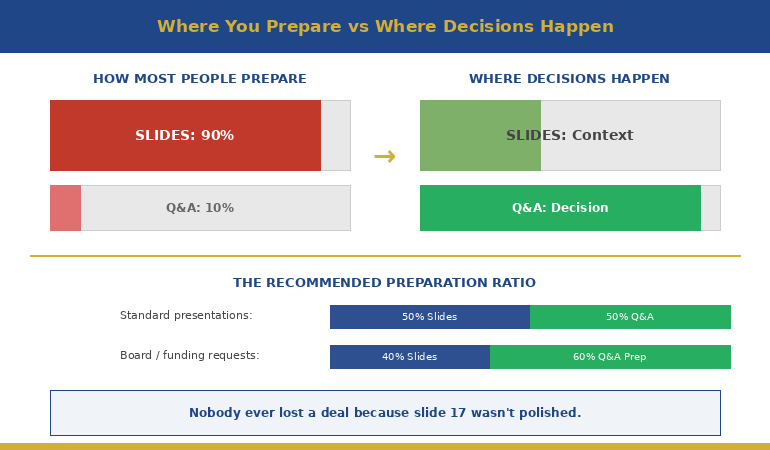
Diagram showing presentation preparation ratio versus where executive decisions actually happen during Q&A

Here’s the preparation ratio I recommend to my clients: once your slides are structurally sound, split your remaining preparation time 50/50 between rehearsing the presentation and preparing for Q&A. For a high-stakes presentation — a board approval, a funding request, a major proposal — I’d go further: 40% slides, 60% Q&A preparation.

That feels counterintuitive. It felt counterintuitive to the senior director who lost the £3.2M deal too. But after working with hundreds of executives through high-stakes presentations, I can tell you: nobody ever lost a deal because slide 17 wasn’t polished enough. Plenty have lost deals because they couldn’t answer question two.

📋 Want the complete Q&A preparation system?

The Executive Q&A Handling System includes question mapping templates, response frameworks, and the exact preparation process that turns Q&A from your biggest risk into your strongest asset.

Get the Executive Q&A Handling System → £39

The Question Map: Predicting What They’ll Ask

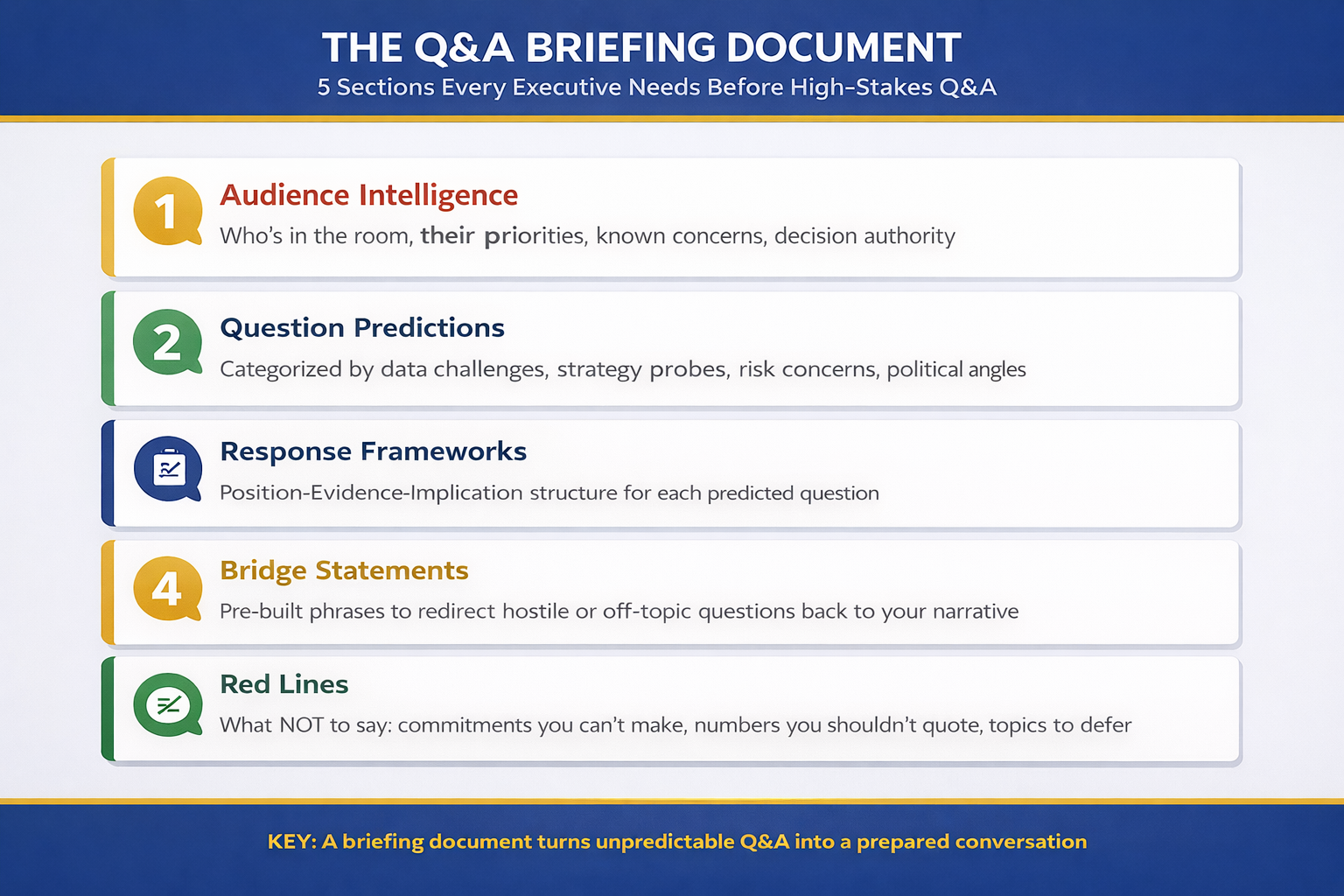
The biggest myth about Q&A is that questions are unpredictable. They’re not. In my experience, you can predict the majority of the questions you’ll receive — if you prepare systematically rather than hoping for the best.

I teach my clients a technique called Question Mapping. Before any high-stakes presentation, you build a map of likely questions organised by stakeholder and by category. Here’s how it works:

Step 1: List every person in the room and their primary concern.

The CFO cares about cost, risk, and return. The CTO cares about technical feasibility and integration. The COO cares about operational disruption. The CEO cares about strategic alignment and timing. Each person will ask questions through their lens. Knowing the lens tells you the question before it’s asked.

Step 2: For each person, write the three questions they’re most likely to ask.

Not the questions you’d like them to ask — the questions they’ll actually ask based on their role, their concerns, and any history you have with them. If the CFO challenged your timeline last time, she’ll challenge your timeline again. Prepare for that specific challenge.

Step 3: For each question, prepare your answer AND your evidence.

The answer is what you’ll say. The evidence is what you’ll show — a backup slide, a data point, a reference to a comparable situation. This is where appendix slides become essential. They’re not afterthoughts; they’re your Q&A arsenal.

Step 4: Identify the two or three questions you can’t answer yet — and prepare honest responses for those too.

Knowing what you don’t know is just as important as knowing what you do. We’ll cover how to handle these in a moment.

When my client lost the £3.2M deal, I asked him afterwards: “Did you do a question map?” He looked at me blankly. He’d spent three weeks on slides and zero minutes mapping the questions his audience was guaranteed to ask. The CFO’s question about the vendor contract penalty wasn’t obscure — it was the most obvious financial question in the room. Ten minutes of question mapping would have caught it.

Answer Architecture: The 3-Part Executive Response

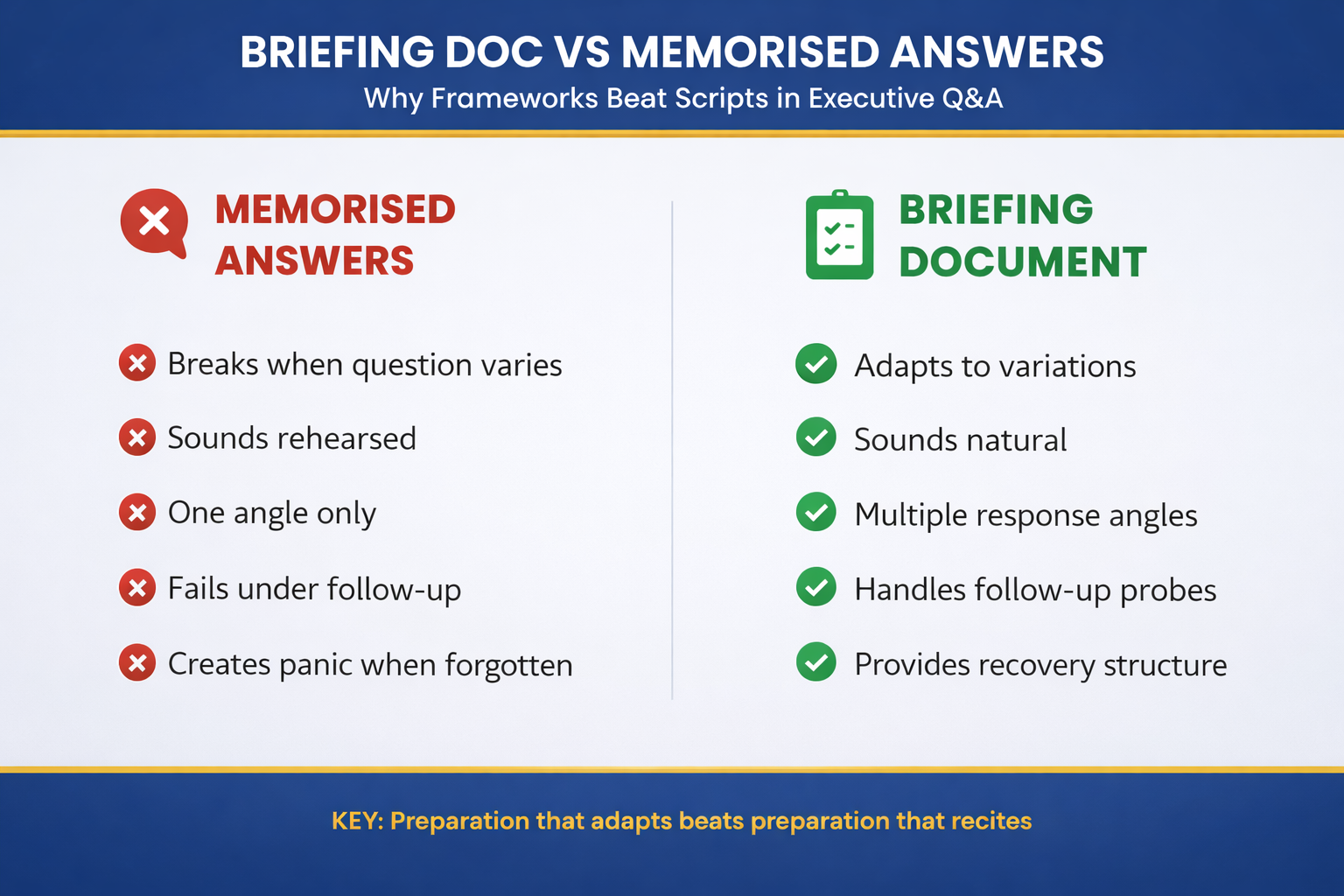
Knowing what they’ll ask is half the battle. The other half is structuring your answer so it lands with a senior audience. Most people answer executive questions the way they’d answer in conversation — they think out loud, circle around the point, add context, and eventually arrive at the answer. For a peer, this is fine. For a CFO with six more meetings after yours, it’s fatal.

I teach a three-part response structure that works for virtually any executive question:

Part 1: Direct Answer (first sentence)

Start with the answer. Not the context, not the caveat, not the background. The answer. “The migration risk is moderate — we estimate two weeks of parallel running with a 15% contingency built in.” The executive now has what they need. Everything after this is supporting detail.

Part 2: One Supporting Point (second sentence)

Give one piece of evidence or reasoning that strengthens your answer. “We’ve based that on the migration timeline from the Singapore rollout last year, which had similar complexity.” One point. Not three. Not a data dump. One credible reference that shows your answer isn’t a guess.

Part 3: The Bridge (optional third sentence)

If it’s useful, connect back to a point from your presentation or redirect to a related strength. “That’s actually why we’ve built the phased approach I showed on slide 8 — it gives us an exit ramp at each stage.” This turns a defensive moment (answering a question) into an offensive one (reinforcing your proposal).

Three sentences. Sometimes two. Never seven. The discipline of brevity in Q&A communicates the same thing it communicates in your slides: you know what matters and you’re not afraid to be direct about it.

📊 Question Maps + Response Frameworks + Recovery Scripts

The Executive Q&A Handling System gives you the complete toolkit: question mapping templates for every stakeholder type, the 3-part response structure with worked examples, “I don’t know” recovery scripts, hostile question techniques, and preparation checklists you can run before any high-stakes presentation.

Get the Executive Q&A Handling System → £39

Instant download. Built from 24 years of real boardroom Q&A across JPMorgan Chase, PwC, RBS, and Commerzbank.

The Most Powerful Answer: “I Don’t Know, But…”

Here’s something that surprises most of my clients: the executives I’ve worked with over 24 years don’t expect you to know everything. What they can’t tolerate is pretending you do when you don’t.

When you bluff in Q&A, senior people can tell. They’ve sat through thousands of presentations. They know the difference between someone who’s genuinely confident in their answer and someone who’s constructing one in real time. Bluffing doesn’t just fail to convince them — it actively undermines every other answer you’ve given, including the ones you were right about.

“I don’t know” — when it’s honest — is a trust-building statement. But it needs a second half.

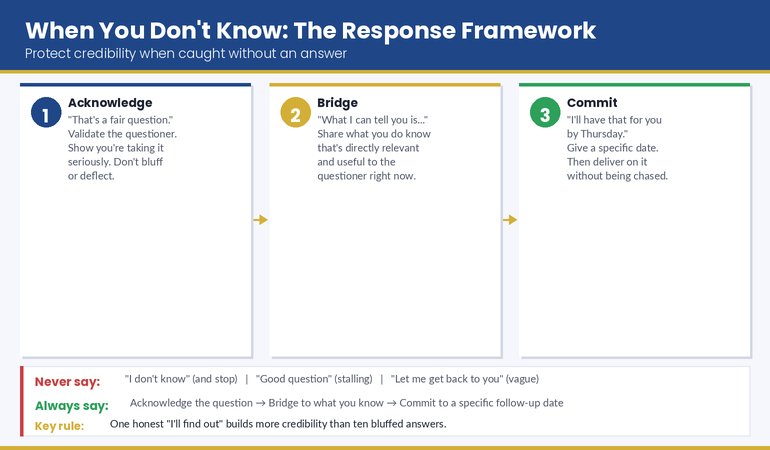
The formula: “I don’t have that figure yet. Here’s what I do know: [related fact]. I’ll have the specific answer to you by [date].”

Three elements: honest admission, related context that shows you understand the territory, and a specific commitment to follow up. The admission shows integrity. The related context shows competence. The commitment shows accountability. Together, they communicate something more valuable than the actual answer: that you’re someone who can be trusted with a £3.2M decision.

My client who lost the deal said “I’ll need to come back to you on that” — which is close but missing the middle element. He didn’t demonstrate that he understood the territory around the question. Compare that with: “I don’t have the exact penalty clause figure, but I know the contract has a 90-day notice period and we’d be within that window for a Q2 start. I’ll confirm the specific financial impact by Friday.”

Same honesty. Completely different impression. The first version says “I didn’t prepare for this.” The second says “I understand the landscape even though I’m missing one data point.”

For a deeper dive into handling the really difficult questions — the hostile ones, the ambush questions, the ones designed to put you on the spot — this guide covers specific techniques for those situations.

🔍 Want the “I don’t know” recovery scripts and hostile question playbook?

The Executive Q&A Handling System includes word-for-word scripts for every Q&A scenario — including the ones you can’t predict. Plus the question mapping template that catches most questions before they’re asked.

Get the Executive Q&A Handling System → £39

How do you prepare for Q&A after an executive presentation?

Use a Question Map: list every person in the room and their primary concern, write the three most likely questions each will ask, prepare direct answers with supporting evidence, and identify the questions you can’t answer yet. Aim to spend at least 50% of your remaining preparation time on Q&A once your slides are structurally sound.

Why do good presentations still fail to get approval?

Because executives don’t decide during slides — they decide during Q&A. Your slides present your best case. Q&A reveals how deeply you’ve thought about risks, alternatives, and second-order consequences. Two unanswered questions can undo twenty-two minutes of perfect delivery.

What’s the best way to answer questions from senior executives?

Use the 3-part structure: direct answer first (one sentence), one supporting point (evidence or reasoning), then an optional bridge back to your presentation. Keep responses under three sentences. Brevity in Q&A signals confidence and clarity — rambling signals uncertainty.

🏆 The Complete Executive Q&A Handling System

Everything you need to turn Q&A from your biggest vulnerability into your strongest moment. Built from 24 years of high-stakes boardroom presentations where the real decisions happened after the slides.

  • Question Mapping templates (by stakeholder role and concern type)
  • The 3-Part Executive Response framework with worked examples
  • “I Don’t Know” recovery scripts that build trust instead of destroying it
  • Hostile question deflection and reframing techniques
  • Appendix slide strategy — what to prepare and when to deploy
  • Pre-presentation Q&A preparation checklist

Built from real situations across banking, consulting, and corporate leadership. Not theory — pattern recognition from hundreds of executive Q&A sessions.

Get the Executive Q&A Handling System → £39

Instant download. Customise for your next high-stakes presentation.

Frequently Asked Questions

How long should I spend preparing for Q&A versus preparing slides?

Once your slide structure is solid, split remaining preparation time at least 50/50 between presentation rehearsal and Q&A preparation. For board-level or funding presentations, consider 40/60 in favour of Q&A. No executive ever rejected a proposal because slide 17 wasn’t polished — but many have rejected proposals because the presenter couldn’t answer question two.

What if I’m asked a question I genuinely haven’t thought of?

Use the “I don’t know, but…” formula: honest admission, one related fact that shows you understand the territory, and a specific commitment to follow up with the answer by a named date. This builds more trust than a bluffed answer that unravels under follow-up questioning.

Should I invite questions during the presentation or only at the end?

For senior audiences, invite questions throughout. Executives don’t wait well — if they have a question on slide 4, they won’t be listening to slides 5 through 20. Saying “I welcome questions at any point” also signals confidence. If the question is answered on a later slide, say so: “Great question — I cover that in two slides. Shall I jump ahead or continue?”

How do I handle it when the Q&A goes completely off-topic?

Acknowledge the question’s value, then redirect: “That’s an important point, and it deserves proper attention. Can I take that offline with you after this meeting so we can give it the time it needs? I want to make sure we cover [the decision you need] in the time we have left.” This respects the questioner while protecting your agenda.

📬 The Winning Edge Newsletter

Weekly executive presentation strategies — Q&A preparation, slide structures, and boardroom techniques that actually work. No filler.

Subscribe Free →

📥 Free: Executive Presentation Checklist

Includes a Q&A preparation section — covers question mapping, response structure, and the appendix slides you need ready before any high-stakes presentation.

Download Free →

Related reading: The breathing technique that stopped my pre-presentation vomiting — managing the physical side of high-stakes presentations, including Q&A anxiety.

Your next step: Before your next presentation, take fifteen minutes and build a Question Map. List every person in the room, their primary concern, and the three questions they’re most likely to ask. Prepare a direct answer for each one. That fifteen minutes will do more for your outcome than another three hours of slide refinement. And if you want the complete Q&A preparation system — question maps, response frameworks, recovery scripts, and hostile question techniques — the Executive Q&A Handling System (£39) gives you everything you need to turn the most dangerous part of your presentation into the most persuasive.

About the Author

Mary Beth Hazeldine is the Owner & Managing Director of Winning Presentations. With 24 years of corporate banking experience at JPMorgan Chase, PwC, Royal Bank of Scotland, and Commerzbank, she has delivered high-stakes presentations in boardrooms across three continents.

A qualified clinical hypnotherapist and NLP practitioner, Mary Beth combines executive communication expertise with evidence-based techniques for managing presentation anxiety. She has trained senior professionals and executive audiences over many years and supported high-stakes funding and approval presentations throughout her career.

Book a discovery call | View services

10 Feb 2026
Executive confidently answering difficult question in boardroom presentation

How to Handle Difficult Questions in a Presentation: The 4-Part Executive System

The CFO leaned forward. “What’s the ROI, and how confident are you in that number?”

I knew the answer. I’d calculated it myself. But in that moment — with twelve executives watching — my mind went blank. I started talking. And talking. Sixty seconds of rambling later, I could see the energy draining from the room.

We lost the deal. Not because of the presentation. The deck was solid. The strategy was sound. We lost it in Q&A, in the space between a reasonable question and an answer that never quite landed.

That was fifteen years ago. Since then, I’ve helped hundreds of executives prepare for exactly these moments — the high-stakes questions that can make or break a decision. What I’ve learned: handling difficult questions is a skill, not a talent. And it’s entirely learnable.

Quick answer: Handle difficult presentation questions using the 4-part system: Forecast the questions before the meeting, Build executive-ready answers using the Headline → Reason → Proof → Close framework, Control the room with bridging phrases and deliberate pacing, and Protect the decision by capturing open loops. Most presenters fail in Q&A because they prepare their slides but not their answers.

Here’s what nobody tells you about executive presentations: the deck is the easy part. You control the narrative. You choose the sequence. You decide what to emphasise and what to minimise.

Q&A is different. Someone asks a question you didn’t anticipate. The room shifts. Suddenly you’re not presenting — you’re defending. And if you don’t have a system for handling that moment, even the best presentation can unravel in sixty seconds.

I’ve watched it happen to brilliant people. Subject matter experts who know their content cold but freeze when challenged. Senior leaders who’ve delivered the same presentation a dozen times but still dread the questions at the end.

The good news: there’s a system that works. I’ve used it myself and taught it to executives facing boards, investors, regulators, and hostile stakeholders. It doesn’t require you to predict every question. It requires you to be ready for any question.

Why Q&A Derails Good Presentations

Most presentation training focuses on delivery. Slide design. Story structure. Eye contact. Voice modulation. All important — but all useless if you lose the room in the last ten minutes.

Q&A derails presentations for predictable reasons:

You answer the question you heard, not the question they asked. Executive questions often have subtext. “What’s the timeline?” might really mean “I’m worried this will slip.” If you answer only the surface question, you miss the real concern.

You go too detailed. When challenged, the instinct is to prove you know your stuff. So you dive into methodology, caveats, edge cases. The executive wanted a 20-second answer. You gave them two minutes. Their eyes glaze over. Your credibility drops.

You get defensive. A sharp question feels like an attack. Your body language shifts. Your tone hardens. Now you’re in a confrontation instead of a conversation. Even if you “win” the exchange, you’ve lost the room.

You ramble while thinking. You don’t know the answer immediately, so you start talking to fill the silence. The longer you talk without landing somewhere, the less confident you appear.

You let one question derail the agenda. Someone asks about a tangent. You engage fully. Twenty minutes later, you’ve never returned to your core message, and the decision you needed hasn’t been made.

Every one of these failures is preventable. Not with more subject matter expertise — with a system.

The 4-Part System That Keeps You in Control

After years of coaching executives through high-stakes Q&A, I’ve distilled the approach into four parts. Each takes 10-20 minutes of preparation. Together, they transform how you handle difficult questions.

Part 1: Forecast the Questions (10 minutes)

Before every high-stakes presentation, spend 10 minutes forecasting the questions that could kill your decision.

Not every possible question — the dangerous ones. The questions that, if answered badly, will derail the meeting.

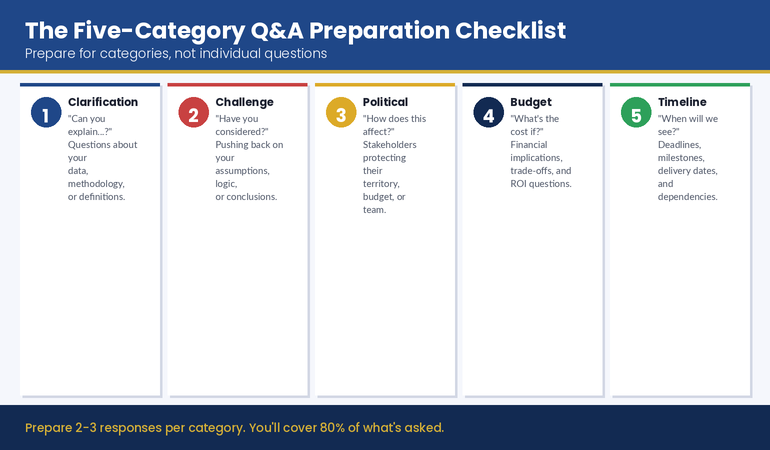
These cluster into six categories:

  • Money: “What’s the ROI?” / “Why is this the best use of budget?” / “What happens if costs overrun?”
  • Risk: “What could go wrong?” / “What’s your contingency?” / “Why should we believe this will work?”
  • Priorities: “Why this over other initiatives?” / “What are we saying no to?”
  • Time: “Why now?” / “What if we wait six months?” / “Can this be done faster?”
  • People: “Do we have the capability?” / “Who’s accountable?” / “What about the team impact?”
  • Credibility: “How do you know?” / “What’s this based on?” / “Who else has done this?”

Write down the 5-10 questions most likely to come from your specific audience. If you’re presenting to a CFO, weight toward Money and Risk. If you’re presenting to a board, weight toward Credibility and Priorities.

🎯 Get the Complete Q&A Preparation System

The Executive Q&A Handling System includes a question forecasting framework, a library of 50+ executive challenge questions organised by category, and a one-page prep sheet you can use before every high-stakes meeting. Stop dreading Q&A — start controlling it.

Get the Executive Q&A Handling System → £39

Instant download. Use it for your next presentation.

Part 2: Build Executive Answers (20 minutes)

For each forecasted question, write a headline answer using this framework:

Headline → Reason → Proof → Close

This structure keeps your answers between 20-45 seconds — long enough to be substantive, short enough to maintain attention.

Example question: “What’s the ROI and how confident are you?”

Headline: “We project 3.2x return within 18 months.”

Reason: “That’s based on conservative estimates of cost reduction in three areas.”

Proof: “We’ve validated these numbers with Finance and they align with what we saw in the pilot.”

Close: “I’m confident in the methodology. Happy to walk through the assumptions if helpful.”

Total time: 30 seconds. The executive got a clear answer, understood the basis, and has an option to go deeper if they want.

Write these out. Don’t just think them through — write them. The act of writing forces clarity. When the question comes live, you won’t remember the exact words, but you’ll remember the structure.

Part 3: Control the Room (Live)

When you’re in the room, three techniques keep you in control:

Pause before answering. A 2-3 second pause signals confidence, not uncertainty. It shows you’re considering the question rather than reacting to it. This is counterintuitive — most people rush to fill silence — but it transforms how you’re perceived.

Use bridging phrases. When a question is hostile or off-topic, bridge back to your message:

  • “That’s an important consideration. The way we’ve addressed it is…”
  • “I understand the concern. What I’d focus on is…”
  • “That’s worth exploring. Before we do, let me make sure we’ve covered…”

These phrases acknowledge the question without letting it hijack the conversation.

Park questions safely. Not every question needs an immediate answer. “I want to give that the attention it deserves. Can I come back to you with a fuller answer by Friday?” This is not weakness — it’s professionalism.

The Executive Q&A Handling System includes a complete library of bridging phrases and control techniques for live Q&A situations.

Part 4: Protect the Decision (After Q&A)

Q&A doesn’t end when the meeting ends. Questions create open loops — concerns raised, information promised, follow-ups needed. If these aren’t captured, decisions drift.

Within 24 hours of every high-stakes presentation, send a brief follow-up:

  • Questions raised and answers provided
  • Open items with owners and deadlines
  • Clear next steps toward the decision

This isn’t administrative busywork. It’s decision protection. It shows you’re organised, reliable, and driving toward action — exactly the qualities that make executives say yes.


4-part Q&A handling system showing Forecast, Build, Control, Protect framework

The 7 Question Types Executives Ask

Once you recognise the patterns, executive questions become predictable. Here are the seven types you’ll encounter most often:

1. The ROI Challenge: “What’s the return?” / “Justify this investment.” / “Why is this worth the money?”

2. The Risk Probe: “What could go wrong?” / “What’s your contingency?” / “What if this fails?”

3. The Trade-off Question: “Why this over X?” / “What are we not doing if we do this?” / “Is this the best option?”

4. The Timing Question: “Why now?” / “Can we wait?” / “Is this urgent?”

5. The Capability Question: “Can we actually do this?” / “Do we have the skills?” / “Who’s going to deliver?”

6. The Evidence Question: “How do you know?” / “What’s this based on?” / “Where’s the data?”

7. The Political Question: “Who else supports this?” / “What does [stakeholder] think?” / “Is this aligned with [initiative]?”

Before any high-stakes presentation, scan your content through these seven lenses. Where are you weakest? That’s where the tough questions will come.

📋 50+ Executive Challenge Questions — Ready to Use

The Executive Q&A Handling System includes a curated library of tough questions organised by category: Money, Risk, Trade-offs, Timing, Capability, Evidence, and Politics. Use it to stress-test every presentation before you deliver it.

Get the Executive Q&A Handling System → £39

Instant download. Includes response frameworks for each question type.

The Response Framework That Works Every Time

The Headline → Reason → Proof → Close framework works for most questions. But some situations need variations:

For Hostile Questions

When the tone is sharp or the question feels like an attack:

Acknowledge → Reframe → Answer → Bridge

“I understand why that’s a concern [acknowledge]. The way I’d frame it is [reframe]. Here’s what we’re doing [answer]. What matters most for this decision is [bridge].”

This defuses tension without being defensive. You’re not fighting the questioner — you’re redirecting the conversation.

For Complex Questions

When a question has multiple parts or requires nuance:

Clarify → Chunk → Answer → Check

“Let me make sure I understand — you’re asking about X and Y? [clarify] I’ll take those separately [chunk]. On X… On Y… [answer] Does that address what you were looking for? [check]”

Breaking complex questions into parts prevents rambling and ensures you actually answer what was asked.

For Questions You Weren’t Expecting

When something comes from left field:

Pause → Acknowledge → Partial Answer → Commit

“[Pause] That’s not something I’d considered from that angle [acknowledge]. My initial thought is [partial answer]. Let me give that more thought and come back to you with a fuller response by [date] [commit].”

This is far better than making something up or rambling while you think.

The response frameworks in the Executive Q&A Handling System include annotated examples for each situation — CFO scrutiny, risk challenges, political questions, and more.

How to Handle “I Don’t Know” Moments

The question every presenter dreads: what if you genuinely don’t know the answer?

First, recognise that this isn’t failure. No one knows everything. The executives asking questions don’t expect omniscience. What they do expect is honesty, competence, and follow-through.

Here’s how to handle it:

Don’t bluff. Executives detect BS instantly. A made-up answer destroys credibility far more than admitting uncertainty. If you don’t know, don’t pretend you do.

Don’t over-apologise. “I don’t know” is fine. “I’m so sorry, I really should know this, I can’t believe I don’t have that information” is weak. State it simply and move on.

Offer what you do know. “I don’t have the exact figure, but I know it’s in the range of X to Y based on [source]. I’ll confirm the precise number and send it by end of day.”

Commit to a specific follow-up. “Let me find out and get back to you by [specific time].” Then actually do it. Reliable follow-through builds more credibility than knowing everything on the spot.

Use the room. Sometimes the answer is in the room. “I don’t have that detail — Sarah, do you know?” This shows collaboration, not weakness.

The magic phrase: “I want to give you an accurate answer rather than a quick one. Let me confirm and get back to you.”

What Changes When You Have a System

I recently worked with a VP preparing for a board presentation. She’d delivered the same content twice before — and both times, Q&A had gone sideways. The board had concerns she couldn’t address cleanly, and the decision kept getting deferred.

We spent 90 minutes applying this system. We forecasted the likely questions (six of them, mostly in the Risk and Capability categories). We wrote headline answers for each. We practised bridging phrases for the one board member who always went off-topic.

The third presentation took 25 minutes. Q&A took 15 minutes. She answered every question in 30-45 seconds, using the frameworks. The decision was approved that day.

Same presenter. Same content. Same board. Different result — because she had a system.

🎯 Handle Tough Questions Like a Senior Leader

The Executive Q&A Handling System gives you everything you need to prepare for and control high-stakes Q&A: question forecasting frameworks, response templates, bridging phrases, a one-page prep sheet, and a decision capture sheet. Stop losing momentum in Q&A.

Get the Executive Q&A Handling System → £39

Instant download. A reusable system you’ll use for every high-stakes meeting.

If you also need deck templates: the Executive Slide System (£39) pairs well with Q&A preparation.

Frequently Asked Questions

How much time should I spend preparing for Q&A?

For a high-stakes presentation, spend 30-45 minutes on Q&A preparation: 10 minutes forecasting questions, 20 minutes writing headline answers, and 5-10 minutes reviewing bridging phrases. This investment pays off dramatically. Most presenters spend hours on slides and zero time on Q&A — then wonder why they lose momentum at the end.

What if someone asks a question I haven’t prepared for?

Use the Pause → Acknowledge → Partial Answer → Commit framework. A 2-3 second pause buys thinking time. Acknowledge the question is valid. Give the best partial answer you can. Commit to a specific follow-up if needed. This handles 90% of unexpected questions professionally.

How do I handle a questioner who’s clearly hostile?

Use Acknowledge → Reframe → Answer → Bridge. Don’t get defensive — it never helps. Acknowledge their concern as valid, reframe to the substance of the issue, give a clear answer, then bridge back to your core message. Stay calm, maintain eye contact, and keep your voice steady. Hostility often dissolves when met with professionalism.

Should I take questions during the presentation or save them for the end?

For executive audiences, it’s usually better to take questions as they arise — executives don’t like waiting. But set a boundary: “I’m happy to take questions as we go. If something requires a longer discussion, I’ll note it and we’ll come back to it at the end.” This keeps you in control while respecting their time.

📬 The Winning Edge Newsletter

Weekly frameworks for executive presentations and high-stakes communication. Join senior professionals who receive actionable techniques every week.

Subscribe free →

Related: If difficult questions trigger physical anxiety — racing heart, shallow breathing, mind going blank — the techniques in The Fight or Flight Hack I Learned From Hypnotherapy can help you stay calm under pressure.

You can have a perfect deck and still lose the room in Q&A. The difference between presenters who maintain control and those who don’t isn’t subject matter expertise — it’s preparation and system.

Forecast the questions. Build executive answers. Control the room with deliberate technique. Protect the decision with clear follow-through.

The next tough question doesn’t have to derail you. You just need a system.

About the Author

Mary Beth Hazeldine is the Owner & Managing Director of Winning Presentations. With 24 years of corporate banking experience, she has faced — and helped clients prepare for — high-stakes Q&A sessions with boards, investors, regulators, and senior leadership teams.

A qualified clinical hypnotherapist and NLP practitioner, Mary Beth combines executive communication expertise with evidence-based techniques for staying calm under pressure. She has trained thousands of executives in presentation skills and Q&A preparation.

08 Feb 2026
Executive mid-answer during boardroom Q&A with presentation screen visible behind

Appendix Slides: The 5 Backup Slides That Win Executive Q&A

The CFO asked a question I wasn’t expecting. I froze — then said, “I actually have a slide on that.”

As I flipped to my appendix, I watched her expression shift from skepticism to something like respect. The question was about our methodology assumptions — the kind of challenge that derails presenters who haven’t thought three steps ahead.

But I had thought three steps ahead. Not because I’m smarter than anyone else in the room. Because I’d learned something most presenters never figure out: appendix slides (also called backup slides) aren’t for “extra information.” They’re pre-built answers to the questions you’ll be asked.

After 24 years in corporate banking and consulting, I’ve noticed a pattern. The people who look most prepared in boardrooms aren’t the ones who memorised every data point. They’re the ones who anticipated the questions — and had slides ready.

Here’s how to build appendix slides that transform Q&A from a threat into an opportunity.

Quick answer: Effective appendix slides (backup slides) aren’t repositories for leftover data — they’re strategically prepared answers to anticipated questions. Build five types: (1) methodology backup for “how did you calculate that?”, (2) deeper data cuts for “what about segment X?”, (3) scenario alternatives for “what if we did Y instead?”, (4) historical context for “how does this compare to last time?”, and (5) risk mitigation for “what could go wrong?” Having these ready transforms Q&A from a threat into an opportunity to demonstrate thorough preparation.

⚡ Presenting to leadership this week?

Build these 3 appendix slides before anything else:

  1. The “How We Got This Number” slide. Whatever your key recommendation relies on — have the calculation visible and ready.
  2. The “What About [Their Pet Topic]” slide. Every senior leader has something they always ask about. Prepare for it.
  3. The “Plan B” slide. If they say no to your first recommendation, what’s the alternative? Have it ready.

These three slides cover 80% of the questions that catch presenters off guard.

If you don’t have the “How we got this number” slide ready, you’re not presenting — you’re negotiating credibility.

The difference between “I’ll get back to you” and “I have a slide on that” is preparation.
Start with templates designed for executive-level Q&A readiness.

Get the Executive Slide System → £39

Why Most Appendix Advice Is Useless

Search “appendix slides” and you’ll find the same advice everywhere: “Put extra information at the end of your presentation.” “Include detailed data that doesn’t fit in your main slides.” “Add references and sources.”

This advice is technically correct and practically useless.

It treats appendix slides as a dumping ground — a place to put things you couldn’t fit elsewhere. That’s backwards. It’s like saying “put a fire extinguisher somewhere in the building” without teaching people where fires actually start.

The real purpose of appendix slides is strategic anticipation.

Every presentation to senior leaders follows a predictable pattern. You present. They listen. Then they ask questions designed to test whether you’ve actually thought this through — or whether you’re just presenting someone else’s analysis.

The questions they ask fall into recognisable categories. And if you’ve prepared slides that answer those categories, something interesting happens: you stop dreading Q&A. You start looking forward to it. Because every question becomes an opportunity to demonstrate that you’re not just a messenger — you’re someone who thinks at their level.

For more on how senior leaders process presentations, see my guide on what executives actually read on your slides.

The 5 Types of Appendix Slides That Actually Matter

After observing thousands of executive presentations — and noting which questions consistently surface — I’ve identified five categories of backup slides that cover nearly every challenging question you’ll face.

Five categories of appendix slides with example questions for each type

Type 1: Methodology Backup (“How did you calculate that?”)

This is the most common challenge in data-heavy presentations. Someone questions your numbers — not because they think you’re wrong, but because they need to understand the foundation before they’ll trust the conclusion.

Your methodology backup slide should include:

  • Data sources (where the numbers came from)
  • Key assumptions (what you held constant)
  • Calculation logic (the formula or approach, simplified)
  • Sensitivity notes (what changes if assumptions shift)

When someone asks “How did you get to that 15% figure?”, you flip to this slide and walk them through it in 60 seconds. Their next response is almost always a nod, not a follow-up challenge.

Type 2: Deeper Data Cuts (“What about segment X?”)

Senior leaders often want to see how aggregate numbers break down. If you’re showing total revenue, someone will ask about revenue by region. If you’re showing overall customer satisfaction, someone will ask about enterprise vs. SMB.

Anticipate the two or three most likely segmentation questions and prepare slides that show:

  • The breakdown they’re likely to ask about
  • Whether the segment trend matches or diverges from the aggregate
  • Any notable outliers worth flagging

The magic phrase: “Great question — let me show you the breakdown.” Then flip to the slide you already prepared.

Type 3: Scenario Alternatives (“What if we did Y instead?”)

Decision-makers rarely accept the first option without exploring alternatives. If you’re recommending Option A, someone will ask what happens with Option B or C.

Your scenario alternative slides should show:

  • The alternative approach (briefly described)
  • Key differences in outcome (cost, timeline, risk, impact)
  • Why you’re not recommending it (the trade-off that makes it inferior)

This demonstrates that you didn’t just fall in love with your recommendation — you evaluated alternatives and made a reasoned choice.

Type 4: Historical Context (“How does this compare to last time?”)

Institutional memory runs deep in senior leadership. They remember the last time someone proposed something similar. They remember how it turned out.

Your historical context slide should address:

  • Previous similar initiatives (briefly)
  • What happened (outcome)
  • What’s different this time (why history won’t repeat)

If you don’t prepare this slide, someone will bring up the past anyway — and you’ll be caught defending against a comparison you didn’t anticipate.

Type 5: Risk Mitigation (“What could go wrong?”)

Every approval involves accepting risk. Leaders want to know you’ve thought about what could fail — and that you have a plan if it does.

Your risk mitigation slide should include:

  • Top 2-3 risks (the realistic ones, not the theoretical)
  • Likelihood and impact (brief assessment)
  • Mitigation approach (what you’ll do if each risk materialises)

This slide transforms “What could go wrong?” from a trap into an opportunity to show thorough thinking.

Build Your Main Deck and Appendix Fast — Without Starting From Blank

The Executive Slide System gives you the complete framework to structure your recommendation deck and prepare for Q&A. Build presentations that anticipate challenges before they’re asked.

Get the Executive Slide System → £39

Instant download. 30-day guarantee.

What’s inside:

  • 10 executive slide templates (recommendation, decision, update, and Q&A-ready structures)
  • 30 Copilot prompt cards (draft → refine → executive polish)
  • Before-You-Present cheat sheet (the 60-second quality check)
  • Lifetime updates + 30-day money-back guarantee

Use it today: Download → pick the recommendation template → drop in your key numbers → add 3 appendix slides using the framework above → present with confidence.

How to Predict Which Questions You’ll Be Asked

Building the right appendix slides requires knowing which questions are coming. Here’s how to predict them.

Step 1: Know Your Audience’s Patterns

Every senior leader has favourite questions. The CFO always asks about ROI assumptions. The COO always asks about implementation timeline. The CEO always asks about competitive response.

Before any presentation, ask yourself: What does each person in this room always want to know? Build an appendix slide for each pattern.

Step 2: Identify Your Weakest Points

You know where your argument is strongest — and where it’s vulnerable. The vulnerable spots are where questions will land.

Be honest with yourself: Which part of my recommendation would I challenge if I were in their seat? Build an appendix slide that addresses that challenge head-on.

Step 3: Anticipate the “Yes, But” Reactions

When you make your recommendation, imagine someone saying “Yes, but…” and completing the sentence. Common completions:

  • “Yes, but we tried something similar before…”
  • “Yes, but what about the risk of…”
  • “Yes, but how does this affect department X…”
  • “Yes, but the timeline seems aggressive…”

Each “yes, but” is an appendix slide waiting to be built.

Step 4: Ask Someone Who’s Been in the Room

If you haven’t presented to this group before, find someone who has. Ask them: “What questions did they ask you?” and “What caught you off guard?”

Their experience becomes your preparation advantage.

For more on handling difficult questions, see my guide on handling difficult questions in presentations.

The “Flip-Back” Technique for Q&A Confidence

Having appendix slides is only half the battle. Using them smoothly is the other half.

Here’s the technique I teach:

Step 1: Acknowledge the Question

“That’s a great question” or “I’m glad you asked that” — something brief that shows you’re not thrown off.

Step 2: Signal That You’re Prepared

“I actually have some data on that” or “Let me show you what we found when we looked at that specifically.”

This moment — before you’ve even shown the slide — is when perception shifts. You’re not scrambling. You anticipated this.

Step 3: Navigate Smoothly

Know your appendix slide numbers. Practice the navigation so you don’t fumble. In PowerPoint, you can type the slide number and press Enter to jump directly there.

Step 4: Answer Concisely

Don’t over-explain. Show the slide, make your point in 30-60 seconds, and ask if that addresses their question. Less is more.

Step 5: Return to Your Flow

After answering, return to where you were in your main presentation — or to your recommendation slide if you were near the end. Don’t let one question derail your entire narrative.

The Psychological Effect

When you flip to a prepared slide during Q&A, something subtle happens in the room. The questioner feels heard (you took their concern seriously enough to prepare for it). The rest of the room sees competence (you thought ahead). And you feel confident (you’re not improvising — you’re executing).

This is why appendix slides change the entire dynamic of executive presentations.

Why Building Appendix Slides First Changes Everything

Here’s a counterintuitive practice that transformed how I prepare presentations: build your appendix slides before your main deck.

Most people do the opposite. They build their main presentation, then throw some extra slides at the end as an afterthought. But this order is backwards.

When you build appendix slides first, you’re forced to think about:

  • What questions will this presentation raise?
  • What challenges will my recommendation face?
  • What context does my audience need that I might forget to include?

This thinking improves your main presentation. You realise which points need more support. You identify gaps in your logic before someone else points them out. You build a stronger argument because you’ve already stress-tested it.

The practical workflow:

  1. Draft your recommendation (one sentence)
  2. List every question or challenge you can imagine
  3. Build appendix slides for the top 5-8 challenges
  4. Now build your main presentation, informed by that thinking
  5. Review: did any appendix content belong in the main deck after all?

This approach takes slightly longer upfront but dramatically reduces revision cycles and — more importantly — transforms your Q&A performance.

For more on executive presentation structure, see my guide on executive presentation structure.

Stop Dreading Q&A. Start Looking Forward to It.

The Executive Slide System gives you the complete framework — main deck templates plus the structure to build appendix slides for every question category. Build presentations that anticipate challenges before they’re asked. Look like the most prepared person in every room.

Get the Executive Slide System → £39

Instant download. 30-day guarantee.

Frequently Asked Questions

How many appendix slides should I have?

Quality matters more than quantity. Aim for 5-10 well-prepared appendix slides that cover the most likely questions. Having 30 appendix slides you can’t navigate quickly is worse than having 5 you know inside out. Focus on the five types described above and you’ll cover most scenarios.

Should I mention my appendix slides during the presentation?

Generally, no. Let them discover your preparation during Q&A — that’s when the “I have a slide on that” moment creates the strongest impression. The exception: if you’re presenting something controversial and want to pre-empt objections, you might say “I have backup data on our methodology in the appendix if anyone wants to dig deeper.”

What if someone asks a question I don’t have an appendix slide for?

It happens. Acknowledge the question, answer as best you can verbally, and offer to follow up with more detail. The goal isn’t to have every possible answer prepared — it’s to have the most likely answers ready. Even covering 70% of questions with prepared slides dramatically improves your Q&A performance.

How do I quickly navigate to appendix slides during a live presentation?

In PowerPoint, type the slide number and press Enter to jump directly there. Know your appendix slide numbers before you present. Some presenters add a small index on their final main slide (visible only to them in presenter view) showing which appendix slides cover which topics. Practice the navigation until it’s smooth.

Your Next Step

Before your next executive presentation, try this: after you’ve drafted your recommendation, spend 30 minutes building appendix slides for the three most likely challenges. Just three.

Then notice how your confidence shifts. You’re no longer hoping they don’t ask hard questions. You’re ready for them. And that readiness shows — in your body language, your voice, and your willingness to engage with whatever comes.

The best-prepared person in the room isn’t the one who knows everything. It’s the one who anticipated what would matter — and prepared accordingly.

Ready to transform your Q&A performance?

Get the Executive Slide System → £39

📧 Get the Winning Edge Newsletter

Weekly insights on executive communication, presentation structure, and high-stakes delivery — from someone who’s spent 24 years in boardroom-style decision meetings.

Subscribe free →

Related reading: Once you’ve built your appendix slides, make sure your main deck is structured for how senior leaders actually scan. Read What Executives Actually Read on Your Slides (In the First 5 Seconds) to ensure your key content lands in the high-attention zones.

About the Author

Mary Beth Hazeldine is the Owner & Managing Director of Winning Presentations. With 24 years in corporate banking and consulting — plus years training senior professionals — she has seen exactly what gets challenged in executive Q&A and what separates presenters who look brilliant from those who look blindsided.

She now helps professionals build presentations that anticipate questions before they’re asked.