🔄
Last Updated: December 2025
• All templates verified & links testedPitch deck templates don’t raise money—clarity does. But some structures show up again and again in successful raises. This page breaks down those patterns.
In 2019, a biotech founder came to me after 23 investor rejections. Her science was solid. Her market was massive. Her team had three PhDs.
But she couldn’t get past the first meeting.
The problem wasn’t her company. It was her deck. She’d built a 47-slide presentation that started with the molecular structure of her compound. By slide 8, investors’ eyes were glazed. She never got to the market opportunity.
We rebuilt her deck using the Sequoia format — 10 slides, story-first, problem-solution structure. She raised £12M in 8 weeks.
The template I’m sharing today is the same structure we used. After reviewing over 5,000 pitch decks in 35 years, I’ve identified the 15 templates that actually work — and I’ll tell you honestly which ones are worth your time.
⭐ Templates give you a starting point. Structure gets you funded.
Investors see 1,000+ decks a year. The Executive Slide System shows you the frameworks that make yours impossible to ignore — the same structures behind £250M+ in funded pitches.
Not another template. A complete system for slides that command attention and close deals.
Get the Executive Slide System → £39
Why 95% of Founders Using Templates Get Rejected
Here’s the uncomfortable truth I’ve learned from reviewing 5,000+ pitch decks:
Templates give you structure. They don’t give you:
- ❌ A compelling narrative that builds to an inevitable conclusion
- ❌ Investor-specific messaging (VC priorities ≠ Angel priorities)
- ❌ The ability to answer objections before they’re asked
- ❌ Visual hierarchy that guides attention to key metrics
- ❌ Confidence to present without reading slides
Templates are training wheels. Use them to learn structure, then either:
- Master pitch narrative design yourself (6-12 months of practice)
- Hire professionals who’ve raised £250M+ for clients (that’s us)
This guide covers both paths: the best templates for DIY founders, and when to stop template-shopping and hire experts.
🎁 7 Best Free Pitch Deck Templates
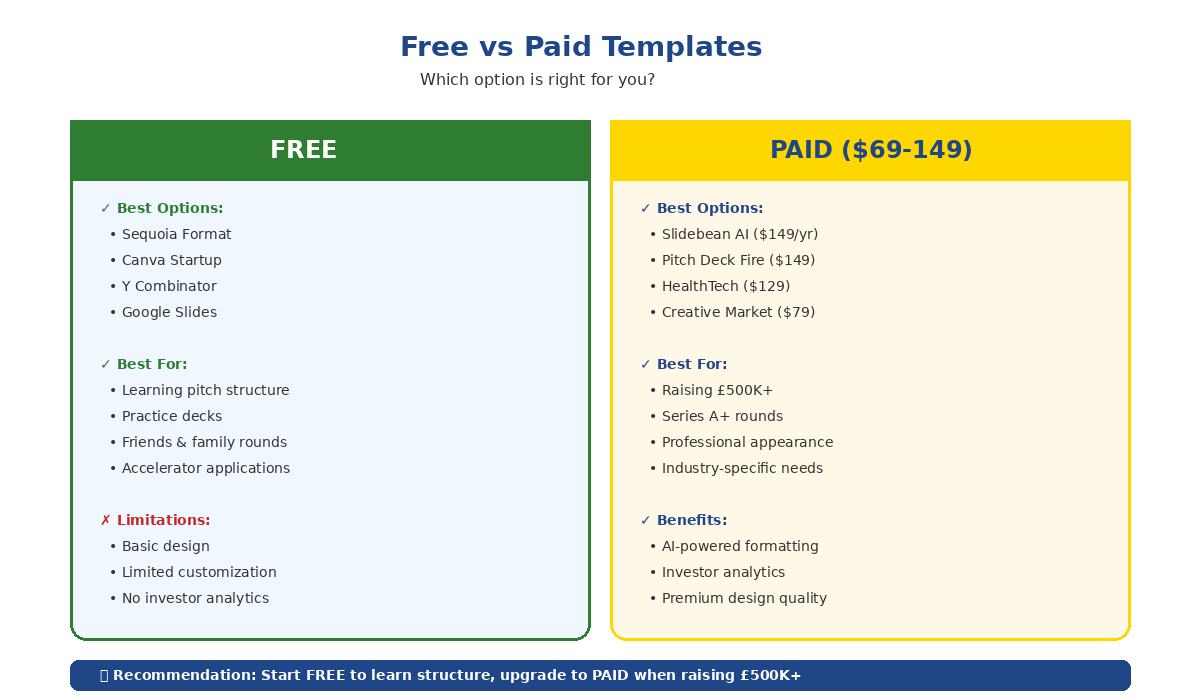
These templates cost nothing and have documented track records. Perfect for learning structure, practice pitches, and early-stage raises.
1. Sequoia Capital Seed Template — The VC Gold Standard ⭐ Editor’s Pick
Price: Free
Track Record: From £1B+ portfolio (Apple, Google, Airbnb)
Best For: Seed stage, following VC-standard format
Time to Complete: 4-6 hours
Sequoia Capital has backed Apple, Google, Airbnb, Stripe, and WhatsApp. They’ve seen more pitch decks than almost anyone in venture capital. This is the format they tell their portfolio companies to use.
The 10-Slide Sequoia Structure:
- Company Purpose — One sentence that defines you
- Problem — The pain you’re solving
- Solution — Your unique approach
- Why Now — Market timing
- Market Size — TAM, SAM, SOM
- Competition — Landscape and positioning
- Product — What you’ve built
- Business Model — How you make money
- Team — Why you’ll win
- Financials — Projections and ask
✅ What I Love:
- Created by legendary VC firm — this is what they want to see
- Zero guesswork on slide order
- Detailed guidance notes included
- Completely free, no signup required
❌ Limitations:
- Very basic design (text-heavy outline)
- No visual templates — just structure
- Requires design work to look professional
💡 Pro Tip:
Use the Sequoia structure as your foundation, then apply a visual template from Canva or Slidebean on top. Structure + design = winning combination.
🔗 Get Sequoia Template Free →
2. Canva Startup Pitch Deck — Best Free for Beginners
Price: Free (Pro version $13/month)
Track Record: 500,000+ users
Best For: First-time founders, practice pitches
Time to Complete: 2-4 hours
Canva’s template is the most popular free option for good reason: easy to use, looks professional, and perfect for learning pitch structure without fighting with design software.
✅ What I Love:
- Beautiful design out of the box
- Drag-and-drop simplicity — zero learning curve
- Edit anywhere (web, mobile, tablet)
- Thousands of design variations
- Cloud-based — never lose your work
❌ Limitations:
- Everyone uses it — VCs see these templates constantly
- Limited PowerPoint export (formatting issues)
- Shallow on financial slide guidance
- Watermark on free plan for some elements
💡 Pro Tip:
Customize the colors and fonts immediately. If a VC has seen 10 decks this week using the default Canva purple, yours won’t stand out.
🔗 Get Canva Template Free →
3. Y Combinator Seed Deck — Best for Accelerator Applications
Price: Free
Track Record: YC companies raised £100B+ collectively
Best For: Accelerator applications, seed fundraising
Time to Complete: 3-5 hours
Y Combinator’s template focuses on traction, not vision. If you have data, this template forces you to lead with it. Perfect for founders who’d rather show numbers than tell stories.
✅ What I Love:
- From world’s top accelerator
- Metric-focused approach — cuts the fluff
- Clear, concise structure
- Updated regularly based on YC learnings
❌ Limitations:
- Very minimal design — functional, not beautiful
- Assumes you have traction data
- Not suitable for pre-product companies
💡 Pro Tip:
If you’re applying to YC specifically, use this exact format. They know what they’re looking for, and deviation creates friction.
🔗 Get YC Template Free →
4. Google Slides Pitch Template — Best for Collaboration
Price: Free
Track Record: Widely used (exact figures unknown)
Best For: Team collaboration, real-time editing
Time to Complete: 3-6 hours
Built into Google Workspace, this template excels at collaborative deck building. If your co-founder is in a different timezone, Google Slides makes simultaneous editing seamless.
✅ What I Love:
- Real-time collaboration (like Google Docs)
- Version history — see every change
- Works on any device with a browser
- Easy sharing with investors (just send link)
- 100% free with Google account
❌ Limitations:
- Basic design compared to dedicated tools
- Fewer templates than Canva
- May not export perfectly to PowerPoint
🔗 Get Google Slides Templates Free →
5. PitchDeckCoach Template — Best Educational Resource
Price: Free
Track Record: £30M+ raised by students
Best For: Learning pitch fundamentals, first-time founders
Time to Complete: 4-8 hours
This template comes with a comprehensive video course explaining each slide. If you want to understand WHY each slide matters (not just WHAT to include), this is your starting point.
✅ What I Love:
- Complete education, not just a template
- Video tutorials for each slide
- Examples from real successful decks
- Beginner-friendly explanations
❌ Limitations:
- Time investment required (need to watch videos)
- Basic design
- May be too slow for experienced founders
🔗 Get PitchDeckCoach Template Free →
6. AngelList Standard Template — Best for Angel Rounds
Price: Free
Track Record: £5B+ raised via platform
Best For: Rolling fundraises, SAFE/convertible notes
Time to Complete: 2-4 hours
Optimized for quick angel rounds rather than institutional VC processes. If you’re raising via AngelList syndicates or angel networks, this format matches what those investors expect.
✅ What I Love:
- Designed for SAFE/convertible structures
- Streamlined for fast decisions
- Focus on traction over elaborate vision
- Angel-investor optimized
❌ Limitations:
- Too simple for institutional VCs
- Limited guidance included
- Not suitable for Series A+
🔗 Get AngelList Template Free →
7. Garage Capital Open Source — Best for Designers
Price: Free (open source)
Track Record: £20M+ raised using derivatives
Best For: Developers, designers, founders who want full control
Time to Complete: 6-12 hours (if customizing heavily)
Fully open-source Figma/Sketch template. Maximum flexibility, maximum work. Only use this if you have design skills or want complete creative control.
✅ What I Love:
- Fully open source — modify anything
- Complete design control
- Works in Figma, Sketch, Adobe XD
- Community contributions improve it over time
❌ Limitations:
- Requires design skills
- Very time-intensive
- No guidance on content
- Steep learning curve for non-designers
🔗 Get Open Source Template Free →
📋 GET THE STRUCTURE RIGHT FIRST
Download the 10-Slide Framework
Use this framework with ANY template above. It’s the same structure we use with clients paying £2,000-5,000 for custom decks.
Download Free →
💰 8 Best Paid Pitch Deck Templates
These templates cost $69-149 but save significant time and deliver professional-grade results. Worth the investment if you’re raising £500K+.
1. Slidebean AI-Powered Template — Best Overall ⭐ Editor’s Pick
Price: $149/year (unlimited use)
Track Record: £180M+ raised by users
Best For: Tech startups, SaaS companies, mobile apps
Time to Complete: 2-4 hours
Slidebean’s template isn’t just slides — it’s an AI-powered design system that automatically adjusts layouts as you add content. Used by 500+ funded startups including companies that raised £50M+ rounds.
✅ What I Love:
- AI auto-formatting — Add content, AI handles design
- Financial slide templates — Built-in charts for metrics, projections
- 50+ design variations — Same content, multiple visual styles
- VC-approved structure — Follows Y Combinator/Sequoia format
- Investor analytics — Track who views what
❌ Limitations:
- Subscription required (can’t buy once)
- Limited to Slidebean platform
- Some design customization restrictions
💼 Real Success Story:
Blueliv (cybersecurity startup) used Slidebean template to raise £8M Series A. Founder quote: “The template forced us to clarify our message. VCs understood our value prop in 3 minutes.”
🔗 Get Slidebean Template →
2. Pitch Deck Fire — Best for High-Stakes Raises (£5M+)
Price: $149 one-time
Track Record: £300M+ raised collectively
Best For: Series A/B fundraising, enterprise B2B, deep-tech
Time to Complete: 4-8 hours
Created by a former VC, Pitch Deck Fire templates are used by YC companies and Techstars graduates. This is the template institutional investors expect to see.
✅ What I Love:
- VC-designed — Created by someone who’s seen 10,000+ decks
- Advanced financial slides — Unit economics, cohort analysis, CAC/LTV
- Enterprise-grade design — Looks like McKinsey made it
- 150-page guide included — What to write on each slide
- One-time purchase — Use forever
❌ Limitations:
- Expensive for early-stage founders
- Complex — not beginner-friendly
- Requires understanding of venture metrics
🔗 Get Pitch Deck Fire →
3. Creative Market Premium Bundle — Best for Consumer Brands
Price: $79 one-time
Track Record: £50M+ in creative industries
Best For: Fashion, design, consumer brands, D2C
Time to Complete: 3-6 hours
If you’re pitching fashion VCs, consumer brand investors, or creative industry funds, your deck needs to look stunning. This bundle delivers visual excellence.
✅ What I Love:
- Designer-created — Professional studio quality
- 12 visual styles — Minimalist, bold, editorial, etc.
- Custom illustrations included
- Fully editable — PowerPoint, Keynote, Canva, Figma
❌ Limitations:
- More style than substance (weak on financial slides)
- Not ideal for B2B SaaS or enterprise tech
- Requires design sense to customize well
🔗 Get Creative Market Bundle →
4. PitchGround Data-Driven Template — Best for AI/Analytics Startups
Price: $97 one-time
Track Record: £120M+ in AI/data companies
Best For: AI/ML startups, data platforms, analytics tools
Time to Complete: 5-10 hours
If your startup is data-heavy, ML-powered, or analytics-focused, you need charts that impress technical VCs. This template excels at visual data storytelling.
✅ What I Love:
- 50+ chart templates — Every data viz type you need
- AI model explanation slides — How to explain ML without losing VCs
- Advanced metrics — Cohort retention, churn analysis, unit economics
- Technical but accessible — Explains complex concepts simply
❌ Limitations:
- Overwhelming for non-technical founders
- Requires real data (not great for pre-product)
- Can feel too technical for generalist VCs
🔗 Get PitchGround Template →
5. HealthTech Investor Template — Best for Medical/Healthcare
Price: $129 one-time
Track Record: £90M+ in healthcare startups
Best For: MedTech, HealthTech, BioTech, Digital Health
Time to Complete: 6-12 hours
Healthcare investors have unique due diligence requirements: regulatory pathway, clinical validation, reimbursement strategy. This template covers them all.
✅ What I Love:
- Regulatory pathway slides — FDA/CE Mark/MHRA approval timelines
- Clinical validation — How to present trial data
- Reimbursement strategy — Payer model explanations
- Scientific credibility — Advisor bios, IP strategy
❌ Limitations:
- Only useful for healthcare startups
- Requires deep domain knowledge
- May be too detailed for early-stage
🔗 Get HealthTech Template →
6. Impact/ESG Pitch Template — Best for Social Enterprises
Price: $79 one-time
Track Record: £45M+ in impact-focused startups
Best For: Social enterprises, B Corps, ESG-focused startups
Time to Complete: 4-8 hours
Impact investors care about financial returns AND social/environmental impact. This template balances both narratives effectively.
✅ What I Love:
- Impact metrics — SDG alignment, social ROI, carbon reduction
- Dual bottom line — Financial + impact returns
- Theory of change — Visual logic model
- B Corp narrative — How to position certification
❌ Limitations:
- Not suitable for traditional VC pitch
- May overcomplicate if impact is secondary
- Requires impact measurement framework
🔗 Get Impact Template →
7. Corporate VC Template — Best for Strategic Partnerships
Price: $89 one-time
Track Record: £200M+ in corporate venture funding
Best For: Corporate ventures, strategic partnerships, enterprise pilots
Time to Complete: 3-5 hours
Pitching corporate VCs is different from pitching traditional VCs. They care about strategic fit, not just returns.
✅ What I Love:
- Strategic fit slides — How you complement corporate parent
- Integration roadmap — Path to full partnership
- Pilot program structure — POC to scale progression
- Synergy mapping — How to create mutual value
❌ Limitations:
- Not suitable for traditional VC pitch
- Requires understanding of corporate parent
- May not work for truly disruptive models
🔗 Get Corporate VC Template →
8. University Spinout Template — Best for Academic Founders
Price: $69 one-time
Track Record: £60M+ in university spinouts
Best For: Academic spinouts, research commercialization, deep tech
Time to Complete: 4-6 hours
Academic founders face unique challenges: translating research to market, IP ownership, commercialization pathway. This template addresses them.
✅ What I Love:
- Research to market — How to explain academic work commercially
- IP strategy — Patents, licensing, university agreements
- Scientific validation — Publications, peer review, grants
- Grant funding bridge — Non-dilutive capital strategy
❌ Limitations:
- Only for university-affiliated ventures
- May be too technical for generalist VCs
- Assumes IP clarity (often not the case)
🔗 Get University Spinout Template →
📊 Complete Comparison Table: All 15 Templates
| Template |
Price |
Track Record |
Best For |
Stage |
Time |
| Slidebean AI ⭐ |
$149/yr |
£180M+ |
Tech startups, SaaS |
Seed-A |
2-4h |
| Sequoia ⭐ |
Free |
£1B+ portfolio |
VC standard format |
Seed |
4-6h |
| Pitch Deck Fire |
$149 |
£300M+ |
Institutional VCs |
Series A-B |
4-8h |
| Canva |
Free |
500K users |
Beginners |
Practice |
2-4h |
| Y Combinator |
Free |
£100B collective |
Accelerators |
Pre-seed |
3-5h |
| Creative Market |
$79 |
£50M+ |
Consumer brands |
Seed-A |
3-6h |
| PitchGround |
$97 |
£120M+ |
AI/Data startups |
Seed-B |
5-10h |
| HealthTech |
$129 |
£90M+ |
Medical/Healthcare |
Seed-A |
6-12h |
| Impact/ESG |
$79 |
£45M+ |
Social enterprises |
Pre-seed-A |
4-8h |
| Corporate VC |
$89 |
£200M+ |
Strategic partners |
Growth |
3-5h |
| University Spinout |
$69 |
£60M+ |
Academic founders |
Pre-seed |
4-6h |
| Google Slides |
Free |
— |
Team collaboration |
Any |
3-6h |
| PitchDeckCoach |
Free |
£30M+ |
Learning |
Education |
4-8h |
| AngelList |
Free |
£5B platform |
Angel rounds |
Pre-seed |
2-4h |
| Open Source |
Free |
£20M+ |
Designers |
Any |
6-12h |
🎯 How to Choose: Decision Tree
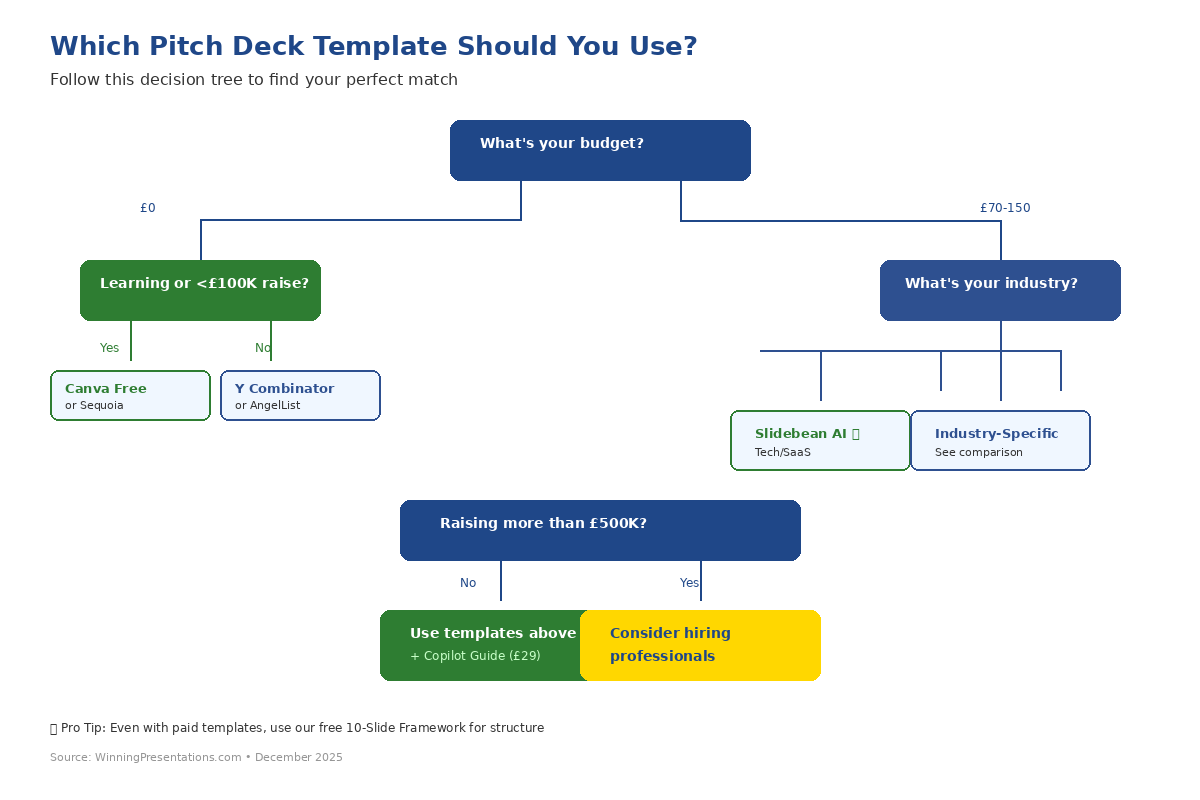
Answer these questions to find your perfect template:
Quick Decision Guide
Q1: What’s your budget?
- £0 → Sequoia (structure) + Canva (design)
- Under £100 → Creative Market or University Spinout
- £100-150 → Slidebean or Pitch Deck Fire
Q2: What stage are you raising?
- Pre-seed / Friends & Family → Canva Free or AngelList
- Seed (£500K-2M) → Slidebean or Sequoia
- Series A (£5M+) → Pitch Deck Fire
- Series B+ (£20M+) → Hire professionals
Q3: What’s your industry?
- SaaS/Tech → Slidebean
- Consumer/Fashion → Creative Market
- AI/Data → PitchGround
- Healthcare → HealthTech Template
- Social Impact → Impact/ESG Template
- Deep Tech/Academic → University Spinout
Q4: How much time do you have?
- Need deck in 2 hours → Canva (fastest)
- Have 4-6 hours → Slidebean or Sequoia
- Can invest 8+ hours → Pitch Deck Fire
🤖 Customize Any Template 5x Faster with AI
Once you’ve chosen a template, you’ll spend hours customizing it. Most founders waste 20+ hours fighting with PowerPoint.
Here’s a better approach: Use Microsoft Copilot for PowerPoint to:
- 🤖 Auto-format your template content
- 📊 Generate financial slide charts from Excel data
- 🎨 Apply consistent branding across all slides
- ✍️ Rewrite bullets for clarity and impact
- 📝 Create speaker notes automatically
But most founders use Copilot wrong. Generic prompts like “improve this slide” generate generic results.
🏆 FOR FOUNDERS & EXECUTIVES
Need More Than Templates? Get the Complete System.
The Executive Buy-In Presentation System includes everything you need to present with confidence and close deals — from first pitch to final approval.
- Frameworks that have helped clients raise £250M+
- How to read the room and adapt in real-time
- Scripts for handling investor objections
- Personal review of your pitch deck
Learn More About the Executive Buy-In System → £199
📌 Related: See our complete comparison of 11 pitch deck software tools including Copilot, Gamma, and Beautiful.ai.
💰 When to Stop Using Templates and Hire Professionals
Here’s what I tell every founder: Templates are training wheels. They help you learn structure. But training wheels have limits.
After reviewing 5,000+ decks in 35 years, I can spot template-based pitches in 30 seconds. So can VCs.
Templates Work When:
- ✅ Learning pitch structure (first 3-5 practice decks)
- ✅ Friends & family rounds (under £100K)
- ✅ Accelerator applications (follow their format)
- ✅ Internal stakeholder presentations
- ✅ Creating a first draft to iterate from
Hire Professionals When:
- 💰 Raising £500K+ — Cost of poor deck > cost of professional help
- 🎯 Series A+ rounds — Institutional VCs expect excellence
- ⏰ High stakes, tight timeline — Can’t afford to learn by trial and error
- 📊 Complex business models — Marketplace, B2B2C, hardware, etc.
- 🔄 Multiple rejections — Your deck probably isn’t the problem; your narrative is
The ROI Math:
Template approach:
- Cost: £0-150 + 40 hours of your time
- Result: 3-5% VC conversion rate
- For £2M raise: 60-100 investor meetings needed
Professional approach:
- Cost: £2,000-5,000 + 10 hours of your time
- Result: 15-20% VC conversion rate (our client average)
- For £2M raise: 10-15 investor meetings needed
Savings: 50+ investor meetings (100+ hours), months of fundraising time, and potentially £100K+ in dilution from faster close.
🎯 RAISING £500K+?
Our Clients Have Raised £250M+
Stop wrestling with templates. We build investor-ready decks with proven narrative structure, professional design, and delivery coaching.
Deck Review
Expert feedback on your existing deck
£500
Full Deck Creation
Custom narrative + professional design
£2,000-5,000
Pitch Coaching
Deck + delivery mastery
Custom
Book Free Discovery Call →
30 minutes. No sales pressure. Honest advice on your situation.
❓ Frequently Asked Questions
Can I really raise £1M+ using a free template?
Yes, but success depends on: strong business fundamentals (product-market fit, traction, team), proper customization (not just filling in blanks), understanding narrative structure, and strong verbal delivery. The template provides structure. You provide substance.
Which template do VCs prefer?
VCs don’t care about your template. They care about: Can you articulate a compelling problem? Do you have a defensible solution? Is there evidence of traction? Can this team execute? That said, VCs appreciate decks that follow Sequoia or YC structure because it’s familiar and they can find information quickly.
Should I use PowerPoint, Keynote, or Google Slides?
PowerPoint if you need advanced features or use Copilot. Keynote if you’re in the Apple ecosystem. Google Slides if you collaborate remotely. Reality: Investors don’t care. Use what you’re comfortable with. Export to PDF for sharing.
How many slides should my pitch deck have?
10-15 slides for in-person pitch. Standard structure: Cover, Problem, Solution, Product, Market, Business Model, Traction, Team, Competition, Financials/Ask. Add 15-20 backup slides in an appendix for Q&A.
Do I need different decks for different investors?
Yes. At minimum: (1) Presentation deck — minimal text, visual, supports verbal pitch. (2) Email/reading deck — more text, self-explanatory. Advanced founders also customize for angels vs. VCs vs. strategic investors.
Can AI write my pitch deck?
AI can help with first drafts, financial charts, and rewriting bullets. But AI can’t: write your unique value proposition, create your narrative strategy, or replace understanding of your business. Use AI as a tool to implement your strategy faster, not to create strategy. See our Copilot Master Guide for how.
What’s the biggest mistake founders make with templates?
Treating them as fill-in-the-blank forms. Templates provide structure, not substance. The biggest failures: (1) Not customizing, (2) Ignoring narrative flow, (3) Overloading slides, (4) Using generic AI-generated language, (5) Forgetting verbal delivery.
How long does it take to create a pitch deck?
Using templates: First draft 4-8 hours, revisions 10-20 hours, testing 20-40 hours. Total: 40-80 hours. Hiring professionals: Your time 10-15 hours (interviews, feedback). Templates save money. Professionals save time (which is worth more when fundraising).
📚 Related Resources
🎯 Your Next Step
You’ve now seen the 15 best pitch deck templates in 2026. Here’s what to do:
Remember: The template is the foundation. Your story, metrics, and delivery are what actually raise money.
Good luck with your pitch. 🚀
Mary Beth Hazeldine
Owner & Managing Director, Winning Presentations
With 35 years in presentation consulting and 24 years in corporate banking at JPMorgan, PwC, RBS, and Commerzbank, Mary Beth has reviewed over 5,000 pitch decks and helped clients raise over £250 million. She specializes in AI-enhanced presentation skills for executives and founders.
📧 The Winning Edge Newsletter
Weekly insights on presentations, pitch decks, and executive communication. Join 10,000+ professionals.
Subscribe Free →
Disclosure: This article contains affiliate links. We may earn a commission if you purchase through these links at no extra cost to you. We only recommend templates we’ve tested and believe will benefit our readers. All track records and pricing verified December 2025.