Tag: speaking fear

12 Feb 2026
Professional reflecting on past presentation experience with contemplative expression

Presentation PTSD Is Real: Signs You’re Still Carrying an Old Failure

It was seven years ago. I still remember exactly what I was wearing.

The room had 40 people. I was presenting quarterly results to the leadership team. Slide 12 — a chart I’d built myself — had an error. The CFO spotted it immediately. “These numbers don’t add up,” he said. Not quietly. Not kindly.

For the next three minutes, I stood there while he picked apart my work in front of everyone. My face burned. My voice disappeared. I wanted the floor to open and swallow me whole.

That presentation ended my confidence for years. Every time I stood up to speak after that, I wasn’t in the current room — I was back in that room, waiting for someone to find the error, waiting for the humiliation to start again.

If you’ve had a presentation experience that still affects how you feel about speaking — even years later — you’re not being dramatic. Your nervous system is doing exactly what it’s designed to do. It’s trying to protect you from a threat it still believes is real.

I’m writing about this now because presentation anxiety is increasingly recognised as a genuine psychological response, not a character flaw. Recent understanding of how trauma affects the nervous system explains why “just get over it” doesn’t work — and what actually does.

Quick answer: Presentation trauma occurs when a difficult speaking experience becomes encoded in your nervous system as a threat. Signs include physical reactions (racing heart, sweating, nausea) that seem disproportionate to the current situation, avoidance behaviours, intrusive memories of past failures, and anticipatory anxiety that starts days before a presentation. Recovery involves recognising the pattern, working with your nervous system rather than against it, and gradually rebuilding positive associations with speaking. Some people notice shifts relatively quickly; deeper patterns can take longer. The key is that recovery is possible — your nervous system learned this response, and it can learn something new.

⏰ Presenting in the next 48 hours?

If you need to calm your nervous system before an upcoming presentation, here’s what to do right now:

  1. Tonight: Use a guided nervous system reset before bed (18-20 min)
  2. Tomorrow morning: Avoid caffeine; do 5 minutes of slow breathing
  3. Minutes before: Use a 90-second physical reset in the corridor

Get all three tools → Conquer Speaking Fear £39

Note: This article discusses presentation-related anxiety and trauma responses. While these experiences are common and the techniques here help many people, persistent or severe symptoms may benefit from support with a qualified mental health professional. The term “PTSD” is used colloquially here to describe trauma-like responses to presentation experiences — clinical PTSD is a specific diagnosis that requires professional assessment.

As a certified hypnotherapist who now works with executives on presentation anxiety, I’ve heard hundreds of these stories. The details differ — a forgotten line, a hostile question, a technology failure, a panic attack — but the pattern is remarkably consistent.

Something happened. It felt terrible. And now, years later, it still controls how you feel about presenting.

The good news: this isn’t permanent. Your nervous system learned this fear response, and it can unlearn it. But first, you need to understand what’s actually happening.

Signs You’re Carrying Presentation Trauma

Presentation trauma doesn’t always announce itself obviously. Sometimes it shows up as “I just don’t like presenting” or “I’m not a natural speaker.” But there are specific signs that suggest you’re carrying something from the past:

1. Your Body Reacts Before Your Mind Does

You get an email about an upcoming presentation. Before you’ve even processed what it says, your heart rate increases. Your stomach tightens. Your palms get clammy.

This instant physical response — before conscious thought — is a hallmark of trauma. Your nervous system has flagged “presentation” as a threat and is activating your fight-or-flight response automatically.

2. The Fear Seems Disproportionate

You’re presenting to three friendly colleagues about a topic you know well. Objectively, the stakes are low. But your body is reacting like you’re about to face a firing squad.

When the fear response doesn’t match the actual situation, it’s often because your nervous system is responding to a past threat, not the current one.

3. You Have Intrusive Memories

When you think about presenting, your mind automatically goes to that time it went wrong. You can see it clearly — the faces, the room, the moment everything fell apart. These memories arrive unbidden and feel uncomfortably vivid.

4. You Avoid at All Costs

You’ve turned down opportunities, delegated important moments to others, or restructured your career to minimise presenting. The avoidance has become a pattern that shapes your professional life.

5. Anticipatory Anxiety Starts Days (or Weeks) Early

A presentation is scheduled for next Thursday. By Sunday, you’re already feeling anxious. By Wednesday night, you can’t sleep. The dread builds exponentially as the date approaches.

6. You Experience Shame, Not Just Fear

There’s a difference between “I’m afraid of presenting” and “I’m ashamed of how I present.” Trauma often carries shame — a feeling that you are fundamentally flawed, not just that the situation is scary.

🎯 Release Presentation Trauma With Guided Nervous System Work

Conquer Speaking Fear uses hypnotherapy and NLP techniques specifically designed to work with your nervous system — not against it. The programme includes three audio tools for different moments:

  • Full Guided Session (18-20 min): Deep nervous system reprogramming — use the night before
  • 90-Second Reset Audio: Quick calm-down for the corridor or bathroom — minutes before
  • Printable Pocket Card: 4-step physical reset — in the moment when you need it

Get Conquer Speaking Fear → £39

Instant download. Created by a certified hypnotherapist who spent five years terrified of presenting — and found a way out.

Why Your Nervous System Won’t “Just Let It Go”

If you’ve ever been told to “just relax” or “it’s not a big deal,” you know how unhelpful that advice is. Here’s why your nervous system doesn’t respond to logic:

The Amygdala Doesn’t Have a Calendar

Your amygdala — the brain’s threat-detection centre — processes experiences without timestamps. A humiliating presentation from 2018 feels just as threatening as one happening right now, because to your amygdala, there’s no difference between “this happened” and “this is happening.”

Emotional Memories Are Stored Differently

Traumatic experiences aren’t filed away like regular memories. They’re stored in a fragmented, sensory way — which is why a particular room layout, a certain type of projector, or even a specific smell can trigger the whole response pattern.

Your Body Keeps the Score

The fear isn’t just in your mind — it’s encoded in your body. Your posture, your breathing pattern, your muscle tension all hold the memory. This is why cognitive approaches (“think positive thoughts”) often fail. The body remembers what the mind tries to forget.

Avoidance Reinforces the Fear

Every time you avoid presenting, your nervous system gets confirmation: “See? That was dangerous. Good thing we escaped.” The avoidance provides temporary relief but strengthens the fear response long-term.

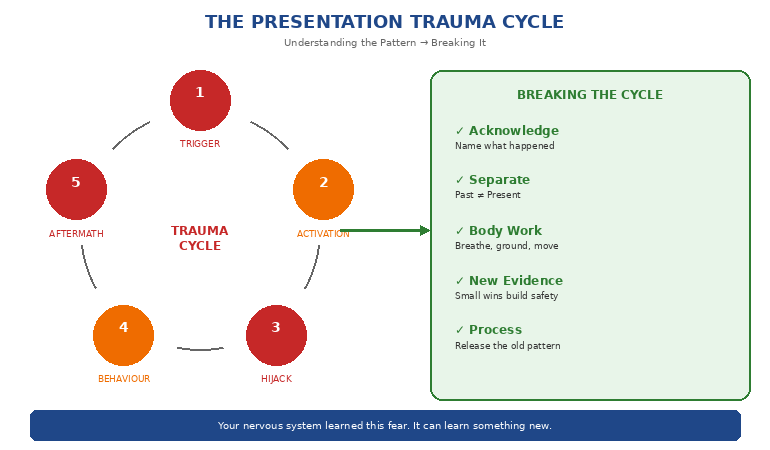
The Trauma Response Cycle

Understanding the cycle helps you interrupt it:

Stage 1: Trigger
Something reminds your nervous system of the original threat — a calendar invite, a request to present, even someone mentioning “presentation” in conversation.

Stage 2: Activation
Your fight-or-flight system activates. Heart rate increases, stress hormones release, blood flows away from your prefrontal cortex (thinking brain) toward your survival systems.

Stage 3: Hijack
Your rational mind goes offline. You can’t think clearly, can’t access your preparation, can’t remember that you’re actually safe. The past has hijacked the present.

Stage 4: Behaviour
You either fight (get defensive, speak too fast, overcompensate), flight (avoid, delegate, call in sick), or freeze (mind goes blank, voice disappears, body locks up).

Stage 5: Aftermath
Regardless of how the presentation actually went, you feel depleted, ashamed, and more convinced than ever that presenting is dangerous. The cycle reinforces itself.


Presentation trauma cycle showing trigger, response, and recovery pathway

Ready to break the cycle? Conquer Speaking Fear includes nervous system techniques that interrupt this pattern — working with your body, not just your mind.

Get the Programme → £39

How to Release the Pattern

Recovery from presentation trauma isn’t about forcing yourself to present more (exposure therapy without proper support often makes things worse). It’s about working with your nervous system to create new associations.

Step 1: Acknowledge What Happened

Stop minimising. “It wasn’t that bad” or “I should be over it by now” keeps you stuck. Something happened that affected you. That’s real. Your response makes sense given what you experienced.

I spent years pretending my CFO moment didn’t bother me. Recovery only started when I admitted: that was humiliating, it hurt, and it changed how I felt about presenting.

Step 2: Separate Past from Present

When you notice the fear response activating, practice naming it: “This is my nervous system responding to 2018, not to today.” You’re not trying to make the feeling go away — you’re creating space between the trigger and your response.

Step 3: Work With Your Body

Because the trauma is stored in your body, body-based techniques are often more effective than cognitive ones:

  • Slow exhales: Longer exhales than inhales can help activate your parasympathetic nervous system
  • Grounding: Feel your feet on the floor, your weight in the chair — anchor yourself in the present moment
  • Movement: Shake out your hands, roll your shoulders — discharge the physical activation
  • Posture reset: Stand tall, open your chest — your body’s position affects your emotional state

Step 4: Create New Experiences

Your nervous system needs evidence that presenting can be safe. This doesn’t mean forcing yourself into high-stakes situations. It means starting small:

  • Speaking up in a meeting with one comment
  • Presenting to one trusted colleague
  • Recording yourself and watching without judgment
  • Gradually increasing the challenge as your nervous system adapts

Step 5: Process the Original Experience

Sometimes the old memory needs direct attention. Techniques like guided visualisation, timeline therapy, or working with a therapist can help you process what happened so it no longer controls your present.

This is where hypnotherapy-based approaches can be particularly effective — they work directly with the subconscious patterns that keep the trauma response active.

🧠 Nervous System Reprogramming for Presentation Trauma

Conquer Speaking Fear was created specifically for professionals carrying presentation trauma. The guided hypnotherapy session helps your nervous system release the old pattern and build new, calmer associations with speaking.

  • Work with your subconscious, not against it
  • Release the physical holding patterns
  • Build genuine confidence (not just “fake it”)
  • Three audio formats for different situations

Get Conquer Speaking Fear → £39

Instant download. Developed from hypnotherapy techniques that helped me release my own presentation trauma after five years of suffering.

Rebuilding Confidence After a Bad Experience

Once you’ve started releasing the trauma pattern, you can begin rebuilding genuine confidence:

Reframe the Original Story

The story you tell yourself about what happened matters. “I failed and everyone saw” is different from “I had a difficult experience and I survived it.”

My CFO story? I eventually reframed it: “I made an error, someone called it out publicly, and I handled a difficult moment without falling apart completely. I went back to work the next day. I kept presenting. I survived.”

Collect Counter-Evidence

Your brain has been selectively remembering the bad experience. Start noticing the neutral and positive ones. After each presentation — even a small one — note what went okay. Build a file of evidence that presenting doesn’t always mean disaster.

Prepare Differently

Trauma often creates over-preparation (spending 20 hours on a 10-minute presentation) or under-preparation (avoiding thinking about it until the last minute). Neither works.

Effective preparation for trauma recovery means: know your content well enough to feel secure, but accept that perfection isn’t the goal. Your safety doesn’t depend on getting everything right.

Build Physical Anchors

Create associations between specific physical actions and calm states. When you’re relaxed, practice a subtle gesture (touching your thumb to your finger, for example). Over time, this gesture can help trigger the calm state — giving you a tool you can use in the moment.

This anchoring technique is part of what makes nervous system-based approaches so effective for presentation anxiety.

Want anchoring techniques you can use immediately? The Conquer Speaking Fear pocket card includes a physical anchor sequence designed for presentation moments.

Get the Pocket Card + Full Programme → £39

What Recovery Actually Looks Like

Recovery from presentation trauma isn’t linear, and it doesn’t mean you’ll never feel nervous again. Here’s what realistic progress looks like:

Week 1-2: You start noticing the pattern — recognising when your nervous system is responding to the past rather than the present.

Week 3-4: The anticipatory anxiety begins to shorten. Instead of dreading a presentation for two weeks, you might dread it for a few days.

Month 2-3: You have a presentation that goes “okay” and notice it. The negative bias starts shifting.

Month 3-6: The physical symptoms become less intense. Your heart still races, but it doesn’t feel life-threatening. You can think while nervous.

Ongoing: Presenting becomes uncomfortable rather than terrifying. You can do it without it ruining your week. Eventually, some presentations feel almost… fine.

This timeline varies. Some people see significant shifts in weeks; others take longer. The key is that progress is possible — your nervous system can learn new patterns.

🎯 Start Your Recovery Today

Conquer Speaking Fear gives you everything you need to begin releasing presentation trauma:

  • Full Guided Session: Deep reprogramming work (use night before presentations)
  • 90-Second Reset: Quick nervous system calm-down (use minutes before)
  • Pocket Card: Physical anchor sequence (use in the moment)
  • Technique Guide: Understanding why this works and how to maximise results

Get Conquer Speaking Fear → £39

Instant download. Created by a certified hypnotherapist with 24 years of corporate experience — who knows exactly what it feels like to carry presentation trauma.

Frequently Asked Questions

Is “presentation PTSD” a real diagnosis?

The term is used colloquially to describe trauma-like responses to presentation experiences. Clinical PTSD is a specific diagnosis with defined criteria that requires professional assessment. However, the nervous system responses described in this article — hypervigilance, avoidance, intrusive memories, disproportionate fear responses — are real and well-documented, even if they don’t meet the clinical threshold for PTSD. Your experience is valid regardless of diagnostic labels.

How long does it take to recover from presentation trauma?

This varies significantly based on the severity of the original experience, how long ago it happened, and what support you have. Some people notice shifts within a few weeks; deeper patterns may take several months of consistent work. There’s no universal timeline — everyone’s nervous system responds differently. If you’re not seeing progress after sustained effort, consider working with a therapist who specialises in anxiety or trauma responses. The key is that recovery is possible — your nervous system learned this response, and it can learn a new one.

Should I force myself to present more to get over it?

Exposure without proper support can actually reinforce the trauma. Simply forcing yourself through more presentations while activated often strengthens the fear response. The goal is to present while regulated — which requires first developing tools to work with your nervous system. Gradual, supported exposure works; white-knuckling through high-stakes presentations usually doesn’t.

Can I fully recover, or will I always be anxious about presenting?

Most people don’t become completely anxiety-free — some presentation nerves are normal and even useful. What changes is the intensity and the control. Instead of anxiety hijacking your ability to think and speak, it becomes manageable background noise. Many people who’ve done this work eventually describe presenting as “uncomfortable but doable” rather than “terrifying and avoided at all costs.”

📬 PS: Weekly techniques for managing presentation anxiety and building genuine confidence. Subscribe to The Winning Edge — practical strategies from a hypnotherapist who’s been there.

Related: If presentation trauma is holding you back from career moments like requesting resources or budget, read The Headcount Request That Got Yes When Everyone Said No for a presentation structure that builds confidence through preparation.

That presentation from years ago — the one you still think about — doesn’t have to control your future.

Your nervous system is doing what it was designed to do: protect you from perceived threats. But the threat isn’t real anymore. The room is different. The audience is different. You are different.

Recovery is possible. Your nervous system learned to fear presenting, and it can learn something new.

It starts with acknowledging what happened, understanding why your body responds the way it does, and working with your nervous system rather than against it.

The past doesn’t have to own your present. You can let it go.

About the Author

Mary Beth Hazeldine is the Owner & Managing Director of Winning Presentations. With 24 years in corporate banking at JPMorgan Chase, PwC, Royal Bank of Scotland, and Commerzbank, she experienced presentation trauma firsthand — including five years of debilitating fear before finding techniques that actually worked.

Now a certified hypnotherapist and NLP practitioner, Mary Beth specialises in helping professionals release presentation anxiety at the nervous system level. She combines executive communication expertise with evidence-based approaches to fear and trauma recovery.

Book a discovery call | View services

Also available: Executive Slide System (£39) — confident-presenter templates that reduce preparation stress.

04 Feb 2026
Executive holding a pill before a presentation, deciding whether to take beta blockers for public speaking anxiety

I Kept Beta Blockers in My Desk for 3 Years. Here’s Why I Never Took One.

Quick answer: Yes, executives take beta blockers before presentations. More than you think. But medication manages the symptoms without touching the fear underneath — and after 24 years in corporate banking and training as a clinical hypnotherapist, I can tell you there is a faster, more permanent path. Here is the honest breakdown of what works, what doesn’t, and what nobody in the boardroom will admit to.

I kept a box of propranolol in my desk drawer for three years.

Not prescribed. Borrowed from a colleague who “got them for migraines.” Every Monday morning, I would open the drawer, look at the box, and wonder if today was the day I would finally take one.

I never did. Not because I was brave, but because I was more afraid of the pill than the presentation. What if it made me drowsy? What if my boss noticed? What if I became dependent and couldn’t present without it?

Those three years taught me something that changed the direction of my career entirely. Working at JPMorgan Chase, then PwC, then Royal Bank of Scotland, I discovered that the medication question isn’t really about medication at all. It is about whether you want to manage the fear — or actually resolve it.

After training as a clinical hypnotherapist, I now understand exactly why I was right to hesitate. And why so many executives don’t.

Comparison chart showing beta blockers versus nervous system retraining for presentation anxiety, with pros and cons of each approach

The Pill in the Boardroom Bathroom

Let me paint you a picture you will recognise.

It is 8:47am. You are presenting the quarterly update to the leadership team at 9:00. You are sitting in the bathroom stall. Your heart is hammering so loudly you can feel it in your ears. Your hands are cold and damp. Your mouth has gone completely dry.

And you are Googling “can I take a beta blocker 15 minutes before a presentation.”

I have been that person. Hundreds of executives I have worked with have been that person. The medication question is the most common thing I am asked in private — and the thing nobody will raise in a group setting.

Here is the reality: beta blockers for public speaking are extraordinarily common among senior professionals. Concert musicians have used propranolol for decades. Surgeons use them. Barristers use them. And yes — your colleagues on the executive floor use them too.

The question is not whether they work. They do, for certain symptoms. The question is whether they are the right solution for you.

What Beta Blockers Actually Do (And What They Don’t)

⚕️ Not medical advice. Beta blockers are prescription medication. Talk to your GP before taking them — they are not suitable for everyone, particularly those with asthma, low blood pressure, or certain heart conditions. This article discusses their use for presentation anxiety from a practical and psychological perspective, not a clinical one.

Beta blockers — typically propranolol — work by blocking adrenaline receptors. When your fight-or-flight response fires before a presentation, adrenaline floods your body. Propranolol stops that adrenaline from reaching your heart and muscles.

What beta blockers DO:

They slow your heart rate. They reduce hand tremor. They stop the visible shaking. They prevent that “thumping chest” sensation that makes you feel like everyone can see your fear. For purely physical symptoms, they can be remarkably effective within 30–60 minutes.

What beta blockers DON’T do:

They do not touch the fear itself. They do not stop the negative thought loop (“they’re judging me,” “I’m going to forget my words,” “they can tell I’m nervous”). They do not build confidence. They do not improve your presentation skills. And critically — they do not help you the day you forget to take one.

This is the distinction most people miss. Beta blockers manage the physical expression of anxiety. They do not address the neurological pattern that creates it.

I have worked with executives who took propranolol before every presentation for five, ten, even fifteen years. When they finally forgot the pill or couldn’t get a refill in time, the panic returned at full force — sometimes worse than before, because now they had an additional fear layered on top: “I can’t present without my medication.”

Do executives take beta blockers before presentations?

Yes — far more commonly than most people realise. Beta blockers like propranolol are widely used by senior professionals to manage the physical symptoms of presentation anxiety, including racing heart and hand tremor. However, they only address symptoms and do not resolve the underlying fear. Many executives use them as a temporary bridge while developing longer-term anxiety management skills.

Your Fear Has a Pattern. You Can Break It.

Conquer Speaking Fear uses clinical hypnotherapy and NLP techniques to retrain the neurological pattern that creates presentation anxiety — not just mask the symptoms. No medication. No willpower. A different nervous system response.

Get Conquer Speaking Fear → £39

Designed by a clinical hypnotherapist with 24 years of corporate banking experience who overcame her own 5-year presentation phobia. Evidence-based. Permanent.

The Executive Anxiety Secret Nobody Discusses

When I started training executives after leaving banking, the most surprising discovery was not how many professionals struggled with presentation anxiety. It was how many senior professionals struggled with it — and how completely they hid it.

Managing Directors. Partners. C-suite leaders. People who looked utterly composed at the front of the room.

Behind closed doors, here is what they told me:

“I’ve been taking propranolol before every board meeting for eight years. My wife doesn’t even know.”

“I rearranged my entire schedule last quarter to avoid presenting at the all-hands. I told my team I had a conflict.”

“I drink two glasses of wine before evening events where I might have to speak. I’ve done it for so long I don’t even think about it anymore.”

These are not weak people. These are accomplished professionals with decades of experience, running teams of hundreds, making decisions worth millions. And they are quietly medicating, drinking, or avoiding their way around a neurological pattern that nobody taught them how to change.

The shame keeps the problem invisible. And the invisibility keeps people reaching for the quick fix — because they do not know a permanent solution exists.

You are not broken — you have a pattern. And patterns can be changed.

Retrain the Fear Pattern → £39

The Dependency Trap: When Medication Becomes a Crutch

I want to be clear: I am not anti-medication. Beta blockers are safe when prescribed appropriately, they have genuine medical applications, and for some people they serve as a valuable bridge while doing deeper work.

But here is the pattern I see repeatedly in my practice:

Stage 1: The relief. You take propranolol before a big presentation. Your heart doesn’t race. Your hands don’t shake. You think: “This is the answer.”

Stage 2: The habit. You take it before the next presentation. And the one after. You start carrying it “just in case.” The box moves from your desk drawer to your briefcase.

Stage 3: The dependency belief. You begin to believe you cannot present without it. This is not a physical dependency — beta blockers are not addictive. It is a psychological dependency. Your brain has created a new rule: “Safe presentations require medication.”

Stage 4: The expanded fear. Now you have two fears. The original presentation anxiety, plus a new one: “What happens if I can’t get my pills?” Travel, forgotten prescriptions, running out of refills — all become sources of anxiety that didn’t exist before.

This is not a theoretical risk. I have worked with three executives in the past year alone who came to me specifically because their propranolol dependency had escalated their presentation nerves rather than reduced them.

The beta blocker dependency cycle: four stages from initial relief to expanded fear, showing how medication can reinforce presentation anxiety

Is propranolol safe for public speaking?

Propranolol is generally considered safe for occasional use before presentations when prescribed by a doctor. It effectively reduces physical symptoms like rapid heartbeat and trembling. However, it can cause lightheadedness, fatigue, and a feeling of emotional disconnection. The larger concern is not physical safety but psychological dependency — the belief that you cannot present without it — which reinforces the anxiety pattern rather than resolving it.

Stop Managing the Symptom. Resolve the Cause.

Conquer Speaking Fear is built on the same clinical hypnotherapy and NLP techniques that resolved my own 5-year presentation phobia — without medication, without white-knuckling it, without “just pushing through.” The nervous system pattern changes permanently.

Get Conquer Speaking Fear → £39

24 years of corporate banking experience. Qualified clinical hypnotherapist and NLP practitioner. Evidence-based techniques from real executive training. A fraction of the cost of one therapy session.

What Actually Works Long-Term (From a Hypnotherapist Who Lived It)

I was terrified of presenting for five years. Not mildly nervous — terrified. Racing heart, dry mouth, shallow breathing, the full physiological cascade that makes you want to cancel, call in sick, or find any excuse to let someone else present.

Beta blockers would have masked the symptoms. But here is what actually resolved the fear permanently:

1. Understand the pattern. Presentation anxiety is not a character flaw. It is a learned neurological response — your amygdala firing a threat signal based on a past experience (or series of experiences) where speaking in front of others felt dangerous. Once you see it as a pattern, you can change it.

2. Work at the subconscious level. This is where medication falls short. The fear response is generated below conscious awareness. Talking about it (traditional therapy) and thinking about it (willpower) operate at the wrong level. Clinical hypnotherapy and NLP techniques access the subconscious pattern directly.

3. Replace the response — don’t suppress it. Beta blockers suppress adrenaline. Hypnotherapy replaces the fear trigger with a calm, resourceful state. The difference: suppression requires ongoing medication. Replacement is permanent.

4. Build evidence. Every successful presentation without medication builds genuine neural evidence that you can do this. Medication-assisted presentations don’t build this evidence — your brain attributes the calm to the pill, not to you.

This is exactly the approach I built into Conquer Speaking Fear — the same techniques that got me from vomiting in the corridor to confidently presenting to boardrooms across three continents.

Replace the fear response — don’t suppress it. Clinical hypnotherapy and NLP techniques that create permanent change.

Get Conquer Speaking Fear → £39

Retrain Your Nervous System — Not Just Your Symptoms

Here is the simplest way to think about the choice:

Beta blockers = turn down the volume on the alarm. The alarm still fires. You just don’t hear it as loudly. Remove the volume control, and the alarm is still there.

Nervous system retraining = change what triggers the alarm. When the presenting situation no longer registers as a threat, the alarm doesn’t fire. Nothing to suppress. Nothing to medicate. Nothing to remember to pack in your briefcase.

I have worked with executives who spent years — and thousands of pounds — on therapy, coaching, and medication. When they finally addressed the subconscious pattern, the shift happened in weeks, not years.

If you are currently using beta blockers and they are helping you function, I am not suggesting you stop immediately. But I am suggesting you start building the permanent solution alongside them. Use the medication as a bridge, not a destination. Work on calming your nerves at the source, and you will find you need the bridge less and less — until one day you leave the pill in the drawer and present anyway.

That is the day everything changes.

What are natural alternatives to beta blockers for presentations?

The most effective natural alternatives address the root neurological pattern rather than just symptoms. Clinical hypnotherapy and NLP retraining can permanently change the fear response. For immediate physical relief, diaphragmatic breathing (4-7-8 technique), peripheral vision activation, and bilateral stimulation can reduce the fight-or-flight response within 60–90 seconds. These techniques build genuine confidence because your brain learns it can manage the situation without external support.

Present Without the Pill. Permanently.

Conquer Speaking Fear gives you the clinical hypnotherapy and NLP techniques I used to overcome my own 5-year presentation phobia — and that I now teach to executives navigating the same fear.

No medication. No willpower. A fundamentally different nervous system response to presenting.

Get Conquer Speaking Fear → £39

Less than the cost of one GP consultation. Designed by a clinical hypnotherapist with 24 years of corporate banking experience. Evidence-based. Permanent.

📊 Want the slides too?

Preparation reduces anxiety. The Executive Slide System (£39) includes confident-presenter templates designed to minimise preparation stress. When your slides are structured for executive approval, your nervous system has one less thing to panic about.

Frequently Asked Questions

Can I take beta blockers and do nervous system retraining at the same time?

Absolutely — and this is often the smartest approach. Use beta blockers as a bridge while actively retraining your fear response through hypnotherapy or NLP techniques. As the retraining takes effect, you will naturally find you need the medication less. Many of my clients follow this exact path: medication provides immediate relief while the deeper work creates permanent change. The key is treating the medication as temporary support, not a long-term solution.

My presentation anxiety is only physical — surely medication is the right answer?

This is one of the most common misconceptions. What feels “only physical” — racing heart, trembling, sweating — is actually the physical expression of a subconscious fear pattern. Your amygdala detects a perceived threat and triggers the adrenaline cascade. Beta blockers block the adrenaline from reaching your muscles and heart, but your amygdala still fires the threat signal every single time. Address the signal itself, and the physical symptoms resolve naturally without medication.

How long does nervous system retraining take compared to medication?

Medication works in 30–60 minutes but stops working when you stop taking it. Nervous system retraining through clinical hypnotherapy and NLP typically shows significant improvement within 2–4 weeks of consistent practice, with permanent results. Most executives I work with notice a measurable reduction in their presentation anxiety after the first week. The trade-off is clear: immediate but temporary symptom relief versus slightly longer but permanent resolution.

Will my doctor judge me for asking about beta blockers for presentations?

No. GPs prescribe propranolol for performance anxiety regularly — it is one of the most common off-label uses. If you want to discuss it with your doctor, be direct: “I experience significant physical anxiety symptoms before work presentations and I would like to discuss whether propranolol might help as a short-term bridge while I work on longer-term solutions.” Most doctors will appreciate the thoughtful approach and the fact that you are not looking for a permanent prescription.

📧 The Winning Edge Newsletter

Weekly insights on presentation confidence, evidence-based anxiety techniques, and what actually works for professionals who need to present at a senior level.

Subscribe Free →

📋 Free: 7 Presentation Frameworks

Structure reduces anxiety. When your presentation has a proven framework behind it, your nervous system has one less unknown to panic about. These seven frameworks give you that certainty before you even open PowerPoint.

Download Free Frameworks →

P.S. Presenting this week and need immediate physical relief? Calm Under Pressure (£19.99) gives you rapid nervous system resets for the corridor before you walk in — no prescription needed.

📌 Related: Even when the anxiety is managed, most executives receive feedback that sounds positive but means nothing. Read Why “Great Presentation” Is the Worst Feedback You Can Get — and learn how to get the actionable input that actually improves your next performance.

Your next step: If you have been reaching for medication before presentations — or thinking about it — recognise that as a signal, not a solution. The fear has a pattern. The pattern can be changed. Start with understanding why the fear exists, then use Conquer Speaking Fear to retrain the response permanently.

Leave the pill in the drawer. Build the skill instead.

About the Author

Mary Beth Hazeldine is the Owner & Managing Director of Winning Presentations. With 24 years of corporate banking experience at JPMorgan Chase, PwC, Royal Bank of Scotland, and Commerzbank, she has delivered high-stakes presentations in boardrooms across three continents.

A qualified clinical hypnotherapist and NLP practitioner, Mary Beth combines executive communication expertise with evidence-based techniques for managing presentation anxiety. She has trained thousands of executives and supported presentations that have secured funding and approvals for high-stakes projects and pitches.

Book a discovery call | View services

03 Feb 2026
Professional woman experiencing emotional moment during presentation, showing vulnerability and composure

What Happens When You Cry During a Presentation (I Know Because I Did)

The tears came without warning.

I was presenting our quarterly results to 40 colleagues. Slide 7. Nothing emotional—just revenue figures. And suddenly my throat closed, my eyes burned, and I felt the first tear escape before I could stop it.

I’d been running on four hours of sleep for two weeks. My father had just been diagnosed with cancer. I hadn’t told anyone at work. And my body chose that moment—in front of my entire department—to finally break.

I excused myself for water. Came back. Finished the presentation with a shaky voice and mascara I was certain had migrated somewhere terrible. Spent the next three days convinced my career was over.

It wasn’t. But the shame lasted longer than it should have, because nobody had ever told me what I’m about to tell you.

Quick answer: Crying during a presentation feels catastrophic in the moment, but it’s rarely the career-ending disaster it seems. What matters most is your recovery—not preventing the tears entirely. The 30-second reset (pause, breathe, acknowledge briefly, continue) preserves far more credibility than fighting visible tears or fleeing the room. Crying happens because your nervous system is overwhelmed—by stress, exhaustion, personal circumstances, or accumulated pressure. It’s a physiological response, not a character flaw. This article covers what actually happens when you cry during a presentation, why it occurs, and the specific recovery techniques that protect your professional standing.

⚡ Presenting Soon and Worried About This?

If you’re reading this because you have a presentation coming up and you’re afraid of losing composure, here’s the emergency protocol:

  1. Before: Press your thumbnail hard into your index finger during high-emotion moments. The mild pain interrupts the crying reflex.
  2. If tears start: Pause. Say “Give me just a moment.” Take three slow breaths. Nobody judges a brief pause.
  3. To continue: Lower your voice slightly and slow your pace. This signals control even when you don’t feel it.
  4. Afterwards: Do NOT apologise repeatedly. One brief acknowledgment maximum, then move forward.

This won’t solve the underlying vulnerability, but it will get you through the immediate situation. For the deeper work, keep reading.

Why Crying During Presentations Happens

Tears during presentations aren’t about weakness. They’re about nervous system overload.

Your body has a threshold for stress. When cumulative pressure exceeds that threshold—sleep deprivation, personal problems, work stress, the presentation itself—your nervous system needs to discharge the excess. Tears are one discharge mechanism. So is trembling. So is the urge to flee.

The cruel irony: the harder you try to suppress tears, the more pressure builds, and the more likely they become. Fighting the crying reflex is like trying to hold back a sneeze—sometimes you can, but often the effort makes it worse.

Common triggers include:

  • Accumulated stress that finally finds an outlet
  • Sleep deprivation (your emotional regulation is significantly impaired after poor sleep)
  • Personal circumstances you’re carrying while trying to perform professionally
  • Feeling attacked or criticised during Q&A
  • Talking about something you genuinely care about (passion and tears share neural pathways)
  • The frustration of not being heard or feeling dismissed

None of these make you unprofessional. They make you human.

For more on the physiological side of presentation anxiety, see my article on managing high-stakes presentation nerves.

What Others Actually See (It’s Not What You Think)

Here’s what I wish someone had told me after that quarterly review:

You experience your tears from the inside. Everyone else sees them from the outside.

From the inside, crying feels like complete loss of control. Humiliation. Exposure. The end of any credibility you’d built.

From the outside? People see a colleague who got emotional for a moment. Most feel empathy, not judgment. Many have been there themselves. The ones who judge harshly reveal more about themselves than about you.

What actually damages credibility:

  • Fleeing the room in visible distress
  • Apologising repeatedly throughout the rest of the presentation
  • Bringing it up again and again in the following days
  • Making others feel responsible for managing your emotions

What preserves credibility:

  • A brief pause to collect yourself
  • Continuing with quiet dignity
  • One brief acknowledgment (“I apologise for that moment”) and then moving on
  • Not making it a bigger deal than it needs to be

The research on this is clear: how you handle emotional moments matters far more than whether they occur. Leaders who show authentic emotion and recover gracefully are often rated more trustworthy than those who seem robotically controlled.

Comparison of internal experience versus external perception when crying during a presentation, plus the 30-second recovery protocol

🎯 Build Unshakeable Presentation Composure

Conquer Speaking Fear is a comprehensive programme for professionals who want to present with genuine confidence—not performed confidence that cracks under pressure. Developed from clinical hypnotherapy and NLP techniques that address the nervous system directly.

What’s included:

  • Nervous system regulation techniques
  • The emotional anchor method
  • Recovery protocols for high-pressure moments
  • Long-term resilience building

Get Conquer Speaking Fear → £39

Instant download. Built for high-pressure professional moments: quarterly updates, steering committees, and senior stakeholder meetings.

The 30-Second Recovery Protocol

If you feel tears coming or they’ve already started, here’s the protocol that works:

Step 1: Pause (5 seconds)

Stop speaking. Don’t try to power through while visibly crying—it makes everyone uncomfortable and damages your credibility more than a pause would.

Simply stop. Look down at your notes or take a sip of water if available.

Step 2: Breathe (10 seconds)

Take two or three slow, deep breaths. This isn’t just calming—it physiologically interrupts the crying reflex by activating your parasympathetic nervous system.

Breathe in for 4 counts, out for 6. The extended exhale is what triggers the calming response.

Step 3: Acknowledge Briefly (5 seconds)

One sentence maximum. Choose based on context:

  • “Give me just a moment.” (neutral, professional)
  • “This topic matters to me. Let me collect myself.” (if the content is genuinely emotional)
  • “I apologise—let me continue.” (if you need to move past it quickly)

Do NOT over-explain. Do NOT apologise repeatedly. One acknowledgment, then move forward.

Step 4: Continue with Adjusted Delivery (10 seconds to recalibrate)

When you resume, speak slightly slower and slightly lower in pitch than normal. This signals control and authority even when you don’t feel it internally.

If you have notes, use them more directly for the next few minutes. Nobody expects perfect recall after an emotional moment.

🎯 Want the complete recovery toolkit? Conquer Speaking Fear (£39) includes in-the-moment recovery protocols plus the deeper nervous system work that reduces vulnerability over time.

Managing the Aftermath

What you do in the hours and days after matters almost as much as the recovery itself.

The First Hour

Don’t flee immediately. If possible, stay for a few minutes after the presentation. Chat normally with a colleague or two. This signals that you’re fine and prevents the “dramatic exit” narrative.

Don’t apologise to everyone individually. One acknowledgment in the room was enough. Going person to person saying “I’m so sorry about that” makes it a bigger deal than it needs to be.

The First Day

If someone brings it up kindly: “Thank you—I had a lot going on that day. I appreciate your understanding.” Then change the subject.

If someone brings it up critically: “I’m human. It won’t affect my work.” No further explanation needed. You don’t owe anyone a justification for having emotions.

The Following Week

Deliver something excellent. The best way to move past an emotional moment is to demonstrate competence in your next visible contribution. Don’t hide—show up and perform.

Don’t keep bringing it up. If you make self-deprecating jokes about it for weeks, you’re the one keeping it alive. Let it fade.

For more on managing the anxiety that can follow difficult presentation experiences, see my article on presentation anxiety before meetings.

💡 The Shame is Usually Worse Than the Reality

In my experience—both personal and working with professionals across industries—the internal experience of crying during a presentation is almost always worse than the external impact. Most colleagues are more empathetic than you expect. Most have their own vulnerable moments they remember. The shame you carry is usually disproportionate to the actual professional consequences.

Reducing Vulnerability Long-Term

While you can’t guarantee you’ll never cry during a presentation, you can significantly reduce your vulnerability.

Address the Basics

Sleep. Emotional regulation is severely impaired when you’re sleep-deprived. Before high-stakes presentations, prioritise sleep above extra preparation.

Stress load. If you’re carrying significant personal stress, consider whether this is the right time for optional high-visibility presentations. Sometimes the wisest choice is to postpone or delegate.

Build Nervous System Resilience

Your nervous system can be trained to handle higher levels of activation without triggering emotional overflow. Techniques include:

  • Regular breathwork practice (not just in emergencies)
  • Progressive exposure to speaking situations
  • Anchoring techniques from NLP that create instant access to calm states
  • Somatic practices that discharge accumulated stress before it reaches overflow

Reframe the Stakes

Often, we cry during presentations because we’ve made the stakes impossibly high in our minds. This presentation will determine my career. Everyone will judge me. I must be perfect.

Realistic reframing: This is one presentation among many. People are mostly thinking about themselves. Imperfection is human and often more relatable than polish.

For deeper work on the panic response that can precede tears, see my article on managing panic attacks before presentations.

🎯 Transform Your Relationship with Presentation Pressure

Conquer Speaking Fear isn’t about suppressing emotions—it’s about building genuine resilience so your nervous system can handle pressure without overwhelm. Developed from clinical hypnotherapy and NLP, used by professionals who need to present under real pressure.

The programme includes:

  • Nervous system regulation foundations
  • The emotional anchor technique
  • In-the-moment recovery protocols
  • Long-term resilience building
  • Reframing techniques for high-stakes situations

Get Conquer Speaking Fear → £39

Instant download. Build the resilience that prevents overwhelm before it starts.

Frequently Asked Questions

What causes crying during presentations?

Crying during presentations is a nervous system overflow response. It occurs when cumulative stress exceeds your current capacity—triggered by factors like sleep deprivation, personal circumstances, feeling attacked or criticised, passion about the topic, or accumulated work pressure. It’s physiological, not a character flaw. Your body needs to discharge excess activation, and tears are one mechanism for that discharge.

How do you stop yourself from crying mid-presentation?

The most effective technique is the extended exhale: breathe in for 4 counts, out for 6-8 counts. This activates your parasympathetic nervous system and interrupts the crying reflex. Physical interrupts also work—pressing your thumbnail into your finger or pressing your tongue to the roof of your mouth. However, if tears have already started, trying to suppress them often makes it worse. A brief pause to collect yourself preserves more credibility than visibly fighting tears while continuing to speak.

What should you say if you start crying during a presentation?

Keep it brief—one sentence maximum. Options include: “Give me just a moment” (neutral), “This topic matters to me—let me collect myself” (if content is genuinely emotional), or simply “I apologise, let me continue” (if you want to move past it quickly). Do not over-explain, repeatedly apologise, or provide detailed context for why you’re emotional. One acknowledgment, then continue.

Is it unprofessional to cry during a presentation?

Having emotions is human, not unprofessional. What matters is how you handle the moment. A brief pause, composure recovery, and continuing with dignity actually demonstrates emotional intelligence and resilience. What damages professionalism is fleeing the room in distress, apologising repeatedly, or making others feel responsible for managing your emotions. Research shows leaders who show authentic emotion and recover gracefully are often rated more trustworthy than those who seem artificially controlled.

Can you recover professionally after crying in front of colleagues?

Yes, absolutely. The key is not making it a bigger deal than necessary. Don’t apologise to everyone individually, don’t keep bringing it up, and don’t hide afterwards. Show up, deliver excellent work in your next visible contribution, and let the moment fade. Most colleagues are more understanding than you expect—many have their own vulnerable moments they remember. Your subsequent performance matters far more than one emotional moment.

Why do some people cry more easily than others?

Crying thresholds vary based on nervous system sensitivity, current stress load, sleep quality, hormonal factors, and life circumstances. Some people’s nervous systems are simply more reactive—this isn’t weakness, it’s biology. Additionally, accumulated stress lowers everyone’s threshold. Someone who cries easily during a difficult period may have much higher resilience when their overall stress load is lower. The good news: nervous system resilience can be trained and improved over time.

How long does it take to recover credibility after crying at work?

In most cases, much shorter than you fear. If you handle the moment with dignity and don’t keep drawing attention to it, colleagues typically move on within days. Your next solid contribution accelerates this. The exception is if you make the incident into an ongoing narrative—repeatedly apologising, making self-deprecating comments, or avoiding situations. That keeps it alive. The fastest path to recovery is demonstrating competence in your next visible moment and letting the incident fade naturally.

📧 The Winning Edge Newsletter

Weekly insights on presenting with confidence, managing presentation anxiety, and building genuine resilience under pressure. From a clinical hypnotherapist who’s been exactly where you are.

Subscribe Free →

📋 Free: 7 Presentation Frameworks

Structure reduces anxiety. These seven frameworks give you reliable starting points for any presentation situation—so you can focus on delivery instead of wondering what comes next.

Download Free Frameworks →

About the Author

Mary Beth Hazeldine is the Owner & Managing Director of Winning Presentations. With 24 years of corporate banking experience at JPMorgan Chase, PwC, Royal Bank of Scotland, and Commerzbank, she knows what it’s like to present under real pressure—and what it costs when it goes wrong.

A qualified clinical hypnotherapist and NLP practitioner, Mary Beth overcame five years of severe presentation anxiety using the techniques she now teaches. She works with thousands of executives on building genuine presentation confidence.

Mary Beth overcame five years of severe presentation anxiety using the techniques she now teaches.

Your Next Step

If you’re reading this because it already happened—I’m sorry. I know how it feels. The shame, the replaying, the certainty that everyone is talking about you.

They’re probably not. And even if they are, it will pass faster than you think.

What matters now is what you do next. Show up. Do good work. Don’t apologise again. Let it fade.

And if you’re reading this because you’re afraid it might happen—that fear itself increases the likelihood. The nervous system techniques in this article can help, but the deeper work is learning to present from a place of genuine resilience rather than performed control.

You’re allowed to be human. Even at work. Even during presentations.

Related: If you’re preparing for a high-stakes meeting and worried about composure, see today’s companion article on the all-hands meeting mistakes that destroy morale—because good structure reduces the pressure that leads to emotional overwhelm.

31 Jan 2026
Professional woman in corporate hallway before presentation, contemplative expression showing pre-presentation anxiety

The Presentation Phobia Nobody Talks About: It’s Not the Audience

I vomited in a bathroom stall before presenting to twelve people.

Twelve. Not twelve hundred. Twelve colleagues I’d worked with for years. People who liked me. People who wanted me to succeed.

It didn’t matter. My hands shook so badly I couldn’t hold my notes. My voice cracked on the second sentence. I rushed through 20 minutes of material in 8 minutes, then fled to my desk pretending I had an urgent email.

That was year three of my glossophobia. I had two more years of terror ahead of me before I finally understood what was actually happening—and why everything I’d tried wasn’t working.

Here’s what I discovered: glossophobia isn’t fear of the audience. It’s fear of being exposed.

Quick answer: Glossophobia—the clinical term for fear of public speaking—affects up to 75% of people to some degree. But most advice focuses on the wrong problem: managing symptoms or “connecting with your audience.” The real fear isn’t the audience at all. It’s the terror of being seen as incompetent, unprepared, or fraudulent. Until you address that core fear, breathing exercises and power poses are just putting plasters on a broken bone. This article explains what’s actually driving your presentation anxiety and the approach that finally addresses the root cause.

The Real Fear Behind Glossophobia

After five years of presentation terror—and then training as a clinical hypnotherapist to understand why—I can tell you exactly what glossophobia is and isn’t.

It’s not fear of the audience. Your audience is usually neutral or supportive. They want you to do well. They’re not waiting for you to fail.

It’s not fear of forgetting your words. You can recover from a forgotten point. Everyone forgets things.

It’s not even fear of judgment, exactly. It’s something more primal.

Glossophobia is fear of exposure.

When you stand up to present, you’re making yourself visible in a way that feels dangerous to your nervous system. Every flaw, every hesitation, every moment of uncertainty is on display. There’s nowhere to hide.

For many professionals, this triggers a specific terror: What if they see that I don’t actually know what I’m doing? What if they realise I’m not as competent as they thought?

This is why glossophobia often hits high achievers hardest. The more successful you become, the more you feel you have to lose. The more you feel like an impostor, the more terrifying exposure becomes.

If your presentations are getting rejected for structural reasons rather than delivery issues, my article on why good presentations get rejected addresses that separate problem.

Why Glossophobia Gets Worse With Success

Here’s something that confuses many professionals: their presentation anxiety gets worse as they advance in their careers, not better.

You’d think more experience would mean more confidence. Instead, the opposite often happens. Why?

Three reasons:

1. Higher stakes, higher visibility. When you’re junior, a mediocre presentation is forgettable. When you’re senior, you’re presenting to boards, clients, and stakeholders who will remember. The exposure feels more dangerous because it is—your reputation is more visible.

2. The competence gap widens. Early in your career, no one expects you to be polished. You get credit for trying. As you advance, expectations rise. The gap between “how competent I should appear” and “how competent I feel” grows wider.

3. Accumulated negative experiences. Each awkward presentation, each moment of panic, each time you stumbled over words—your nervous system remembers all of it. These memories compound. By mid-career, you may have dozens of “evidence points” that presenting is dangerous.

This is why glossophobia rarely improves on its own. Without intervention, it typically gets worse. For more on the physical symptoms and how to manage them, see my guide on presentation anxiety before meetings.

The glossophobia cycle diagram showing fear of exposure leading to physical symptoms, confirmation, and avoidance

Why Standard Advice Doesn’t Work

If you’ve struggled with glossophobia, you’ve probably tried the standard advice:

  • “Just breathe deeply”
  • “Picture the audience in their underwear”
  • “Practice more”
  • “Focus on your message, not yourself”
  • “Fake it till you make it”

None of this works for true glossophobia. Here’s why:

Breathing exercises address symptoms, not causes. Yes, deep breathing can temporarily slow your heart rate. But it doesn’t touch the underlying fear that’s triggering the panic response. The moment you step up to present, your nervous system overrides your breathing technique.

“Picture them in underwear” is absurd. Your amygdala—the fear centre of your brain—doesn’t respond to cognitive tricks when it’s in threat mode. You can’t think your way out of a fight-or-flight response.

Practice makes permanent, not perfect. If you practice while anxious, you’re training your brain to associate presenting with anxiety. More practice can actually make glossophobia worse if the practice itself is fear-inducing.

“Fake it till you make it” is exhausting. Pretending to be confident while terrified creates cognitive dissonance that your audience can often sense. It also depletes mental resources you need for actual presenting.

The problem with all this advice is that it treats glossophobia as a thinking problem. It’s not. It’s a nervous system problem.

⭐ Ready to Address the Root Cause?

Conquer Speaking Fear combines clinical hypnotherapy techniques with NLP methods specifically designed for professionals with presentation anxiety. Not breathing exercises. Not positive thinking. Real nervous system reprogramming.

What’s inside:

  • The Exposure Reframe technique (addressing the real fear)
  • Nervous system reset protocols
  • Pre-presentation anchoring methods
  • The Confidence Compound system

Get Conquer Speaking Fear → £39

Developed by a clinical hypnotherapist who overcame severe glossophobia.

The Nervous System Problem

To understand why glossophobia is so resistant to logical solutions, you need to understand what’s happening in your body.

When you perceive a threat—and your nervous system has learned that presenting IS a threat—your amygdala triggers the fight-or-flight response. This happens automatically, before your conscious mind can intervene.

Within milliseconds:

  • Adrenaline floods your system
  • Your heart rate spikes
  • Blood flows away from your brain (making thinking harder) and toward your muscles (preparing you to run)
  • Your vocal cords tighten (causing voice changes)
  • Your hands shake (excess adrenaline with nowhere to go)
  • Your digestive system shuts down (causing nausea)

This is why you can’t think your way out of glossophobia. By the time you’re trying to remember your breathing techniques, the physiological cascade has already started. Your prefrontal cortex—the thinking part of your brain—is being actively suppressed by your fear response.

The solution isn’t to fight this response in the moment. It’s to retrain your nervous system so it stops perceiving presenting as a threat in the first place.

🧠 Want to retrain your nervous system response? Conquer Speaking Fear includes the specific protocols I used to overcome five years of presentation terror.

What Actually Works

After training as a clinical hypnotherapist and working with hundreds of professionals with presentation anxiety, I’ve identified what actually moves the needle on glossophobia:

1. Addressing the Core Fear (Not the Symptoms)

The first step is identifying what you’re actually afraid of. For most professionals, it’s not “the audience” in abstract—it’s a specific fear of exposure:

  • Being seen as incompetent
  • Having your knowledge gaps exposed
  • Losing status or respect
  • Confirming your own impostor feelings

Once you identify your specific fear, you can work with it directly rather than trying to suppress symptoms.

2. Nervous System Reprogramming

Your nervous system learned that presenting is dangerous. It can learn that presenting is safe. This requires creating new associations—pairing the act of presenting with calm, competence, and safety rather than threat.

Techniques that work at the nervous system level include:

  • Anchoring (creating physical triggers for calm states)
  • Gradual exposure with positive associations
  • Hypnotic rehearsal (visualising success while in a deeply relaxed state)
  • Somatic release work (discharging stored fear from past experiences)

3. Building a New Evidence Base

Your nervous system has collected “evidence” that presenting is dangerous. Every past anxiety experience reinforced this belief. To change it, you need to create new evidence—successful presenting experiences that your nervous system registers as safe.

This doesn’t mean forcing yourself through terrifying presentations. It means creating controlled, positive experiences that gradually expand your comfort zone. For techniques on calming nerves before a presentation, see my guide on how to calm nerves before presenting.

⭐ The Nervous System Approach

Conquer Speaking Fear teaches you to work WITH your nervous system instead of fighting against it. These are the same clinical techniques I used to go from vomiting before presentations to training executives in boardrooms.

Get Conquer Speaking Fear → £39

Includes anchoring protocols, rehearsal techniques, and the Exposure Reframe method.

How I Finally Overcame It

For five years, I tried everything. Breathing exercises. Visualisation. Toastmasters. Beta blockers (which helped the symptoms but left me feeling disconnected and flat). Nothing addressed the core terror I felt every time I had to present.

What finally worked was training as a clinical hypnotherapist—not because I wanted to treat others, but because I was desperate to treat myself.

Through that training, I learned something that changed everything: my fear wasn’t irrational. It was a perfectly rational response to what my nervous system believed was a genuine threat.

The problem wasn’t my fear response. The problem was my nervous system’s threat assessment. Once I understood that, I could work on changing the assessment rather than suppressing the response.

Today, I present to executives, boards, and large audiences without the terror that once defined my professional life. Not because I’m braver than I was, but because my nervous system no longer perceives presenting as a threat.

That’s the difference between managing glossophobia and actually overcoming it.

🎯 Ready to change your nervous system’s threat assessment? Conquer Speaking Fear gives you the exact protocols I developed through clinical training and personal experience.

What is glossophobia and what causes it?

Glossophobia is the clinical term for fear of public speaking. It affects up to 75% of people to some degree, making it one of the most common phobias. The cause isn’t the audience itself—it’s fear of exposure and judgment. When you present, you become visible in a way that feels threatening to your nervous system. Past negative experiences, perfectionism, impostor syndrome, and accumulated anxiety all contribute. The fear often worsens with career success because stakes and visibility increase.

Why does glossophobia get worse over time?

Glossophobia typically worsens because of three factors: accumulated negative experiences (your nervous system remembers every anxious presentation), increasing stakes (senior roles mean higher-visibility presenting), and the widening gap between expected competence and felt competence. Each anxious presentation reinforces your nervous system’s belief that presenting is dangerous. Without intervention that addresses the root cause, the fear compounds rather than fades.

Can glossophobia be cured?

Yes, glossophobia can be overcome—but not through willpower, breathing exercises, or “just doing it more.” Effective treatment requires retraining your nervous system’s threat response through techniques like anchoring, gradual exposure with positive associations, and addressing the core fear of exposure. Many professionals find significant improvement through clinical approaches like hypnotherapy and NLP that work at the nervous system level rather than the cognitive level.

⭐ Overcome Glossophobia—For Real

Conquer Speaking Fear is the programme I wish existed during my five years of presentation terror. Clinical techniques, nervous system protocols, and the Exposure Reframe method that finally addresses the root cause.

You’ll learn:

  • Why standard advice fails (and what works instead)
  • The Exposure Reframe technique
  • Pre-presentation anchoring protocols
  • How to build a new evidence base for your nervous system

Get Conquer Speaking Fear → £39

From someone who’s been where you are—and found the way out.

Frequently Asked Questions

Is glossophobia the same as social anxiety?

No, though they can overlap. Social anxiety is a broader condition affecting many social situations. Glossophobia is specifically fear of public speaking or presenting. Many people with glossophobia are perfectly comfortable in other social situations—meetings, conversations, even networking events. They only experience anxiety when they’re “on stage” and the focus is entirely on them. However, if you experience anxiety across many social situations, addressing underlying social anxiety may be necessary alongside glossophobia-specific techniques.

Why do I have glossophobia even though I’m confident otherwise?

This is extremely common. Glossophobia often hits high achievers hardest because they have more to lose (or feel they do). Your confidence in other areas may actually increase your glossophobia—you’ve built a reputation for competence, and presenting feels like a moment where that reputation could be destroyed. The fear isn’t about lacking confidence generally; it’s about the specific vulnerability of being visibly evaluated while performing.

Can medication help with glossophobia?

Beta blockers (like propranolol) can reduce physical symptoms—shaking hands, racing heart, trembling voice. They work by blocking adrenaline’s effects on your body. However, they don’t address the underlying fear, and some people report feeling disconnected or flat when using them. Medication can be a useful bridge while you work on root-cause solutions, but it’s rarely a complete answer on its own. Always consult a doctor before using any medication for anxiety.

How long does it take to overcome glossophobia?

This varies significantly based on severity and approach. Surface-level symptom management can show results in days. Deeper nervous system reprogramming typically takes weeks to months of consistent practice. The key factor is whether you’re addressing symptoms or root causes. Quick fixes that manage symptoms tend to fail under pressure; approaches that retrain your nervous system’s threat response create lasting change. Most professionals who commit to root-cause work see significant improvement within 4-8 weeks.

📧 The Winning Edge Newsletter

Weekly insights on presentation confidence, executive communication, and evidence-based techniques for managing anxiety.

Subscribe Free →

📋 Free: 7 Presentation Frameworks

Structure reduces anxiety. These seven frameworks give you a clear path through any presentation—so you’re not improvising under pressure.

Download Free Frameworks →

⚡ Need immediate relief? Calm Under Pressure → £19.99 gives you rapid nervous system reset techniques for when you need to present soon and can’t wait for deeper work.

About the Author

Mary Beth Hazeldine is the Owner & Managing Director of Winning Presentations. With 24 years of corporate banking experience at JPMorgan Chase, PwC, Royal Bank of Scotland, and Commerzbank, she has delivered high-stakes presentations in boardrooms across three continents.

A qualified clinical hypnotherapist and NLP practitioner, Mary Beth combines executive communication expertise with evidence-based techniques for managing presentation anxiety. She has trained thousands of executives and supported high-stakes funding rounds and executive approvals.

Book a discovery call | View services

Your Next Step

If you’ve read this far, you probably recognise the pattern I’ve described. The fear that doesn’t respond to logic. The symptoms that hijack your body before you can stop them. The sense that you should be over this by now.

You’re not broken. Your nervous system learned something that isn’t true—that presenting is dangerous. It can learn something different.

The question isn’t whether glossophobia can be overcome. It can. The question is whether you’ll address the root cause or keep fighting symptoms.

I spent five years fighting symptoms. It didn’t work. Addressing the root cause did.

Related: If your presentation anxiety stems partly from poor structure or feeling unprepared, see my article on why presentations get rejected—sometimes better slides reduce anxiety naturally.