Tag: presentaiton skills

06 Jan 2026
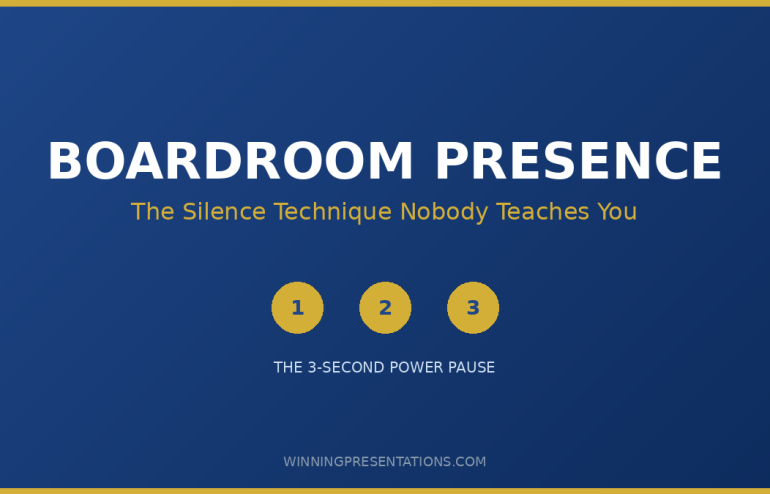
Boardroom presence - executive using strategic silence to command attention in board meeting

Boardroom Presence: The Silence Technique Nobody Teaches You

Quick Answer: Boardroom presence comes from strategic silence, not more talking. The technique: pause for 3 seconds before your key recommendation, hold eye contact with the decision-maker, then deliver your point. This “power pause” signals confidence and commands attention. Most professionals rush through their most important momentsβ€”the silence technique forces the room to lean in.

The VP had 47 metrics on 23 slides. She talked for 12 minutes straight.

Nobody remembered a single number.

I watched this unfold at JPMorgan Chase during a quarterly review. Her analysis was thorough. Her boardroom presence, however, was non-existent. She filled every silence with more words, more data, more justificationβ€”as if volume could substitute for authority.

The CFO interrupted: “What’s your recommendation?”

She hesitated. Then launched into another explanation.

He checked his phone. The room followed.

Three months later, I coached a different executive on the same presentation. Same data. Same audience. But this time, she paused for three full seconds before her recommendation. The room went quiet. Everyone leaned in.

She got unanimous approval in under eight minutes.

The difference? Boardroom presence through strategic silence.

The Executive Slide System

Your boardroom presence starts with slides that command attention. The Executive Slide System gives you the exact frameworks, templates, and structures that senior leaders expectβ€”so your delivery can focus on presence, not fumbling with format.

Includes: Board-ready slide templates, executive summary frameworks, and the one-page formats that get read.

Get the Executive Slide System β†’

Why Boardroom Presence Comes From Silence, Not Speaking

Most professionals believe boardroom presence means commanding the room with words. More data. Stronger arguments. Louder delivery.

They’re wrong.

After 24 years coaching executives at JPMorgan, PwC, RBS, and Commerzbank, I’ve observed a consistent pattern: the leaders with the strongest boardroom presence speak less than everyone else. They use silence as a tool.

Here’s why it works: When you pause before a key point, you create anticipation. The room’s attention shifts from passive listening to active waiting. Your next words carry weight they wouldn’t otherwise have.

Neuroscience backs this up. The brain processes silence as a signal that something important is coming. It’s the verbal equivalent of a spotlightβ€”everything that follows gets heightened attention.

The 3-Second Boardroom Presence Technique

The technique is simple. Executing it under pressure is hard. Here’s the framework:

Step 1: Identify your key moment. Every boardroom presentation has one critical pointβ€”the recommendation, the ask, the decision you need. Know exactly when it’s coming.

Step 2: Stop talking. When you reach that moment, close your mouth. Don’t fill the space with “so,” “um,” or “basically.” Just stop.

Step 3: Hold for three seconds. Count in your head: one-Mississippi, two-Mississippi, three-Mississippi. It will feel like an eternity. That discomfort is the point.

Step 4: Make eye contact. During the pause, find the primary decision-maker. Hold their gaze. This isn’t aggressiveβ€”it’s confident.

Step 5: Deliver with conviction. After the pause, state your point clearly. No hedging. No qualifiers. “I recommend we proceed with Option B.”

Boardroom presence 3-second silence technique - 5-step framework for commanding executive attention

What Boardroom Presence Mistakes Kill Your Credibility

The silence technique works because it counters the three most common boardroom presence killers:

Mistake 1: Rushing through recommendations. When you’re nervous, you speed up. Your most important point gets buried in a flood of words. The pause forces you to slow down precisely when it matters most.

Mistake 2: Over-explaining before asking. Executives don’t need 15 minutes of context before your recommendation. They need your recommendation, followed by supporting evidence if they ask. The pause separates setup from substance.

Mistake 3: Filling silence with justification. The moment you make a recommendation, the instinct is to keep talkingβ€”to defend before you’re attacked. Resist. Let your point land. If they have questions, they’ll ask.

How to Practice Boardroom Presence Before Your Next Meeting

You can’t learn this in the boardroom. You need to practice before the stakes are real.

Rehearsal method: Record yourself delivering your key recommendation. Watch the playback. Notice where you rush, where you fill silence, where you look away. Then do it again with deliberate pauses.

The mirror test: Practice holding your own gaze in a mirror during the 3-second pause. If you can’t maintain eye contact with yourself, you won’t maintain it with a skeptical CFO.

The conversation test: Use the technique in low-stakes conversations first. Pause before answering questions in team meetings. Get comfortable with silence when it doesn’t matter, so you can deploy it when it does.

For more on building executive presence that commands any room, read my complete guide: Executive Presence Presentations: Why Your Content Fails Without It.

FAQ: Boardroom Presence

How long does the boardroom presence silence technique take to master?

Most professionals can execute the basic 3-second pause within 1-2 practice sessions. However, doing it under pressureβ€”when a CFO is staring at youβ€”takes 2-3 weeks of deliberate practice. Start in low-stakes meetings and gradually work up to boardroom settings.

Won’t pausing make me look like I’ve forgotten what to say?

Only if you look panicked. Boardroom presence through silence works because of what you do during the pause: maintain eye contact, keep your posture grounded, and breathe normally. The difference between “forgot my words” and “commanding the room” is entirely in your body language.

Does boardroom presence differ for virtual board meetings?

Yes. In virtual settings, the pause needs to be slightly shorter (2 seconds instead of 3) because screen silence feels longer. More importantly, you must look directly at your camera during the pauseβ€”not at participants’ faces on screen. This creates the eye contact that signals boardroom presence virtually.

What if someone interrupts during my strategic pause?

Let them. If a board member speaks during your pause, they’ve just revealed what’s on their mindβ€”valuable information. Address their point briefly, then reset: “To answer your question directly…” followed by another deliberate pause before your recommendation. Boardroom presence means staying composed regardless of interruptions.

Can I use the silence technique multiple times in one presentation?

Use it sparinglyβ€”once or twice maximum. If you pause dramatically before every point, it loses impact and starts feeling performative. Reserve your strategic silence for the one moment that matters most: your core recommendation or the decision you need from the room.

πŸ“§ Join 2,000+ professionals getting weekly presentation insights. Subscribe to The Winning Edge β†’

πŸ“‹ Free Download: Executive Presentation Checklist

Get the same pre-boardroom checklist I give to clients before high-stakes presentations. Covers presence signals, slide structure, and room preparation.

Get Your Free Checklist β†’


About the Author

Mary Beth Hazeldine spent 24 years at JPMorgan, PwC, RBS, and Commerzbank. She’s a clinical hypnotherapist and MD of Winning Presentations.

23 Dec 2025
Storytelling in presentations - NLP techniques that captivate any audience

Storytelling in Presentations: The NLP Techniques That Captivate Any Audience

Why some presenters hold attention effortlessly β€” and how to use the same neurological triggers

I’ve watched hundreds of presentations where the data was solid, the slides were clean, and the recommendation made sense. And still, the audience checked out within three minutes.

Then I’ve watched presenters with weaker data and simpler slides hold a room captive for 45 minutes. The difference wasn’t charisma. It was storytelling in presentations β€” specifically, story structures that work at a neurological level.

As a qualified NLP practitioner and clinical hypnotherapist, I’ve spent years studying why certain narratives bypass resistance and embed in memory. This isn’t presentation theory. It’s applied neuroscience β€” and it’s the reason my clients have raised over Β£250 million using these techniques.

Here’s what actually works.

🎁 Free Download: 7 Presentation Frameworks β€” including the story structures in this article. Print-ready PDF.

Why Storytelling in Presentations Works (The Neuroscience)

When you present facts, you activate two areas of the brain: Broca’s area (language processing) and Wernicke’s area (language comprehension). That’s it.

When you tell a story, you activate those areas plus the motor cortex, sensory cortex, and frontal cortex. The listener’s brain literally synchronises with yours β€” a phenomenon called “neural coupling.”

This matters because:

  • Stories are 22x more memorable than facts alone (Stanford research)
  • Narrative transport reduces counter-arguing β€” when someone is absorbed in a story, they’re less likely to mentally object
  • Emotional engagement drives action β€” decisions are made emotionally and justified rationally, not the other way around

In NLP terms, stories access the unconscious mind directly. Facts hit the conscious filter first β€” where objections live. Stories slip past.

This is why a CFO who would reject a data-heavy slide deck will approve the same budget request when it’s wrapped in narrative. The information hasn’t changed. The delivery has.

Related: How to Create Executive Presentations That Get Results

The 5 Storytelling Structures That Work in Business Presentations

Not all stories work in professional settings. The hero’s journey is great for Hollywood, but it’ll get you laughed out of a board meeting.

These five structures are specifically designed for business storytelling in presentations:

1. The S.E.E. Formula (Story-Evidence-Emotion)

This is my go-to structure for persuasive presentations. It works because it hits all three levels of processing:

  • Story: A specific, concrete example that illustrates your point
  • Evidence: Data that validates the story isn’t an outlier
  • Emotion: The implication β€” what this means for the listener

Example:

“Last quarter, a biotech client came to us with a 60-slide investor deck. Three months of work, zero meetings booked. [STORY] When we analysed 50 successful biotech raises, we found that decks over 20 slides had a 40% lower response rate. [EVIDENCE] If your deck is sitting in inboxes unopened, the problem might not be your science β€” it might be your slide count. [EMOTION]”

2. The Before-After-Bridge

Paint the current painful state, show the future desired state, then bridge the gap with your solution.

Example:

“Right now, your team spends 6-8 hours building each presentation. [BEFORE] Imagine cutting that to 90 minutes β€” same quality, less burnout. [AFTER] The bridge is a systematic AI workflow that handles the 80% that doesn’t require human judgment. [BRIDGE]”

This works because the brain is wired to resolve tension. You create the gap, then fill it.

3. The Contrast Story

Two characters, two approaches, two outcomes. Let the audience draw their own conclusion.

Example:

“Two analysts at RBS, similar experience, similar technical skills. One led with data every time β€” comprehensive, thorough, exhausting. The other wrapped her data in client stories. Same information, different frame. Guess who made Director first.”

The power of contrast stories is that you never explicitly state the lesson. The audience internalises it themselves, which makes it stickier.

4. The “What I Learned” Frame

Personal vulnerability + insight = credibility + connection.

Example:

“Early in my banking career, I presented quarterly results to a credit committee. I had 47 slides of analysis. I was thorough. I was comprehensive. I was also completely ignored. The senior partner stopped me on slide 12 and asked, ‘What’s the recommendation?’ I learned that day: executives don’t want your journey. They want your conclusion.”

This structure works because it positions you as someone who’s made mistakes and grown β€” not an untouchable expert.

5. The Nested Loop

Start a story, pause it, tell another story that illuminates the first, then close both. This is an advanced NLP technique that creates cognitive tension β€” the audience stays engaged because they need closure.

Example:

“I was about to present to the biggest client of my career… [PAUSE β€” don’t resolve] Let me tell you about something my mentor told me years earlier. She said, ‘Mary Beth, the room decides in the first 30 seconds whether they’ll listen to you.’ [SECOND STORY] So there I was, about to walk into that meeting, and I remembered her words. I threw out my opening slide and started with a question instead. [CLOSE BOTH]”

Nested loops are what make TED talks feel magnetic. The audience is holding multiple open threads, which keeps attention locked.

Related: Presentation Structure: 7 Frameworks That Actually Work

5 storytelling structures for business presentations: S.E.E. Formula, Before-After-Bridge, Contrast Story, What I Learned, Nested Loop

How to Find Stories for Your Presentations (The NLP Approach)

The biggest objection I hear: “I don’t have any good stories.”

Yes, you do. You just haven’t learned to recognise them.

In NLP, we use a technique called “anchoring” β€” attaching emotional states to specific memories. You can reverse-engineer this to find stories:

Step 1: Identify the emotion you want your audience to feel.

Do you want them to feel urgency? Relief? Curiosity? Confidence? Name it specifically.

Step 2: Recall a moment when YOU felt that emotion.

Not a concept. A moment. Where were you? Who was there? What happened immediately before?

Step 3: Extract the universal principle.

Your story is specific, but the lesson applies broadly. That bridge is what makes the story relevant to your audience.

Example:

I want my audience to feel confident that they can handle tough Q&A. So I recall a moment when I felt that confidence β€” specifically, a board meeting where I answered a hostile question calmly and the room’s energy shifted. The universal principle: preparation plus a framework equals composure under pressure.

Now I have a story that creates the emotion I want my audience to feel.

Related: Business Presentation Skills: What Actually Matters in Corporate Environments

Master Business Storytelling in 2 Hours

The Business Storytelling Mini-Course gives you the complete system for finding, structuring, and delivering stories that persuade.

What’s included:

  • All 5 story structures with fill-in templates
  • The “Story Mining” exercise to uncover your best material
  • NLP techniques for emotional delivery
  • Before/after examples from real client presentations
  • The S.E.E. Formula worksheet

Β£29 β€” Get the Storytelling Mini-Course β†’

Storytelling Mistakes That Kill Business Presentations

Stories can backfire. Here’s what to avoid:

1. Stories that make you the hero.

If every story ends with you saving the day, you’ll come across as arrogant. Better: stories where you learned something, or where your client/colleague succeeded.

2. Stories without a point.

“And then we had lunch” endings kill momentum. Every story needs a clear “so what” β€” the reason you’re telling it.

3. Stories that are too long.

Business stories should be 60-90 seconds maximum. If you’re going longer, you’re including unnecessary detail. Cut the scene-setting and get to the tension faster.

4. Stories that feel rehearsed.

A story told the same way every time loses its energy. Know your beats, not your script. Let the words vary while the structure stays consistent.

5. Stories without specificity.

“A client once came to us with a problem” is weak. “Last March, a biotech CEO called me at 7am, panicking because their Series B pitch was in 48 hours and nothing was working” is strong. Specific details create believability.

Related: How to Present Like a CEO: Executive Presentation Skills for Leadership

How to Deliver Stories in Presentations (NLP Techniques)

The structure is only half the equation. Delivery determines whether your story lands or falls flat.

Pace changes: Slow down at emotional moments. Speed up during action. The contrast signals importance to the brain.

Sensory language: “I walked into the boardroom” is weak. “I walked into a boardroom that smelled like stale coffee and anxiety” engages more brain regions.

Present tense for climax: Shift from past to present tense at the critical moment. “And then he says to me…” This pulls the audience into the scene.

The pause: Before your key insight, pause. Two full seconds. The silence creates anticipation and signals that what comes next matters.

Eye contact during the lesson: Tell the story to the room generally, but deliver the insight to specific individuals. This creates personal connection with your conclusion.

These techniques come from hypnotherapy β€” they’re designed to create trance states, which is essentially deep engagement. You don’t need to hypnotise your audience, but you can use the same tools to hold attention.

Go Deeper: Master Storytelling + AI + Persuasion

AI-Enhanced Presentation Mastery includes a complete module on the S.E.E. Formula and business storytelling β€” plus AI prompts that help you find and structure stories faster.

8 self-paced modules (January–April 2026):

  • The S.E.E. Formula: Story-Evidence-Emotion for persuasive messaging
  • The AVP Framework: Action-Value-Proof structure for any presentation
  • AI prompts that help you mine stories from your experience
  • Data storytelling: turn numbers into narratives
  • 2 live coaching sessions with personalised feedback

Presale price: Β£249 (increases to Β£299, then Β£499)

60 seats total.

See the full curriculum β†’

Frequently Asked Questions About Storytelling in Presentations

How long should a story be in a business presentation?

60-90 seconds for most business contexts. You can go longer (2-3 minutes) if the story is central to your argument, but never longer than that. If your story takes 5 minutes, it’s a monologue, not a story.

Can I use the same story in multiple presentations?

Absolutely. Your best stories should become part of your repertoire. Adjust the framing to match the audience and context, but the core narrative can stay the same. Great speakers have 5-10 signature stories they deploy strategically.

What if my work isn’t “interesting” enough for stories?

Every field has stories β€” you just need to recognise them. The moment a project almost failed. The client who taught you something unexpected. The mistake that changed how you work. Interest comes from tension and transformation, not from the subject matter itself.

How do I transition from a story back to my slides?

End your story with the lesson explicitly stated, then link it to your next point: “That’s why [lesson from story]. And it’s the reason I’m recommending [next slide content].” The story should feel like setup for what comes next, not a detour.

Is storytelling appropriate for technical presentations?

More appropriate than you think. Technical audiences are still human β€” they respond to narrative just like everyone else. The difference is that your stories should feature technical challenges, elegant solutions, and lessons learned. The structure stays the same.


Your Next Step: Build Your Story Repertoire

Storytelling in presentations isn’t a talent. It’s a skill β€” and like any skill, it improves with structure and practice.

🎁 START FREE: Download 7 Presentation Frameworks β€” including story structures you can use immediately.

πŸ“˜ GET THE SYSTEM (Β£29): The Business Storytelling Mini-Course gives you templates, exercises, and NLP techniques for finding and delivering stories that persuade.

πŸŽ“ MASTER IT ALL (Β£249): AI-Enhanced Presentation Mastery β€” 8 modules covering storytelling, structure, AI tools, and delivery. January–April 2026, 60 seats.

The presenters who captivate aren’t born. They’ve learned to structure their experiences into narratives that stick. You can learn it too.


Mary Beth Hazeldine is a qualified NLP practitioner and clinical hypnotherapist who spent 24 years in corporate banking at JPMorgan, PwC, Royal Bank of Scotland, and Commerzbank. She now trains executives in the storytelling and persuasion techniques that drive decisions β€” combining boardroom experience with the psychology of influence.