

The Q&A Preparation Checklist Senior Executives Use
One question. Eleven words. £4 million gone. He hadn’t prepared for it.
A CFO looked at slide 38 of a proposal presentation and asked a question so simple it shouldn’t have been difficult: “What happens to the timeline if procurement takes 12 weeks?” The presenter — a senior director who’d spent two weeks building the deck — didn’t have an answer. The room went quiet. The deal was deferred. It never came back.
The question wasn’t obscure. It wasn’t hostile. It was entirely predictable. And that’s the point: most Q&A failures aren’t caused by impossible questions. They’re caused by predictable questions that nobody prepared for.
Quick Answer: Senior executives prepare for Q&A using a structured checklist that covers five categories: decision questions, financial questions, risk questions, stakeholder questions, and timeline questions. By preparing answers in these five areas, you can anticipate the majority of questions before they’re asked — and walk into Q&A with confidence instead of dread.
🚨 High-stakes Q&A session coming up this week?
Quick diagnostic — can you answer these right now?
- What’s the one question that would derail your recommendation?
- Which stakeholder in the room is most likely to challenge you — and on what point?
- If someone asks “what happens if this fails?” — do you have a specific answer?
→ Need the complete Q&A preparation system? Get the Executive Q&A Handling System (£39)
In this article:
I worked with a VP at a technology company who was preparing for a budget review with the executive committee. She’d built a strong deck. Her numbers were solid. Her recommendation was clear.
But when I asked her what questions she expected, she said: “I don’t know. That’s what scares me.”
We spent 45 minutes building a question map — categorising every likely question by stakeholder, topic, and intent. By the end, she had prepared answers for 14 specific questions. In the actual meeting, 11 of them came up almost exactly as we’d predicted.
She didn’t need to be smarter. She needed a system.
That system is what I’m sharing here.

Why Most Q&A Preparation Fails (The “Think of Everything” Trap)
Most professionals prepare for Q&A by trying to anticipate every possible question. They brainstorm a list of 30-40 questions, write rough answers for half of them, and hope for the best.
This doesn’t work for three reasons.
First, it creates false confidence. Having a long list feels like preparation. But if the questions aren’t organised by category, you can’t spot the gaps. You end up over-prepared for easy questions and under-prepared for the ones that actually matter.
Second, it overwhelms working memory. In the moment, you can’t search through 30 prepared answers. You need a mental framework that tells you which category a question belongs to — so you can retrieve the right response structure, even if you haven’t prepared for that exact question.
Third, it ignores the questioner. The same question from the CFO and the Head of Operations means different things. “What’s the ROI?” from Finance means “show me the numbers.” “What’s the ROI?” from Operations means “is this worth the disruption to my team?” Same words. Different answers needed.
The checklist below solves all three problems. It organises preparation by category, limits the total number of prepared answers to a manageable set, and maps questions to the people most likely to ask them.
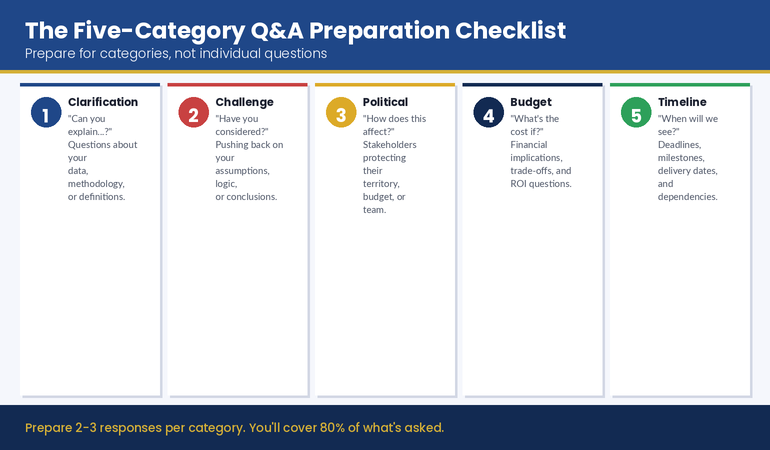
The Five-Category Q&A Preparation Checklist
Every executive Q&A question falls into one of five categories. Prepare two strong answers in each category, and you’ll walk in ready for the majority of what’s coming.
Category 1: Decision Questions
“Why this? Why now? Why not the alternative?” These are the questions that test your recommendation. Your answers need to include the specific trigger (why now), the comparison (why this option over others), and the cost of delay (what happens if they say no).
Category 2: Financial Questions
“What’s the total cost? What’s the payback period? What’s the impact on this quarter’s numbers?” Financial questions come in two varieties: the headline number and the hidden cost. Prepare for both. Know the total budget. Know the phasing. Know what’s not included.
Category 3: Risk Questions
“What could go wrong? What’s your contingency? What’s the worst-case scenario?” Risk questions test whether you’ve thought beyond the optimistic path. The best answers name a specific risk, a specific mitigation, and a specific trigger that would activate the contingency plan.
Category 4: Stakeholder Questions
“Who else has signed off on this? Does the CFO agree? What does the Head of [X] think?” These questions test alignment. If you haven’t consulted key stakeholders, say so honestly — but explain what you’ve done and what’s planned. “I’ve briefed the CFO’s team; formal sign-off is scheduled for Thursday” is infinitely better than “I haven’t spoken to Finance yet.”
Category 5: Timeline and Implementation Questions
“When does this start? What are the milestones? What resources do you need from us?” Timeline questions are the most commonly under-prepared category. Know your key dates. Know the dependencies. Know which milestones require board-level updates.
Walk Into Q&A Knowing What’s Coming
The Executive Q&A Handling System gives you the complete preparation framework — so you predict the questions before they’re asked, not after.
- The five-category question prediction system used by senior executives at global companies
- Stakeholder-question mapping templates — know who asks what, and why
- Response frameworks for the six most common Q&A traps (hostile questions, compound questions, “I don’t know” moments)
- Rehearsal protocols that build delivery confidence, not just content knowledge
Get the Executive Q&A Handling System → £39
Built from 24 years of executive Q&A across boardrooms at JPMorgan, PwC, RBS, and Commerzbank.
The Stakeholder-Question Matrix (Who Asks What — And Why)
The most effective Q&A preparation doesn’t just predict what will be asked. It predicts who will ask it — and what they’re really testing.
Here’s the pattern I’ve seen across hundreds of executive Q&A sessions:
The CFO asks financial questions. But not the ones you expect. They rarely ask about the headline number (they’ve read the pre-read). They ask about the assumptions beneath it. “What happens to the ROI if adoption is 60% instead of 80%?” Prepare for the sensitivity analysis, not the summary.
The COO asks operational questions. They want to know about disruption, dependencies, and resource requirements. “Which teams are affected?” and “What does this do to Q3 deliverables?” are their standard openings.
The CEO asks strategic questions. They’re less interested in detail and more interested in fit. “How does this align with the three-year plan?” and “What happens to this if we pivot on [strategy X]?” Prepare for the strategic context, not just the project detail.
The board chair asks governance questions. “Is there a conflict of interest?” “Has legal reviewed this?” “What’s the reporting cadence?” These are process questions, not content questions. Have the governance answers ready.
Before your next presentation, write each attendee’s name on a card. Under each name, write the two questions they’re most likely to ask based on their role and priorities. Then prepare your answers. This takes 20 minutes and transforms your readiness.
Want the stakeholder-question mapping template ready to fill in?
The Executive Q&A Handling System includes the complete stakeholder mapping framework — pre-built for board, executive committee, and client presentations.
How to Rehearse for Q&A (Not Just Answers — Delivery)
Knowing the answer and delivering it well are different skills. Here’s the rehearsal method I recommend:
Step 1: Write your top 10 predicted questions. Two per category. Write the full question as the stakeholder would phrase it.
Step 2: Write your answer in two sentences maximum. If you can’t answer a board-level question in two sentences, you don’t understand it well enough. The detail comes in the follow-up — the initial response must be concise.
Step 3: Say your answers out loud. Not in your head. Out loud. The first time you speak an answer aloud should not be in front of the board. Written answers sound different from spoken answers. You’ll find that some written responses feel stilted when you actually say them.
Step 4: Practise the “bridge.” After your two-sentence answer, practise bridging to your key message. “The short answer is [X]. The important thing to note is [bridge to your strategic point].” This technique ensures that even challenging questions serve your narrative rather than derailing it.
Step 5: Practise the pause. When you hear a question, pause for two seconds before responding. This isn’t hesitation — it’s composure. It signals that you’re considering the question seriously, not reacting defensively. In practice, most nervous presenters answer too quickly. The pause is a trust signal.

Presenting to a board or executive committee soon?
Today’s partner article covers the exact structure for your first board presentation as a new director — including the five questions every board asks.
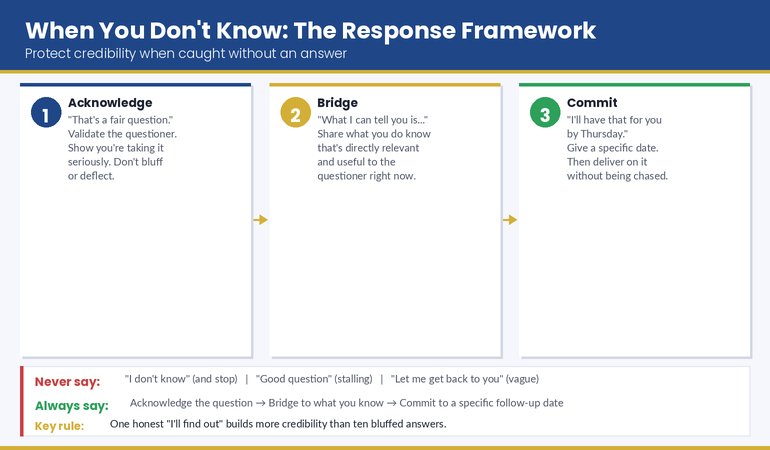
When You Don’t Know: The Response Framework That Protects Credibility
No amount of preparation covers every question. There will be moments when you genuinely don’t know the answer. What matters is how you handle them.
The credibility-preserving response has three parts:
Acknowledge: “That’s a fair question, and I don’t have the exact figure in front of me.” Don’t waffle. Don’t guess. Don’t hedge with “I think it’s roughly around…”
Commit: “I’ll confirm the number and send it to you by end of day.” Be specific about when and how you’ll follow up. Vague promises (“I’ll look into that”) signal that the question will be forgotten.
Bridge: “What I can tell you is [related information you do know].” This demonstrates that you understand the territory, even if you don’t have the specific data point. It prevents the silence from becoming an impression of incompetence.
Used well, this framework actually builds trust. Directors respect honesty over improvisation. What they don’t respect is guessing — because they can always tell. (For more on this, see what to say when you don’t know the answer.)
People Also Ask:
How many questions should you prepare for before a presentation?
Prepare for 10 specific questions: two per category (decision, financial, risk, stakeholder, timeline). This is manageable to rehearse and covers the majority of what you’ll face. Add 2-3 wildcard questions specific to your topic for a total of 12-13 prepared answers.
How do you handle hostile questions in a presentation?
First, pause. A hostile question often sounds worse than it is. Second, restate the question neutrally — a technique I cover in executive questions as trust tests: “If I understand correctly, you’re asking whether…” This removes the hostility and gives you control of the framing. Third, answer the restated version. Most hostile questions are legitimate concerns wrapped in frustrated delivery.
What’s the difference between Q&A preparation and presentation rehearsal?
Presentation rehearsal is about perfecting your delivery of prepared content. Q&A preparation is about building the judgement and framework to respond to unprepared content. They require different skills. Rehearsal builds fluency. Q&A preparation builds adaptability. You need both.
Stop Walking Into Q&A Hoping for the Best
The Executive Q&A Handling System replaces hope with a system — the same structured approach used by executives who handle boardroom questions with visible confidence.
Get the Executive Q&A Handling System → £39
Used across board meetings, executive committees, and client presentations at global financial institutions.
Is the Executive Q&A Handling System Right For You?
✓ This is for you if:
- You present to boards, executive committees, or senior stakeholders and the Q&A is the part you dread most
- You’ve been caught off guard by a question in a meeting and it affected the outcome
- You want a systematic way to predict and prepare for questions rather than hoping for the best
- You need the stakeholder-question mapping templates, response frameworks, and rehearsal protocols ready to use
✗ This is NOT for you if:
- You present to small team meetings where Q&A is informal and low-stakes
- Your challenge is the presentation itself, not the questions after (consider the Executive Slide System instead)
- Your primary issue is anxiety rather than preparation (consider Conquer Speaking Fear for nervous system regulation)
24 Years of Executive Q&A. Now a System You Can Use.
The Executive Q&A Handling System was built from real boardroom Q&A sessions at JPMorgan Chase, PwC, Royal Bank of Scotland, and Commerzbank. Every framework reflects how senior executives actually prepare — not how training courses say they should.
- The five-category question prediction checklist (decision, financial, risk, stakeholder, timeline)
- Stakeholder-question mapping templates for board, ExCo, and client presentations
- Response frameworks for hostile questions, compound questions, and “don’t know” moments
- The rehearsal protocol that builds delivery confidence in under 30 minutes
Get the Executive Q&A Handling System → £39
Walk into Q&A knowing what’s coming. Trusted by thousands of executives across banking, consulting, and corporate finance.
Frequently Asked Questions
How far in advance should I start preparing for Q&A?
Start Q&A preparation at least three days before the presentation — ideally at the same time you begin building your slides. Many presenters treat Q&A as an afterthought, spending days on the deck and 30 minutes on Q&A prep. Invert the ratio: spend as much time on Q&A preparation as you do on the slides themselves. The presentation gets you to the table. The Q&A determines the outcome.
Should I prepare written answers or just bullet points?
Write the first sentence of each answer in full — this is your opening response and needs to be crisp. After that, bullet points are sufficient. The first sentence is what you’ll deliver under pressure, so it needs to be rehearsed. The supporting detail can be more loosely prepared, as you’ll adapt it based on the follow-up questions.
What if the same person keeps asking follow-up questions?
Persistent questioning usually signals that your initial answer didn’t address the questioner’s real concern. After the second follow-up, try: “I want to make sure I’m answering the right question — is your concern specifically about [X]?” This resets the exchange and often reveals what they’re actually testing. Once you identify the real concern, you can address it directly rather than circling around it.
📬 The Winning Edge Newsletter
Weekly boardroom-tested techniques for executives who present under pressure. Q&A strategies, slide structures, and confidence techniques. One actionable insight every week.
🆓 Want to start free? Download the CFO Questions Cheatsheet first.
Read next: If the presentation itself needs work before you worry about Q&A, read how to structure your first board presentation as a new director. And if it’s the nerves around Q&A that concern you most, see why even confident presenters still get nervous — it’s more universal than you think.
About the Author
Mary Beth Hazeldine is the Owner & Managing Director of Winning Presentations. With 24 years of corporate banking experience at JPMorgan Chase, PwC, Royal Bank of Scotland, and Commerzbank, she has delivered high-stakes presentations in boardrooms across three continents.
A qualified clinical hypnotherapist and NLP practitioner, Mary Beth combines executive communication expertise with evidence-based techniques for managing presentation anxiety. She has trained thousands of executives and supported presentations for high-stakes funding rounds and approvals.
Your next Q&A is on the calendar. Twenty minutes of structured preparation — two questions per category, mapped to the people in the room — will transform how you walk into it.
Get the Executive Q&A Handling System (£39) and walk in knowing what they’ll ask before they ask it.