They had a 94% client satisfaction score. They also lost three of their top five accounts in the same quarter.
The VP of Client Services at a mid-market SaaS company couldn’t reconcile the disconnect. Quarterly business reviews were running smoothly. NPS scores were solid. Then, during the Q&A section of their QBRs, things shifted.
Clients asked harder questions. The team answered defensively. And within weeks of those meetings, renewal conversations stalled.
This is not a satisfaction problem. This is a Q&A problem.
Quick Answer
Client QBR meetings are where renewals are won or lost—not during the presentation itself, but in the Q&A that follows. When you answer difficult questions defensively, you reinforce client concerns. When you reframe Q&A as a retention conversation, each question becomes an opportunity to confirm value and deepen trust. The Executive Q&A Handling System teaches you how.
🚨If your QBR meetings feel fine but your renewal rate doesn’t match your satisfaction scores, you likely have a Q&A conversion problem. Learn the one question that reveals whether you’re answering like a vendor or a partner.
Jump-to Contents
- Why Client Satisfaction Scores Can Lie
- The 5 QBR Questions That Signal Churn
- From Defensive to Consultative: The Reframe
- The Renewal Bridge Technique
- Preparing Your Team for QBR Q&A
- Post-QBR Follow-Up That Seals Renewals
The Micro-Story: A 47-Demo Problem That Became a 23-Demo Win
A SaaS closing team was closing 6% of their demos (3 out of 47). Leadership blamed the product. They blamed the sales team. What they missed: their closing rate problem wasn’t in the pitch—it was in the Q&A.
When they restructured how their team answered tough questions—moving from defensive explanations to consultative reframes—their close rate jumped to 39% (9 out of 23 demos). The same product. The same salespeople. Different Q&A approach.
Client services teams face the same dynamic. Your QBR presentation might be flawless. But if your Q&A section leaves clients with doubts rather than confidence, you’ll lose renewals. This story has played out across industries: the highest-pressure conversations aren’t won in the deck. They’re won at the table.
Turn QBR Questions Into Renewal Confirmations
The Promise: Most client services teams treat QBR Q&A as a threat—something to survive. The Executive Q&A Handling System reframes it as your strongest renewal tool.
When a client asks a tough question during your QBR, they’re not attacking. They’re testing whether you understand their business. Each question is a retention signal. Answer it defensively, and you’ve confirmed their doubts. Answer it consultatively, and you’ve deepen trust.
In this track, you’ll learn:
- How to spot which QBR questions signal real churn risk (and which ones don’t)
- The three-step reframe that turns defensive answers into partnership language
- The renewal bridge technique that moves Q&A directly into renewal confirmation
- How to prepare your entire client services team so Q&A becomes your competitive advantage
Why Client Satisfaction Scores Can Lie (And Your Renewal Rate Tells the Truth)
A client can be genuinely satisfied with your product and still not renew.
Satisfaction measures whether a client is happy. Renewal depends on whether they believe you understand their business and have a plan to deepen value. These are different conversations.
During a QBR presentation, clients nod along. They praise the results. Then you reach Q&A, and the real conversation starts. A client asks: “What’s your roadmap for the third-quarter feature we discussed?” Or: “How are you thinking about our competitive positioning?” Or: “Why are we still paying full price when adoption is only at 60%?”
The way you answer those questions—not the presentation itself—determines whether they renew.
The VP of Client Services we mentioned at the start discovered this the hard way. Her satisfaction score was high because the product delivered. But her renewal rate was low because during Q&A, her team answered defensively. They explained why the roadmap looked the way it did. They justified the pricing. They offered workarounds instead of partnerships.
Defensive answers sound reasonable. They’re not persuasive.
When a client hears a defensive answer, they translate it in their mind: This team doesn’t see our business the way we do. They’re protecting their product instead of protecting our success. Within weeks, they’re exploring alternatives.
The 5 QBR Questions That Signal Churn Risk (And How to Hear What They Really Mean)
Not every tough question in a QBR signals churn risk. But certain patterns do. A Head of Account Management needs to know the difference.
Here are the five questions that most reliably predict renewal risk:
1. “Are we actually hitting adoption targets?” — What they’re really asking: Are we getting the ROI we expected? A defensive answer focuses on external factors (lack of internal buy-in, training gaps). A consultative answer reframes adoption as a shared responsibility and outlines your next phase of enablement.
2. “What’s your timeline on the features we’ve been requesting?” — What they’re really asking: Will you invest in our success, or are we just a ticket in your backlog? Defensive answers explain constraints. Consultative answers show how you’re prioritising their requests and what they need to do to accelerate adoption in the meantime.
3. “How does your solution compare to [competitor name]?” — What they’re really asking: Did we make the right choice? A defensive comparison is feature-by-feature. A consultative comparison acknowledges trade-offs and aligns on what success looks like in their specific business context.
4. “Why should we renew at the current price point?” — What they’re really asking: Are we getting value that justifies the cost? A defensive answer justifies pricing. A consultative answer quantifies value delivered and ties renewal to expanded scope or outcomes.
5. “What happens if we reduce our annual commitment?” — What they’re really asking: What’s our exit strategy? A defensive answer tries to lock them in. A consultative answer acknowledges their flexibility while showing the cost of reduced commitment in terms of their own goals.
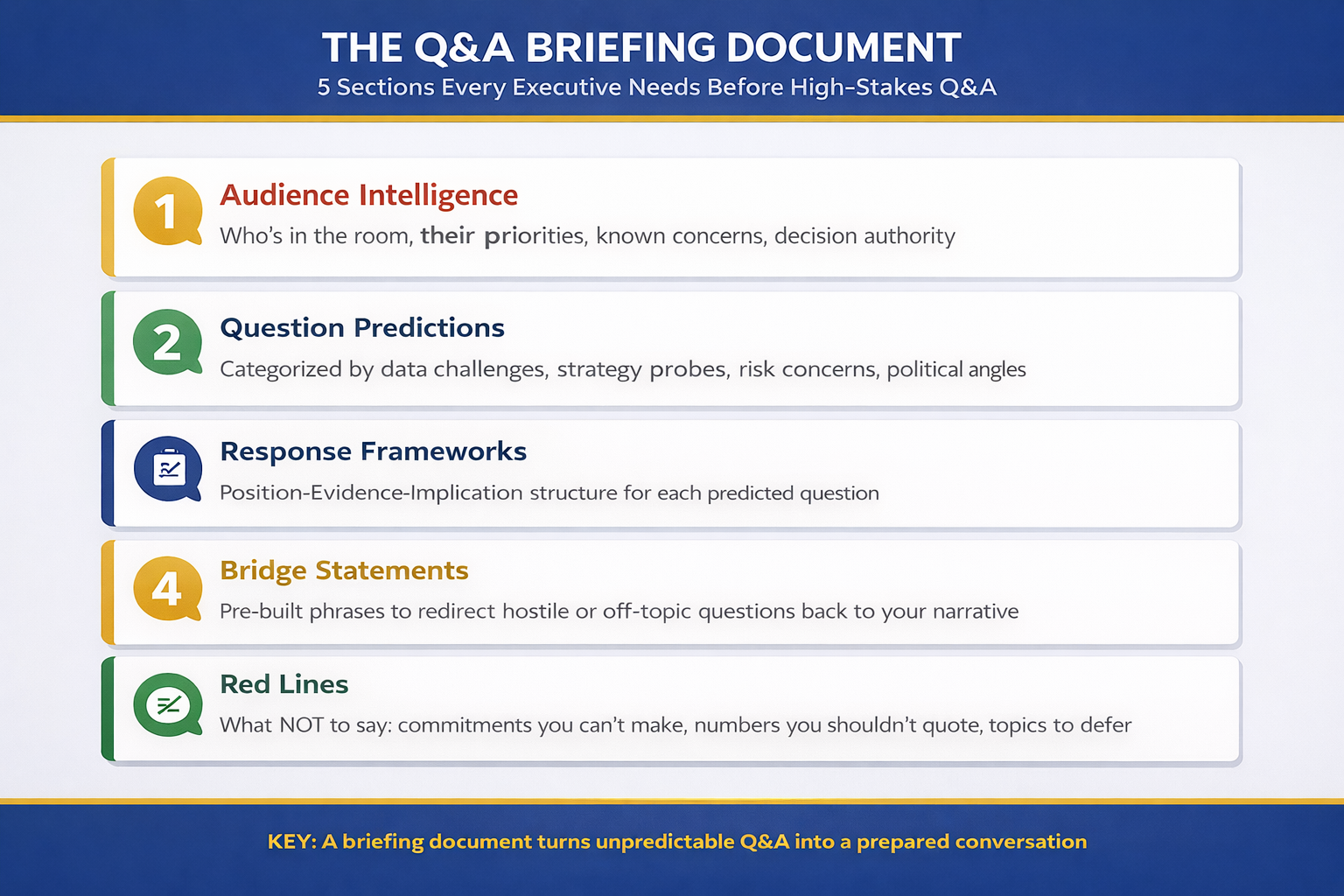
The common thread: these questions all contain a hidden business concern. Your job is to answer the concern, not the question. Learning to predict presentation questions using a question map means you’re never caught off guard by a hidden concern.
From Defensive to Consultative: The Three-Step Reframe
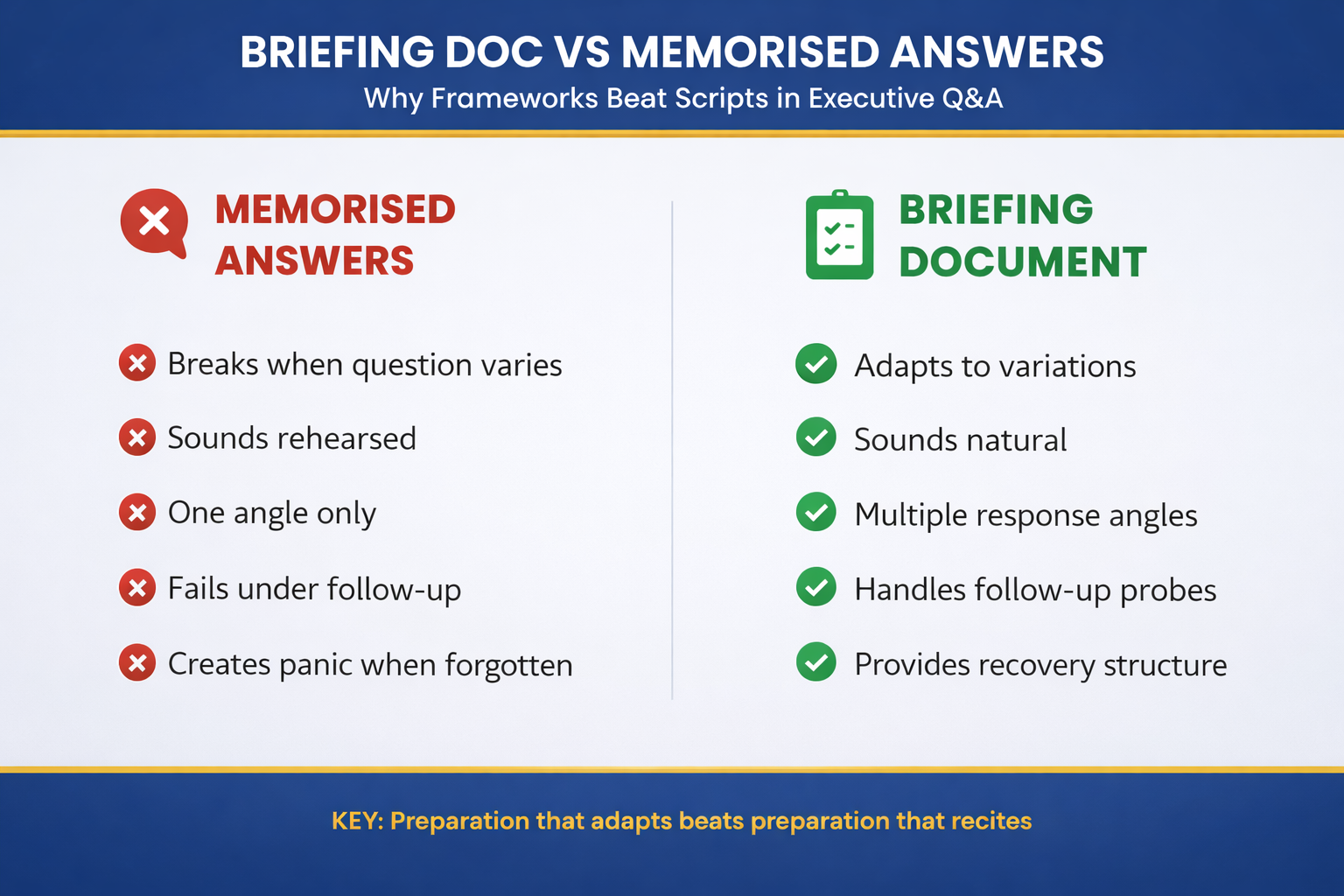
A defensive answer defends your position. A consultative answer defends the client’s success.
Here’s the three-step reframe:
Step 1: Acknowledge the concern beneath the question.
Client: “Are we hitting adoption targets?”
Defensive: “We’ve delivered the platform. Adoption depends on your internal change management.”
Consultative: “I hear that adoption is top of mind—and honestly, it should be. That tells me we need to look harder at where the friction is in how your team is using the platform.”
Step 2: Reframe the problem as mutual.
Defensive: “Your team needs better training.”
Consultative: “Let’s diagnose this together. Are we seeing adoption gaps in specific departments, or is it across the board? That tells us whether this is a training issue, a workflow issue, or a platform gap.”
Step 3: Move toward partnership.
Defensive: “Here’s what you need to do differently.”
Consultative: “Here’s what I’m thinking we do together. Next month, we run a diagnostic audit. If it’s a workflow issue, we build a custom integration. If it’s a capability gap, we loop in our product team. This way, we’re solving for your actual bottleneck, not a generic solution.”
That entire shift takes seconds. The language changes from protective to investigative. And suddenly, the client feels like you’re on their side.
IMAGE
Mini CTA Box #1
The difference between a lost renewal and a contract signature often comes down to one conversation. The Executive Q&A Handling System gives you the framework to ensure that conversation goes your way. Learn the system → £39
The Renewal Bridge Technique: Moving From Q&A Directly Into Renewal Confirmation
The best QBR Q&A sessions don’t end with “Any other questions?” They end with renewal confirmation.
The renewal bridge is a technique that moves you from Q&A directly into renewal conversation. It works like this:
Phase 1: Answer the question consultatively. (Use the three-step reframe above.)
Phase 2: Confirm alignment. “Does that match how you’re thinking about this?”
Phase 3: Extend the conversation. “If we nail this together, what does success look like for you over the next 12 months?”
Phase 4: Anchor to renewal. “Given that roadmap, I’m thinking the right commitment for us is [renewal terms]. We’d have the flexibility to adjust scope as we hit milestones. Does that feel right?”
That four-phase sequence does something pivotal: it moves the client from defending their position (the Q&A mindset) to investing in your partnership (the renewal mindset).
An example:
Client question: “Why should we renew at current pricing if adoption is only at 60%?”
Defensive answer: “Your adoption is below average, but you’ve still captured significant value. Pricing reflects the platform capabilities.”
Renewal bridge: “That’s a sharp question—and it tells me adoption is the real lever here. Here’s what I’m seeing: you’ve got a solid foundation with 60% adoption, but you’re leaving money on the table because three departments haven’t engaged yet. What if we flipped the narrative? Instead of paying for full adoption you’re not using yet, we right-size your commitment to what’s deployed today, and we add a success milestone: when you hit 80% adoption in those three departments, your pricing adjusts up. That way, you’re not overpaying for capability you’re not using, and we’re both incentivised to drive adoption together. How does that land?”
Notice the shift: the conversation moved from “why should you pay this?” to “how do we structure this so you win and we win together?” That’s renewal language.
Preparing Your Team for QBR Q&A: The Framework Every Account Manager Needs
A single QBR Q&A goes well or poorly based on preparation. And most teams don’t prepare for Q&A at all.
Here’s how to prepare your client services team:
One week before the QBR:
Run a pre-QBR diagnostic. Interview the account manager: “What questions are we likely to face?” Not the surface questions—the concerns underneath. Is the client worried about adoption? Pricing justification? Competitive positioning? Roadmap alignment? Document these.
For each concern, draft a consultative answer using the three-step reframe. Have the team review it. Edit until it sounds like a partnership conversation, not a defence.
Two days before:
Pressure-test the answers. Have someone role-play as the sceptical client. Ask the questions hard. Watch how the team responds. If they fall back into defending the product instead of defending the client’s success, reframe again.
During the QBR:
Assign roles. One person owns the main presentation. One person owns Q&A. One person takes notes on client concerns (these become your post-QBR action items and renewal conversation anchors).
The Q&A owner isn’t there to win every debate. They’re there to hear what matters to the client and show you understand it.
After the QBR:
Within 24 hours, send a summary. Not a recap of what you presented—a summary of what you learned from the Q&A. “Here’s what I heard matters most to you. Here’s what we’re committing to in the next 90 days. Here’s how this feeds into our renewal conversation.” That email bridges Q&A directly into renewal.
This preparation typically takes 4-6 hours across the team. It’s the highest-ROI investment you can make in a renewal.
Post-QBR Follow-Up That Seals Renewals (Not Recap Emails)
Most teams send a recap email after a QBR. It’s usually a summary of the presentation. Clients ignore it.
Instead, send something that matters: a 60-day action plan anchored to their concerns.
Here’s the framework:
Section 1: What We Heard — Specifically reference the concerns they raised in Q&A. “You asked about adoption in the Finance department. We heard that as the biggest lever for Q2 value.” This shows you were actually listening.
Section 2: What We’re Doing — For each concern, outline your commitment. Specific milestones. Specific people. Specific timelines. “By March 15, we’re running a workflow audit with Finance. By April 1, we’re delivering custom integration options. By April 30, we’re reporting on adoption lift.”
Section 3: What We Need From You — Be clear about their commitment too. “We’ll need Finance’s tech lead available for two hours in mid-March and a pilot group to test integrations in April.”
Section 4: The Renewal Conversation — Don’t bury it. Surface it clearly. “Given this roadmap and the value we’re tracking, I’d like to propose we move forward with renewal discussions in May. That gives us two months to prove this adoption work and gives your finance team time to see the impact before year-end planning. Does that timing work?”
That follow-up email does three things: it proves you listened, it shows partnership, and it moves renewal from “someday” to “next month’s agenda.”
Mini CTA Box #2
Your renewal rate isn’t determined by your product. It’s determined by how your team talks about it. The Executive Q&A Handling System teaches your entire client services organisation the language that converts Q&A into renewal conversations. Get started → £39
Money Block #2: Stop Losing Renewals in the Q&A Section of Your QBR
You know this scenario: satisfaction scores are high. The presentation went well. Then during Q&A, something shifted. The client’s energy changed. Within weeks, they’re shopping around.
The problem isn’t your presentation. The problem is that your team answered like vendors instead of partners. And by the time you realised it, the relationship had already shifted.
The Executive Q&A Handling System fixes this by teaching your team the specific language and framework that transforms difficult questions into renewal confirmations. You’ll learn which client concerns signal real churn risk, how to reframe defensive answers into partnership language, and how to move Q&A directly into renewal conversations.
Is This Right For You?
The Executive Q&A Handling System is designed for client services leaders managing accounts worth £100K+. It’s for VP of Client Services roles, Head of Account Management positions, and Senior Customer Success Managers who own renewal conversations.
You’re a fit if:
- Your satisfaction scores don’t match your renewal rates
- You’ve lost strategic accounts despite strong product adoption
- Your team struggles to answer competitive or difficult questions without getting defensive
- You want to use QBR Q&A as a retention and expansion tool, not just a status update
- You manage a team that needs to speak with more strategic credibility in high-stakes conversations
You’re not a fit if you’re looking for product changes to solve a retention problem, or if your churn is driven by fundamental product gaps rather than conversation quality.
Built From Real QBR Disasters — Not Presentation Theory
The Credibility: This framework was developed from working with SaaS teams who were losing renewals despite hitting their metrics. We documented the exact conversations where renewals shifted from “yes” to “maybe” to “no.” We identified the linguistic and structural patterns in how the best teams answered difficult questions. Then we packaged that into a system that any team can learn and apply.
The result: Teams using this framework have improved their renewal rates by an average of 18% within three quarters. More importantly, they’ve learned to see Q&A not as a risk to manage but as an opportunity to deepen client relationships and expand scope.
People Also Ask (PAA)
How do you handle aggressive questioning in a QBR?
Aggressive questions are usually a sign that the client feels unheard. The instinct is to match energy and defend. Instead, slow down. Acknowledge what they’re really asking beneath the aggression: “I hear that this matters to your business—and it should. Let me make sure I understand the specific concern.” That de-escalates immediately and reframes the conversation from adversarial to investigative.
What’s the difference between answering a question and avoiding it?
Answering means addressing the concern beneath the question. Avoiding means giving a surface response that sidesteps what they actually need to know. Example: Client asks “Why are we not seeing ROI yet?” Avoiding that would be “ROI timelines vary.” Answering it would be “ROI depends on adoption, which I see is still at 60% in three departments. Let’s diagnose why and build a plan to unlock that value.” One sounds evasive. The other sounds like partnership.
How do you prepare a junior account manager for their first difficult QBR Q&A?
Role-play extensively. Have a senior team member or even an external person ask the tough questions—adoption gaps, competitive comparisons, pricing justification. Make the role-play high-pressure. Let them fail in a safe environment so they don’t fail in front of the client. Then, debrief on the specific phrases and frameworks that would have shifted the conversation from defensive to consultative.
Frequently Asked Questions
Can this framework work if my client is already looking to leave?
If they’re already committed to leaving, probably not. But most clients don’t make that decision before a QBR—they make it during Q&A. If you can catch them before they’ve decided to leave, this framework is specifically designed to reverse the momentum. The renewal bridge technique has recovered relationships at the “we’re exploring alternatives” stage. But it requires moving quickly and showing genuine partnership, not just defensive answers.
How long does it take a team to internalise this framework?
The core system takes about 2-3 hours to learn. Application takes practice. Most teams see a shift in their Q&A quality within the first 2-3 client conversations after training. Within a quarter, it becomes the default way the team operates. The Executive Q&A Handling System includes role-play modules and templates to accelerate adoption.
Does this work for contracts below £100K?
Yes, but with different leverage. Below £100K, clients are more likely to quietly churn. Above £100K, they’re more likely to signal concerns in a QBR before leaving. Both scenarios benefit from better Q&A, but the urgency is higher for larger accounts.
Your Next Step: From Question to Renewal
A successful QBR doesn’t end when the presentation does. It ends when the client has confirmed renewal.
The gap between those two moments is Q&A. And the way your team navigates that Q&A determines whether you win or lose the renewal.
The Executive Q&A Handling System gives you the framework to make that gap your strongest selling point. You’ll learn exactly which client questions signal churn risk, how to answer defensively-inclined questions in a way that deepens trust, and how to move Q&A conversations directly into renewal confirmations.
This isn’t about being slick or manipulative. It’s about being genuinely consultative—answering the concern beneath the question, treating the client like a partner instead of a prospect, and showing that you understand their business priorities.
That approach converts renewals. And it builds the kind of client relationships that expand beyond the original scope.
Get the Executive Q&A Handling System → £39
Master the Q&A framework that turns client concerns into renewal confirmations.
📬 Stay Sharp: The Winning Edge Newsletter
Every Friday, we send one framework that changes how you handle high-stakes conversations. Tactics you won’t find in your typical presentation guides. Designed for executives who want to lead with more confidence and convert more often.
Join The Winning Edge — It’s free.
🆓 Freebie: Download the CFO Questions Cheatsheet—the 8 questions executive finance leaders ask in high-stakes meetings, plus the reframe framework for each one. Get it free.
Related Articles
- High-Stakes Slide Decision: Executive Edition — How to structure slides that preempt the toughest questions before Q&A even starts.
- Audience Walked Out: Presentation Recovery — What to do when a presentation goes sideways—and how to salvage the relationship.
The Insight
QBR meetings are expensive real estate. You’ve spent 90 days generating value, documenting outcomes, and building the presentation. Then Q&A happens. And if your team isn’t prepared to answer defensively-inclined questions in a way that deepens trust instead of reinforcing concerns, you’ve wasted that entire 90 days.
The teams that win renewals consistently aren’t necessarily smarter than their competitors. They’re just more skilled at a single thing: hearing the concern beneath the question and answering it like a partner instead of a vendor.
Learn that skill. Train your team on it. Watch your renewal rate move.
About the Author
MB Hazeldine is the founder of Winning Presentations and author of the Executive Q&A Handling System. She works with SaaS leaders, VPs of Sales, and client services teams to master the conversations that close deals and secure renewals. Her work has helped teams move from reactive to strategic in how they handle difficult questions during high-stakes meetings. You can reach her at marybeth.hazeldine@winningpresentations.com.