

Quick answer: Pre-presentation nausea is a vagus nerve response to perceived threat — not weakness, not “just nerves,” and not something you can think your way out of. The vagal breathing reset (extended exhale pattern: 4 counts in, 2 hold, 8 counts out) can help calm the nerve that influences your stomach. Many people notice relief within 60–90 seconds. Below: exactly how to do it, why it often works when other breathing techniques don’t, and what to do if you’re already in the bathroom.
⚕️ This article is educational, not medical advice. If nausea or vomiting is frequent, occurs outside presentation situations, or is accompanied by pain, blood, or weight loss, please consult a medical professional.
Jump to:
I Was on My Knees in a Bathroom Stall Fifteen Minutes Before the Biggest Presentation of My Career.
It was 2008. I was presenting to the executive committee at one of the largest banks in Europe. Twelve people. One recommendation. A decision worth millions. I’d prepared for weeks. I knew the material cold.
And I was throwing up in the third-floor bathroom while my colleagues assumed I was doing a final review of my notes.
This wasn’t new. The nausea had started about three years into my banking career. Not every presentation — just the ones that mattered. Board meetings. Client pitches. Anything where the stakes felt personal. It would begin the night before, a low churning that I’d try to ignore. By morning it was a wave I couldn’t control. By the time I arrived at the office, I was running straight for the bathroom.
I tried everything. Ginger tablets. Eating nothing beforehand. Eating something bland beforehand. Deep breathing — the standard “breathe in for four, out for four” that every article recommends. None of it worked. The deep breathing actually made it worse sometimes, because focusing on my breathing made me more aware of my stomach.
What finally stopped it was something I learned during my clinical hypnotherapy training, years after that bathroom floor moment. It wasn’t a relaxation technique. It was a nervous system reset — a specific breathing pattern that targets the exact nerve responsible for the nausea. It took 90 seconds. And the first time I used it before a presentation, I walked into the room feeling something I hadn’t felt in years: normal.
I’ve since taught this technique to many executives who experience the same thing. Some had been dealing with it for years. Some had never told anyone. Nearly all of them had the same reaction when it worked: “Why didn’t anyone teach me this sooner?”
🚨 The Nausea Protocol Above Is 1 of 13 in This Toolkit
Calm Under Pressure is the complete physical symptom toolkit — 13 timed emergency protocols for racing heart, nausea, shaking hands, voice tremor, sweating, freezing, hyperventilation, blushing, dry mouth, chest tightness, dizziness, crying, and talking too fast. Plus anticipatory anxiety protocols (night-before, 3am wake-ups, can’t eat), pre-presentation resets, NLP techniques including the Confidence Anchor and self-hypnosis script, and a 14-day rewiring protocol.
Built by a qualified clinical hypnotherapist who experienced every symptom on this list.
Get Calm Under Pressure → £19.99
Instant download — 21 pages, 13 protocols, 7 situation playbooks, printable quick reference card.
Why Your Stomach Reacts to Presentation Fear (It’s Not “Just Nerves”)
If you’ve ever been told to “just relax” when you’re nauseous before a presentation, you already know how unhelpful that is. You can’t relax your way out of nausea any more than you can relax your way out of a sunburn. It’s a physiological response, not a mindset problem.
Here’s what’s actually happening. Your vagus nerve — the longest nerve in your body, running from your brainstem to your abdomen — is your body’s communication superhighway between brain and gut. When your brain perceives a threat (and for many people, a high-stakes presentation registers as a genuine threat), it activates your sympathetic nervous system: the fight-or-flight response.
That activation disrupts your vagus nerve signalling. Your digestion slows or stops. Your stomach muscles contract. Acid production increases. Blood diverts away from your digestive system toward your muscles. The result is nausea — and in severe cases, vomiting. Your body is literally preparing to fight or run, and it’s shutting down non-essential systems (like digestion) to do it.
This is why willpower doesn’t work. You’re not choosing to feel nauseous. Your autonomic nervous system is making that decision for you, based on a threat assessment that happens below conscious awareness. Standard advice like “think positive thoughts” or “visualise success” doesn’t reach the autonomic system. It’s like trying to lower your heart rate by thinking about it — the wrong tool for the job.
What you need is something that talks directly to the vagus nerve. And the fastest way to do that is through your breath — but not just any breathing pattern.
The Vagal Breathing Reset: Step by Step
This technique works because it specifically activates your parasympathetic nervous system — the “rest and digest” mode — through extended exhalation. When your exhale is significantly longer than your inhale, it stimulates the vagus nerve and signals your body to stand down from threat mode. Your stomach calms. The nausea subsides.
Here’s the exact pattern:
Step 1: Find a position where your abdomen isn’t compressed.
Standing or sitting upright. Not hunched over (which is your instinct when nauseous, but it makes things worse by compressing your diaphragm). If you’re in a bathroom stall, stand up and lean your back against the wall.
Step 2: Place one hand on your stomach, just below your ribs.
This isn’t decorative — it gives your brain proprioceptive feedback about your breathing depth. You’ll feel your hand move if you’re breathing into your diaphragm rather than your chest.
Step 3: Inhale through your nose for 4 counts.
Slow counts, about one second each. Breathe into your stomach, not your chest. Your hand should move outward. If your shoulders rise, you’re breathing too shallow — try again.
Step 4: Hold for 2 counts.
Gentle hold. Not straining. This brief pause creates the transition between the sympathetic (inhale) and parasympathetic (exhale) phases.
Step 5: Exhale through your mouth for 8 counts.
This is the critical part. The exhale must be roughly double the inhale. Slow, controlled, through slightly pursed lips — as if you’re breathing through a straw. Your hand should move inward. This extended exhale is what activates the vagus nerve.
Step 6: Repeat for 4–6 cycles.
Many people notice the nausea begin to ease by cycle 3. By cycle 5 or 6, the acute wave has often passed. Total time: roughly 60–90 seconds.
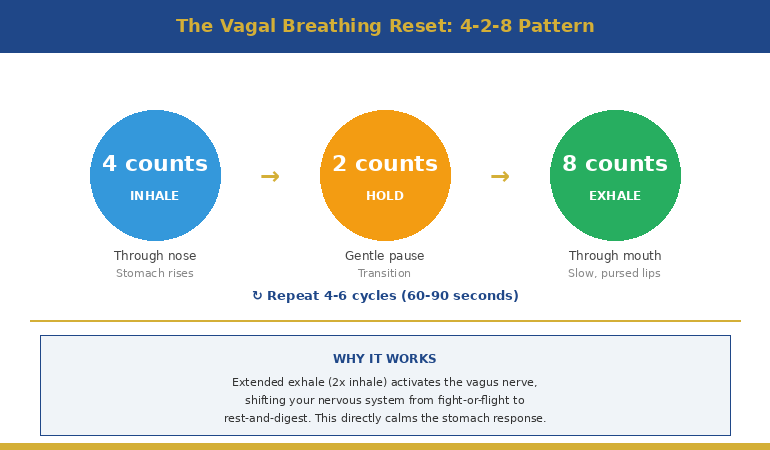
The pattern is 4-2-8. Inhale 4. Hold 2. Exhale 8. That’s it. No apps, no special equipment, no one needs to know you’re doing it. You can do it standing in a corridor, sitting in a bathroom, or even at the table before a meeting starts.
📋 Nausea isn’t your only symptom, is it?
Calm Under Pressure covers 13 physical symptoms — shaking hands, racing heart, voice tremor, blushing, dry mouth, chest tightness, and 7 more. Each one has a timed, sequenced emergency protocol. Plus anticipatory anxiety systems for the night before, 3am wake-ups, and the morning of. Get the complete toolkit → £19.99
Why This Works When Other Breathing Techniques Don’t
If you’ve tried “deep breathing” before and it didn’t help — or made things worse — you’re not alone. There’s a specific reason standard breathing advice fails for nausea.
Most breathing exercises use equal ratios: breathe in for four, out for four. Or they emphasise the inhale — “take a deep breath.” The problem is that inhalation activates your sympathetic nervous system. When you take a big, deliberate inhale, you’re actually stimulating the fight-or-flight response slightly. For someone who’s already in sympathetic overdrive (which is what’s causing the nausea), emphasising the inhale is like throwing petrol on a fire.
The vagal reset reverses the ratio. By making the exhale twice as long as the inhale, you’re spending more time in parasympathetic activation than sympathetic. Each cycle tips the balance further toward “rest and digest.” After several cycles, you’ve shifted your autonomic state enough that the nausea signal diminishes.
This is also why the 4-7-8 technique works well for some people — it follows the same principle of extended exhalation. The 4-2-8 pattern I teach is a simplified version that’s easier to remember under stress. When you’re nauseous and panicking, you need a pattern you can recall without thinking.
The other critical difference is the hand placement. Putting your hand on your stomach does two things: it ensures you’re breathing diaphragmatically (which maximises vagal stimulation), and it gives your anxious brain something concrete to focus on. Instead of spiralling through “I’m going to be sick, everyone will notice, this is a disaster,” your attention anchors to the physical sensation of your hand moving. It’s a grounding technique disguised as a breathing exercise.
The Emergency Protocol: When You’re Already in the Bathroom
Sometimes the technique above isn’t enough to prevent an episode. Sometimes you’re already in crisis when you remember to try it. Here’s the protocol for when you’re past the prevention stage:
First: Don’t fight it.
If you’re going to be sick, let it happen. Fighting nausea increases tension in your abdomen, which makes everything worse. The physical act itself isn’t the problem — the anxiety about it is what keeps the cycle going.
Second: Cold water on your wrists.
Run cold water over the inside of your wrists for 15–20 seconds. This is a mammalian dive reflex trigger — cold on your pulse points activates your parasympathetic nervous system through a different pathway than breathing. It’s a backup route to the same destination.
Third: Start the 4-2-8 pattern immediately after.
Once the acute moment has passed, begin the vagal reset. Your body is actually more receptive to it after the release — your system is already trying to return to baseline, and the breathing pattern accelerates that process.
Fourth: Give yourself five minutes.
You don’t need to rush into the room. Five minutes of vagal breathing after an episode is enough for your system to stabilise. Your colour will return. The shaking will stop. You’ll walk in looking normal — and nobody will know what happened five minutes earlier.
I’ve used this exact protocol myself. The presentation I mentioned at the start of this article? I used an earlier version of this emergency sequence. I walked into that boardroom six minutes late, apologised for a “phone call that ran over,” and delivered the presentation. It went well. Nobody knew.
⏱️ 20-Minute Reset. 5-Minute Reset. 2-Minute Emergency Reset.
Calm Under Pressure includes three structured pre-presentation warm-up sequences — physical discharge, breathing reset, voice warm-up, mental preparation, and NLP anchor activation — timed to the minute. Plus 7 situation-specific playbooks for board presentations, virtual calls, all-hands, client pitches, job interviews, impromptu requests, and hostile Q&A. Each one adapted to the unique pressure of that context.
Get Calm Under Pressure → £19.99
Instant download. Built by a qualified clinical hypnotherapist and NLP practitioner.
Breaking the Pattern Long-Term
The vagal breathing reset is an intervention — it works in the moment. But if you’re someone who experiences nausea before every significant presentation, you’ll also want to address the pattern itself. Not just managing the symptom, but reducing the trigger.
The nausea pattern gets worse over time because of something called anticipatory conditioning. Your brain learns: presentation → nausea. Once that association is established, the nausea starts earlier and earlier. First it’s the morning of. Then it’s the night before. Eventually, some people feel it days in advance.
Breaking this cycle requires working at the nervous system level — not the cognitive level. Positive self-talk doesn’t reach the part of your brain that’s creating the association. What does work is gradually retraining your nervous system’s threat response through techniques like the fight-or-flight reset from hypnotherapy, systematic desensitisation, and building a pre-presentation routine that consistently signals safety to your nervous system.
The vagal breathing reset can actually become part of this long-term retraining. When you use it consistently before presentations — even presentations where the nausea isn’t severe — you’re building a competing association: presentation → breathing → calm. Over time, the calm pathway gets stronger and the nausea pathway gets weaker.
For a broader approach to calming nerves before presentations, combining the vagal reset with a structured pre-presentation routine produces the most reliable results.
🔍 Ready to reduce symptom intensity over time?
The 14-Day Rewiring Protocol in Calm Under Pressure combines vagal activation exercises with NLP techniques — the Confidence Anchor, Circle of Excellence, and Inner Coach reframe. Most people see a 2–4 point drop on a 10-point symptom scale by Day 14. Get the complete toolkit → £19.99
Why do I feel sick before presentations?
Pre-presentation nausea is caused by your vagus nerve responding to a perceived threat. When your brain registers a high-stakes presentation as dangerous, it activates fight-or-flight mode, which disrupts digestion, increases stomach acid, and contracts abdominal muscles. It’s an autonomic nervous system response — not weakness or poor preparation.
Can breathing exercises stop nausea?
Yes — but only specific patterns. Standard “deep breathing” with equal inhale/exhale ratios can actually make nausea worse by stimulating the sympathetic nervous system. Extended exhale patterns (like the 4-2-8 vagal reset) can help calm the vagus nerve, which influences the stomach response. Many people notice relief within 3–5 cycles.
How do I stop throwing up before a presentation?
Use the emergency protocol: don’t fight the nausea, run cold water on the inside of your wrists for 15–20 seconds (triggers the mammalian dive reflex), then immediately begin the 4-2-8 vagal breathing reset. Give yourself five minutes to stabilise before entering the room. This sequence works because it targets the nervous system through multiple pathways.
🏆 Calm Under Pressure: The Complete Physical Symptom Toolkit
The breathing technique in this article is one protocol. The toolkit has 13 — plus everything you need before, during, and after any presentation.
- 13 Emergency Protocols: Racing heart, nausea, shaking, voice tremor, sweating, freeze, hyperventilation, blushing, dry mouth, chest tightness, dizziness, crying, talking too fast — each timed and sequenced
- Anticipatory Anxiety: Night-before protocol, 3am wake-up protocol, morning-of protocol, can’t eat protocol, catastrophizing interrupt
- Pre-Presentation Resets: 20-minute, 5-minute, and 2-minute emergency versions
- NLP Toolkit: Confidence Anchor, Circle of Excellence, Inner Coach reframe, 10 cognitive reframe cards, 5-minute self-hypnosis script
- 14-Day Rewiring Protocol: Daily exercises that reduce symptom intensity over time
- 7 Situation Playbooks: Board, virtual, all-hands, client pitch, interview, impromptu, hostile Q&A
- Post-Presentation Recovery: Shame spiral interrupt, 24-hour debrief protocol
- Quick Reference Card: 13 symptoms, one-page, printable
21 pages. Built by a qualified clinical hypnotherapist who spent 5 years experiencing every symptom on this list.
Get Calm Under Pressure → £19.99
Instant download. Less than one therapy session — and you keep it forever.
📊 Want the slides too? Preparation reduces anxiety. The Executive Slide System (£39) includes confident-presenter templates designed to minimise preparation stress.
Frequently Asked Questions
Is it normal to throw up before a presentation?
It’s more common than most people realise. Severe pre-presentation nausea affects professionals at every level, including senior executives. It’s a physiological response — your vagus nerve reacting to perceived threat — not a sign of weakness or inadequacy. Many of the executives I’ve worked with experienced this for years before learning techniques that helped.
Should I eat before a presentation if I get nauseous?
Eat something small and plain about 90 minutes beforehand — a piece of toast, a banana, or crackers. An empty stomach makes nausea worse because there’s nothing to absorb the excess acid your stress response produces. Avoid caffeine, dairy, and heavy foods. Don’t eat within 30 minutes of presenting.
How long does the vagal breathing reset take to work?
Many people notice the nausea begin to ease by the third cycle (about 45 seconds). By 5–6 cycles (60–90 seconds), the acute wave has often passed. With regular practice, you may find it works faster — your nervous system can learn the “stand down” signal and respond more quickly over time.
What if the breathing technique doesn’t work for me?
If the 4-2-8 pattern doesn’t provide relief, try extending the exhale further (4-2-10) or adding the cold water wrist technique simultaneously. If nausea is persistent and severe despite these interventions, it’s worth exploring the deeper pattern with a professional who understands the nervous system — a clinical hypnotherapist or a therapist trained in somatic approaches. The symptom is treatable.
📬 The Winning Edge Newsletter
Weekly strategies for confident presentations — physical symptom management, slide structures, and executive communication techniques. No filler.
🧠 P.S. Want to address the root cause, not just the symptom? Conquer Speaking Fear (£39) retrains the nervous system pattern that creates the anxiety in the first place.
Related reading: The presentation was perfect — the Q&A lost the deal — once the nausea is managed, preparing for the decision-making moment that follows your slides.
Your next step: The next time you feel nausea building before a presentation, stand up, place your hand on your stomach, and run through the 4-2-8 pattern. Four counts in through your nose. Two counts hold. Eight counts out through pursed lips. Five cycles. Ninety seconds. That’s all it takes to shift from “I can’t do this” to “I’ve got this.” And if nausea isn’t your only symptom — if your hands shake, your voice cracks, your heart races, or you lie awake at 3am — Calm Under Pressure (£19.99) has a timed protocol for all 13 physical symptoms, plus anticipatory anxiety systems, NLP techniques, and a 14-day rewiring protocol.
About the Author
Mary Beth Hazeldine is the Owner & Managing Director of Winning Presentations. With 24 years of corporate banking experience at JPMorgan Chase, PwC, Royal Bank of Scotland, and Commerzbank, she has delivered high-stakes presentations in boardrooms across three continents.
A qualified clinical hypnotherapist and NLP practitioner, Mary Beth combines executive communication expertise with evidence-based techniques for managing presentation anxiety. She spent five years experiencing severe presentation anxiety herself before training in the clinical approaches that resolved it — and now teaches those same techniques to senior professionals.