Tag: presentation openers

18 Dec 2025
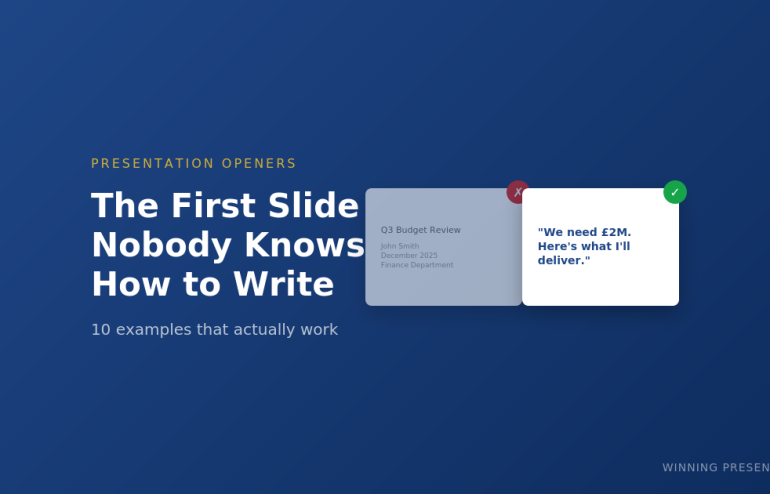
First slide examples for presentations before and after

The First Slide Nobody Knows How to Write (And 10 Examples That Work)

Stop staring at a blank title slide. Here’s exactly what to put on it.

You’ve got your presentation structured. You know your key points. You’ve even rehearsed the middle section.

But you’re still staring at slide one.

What do you actually put on the first slide? Your name and the date? A clever quote? The company logo? Something that “grabs attention”?

Most people get this wrong — and it costs them the room before they’ve said a word.

After 24 years presenting to boards, investors, and C-suite executives at JPMorgan, PwC, and Royal Bank of Scotland, I’ve tested dozens of opening slide approaches. Here are the 10 that consistently work.

Want all 10 openers (plus 15 closers) as copy-paste templates?

The Openers & Closers Swipe File gives you 25 ready-to-use templates with fill-in-the-blank scripts. Stop staring at blank slides.

Get the Swipe File (£9.99) →

Why Your First Slide Matters More Than You Think

Your audience decides in the first 30 seconds whether to pay attention or check their phones. The first slide sets that tone.

A weak first slide signals: “This will be like every other boring presentation.”

A strong first slide signals: “This person knows what they’re doing. I should listen.”

The difference isn’t design. It’s intent. Your first slide should do ONE of three things:

  • Create curiosity — make them want to know more
  • Establish stakes — show them why this matters
  • State your position — tell them exactly what you’re recommending

Here are 10 ways to do that.

10 First Slide Presentation Examples That Actually Work

1. The Bold Claim

State your conclusion upfront. No build-up, no context, no “let me walk you through.”

Example:

“We should acquire Company X for £15M. Here’s why.”

Why it works: Executives don’t want to wait for your conclusion. Give it to them immediately, then spend the rest of the presentation proving it.

Best for: Board presentations, executive briefings, any audience with authority and limited time.

Related: The Pyramid Principle for Presentations

2. The Provocative Question

Ask something that challenges assumptions or creates immediate tension.

Example:

“What if everything we know about customer retention is wrong?”

Why it works: Questions engage the brain differently than statements. The audience can’t help but start formulating answers.

Best for: Strategy presentations, innovation pitches, challenging the status quo.

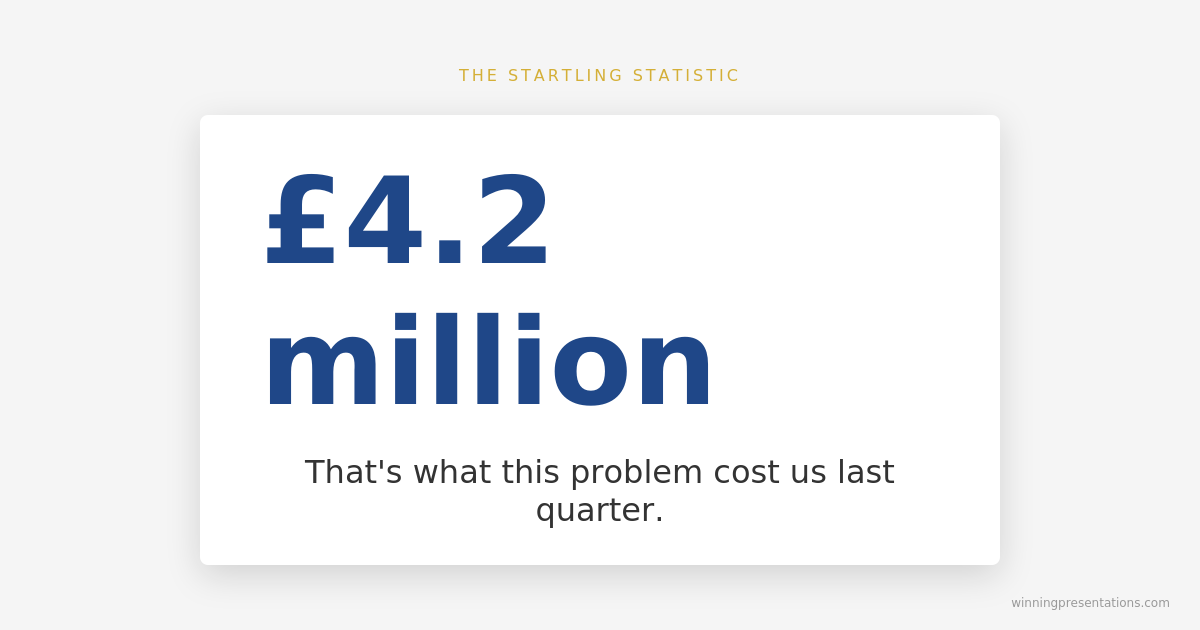
3. The Startling Statistic

Lead with a number that makes people sit up.

Example:

“£4.2 million. That’s what this problem cost us last quarter.”

Why it works: Specific numbers feel concrete and credible. They create immediate stakes.

Best for: Budget requests, problem presentations, any situation where you need to establish urgency.
First slide example showing startling statistic presentation opening

4. The Before/After Promise

Show the transformation you’re offering.

Example:

“From 6-hour turnaround to 45 minutes. This is what AI did for our team.”

Why it works: People understand contrast instantly. The gap between before and after creates curiosity about how you got there.

Best for: Case studies, sales presentations, process improvement updates.

5. The Enemy Slide

Name the problem your audience is fighting.

Example:

“Manual reporting is killing your team’s productivity.”

Why it works: When you articulate someone’s pain better than they can, you earn instant credibility. They think: “This person understands my world.”

Best for: Sales pitches, proposals, any presentation where you’re solving a problem.

Related: How to Structure a Presentation: The Step-by-Step Guide

6. The Counterintuitive Truth

Challenge conventional wisdom immediately.

Example:

“The best sales teams don’t focus on selling.”

Why it works: Contradictions create cognitive tension. The audience needs to hear the explanation to resolve it.

Best for: Thought leadership, keynotes, any presentation where you’re changing minds.

7. The Single Word

Maximum impact, minimum noise.

Example:

“Momentum.”

Why it works: A single word forces the audience to lean in. What does it mean? Why that word? You have their full attention for your verbal explanation.

Best for: Keynotes, team rallies, presentations where you want to create a memorable moment.

Get All 25 Templates

The Openers & Closers Swipe File includes:

  • 10 opening slide templates (with fill-in-the-blank scripts)
  • 15 closing slide templates (including “The Ask” and “The Callback”)
  • Before/after examples showing weak vs. strong versions
  • Guidance on which opener fits which situation

Stop reinventing the wheel for every presentation.

Get instant access (£9.99) →

8. The “What If” Scenario

Paint a picture of a different future.

Example:

“What if you could close deals in half the time with twice the confidence?”

Why it works: “What if” bypasses skepticism. It’s hypothetical, so there’s nothing to argue with. But it plants a seed of possibility.

Best for: Product launches, vision presentations, sales pitches.

9. The Audience Mirror

Describe exactly what they’re experiencing right now.

Example:

“You’ve got 47 slides, a meeting in an hour, and no idea what your main point is.”

Why it works: When someone describes your situation perfectly, you trust them. They clearly understand your world.

Best for: Training sessions, consulting pitches, any presentation where you’re positioning yourself as the expert.

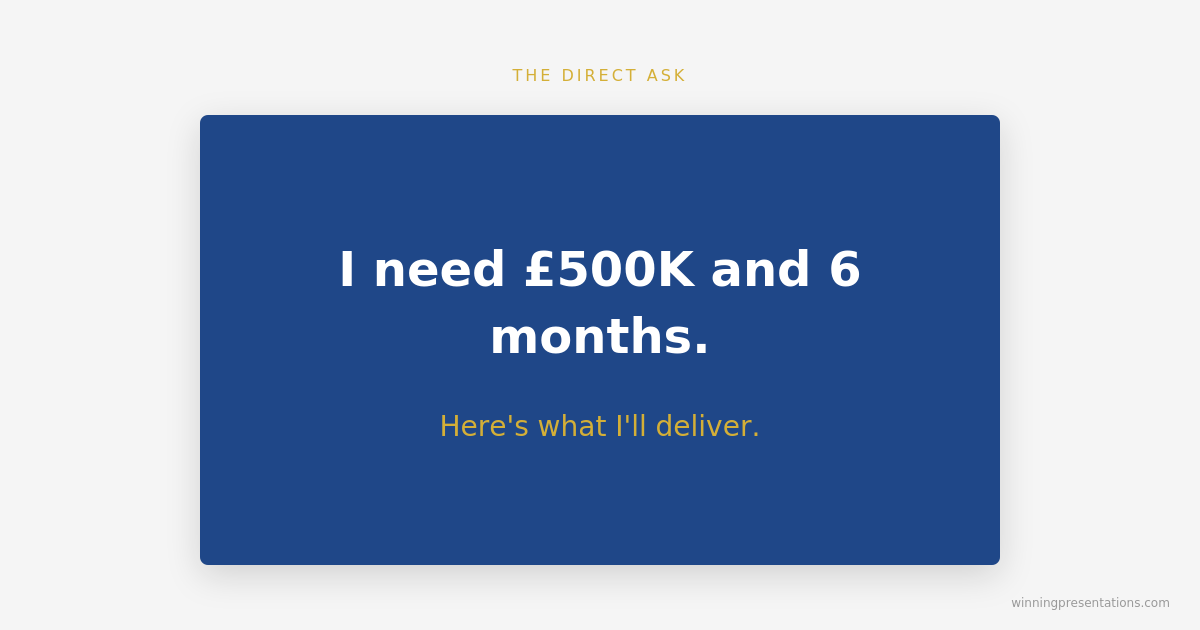
10. The Direct Ask

Skip the preamble entirely. Say what you want.

Example:

“I need £500K and 6 months. Here’s what I’ll deliver.”

Why it works: Directness signals confidence. It respects the audience’s time. And it frames everything that follows as justification for a specific request.

Best for: Budget requests, investor pitches, any presentation where you’re asking for a decision.

Related: How to End a Presentation: 7 Closing Techniques
Opening slide example showing direct ask presentation technique

What NOT to Put on Your First Slide

Now that you know what works, here’s what to avoid:

❌ Your name and title — Nobody cares yet. Earn their attention first.

❌ The date and meeting title — They know what meeting they’re in.

❌ A table of contents — Save it for documents. Presentations should flow.

❌ “Today we’ll cover…” — This signals a lecture, not a conversation.

❌ A generic quote — Unless it’s directly relevant, it’s filler.

❌ Your company logo taking up the whole slide — Branding matters, but not more than your message.

Your first slide has one job: make them want slide two.

Matching Your Opener to Your Situation

The right opening depends on your audience and goal:

Situation Best Openers
Board presentation Bold Claim, Direct Ask
Sales pitch Enemy Slide, Before/After, What If
Investor pitch Startling Statistic, Direct Ask, Bold Claim
Keynote / all-hands Single Word, Provocative Question, Counterintuitive Truth
Training session Audience Mirror, Before/After
Strategy recommendation Bold Claim, Provocative Question

Frequently Asked Questions

Should I introduce myself on the first slide?

No. Earn their attention first, then introduce yourself — either verbally after your opening or on slide two. The exception is if you’re unknown to the audience AND your credibility is central to the message. Even then, keep it brief.

What about title slides for formal presentations?

If protocol requires a title slide (some board meetings, academic presentations), use it — but make it work harder. Instead of “Q3 Financial Update,” try “Q3 Results: Why We’re Accelerating Investment.” Same information, but it creates curiosity.

How do I choose between these openers?

Ask yourself: What does my audience need to feel in the first 10 seconds? Curious? Alarmed? Reassured? Challenged? Pick the opener that creates that emotion. When in doubt, go with The Bold Claim for executives or The Enemy Slide for sales.


Stop Staring at Blank Slides

Your first slide sets the tone for everything that follows. Get it right, and you’ve earned attention. Get it wrong, and you’re fighting uphill for the next 20 minutes.

The Openers & Closers Swipe File gives you 25 templates you can use immediately:

  • 10 opening slides with fill-in-the-blank scripts
  • 15 closing slides (including The Single Ask, The Callback, and The Forward Story)
  • Before/after examples showing weak vs. strong versions
  • Situation guide so you always pick the right one

Get the Swipe File (£9.99) →

Instant download. Use it on your next presentation.


Mary Beth Hazeldine is the Managing Director of Winning Presentations. She spent 24 years in corporate banking at JPMorgan Chase, PwC, Royal Bank of Scotland, and Commerzbank before training thousands of executives to present with impact. Her clients have raised over £250M using her frameworks.

16 Dec 2025
Presentation Opening Lines: 50 Examples from TED Talks to Boardrooms

Presentation Opening Lines: 50 Examples from TED Talks to Boardrooms

Quick Answer: The best presentation opening lines create instant curiosity. Examples: “What if everything you knew about [topic] was wrong?” or “In the next 10 minutes, I’ll show you how to [specific benefit].” Avoid “Today I’m going to talk about…” — it kills attention immediately.

You’re standing in front of the room. Everyone’s looking at you. And you have exactly 10 seconds before they decide whether to pay attention or check their phones.

What do you say?

After training over 10,000 executives, I’ve collected the opening lines that actually work — from TED stages to investment banking boardrooms. Here are 50 you can steal today.

Want these 50 lines in a swipe file?

Get my Presentation Openers & Closers Swipe File — ready to copy, paste, and customize for your next presentation.

Get the Swipe File — £9.99

Opening Lines That Create Curiosity

These openers make your audience need to know what comes next:

1. “What if everything you’ve been taught about [topic] is wrong?”

2. “There’s a reason 90% of [audience] fail at [challenge]. And it’s not what you think.”

3. “I’m about to show you something that changed how I think about [topic] forever.”

4. “The biggest lie in [industry] is that [common belief]. Here’s the truth.”

5. “Three years ago, I discovered something that [specific result]. Today, I’m sharing it with you.”

Opening Lines with Shocking Statistics

Numbers that surprise create instant engagement:

6. “75% of [audience] will [negative outcome] this year. You don’t have to be one of them.”

7. “In the time it takes me to finish this sentence, [striking statistic].”

8. “£4.2 million. That’s what [problem] cost companies like yours last year.”

9. “The average [professional] spends 23 hours a week on [activity]. I’m going to show you how to cut that in half.”

10. “Only 3% of [audience] ever achieve [goal]. Here’s what they do differently.”

Opening Lines with Stories

Stories activate emotion and memory:

11. “Last Tuesday, I watched a CEO lose a £10 million deal in eleven words.”

12. “When I walked into my first board meeting at JPMorgan, I made a mistake I’ll never forget.”

13. “Picture this: It’s 2am, you’re staring at 47 slides, and your presentation is in 6 hours.”

14. “The worst presentation of my career taught me the most valuable lesson.”

15. “A client called me last week in a panic. What happened next surprised us both.”

5 Categories of Powerful Presentation Opening Lines

Opening Lines with Questions

Questions force active engagement:

16. “When was the last time you sat through a presentation and thought, ‘I wish this was longer’?”

17. “What would it mean for your career if you could [specific outcome]?”

18. “How many of you have ever [common frustrating experience]?” (Wait for hands)

19. “What’s the one thing standing between you and [goal]?”

20. “If I could guarantee [result], would that be worth 15 minutes of your time?”

Opening Lines with Bold Statements

Confidence commands attention:

21. “Everything you’re about to hear contradicts conventional wisdom. And it works.”

22. “I’m not here to give you information. I’m here to change how you think.”

23. “This presentation will either transform your approach or confirm you’re already doing it right.”

24. “By the end of this session, you’ll never [common mistake] again.”

25. “I’ve spent 24 years in boardrooms. Here’s what actually matters.”

Opening Lines for Specific Situations

For Board Presentations:

26. “I’ll give you the recommendation first, then the reasoning. We need £2.3 million to [goal].”

27. “Three numbers tell the story of this quarter: [X], [Y], and [Z].”

28. “Before I show you the data, let me tell you what it means for next year.”

For Investor Pitches:

29. “[Market] is a £4 billion problem. We’ve built the solution.”

30. “In 18 months, we’ve gone from idea to £2 million ARR. Here’s how we’ll 10x that.”

31. “The companies that invested in [comparable] early made 40x returns. This is that opportunity.”

For Sales Presentations:

32. “Your competitors are already doing this. Let me show you what you’re missing.”

33. “I’ve spoken to 50 companies like yours. They all have the same problem.”

34. “What if I told you there’s a way to [benefit] without [sacrifice]?”

For Team Meetings:

35. “I’ve got good news and better news. Which do you want first?”

36. “We’ve achieved something this quarter that’s never been done before.”

37. “I need your help solving a problem that’s been keeping me up at night.”

Opening Lines to Avoid

Never start with these — they kill momentum instantly:

❌ “Good morning, my name is… and today I’m going to talk about…”

❌ “Can everyone hear me okay?”

❌ “I know you’re all busy, so I’ll try to be quick…”

❌ “I’m just going to quickly run through…”

❌ “Sorry, let me just get my slides working…”

❌ “I’m not really an expert, but…”

For a deeper dive into why these openings fail and the psychology behind what works, read my complete guide: How to Start a Presentation: 15 Powerful Openers That Grab Attention.

Ready to Transform Your Openings?

My Presentation Openers & Closers Swipe File gives you 50 proven opening lines AND 30 powerful closing techniques — ready to use in your next presentation.

Get the Swipe File — £9.99

Want the complete system? Join my AI-Enhanced Presentation Mastery course →


Mary Beth Hazeldine has trained over 10,000 executives in presentation skills. With 24 years in investment banking (JPMorgan, PwC, RBS, Commerzbank) and 16 years as a presentation coach, she knows what works in high-stakes situations. Learn more at Winning Presentations.

Related Reading:

16 Dec 2025
How to Start a Presentation: 15 Powerful Openers That Grab Attention

How to Start a Presentation: 15 Powerful Openers That Grab Attention

Quick Answer: The best way to start a presentation is to grab attention in the first 10 seconds with a surprising statistic, a bold statement, a relevant story, or a thought-provoking question. Avoid starting with “Today I’m going to talk about…” — you’ll lose your audience before you begin.

I’ve watched over 500 executive presentations in my career. Investment bankers pitching billion-pound deals. Biotech founders presenting to skeptical investors. Senior leaders defending budgets to hostile boards.

And I can tell you exactly when most of them lost their audience: the first 30 seconds.

The opening of your presentation isn’t just important — it’s everything. Get it wrong, and you’re fighting an uphill battle for the next 20 minutes. Get it right, and your audience leans in, ready to hear what you have to say.

After 24 years in investment banking at JPMorgan, PwC, RBS, and Commerzbank — plus 16 years coaching executives on high-stakes presentations — I’ve identified exactly what works. Here are 15 powerful openers that grab attention and set you up for success.

Want 50 ready-to-use opening lines?

My Presentation Openers & Closers Swipe File gives you proven opening lines for every situation — from board meetings to investor pitches.

Get 50 Opening Lines — £9.99

Why the First 10 Seconds Matter More Than Anything Else

Neuroscience tells us something uncomfortable: your audience decides whether to pay attention within the first 10 seconds. Not 10 minutes. Ten seconds.

This is called the “primacy effect” — we remember beginnings and endings far more than middles. And in those crucial first moments, your audience is asking one question:

“Is this going to be worth my time?”

If you start with “Good morning, my name is Sarah and today I’m going to talk about our Q3 results…” — you’ve already answered that question. And the answer is no.

Here’s what the best presenters do differently.

15 Powerful Ways to Start a Presentation

15 Powerful Presentation Openers Infographic

1. The Shocking Statistic

Numbers that surprise create instant engagement. The key is contrast — show them something that challenges their assumptions.

Example: “75% of venture-backed startups fail. But the companies that master investor presentations are 40% more likely to get funded. Today, I’m going to show you exactly what separates the funded from the forgotten.”

Why it works: You’ve created a gap between what they know and what they need to know. Now they have to keep listening.

2. The Bold Statement

Make a claim that’s unexpected or even slightly controversial. This triggers curiosity and positions you as someone with a point of view.

Example: “Everything you’ve been taught about presenting to boards is wrong. And it’s costing you promotions.”

Why it works: You’ve challenged the status quo. Even if they disagree, they want to hear your reasoning.

3. The Relevant Story

Stories activate different parts of the brain than data alone. A well-chosen story creates emotional connection and makes abstract concepts concrete.

Example: “Three years ago, I sat in a boardroom in Frankfurt and watched a CFO lose a £4 million budget approval in eleven words. He opened with ‘I know we’re over budget, but let me explain.’ The meeting was over before it started.”

Why it works: Stories create suspense. Your audience wants to know what happened next — and how to avoid the same fate.

4. The Thought-Provoking Question

Questions engage the brain differently than statements. They force your audience to think, which means they’re actively participating rather than passively listening.

Example: “When was the last time you sat through a presentation and thought, ‘I wish this was longer’?”

Why it works: You’ve made them smile and acknowledged a shared frustration. You’re on the same side now.

5. The “Imagine” Scenario

Invite your audience into a future state. This technique, borrowed from hypnotherapy, creates a vivid mental picture that makes your solution feel tangible.

Example: “Imagine walking into your next board presentation completely calm. You know exactly what to say. The executives are nodding. And when you finish, the CEO says, ‘That was exactly what we needed.’ What would that be worth to you?”

Why it works: You’ve made them feel the outcome before you’ve explained the process.

6. The Counterintuitive Truth

Share something that goes against conventional wisdom. This positions you as an expert with insider knowledge.

Example: “The best presentations I’ve ever seen had zero bullet points. None. And they won billion-pound deals.”

Why it works: You’ve challenged a default assumption. Now they need to understand why.

7. The Specific Promise

Tell them exactly what they’ll get from the next few minutes. Be specific and benefit-focused.

Example: “In the next 12 minutes, I’m going to give you the three-slide structure that’s helped my clients raise over £250 million in funding. You can implement it in your next presentation tomorrow.”

Why it works: You’ve set clear expectations and promised immediate value. They know what’s coming and why it matters.

8. The Shared Problem

Articulate the pain your audience is experiencing. When people feel understood, they trust you to provide the solution.

Example: “You’ve spent three weeks on this presentation. You’ve rehearsed it a dozen times. And you still can’t shake the feeling that when you stand up, your mind will go blank and everyone will see you’re not ready.”

Why it works: You’ve demonstrated that you understand their world. You’re not just another presenter — you’re someone who gets it.

Struggling with presentation anxiety?

My Calm Under Pressure Toolkit gives you breathing techniques, confidence frameworks, and mental preparation strategies used by professional speakers.

Get the Confidence Toolket — £19.99 →

9. The Behind-the-Scenes Insight

Give them access to information they wouldn’t normally have. This creates a sense of exclusivity and trust.

Example: “I’ve sat in due diligence meetings at four global banks. And I can tell you exactly what the investment committee says after you leave the room…”

Why it works: You’re offering insider knowledge. They’re getting something not everyone gets access to.

10. The Historical Parallel

Connect your topic to a famous moment in history. This adds weight and context to your message.

Example: “In 1984, Steve Jobs stood in front of shareholders and said three words that changed Apple forever. Those three words weren’t about technology — they were about belief. And they’re the same three words you need in your next pitch.”

Why it works: You’ve borrowed credibility from a known success story and created curiosity about the connection.

11. The Live Demonstration

Show rather than tell. A well-executed demo captures attention like nothing else.

Example: Start by silently walking to the front of the room, pausing for three full seconds, and making eye contact with five people before saying a word. Then say: “That silence made you pay attention. Today, I’m going to show you how to command a room before you even speak.”

Why it works: You’ve demonstrated your expertise in real-time. No one is checking their phone now.

12. The Personal Failure

Vulnerability creates connection. When you share a mistake, you become human — and your audience trusts you more.

Example: “The worst presentation of my career was in front of 200 people at a banking conference. I blanked on my own name. Literally forgot who I was. And what I learned in the next 30 seconds saved my career.”

Why it works: They want to know how you recovered. And they believe you’ll help them avoid the same fate.

13. The Unexpected Object

Bring a physical prop. Objects create visual interest and give you something to anchor your message.

Example: Hold up a single slide printout. “This is the only slide that mattered in a £50 million deal. One slide. The other 47 were background noise. Today, I’ll show you how to find your one slide.”

Why it works: Physical objects break the pattern of typical presentations. People pay attention to what’s different.

14. The Direct Challenge

Challenge your audience to think differently or take action. This creates engagement through a sense of urgency.

Example: “By the end of this presentation, you’ll either change how you open every meeting — or you’ll keep losing your audience in the first 30 seconds. The choice is yours.”

Why it works: You’ve raised the stakes. This isn’t just information — it’s a decision point.

15. The Silence

Sometimes the most powerful opening is no words at all. Strategic silence commands attention and demonstrates confidence.

Example: Walk to the front. Stand still. Look at your audience for 5 full seconds. Then, quietly: “Now that I have your attention… let’s talk about why most presentations lose it.”

Why it works: Silence is unexpected. In a world of noise, quiet commands the room.

The Openings That Kill Your Credibility

Now that you know what works, here’s what to avoid:

❌ “Can everyone hear me?” — Start as if you’re already in command.

❌ “I’m just going to quickly talk about…” — The word “just” diminishes your message before you’ve delivered it.

❌ “I know you’re all busy, so I’ll try to be quick…” — You’ve just signaled that what you’re about to say isn’t important.

❌ “Today I’m going to talk about…” — Boring. They know you’re going to talk. Show them why they should care.

❌ “Let me just share my screen…” — Technical fumbling kills momentum. Have everything ready before you speak.

❌ Apologizing for anything — Never open with an apology. It puts you on the back foot immediately.

How to Choose the Right Opening for Your Situation

Not every opener works for every context. Here’s how to match your opening to your audience:

Board presentations: Use the Bold Statement, Specific Promise, or Shocking Statistic. Executives want confidence and clarity.

Investor pitches: Use the Relevant Story, Specific Promise, or Behind-the-Scenes Insight. Investors need to trust you before they trust your numbers.

Team meetings: Use the Shared Problem, Thought-Provoking Question, or “Imagine” Scenario. Internal audiences need to feel included.

Sales presentations: Use the Counterintuitive Truth, Direct Challenge, or Personal Failure. Buyers are skeptical — surprise them.

Conference keynotes: Use the Live Demonstration, Silence, or Historical Parallel. Large audiences need theatrical moments to stay engaged.

Ready to Transform How You Present?

For immediate help:

For complete transformation:

My AI-Enhanced Presentation Mastery course covers everything — from opening to closing, from confidence to content. Live cohort starts January 2026.

Join the Maven Course — £249

The 30-Second Opening Framework

If you remember nothing else from this article, use this simple framework for your next presentation:

Second 1-5: Establish presence (pause, make eye contact, breathe)

Second 6-15: Hook them (statistic, story, question, or bold statement)

Second 16-25: Create relevance (why this matters to THEM)

Second 26-30: Preview the value (what they’ll get from the next X minutes)The 30-Second Opening Framework: Presence, Hook, Relevance, Preview

That’s it. Thirty seconds to change the trajectory of your entire presentation.

What Happens After a Great Opening

A powerful opening does more than grab attention — it changes the dynamic of the entire presentation.

When you open strong, you feel more confident. Your audience is engaged. You have momentum. Everything that follows is easier.

When you open weak, you spend the rest of the presentation trying to recover. You can feel the room’s attention drifting. You rush. You doubt yourself.

The difference between a presentation that wins and one that’s forgotten often comes down to those first 30 seconds.

Choose your opening carefully. Practice it until it’s second nature. And walk into that room knowing that before you’ve even finished your first sentence, you’ve already won half the battle.


Mary Beth Hazeldine is an executive presentation coach with 24 years in investment banking (JPMorgan, PwC, RBS, Commerzbank) and 16 years training executives to present with confidence. She has trained over 10,000 executives through Winning Presentations.

Related Reading: