
Tag: performance anxiety

12 Feb 2026
Professional reflecting on past presentation experience with contemplative expression

Presentation PTSD Is Real: Signs You’re Still Carrying an Old Failure

It was seven years ago. I still remember exactly what I was wearing.

The room had 40 people. I was presenting quarterly results to the leadership team. Slide 12 — a chart I’d built myself — had an error. The CFO spotted it immediately. “These numbers don’t add up,” he said. Not quietly. Not kindly.

For the next three minutes, I stood there while he picked apart my work in front of everyone. My face burned. My voice disappeared. I wanted the floor to open and swallow me whole.

That presentation ended my confidence for years. Every time I stood up to speak after that, I wasn’t in the current room — I was back in that room, waiting for someone to find the error, waiting for the humiliation to start again.

If you’ve had a presentation experience that still affects how you feel about speaking — even years later — you’re not being dramatic. Your nervous system is doing exactly what it’s designed to do. It’s trying to protect you from a threat it still believes is real.

I’m writing about this now because presentation anxiety is increasingly recognised as a genuine psychological response, not a character flaw. Recent understanding of how trauma affects the nervous system explains why “just get over it” doesn’t work — and what actually does.

Quick answer: Presentation trauma occurs when a difficult speaking experience becomes encoded in your nervous system as a threat. Signs include physical reactions (racing heart, sweating, nausea) that seem disproportionate to the current situation, avoidance behaviours, intrusive memories of past failures, and anticipatory anxiety that starts days before a presentation. Recovery involves recognising the pattern, working with your nervous system rather than against it, and gradually rebuilding positive associations with speaking. Some people notice shifts relatively quickly; deeper patterns can take longer. The key is that recovery is possible — your nervous system learned this response, and it can learn something new.

⏰ Presenting in the next 48 hours?

If you need to calm your nervous system before an upcoming presentation, here’s what to do right now:

  1. Tonight: Use a guided nervous system reset before bed (18-20 min)
  2. Tomorrow morning: Avoid caffeine; do 5 minutes of slow breathing
  3. Minutes before: Use a 90-second physical reset in the corridor

Get all three tools → Conquer Speaking Fear £39

Note: This article discusses presentation-related anxiety and trauma responses. While these experiences are common and the techniques here help many people, persistent or severe symptoms may benefit from support with a qualified mental health professional. The term “PTSD” is used colloquially here to describe trauma-like responses to presentation experiences — clinical PTSD is a specific diagnosis that requires professional assessment.

As a certified hypnotherapist who now works with executives on presentation anxiety, I’ve heard hundreds of these stories. The details differ — a forgotten line, a hostile question, a technology failure, a panic attack — but the pattern is remarkably consistent.

Something happened. It felt terrible. And now, years later, it still controls how you feel about presenting.

The good news: this isn’t permanent. Your nervous system learned this fear response, and it can unlearn it. But first, you need to understand what’s actually happening.

Signs You’re Carrying Presentation Trauma

Presentation trauma doesn’t always announce itself obviously. Sometimes it shows up as “I just don’t like presenting” or “I’m not a natural speaker.” But there are specific signs that suggest you’re carrying something from the past:

1. Your Body Reacts Before Your Mind Does

You get an email about an upcoming presentation. Before you’ve even processed what it says, your heart rate increases. Your stomach tightens. Your palms get clammy.

This instant physical response — before conscious thought — is a hallmark of trauma. Your nervous system has flagged “presentation” as a threat and is activating your fight-or-flight response automatically.

2. The Fear Seems Disproportionate

You’re presenting to three friendly colleagues about a topic you know well. Objectively, the stakes are low. But your body is reacting like you’re about to face a firing squad.

When the fear response doesn’t match the actual situation, it’s often because your nervous system is responding to a past threat, not the current one.

3. You Have Intrusive Memories

When you think about presenting, your mind automatically goes to that time it went wrong. You can see it clearly — the faces, the room, the moment everything fell apart. These memories arrive unbidden and feel uncomfortably vivid.

4. You Avoid at All Costs

You’ve turned down opportunities, delegated important moments to others, or restructured your career to minimise presenting. The avoidance has become a pattern that shapes your professional life.

5. Anticipatory Anxiety Starts Days (or Weeks) Early

A presentation is scheduled for next Thursday. By Sunday, you’re already feeling anxious. By Wednesday night, you can’t sleep. The dread builds exponentially as the date approaches.

6. You Experience Shame, Not Just Fear

There’s a difference between “I’m afraid of presenting” and “I’m ashamed of how I present.” Trauma often carries shame — a feeling that you are fundamentally flawed, not just that the situation is scary.

🎯 Release Presentation Trauma With Guided Nervous System Work

Conquer Speaking Fear uses hypnotherapy and NLP techniques specifically designed to work with your nervous system — not against it. The programme includes three audio tools for different moments:

  • Full Guided Session (18-20 min): Deep nervous system reprogramming — use the night before
  • 90-Second Reset Audio: Quick calm-down for the corridor or bathroom — minutes before
  • Printable Pocket Card: 4-step physical reset — in the moment when you need it

Get Conquer Speaking Fear → £39

Instant download. Created by a certified hypnotherapist who spent five years terrified of presenting — and found a way out.

Why Your Nervous System Won’t “Just Let It Go”

If you’ve ever been told to “just relax” or “it’s not a big deal,” you know how unhelpful that advice is. Here’s why your nervous system doesn’t respond to logic:

The Amygdala Doesn’t Have a Calendar

Your amygdala — the brain’s threat-detection centre — processes experiences without timestamps. A humiliating presentation from 2018 feels just as threatening as one happening right now, because to your amygdala, there’s no difference between “this happened” and “this is happening.”

Emotional Memories Are Stored Differently

Traumatic experiences aren’t filed away like regular memories. They’re stored in a fragmented, sensory way — which is why a particular room layout, a certain type of projector, or even a specific smell can trigger the whole response pattern.

Your Body Keeps the Score

The fear isn’t just in your mind — it’s encoded in your body. Your posture, your breathing pattern, your muscle tension all hold the memory. This is why cognitive approaches (“think positive thoughts”) often fail. The body remembers what the mind tries to forget.

Avoidance Reinforces the Fear

Every time you avoid presenting, your nervous system gets confirmation: “See? That was dangerous. Good thing we escaped.” The avoidance provides temporary relief but strengthens the fear response long-term.

The Trauma Response Cycle

Understanding the cycle helps you interrupt it:

Stage 1: Trigger
Something reminds your nervous system of the original threat — a calendar invite, a request to present, even someone mentioning “presentation” in conversation.

Stage 2: Activation
Your fight-or-flight system activates. Heart rate increases, stress hormones release, blood flows away from your prefrontal cortex (thinking brain) toward your survival systems.

Stage 3: Hijack
Your rational mind goes offline. You can’t think clearly, can’t access your preparation, can’t remember that you’re actually safe. The past has hijacked the present.

Stage 4: Behaviour
You either fight (get defensive, speak too fast, overcompensate), flight (avoid, delegate, call in sick), or freeze (mind goes blank, voice disappears, body locks up).

Stage 5: Aftermath
Regardless of how the presentation actually went, you feel depleted, ashamed, and more convinced than ever that presenting is dangerous. The cycle reinforces itself.
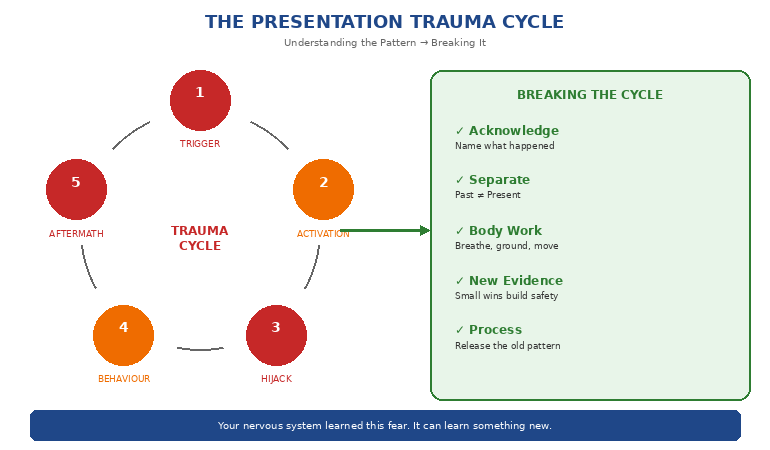

Presentation trauma cycle showing trigger, response, and recovery pathway

Ready to break the cycle? Conquer Speaking Fear includes nervous system techniques that interrupt this pattern — working with your body, not just your mind.

Get the Programme → £39

How to Release the Pattern

Recovery from presentation trauma isn’t about forcing yourself to present more (exposure therapy without proper support often makes things worse). It’s about working with your nervous system to create new associations.

Step 1: Acknowledge What Happened

Stop minimising. “It wasn’t that bad” or “I should be over it by now” keeps you stuck. Something happened that affected you. That’s real. Your response makes sense given what you experienced.

I spent years pretending my CFO moment didn’t bother me. Recovery only started when I admitted: that was humiliating, it hurt, and it changed how I felt about presenting.

Step 2: Separate Past from Present

When you notice the fear response activating, practice naming it: “This is my nervous system responding to 2018, not to today.” You’re not trying to make the feeling go away — you’re creating space between the trigger and your response.

Step 3: Work With Your Body

Because the trauma is stored in your body, body-based techniques are often more effective than cognitive ones:

  • Slow exhales: Longer exhales than inhales can help activate your parasympathetic nervous system
  • Grounding: Feel your feet on the floor, your weight in the chair — anchor yourself in the present moment
  • Movement: Shake out your hands, roll your shoulders — discharge the physical activation
  • Posture reset: Stand tall, open your chest — your body’s position affects your emotional state

Step 4: Create New Experiences

Your nervous system needs evidence that presenting can be safe. This doesn’t mean forcing yourself into high-stakes situations. It means starting small:

  • Speaking up in a meeting with one comment
  • Presenting to one trusted colleague
  • Recording yourself and watching without judgment
  • Gradually increasing the challenge as your nervous system adapts

Step 5: Process the Original Experience

Sometimes the old memory needs direct attention. Techniques like guided visualisation, timeline therapy, or working with a therapist can help you process what happened so it no longer controls your present.

This is where hypnotherapy-based approaches can be particularly effective — they work directly with the subconscious patterns that keep the trauma response active.

🧠 Nervous System Reprogramming for Presentation Trauma

Conquer Speaking Fear was created specifically for professionals carrying presentation trauma. The guided hypnotherapy session helps your nervous system release the old pattern and build new, calmer associations with speaking.

  • Work with your subconscious, not against it
  • Release the physical holding patterns
  • Build genuine confidence (not just “fake it”)
  • Three audio formats for different situations

Get Conquer Speaking Fear → £39

Instant download. Developed from hypnotherapy techniques that helped me release my own presentation trauma after five years of suffering.

Rebuilding Confidence After a Bad Experience

Once you’ve started releasing the trauma pattern, you can begin rebuilding genuine confidence:

Reframe the Original Story

The story you tell yourself about what happened matters. “I failed and everyone saw” is different from “I had a difficult experience and I survived it.”

My CFO story? I eventually reframed it: “I made an error, someone called it out publicly, and I handled a difficult moment without falling apart completely. I went back to work the next day. I kept presenting. I survived.”

Collect Counter-Evidence

Your brain has been selectively remembering the bad experience. Start noticing the neutral and positive ones. After each presentation — even a small one — note what went okay. Build a file of evidence that presenting doesn’t always mean disaster.

Prepare Differently

Trauma often creates over-preparation (spending 20 hours on a 10-minute presentation) or under-preparation (avoiding thinking about it until the last minute). Neither works.

Effective preparation for trauma recovery means: know your content well enough to feel secure, but accept that perfection isn’t the goal. Your safety doesn’t depend on getting everything right.

Build Physical Anchors

Create associations between specific physical actions and calm states. When you’re relaxed, practice a subtle gesture (touching your thumb to your finger, for example). Over time, this gesture can help trigger the calm state — giving you a tool you can use in the moment.

This anchoring technique is part of what makes nervous system-based approaches so effective for presentation anxiety.

Want anchoring techniques you can use immediately? The Conquer Speaking Fear pocket card includes a physical anchor sequence designed for presentation moments.

Get the Pocket Card + Full Programme → £39

What Recovery Actually Looks Like

Recovery from presentation trauma isn’t linear, and it doesn’t mean you’ll never feel nervous again. Here’s what realistic progress looks like:

Week 1-2: You start noticing the pattern — recognising when your nervous system is responding to the past rather than the present.

Week 3-4: The anticipatory anxiety begins to shorten. Instead of dreading a presentation for two weeks, you might dread it for a few days.

Month 2-3: You have a presentation that goes “okay” and notice it. The negative bias starts shifting.

Month 3-6: The physical symptoms become less intense. Your heart still races, but it doesn’t feel life-threatening. You can think while nervous.

Ongoing: Presenting becomes uncomfortable rather than terrifying. You can do it without it ruining your week. Eventually, some presentations feel almost… fine.

This timeline varies. Some people see significant shifts in weeks; others take longer. The key is that progress is possible — your nervous system can learn new patterns.

🎯 Start Your Recovery Today

Conquer Speaking Fear gives you everything you need to begin releasing presentation trauma:

  • Full Guided Session: Deep reprogramming work (use night before presentations)
  • 90-Second Reset: Quick nervous system calm-down (use minutes before)
  • Pocket Card: Physical anchor sequence (use in the moment)
  • Technique Guide: Understanding why this works and how to maximise results

Get Conquer Speaking Fear → £39

Instant download. Created by a certified hypnotherapist with 24 years of corporate experience — who knows exactly what it feels like to carry presentation trauma.

Frequently Asked Questions

Is “presentation PTSD” a real diagnosis?

The term is used colloquially to describe trauma-like responses to presentation experiences. Clinical PTSD is a specific diagnosis with defined criteria that requires professional assessment. However, the nervous system responses described in this article — hypervigilance, avoidance, intrusive memories, disproportionate fear responses — are real and well-documented, even if they don’t meet the clinical threshold for PTSD. Your experience is valid regardless of diagnostic labels.

How long does it take to recover from presentation trauma?

This varies significantly based on the severity of the original experience, how long ago it happened, and what support you have. Some people notice shifts within a few weeks; deeper patterns may take several months of consistent work. There’s no universal timeline — everyone’s nervous system responds differently. If you’re not seeing progress after sustained effort, consider working with a therapist who specialises in anxiety or trauma responses. The key is that recovery is possible — your nervous system learned this response, and it can learn a new one.

Should I force myself to present more to get over it?

Exposure without proper support can actually reinforce the trauma. Simply forcing yourself through more presentations while activated often strengthens the fear response. The goal is to present while regulated — which requires first developing tools to work with your nervous system. Gradual, supported exposure works; white-knuckling through high-stakes presentations usually doesn’t.

Can I fully recover, or will I always be anxious about presenting?

Most people don’t become completely anxiety-free — some presentation nerves are normal and even useful. What changes is the intensity and the control. Instead of anxiety hijacking your ability to think and speak, it becomes manageable background noise. Many people who’ve done this work eventually describe presenting as “uncomfortable but doable” rather than “terrifying and avoided at all costs.”

📬 PS: Weekly techniques for managing presentation anxiety and building genuine confidence. Subscribe to The Winning Edge — practical strategies from a hypnotherapist who’s been there.

Related: If presentation trauma is holding you back from career moments like requesting resources or budget, read The Headcount Request That Got Yes When Everyone Said No for a presentation structure that builds confidence through preparation.

That presentation from years ago — the one you still think about — doesn’t have to control your future.

Your nervous system is doing what it was designed to do: protect you from perceived threats. But the threat isn’t real anymore. The room is different. The audience is different. You are different.

Recovery is possible. Your nervous system learned to fear presenting, and it can learn something new.

It starts with acknowledging what happened, understanding why your body responds the way it does, and working with your nervous system rather than against it.

The past doesn’t have to own your present. You can let it go.

About the Author

Mary Beth Hazeldine is the Owner & Managing Director of Winning Presentations. With 24 years in corporate banking at JPMorgan Chase, PwC, Royal Bank of Scotland, and Commerzbank, she experienced presentation trauma firsthand — including five years of debilitating fear before finding techniques that actually worked.

Now a certified hypnotherapist and NLP practitioner, Mary Beth specialises in helping professionals release presentation anxiety at the nervous system level. She combines executive communication expertise with evidence-based approaches to fear and trauma recovery.

Book a discovery call | View services

Also available: Executive Slide System (£39) — confident-presenter templates that reduce preparation stress.

06 Feb 2026
Senior executive looking pensive before high-stakes presentation in corporate setting

Performance Anxiety in Older Professionals: Why It Gets Worse With Seniority

I was more terrified presenting at 45 than I was at 25.

That sounds backwards. Twenty years of experience. Hundreds of presentations. A track record of success. By every logical measure, I should have been more confident, not less.

But there I was — senior enough to present to the executive committee at Commerzbank, experienced enough to know exactly what I was doing, and so anxious before every high-stakes presentation that I sometimes couldn’t eat for 24 hours beforehand.

When I finally trained as a clinical hypnotherapist and started working with executives on presentation anxiety, I discovered something that changed everything: I wasn’t unusual. The pattern I experienced — anxiety that increases with seniority rather than decreasing — is remarkably common among high-performing professionals.

And there’s solid neuroscience behind why it happens.

Quick answer: Performance anxiety often intensifies with seniority because of three factors: accumulated negative experiences that compound over time, genuinely higher stakes as you advance, and identity threat — the fear that a poor presentation will reveal you as less competent than your position suggests. The good news: these specific causes respond well to targeted interventions that work differently from generic “confidence building” advice.

⚡ Presenting in the next 24 hours?

Do this now:

  1. 4-7-8 breathing × 2: Inhale 4 seconds, hold 7, exhale 8. Repeat twice.
  2. 10-second “eyes soft” reset: Soften your gaze, drop your shoulders, unclench your jaw.
  3. First sentence memorised: Know your opening cold. Everything else can flex.
  4. One “re-entry line” ready: If you lose your place: “Let me come back to the key point here…”

This 60-second protocol interrupts the anxiety spiral. For the deeper work of rewiring the pattern permanently, that’s what Conquer Speaking Fear is designed to do.

Get Conquer Speaking Fear → £39

Why Performance Anxiety Gets Worse With Experience

The assumption that experience reduces anxiety is intuitive but wrong. Here’s why:

Your brain doesn’t average experiences — it accumulates them.

Every presentation that went badly, every moment you stumbled over words, every time you saw someone check their phone while you were speaking — your amygdala filed all of it. Not as “learning experiences.” As threats.

At 25, you might have had one or two awkward presentations stored in your threat database. At 45, you might have dozens. Your conscious mind remembers the successes. Your nervous system remembers every moment of perceived danger.

This is why a senior executive with a stellar track record can feel more anxious than a graduate giving their first presentation. The graduate has no threat history. The executive has twenty years of accumulated micro-traumas, most of which they’ve consciously forgotten but their body hasn’t.

The Anxiety Accumulation Effect

I call this phenomenon the Anxiety Accumulation Effect. It works like this:

Senior executive looking pensive before high-stakes presentation in corporate setting

Early career: You’re nervous but resilient. Bad presentations sting, but you bounce back quickly. You have less to lose and more time to recover.

Mid-career: Stakes rise. Bad presentations now have real consequences — missed promotions, lost clients, damaged reputation. Each negative experience leaves a slightly deeper mark. Your nervous system starts anticipating threat more quickly.

Senior level: You’ve accumulated years of high-stakes experiences. Your threat detection system is finely tuned — perhaps too finely tuned. You notice micro-signals in the audience that junior presenters miss entirely. Your body responds to a board member shifting in their seat the same way it would respond to a genuine threat.

The cruel irony: the skills that made you successful — attention to detail, reading the room, high standards — become the very mechanisms that amplify your anxiety.

Higher Stakes, Higher Fear

Let’s be honest about something: the stakes are higher when you’re senior.

At 25, a bad presentation might mean an uncomfortable conversation with your manager. At 45, it might mean:

Career consequences: You’re presenting to people who decide your bonus, your promotion, your future at the company. The evaluation is real, not imagined.

Financial exposure: You might be presenting a proposal worth millions. Your mortgage, your children’s education, your retirement — they’re all connected to your professional performance in ways they weren’t at 25.

Reputation risk: You’ve spent two decades building credibility. One truly disastrous presentation in front of the wrong people can undo years of careful positioning.

Leadership expectations: People expect you to be polished. The tolerance for nervousness that exists for junior staff evaporates at senior levels. Visible anxiety can be interpreted as lack of confidence in your own recommendations.

Your anxiety isn’t irrational. It’s your brain accurately perceiving that the consequences of failure have genuinely increased.

The problem isn’t that you’re afraid. The problem is that fear has become disproportionate to the actual probability of those consequences occurring.

Break the Accumulation Pattern

Conquer Speaking Fear uses clinical hypnotherapy and NLP techniques specifically designed to interrupt the anxiety accumulation that builds over a career. Not positive thinking. Not “just practice more.” Actual neurological intervention that changes how your brain responds to presentation situations.

Get Conquer Speaking Fear → £39

Created by a clinical hypnotherapist who experienced this pattern firsthand.

When Your Identity Is on the Line

This is the factor nobody talks about, and it might be the most important one.

At 25, your identity is still forming. A bad presentation doesn’t threaten who you are — it’s just something that happened while you were learning.

At 45, you’ve built an identity around being competent, experienced, capable. You’re the person others come to for advice. You’re the senior voice in the room. You’ve earned your position through demonstrated ability.

And every high-stakes presentation becomes a test of that identity.

The fear isn’t just “what if I stumble over my words?” It’s “what if they discover I’m not as competent as they think I am?” What if this presentation reveals that my success was luck, not skill? What if I’ve been fooling everyone, including myself?

Psychologists call this identity threat. It’s closely related to imposter syndrome, but it’s slightly different. Imposter syndrome is the chronic feeling that you don’t deserve your success. Identity threat is the acute fear that a specific performance will expose you.

Senior professionals are particularly vulnerable to identity threat because they have more identity invested in their professional competence. The more you’ve built your self-concept around being good at your job, the more terrifying it is to risk that self-concept in public.

For more on the psychology of presentation confidence, see my guide on building presentation confidence that actually lasts.

Ready to address identity threat at its root? The Conquer Speaking Fear programme includes specific techniques for separating your self-worth from any single presentation.

Get Conquer Speaking Fear → £39

What Actually Helps (And What Doesn’t)

If you’re experiencing worsening presentation anxiety as you advance in your career, generic advice won’t help. You’ve probably already tried it.

What doesn’t work:

“Just practice more.” You’ve been practicing for 20 years. If practice alone solved this, you’d be cured by now. Practice without addressing the underlying threat response just gives you more opportunities to reinforce the anxiety pattern.

“Imagine the audience in their underwear.” This advice was always absurd, but it’s particularly useless for senior professionals presenting to boards and executive committees. You can’t trick your brain into thinking high-stakes situations aren’t high-stakes.

“Fake it till you make it.” You’ve been “making it” for two decades. The problem isn’t lack of success — it’s that success hasn’t translated into reduced anxiety. Faking confidence while feeling terrified is exhausting, and your body knows the difference.

“Remember, the audience wants you to succeed.” Maybe. But your nervous system doesn’t care about the audience’s intentions. It cares about the perceived threat of evaluation. Rational reframes rarely override limbic system responses.

What actually works:

Nervous system regulation. Before you can think differently, you need to feel differently. Techniques that directly calm the physiological stress response — specific breathing patterns, vagal toning, somatic interventions — create a foundation for everything else.

Pattern interruption. The anxiety response is a learned pattern. Your brain learned to associate presentations with threat. Clinical techniques like hypnotherapy and NLP can interrupt and rewrite these patterns at a level that conscious effort can’t reach.

Identity work. If your anxiety is rooted in identity threat, you need to do the deeper work of separating your self-worth from any single performance. This isn’t about lowering your standards — it’s about recognising that you remain competent even when a specific presentation doesn’t go perfectly.

Graduated exposure with support. Not just “do more presentations” — but structured exposure with proper nervous system support, so each presentation becomes evidence of safety rather than another threat to accumulate.

For immediate physiological techniques, see my guide on calming nerves before a presentation.

These approaches fail because they target the wrong system. Presentation anxiety in experienced professionals is a nervous system pattern, not a knowledge gap. Conquer Speaking Fear targets the pattern directly using clinical techniques.

Get Conquer Speaking Fear → £39

The Permission You Might Need

If you’re a senior professional struggling with presentation anxiety that seems to be getting worse, I want to tell you something important:

This doesn’t mean you’re weak. It doesn’t mean you’re a fraud. It doesn’t mean you don’t deserve your success.

It means your nervous system has been doing its job — protecting you from perceived threats — and it’s gotten a bit too good at it. The very vigilance that helped you succeed is now working against you.

You’re not broken. You’re not unusual. And you’re not stuck with this forever.

The anxiety accumulation that happens over a career can be addressed. The patterns can be interrupted. The nervous system can be retrained. I know because I’ve done it myself, and I’ve helped hundreds of other senior professionals do the same.

For a deeper understanding of how to overcome speaking fear at its root, see my comprehensive guide on overcoming the fear of public speaking.

It’s Time to Break the Pattern

Conquer Speaking Fear gives you the clinical tools to interrupt the anxiety accumulation that builds over a career. Hypnotherapy recordings, NLP techniques, nervous system regulation protocols, and the identity work that separates your self-worth from any single presentation.

Get Conquer Speaking Fear → £39

Instant download. Start interrupting the pattern today.

Frequently Asked Questions

Is it normal for presentation anxiety to get worse as I get more senior?

Yes, and it’s more common than you think. The combination of accumulated negative experiences, genuinely higher stakes, and increased identity investment creates conditions for anxiety to intensify rather than fade. Many senior executives experience this but don’t discuss it because they assume it reflects poorly on them. It doesn’t — it reflects the normal functioning of a nervous system that’s become overly protective.

I’ve been successful for 20 years. Why do I still feel like a fraud before presentations?

This is identity threat at work. The more you’ve built your professional identity around competence, the more any single presentation feels like a test of that identity. Your brain isn’t questioning your track record — it’s worried that this specific presentation might be the one that “exposes” you. This fear is almost always disproportionate to reality, but knowing that doesn’t make it go away. It requires intervention at the nervous system level.

Will medication help with presentation anxiety?

Beta blockers can reduce physical symptoms like racing heart and shaking hands, and some executives use them for high-stakes presentations. However, medication addresses symptoms without changing the underlying pattern. It can be useful as a short-term support while you do deeper work, but most people find they want to eventually present without chemical assistance. The goal should be rewiring the anxiety response, not permanently managing it.

How is this different from the anxiety I felt early in my career?

Early-career anxiety is typically about competence uncertainty — “Can I do this?” Senior-level anxiety is typically about identity threat — “What if this reveals I’m not who I appear to be?” The underlying fear has shifted from capability to exposure. This requires different interventions. Early-career anxiety often responds to skill-building and practice. Senior-level anxiety requires nervous system work and identity separation.

Your Next Step

If presentation anxiety has been getting worse as you’ve advanced in your career, you’re not alone — and you’re not stuck with it.

The anxiety accumulation pattern can be interrupted. The nervous system can be retrained. The identity threat can be addressed.

You’ve earned your position through decades of hard work. You deserve to present without the anxiety that’s been accumulating along the way.

Ready to break the pattern?

Get Conquer Speaking Fear → £39

📧 Get the Winning Edge Newsletter

Weekly insights on presentation confidence, nervous system regulation, and the psychology of high-stakes communication — from a clinical hypnotherapist with 24 years in banking.

Subscribe free →

Related reading: If your anxiety spikes specifically around monthly or quarterly business reviews, the problem might be structural as much as psychological. Read Monthly Business Reviews That Don’t Bore Everyone to Death for the 20-minute format that reduces both preparation stress and presentation pressure.

About the Author

Mary Beth Hazeldine is the Owner & Managing Director of Winning Presentations. With 24 years of corporate banking experience at JPMorgan Chase, PwC, Royal Bank of Scotland, and Commerzbank, she experienced firsthand the anxiety accumulation pattern described in this article.

Now a qualified clinical hypnotherapist and NLP practitioner, Mary Beth specialises in helping senior professionals break the presentation anxiety patterns that build over a career. She combines executive communication expertise with evidence-based clinical techniques.

04 Feb 2026
Executive holding a pill before a presentation, deciding whether to take beta blockers for public speaking anxiety

I Kept Beta Blockers in My Desk for 3 Years. Here’s Why I Never Took One.

Quick answer: Yes, executives take beta blockers before presentations. More than you think. But medication manages the symptoms without touching the fear underneath — and after 24 years in corporate banking and training as a clinical hypnotherapist, I can tell you there is a faster, more permanent path. Here is the honest breakdown of what works, what doesn’t, and what nobody in the boardroom will admit to.

I kept a box of propranolol in my desk drawer for three years.

Not prescribed. Borrowed from a colleague who “got them for migraines.” Every Monday morning, I would open the drawer, look at the box, and wonder if today was the day I would finally take one.

I never did. Not because I was brave, but because I was more afraid of the pill than the presentation. What if it made me drowsy? What if my boss noticed? What if I became dependent and couldn’t present without it?

Those three years taught me something that changed the direction of my career entirely. Working at JPMorgan Chase, then PwC, then Royal Bank of Scotland, I discovered that the medication question isn’t really about medication at all. It is about whether you want to manage the fear — or actually resolve it.

After training as a clinical hypnotherapist, I now understand exactly why I was right to hesitate. And why so many executives don’t.

Comparison chart showing beta blockers versus nervous system retraining for presentation anxiety, with pros and cons of each approach

The Pill in the Boardroom Bathroom

Let me paint you a picture you will recognise.

It is 8:47am. You are presenting the quarterly update to the leadership team at 9:00. You are sitting in the bathroom stall. Your heart is hammering so loudly you can feel it in your ears. Your hands are cold and damp. Your mouth has gone completely dry.

And you are Googling “can I take a beta blocker 15 minutes before a presentation.”

I have been that person. Hundreds of executives I have worked with have been that person. The medication question is the most common thing I am asked in private — and the thing nobody will raise in a group setting.

Here is the reality: beta blockers for public speaking are extraordinarily common among senior professionals. Concert musicians have used propranolol for decades. Surgeons use them. Barristers use them. And yes — your colleagues on the executive floor use them too.

The question is not whether they work. They do, for certain symptoms. The question is whether they are the right solution for you.

What Beta Blockers Actually Do (And What They Don’t)

⚕️ Not medical advice. Beta blockers are prescription medication. Talk to your GP before taking them — they are not suitable for everyone, particularly those with asthma, low blood pressure, or certain heart conditions. This article discusses their use for presentation anxiety from a practical and psychological perspective, not a clinical one.

Beta blockers — typically propranolol — work by blocking adrenaline receptors. When your fight-or-flight response fires before a presentation, adrenaline floods your body. Propranolol stops that adrenaline from reaching your heart and muscles.

What beta blockers DO:

They slow your heart rate. They reduce hand tremor. They stop the visible shaking. They prevent that “thumping chest” sensation that makes you feel like everyone can see your fear. For purely physical symptoms, they can be remarkably effective within 30–60 minutes.

What beta blockers DON’T do:

They do not touch the fear itself. They do not stop the negative thought loop (“they’re judging me,” “I’m going to forget my words,” “they can tell I’m nervous”). They do not build confidence. They do not improve your presentation skills. And critically — they do not help you the day you forget to take one.

This is the distinction most people miss. Beta blockers manage the physical expression of anxiety. They do not address the neurological pattern that creates it.

I have worked with executives who took propranolol before every presentation for five, ten, even fifteen years. When they finally forgot the pill or couldn’t get a refill in time, the panic returned at full force — sometimes worse than before, because now they had an additional fear layered on top: “I can’t present without my medication.”

Do executives take beta blockers before presentations?

Yes — far more commonly than most people realise. Beta blockers like propranolol are widely used by senior professionals to manage the physical symptoms of presentation anxiety, including racing heart and hand tremor. However, they only address symptoms and do not resolve the underlying fear. Many executives use them as a temporary bridge while developing longer-term anxiety management skills.

Your Fear Has a Pattern. You Can Break It.

Conquer Speaking Fear uses clinical hypnotherapy and NLP techniques to retrain the neurological pattern that creates presentation anxiety — not just mask the symptoms. No medication. No willpower. A different nervous system response.

Get Conquer Speaking Fear → £39

Designed by a clinical hypnotherapist with 24 years of corporate banking experience who overcame her own 5-year presentation phobia. Evidence-based. Permanent.

The Executive Anxiety Secret Nobody Discusses

When I started training executives after leaving banking, the most surprising discovery was not how many professionals struggled with presentation anxiety. It was how many senior professionals struggled with it — and how completely they hid it.

Managing Directors. Partners. C-suite leaders. People who looked utterly composed at the front of the room.

Behind closed doors, here is what they told me:

“I’ve been taking propranolol before every board meeting for eight years. My wife doesn’t even know.”

“I rearranged my entire schedule last quarter to avoid presenting at the all-hands. I told my team I had a conflict.”

“I drink two glasses of wine before evening events where I might have to speak. I’ve done it for so long I don’t even think about it anymore.”

These are not weak people. These are accomplished professionals with decades of experience, running teams of hundreds, making decisions worth millions. And they are quietly medicating, drinking, or avoiding their way around a neurological pattern that nobody taught them how to change.

The shame keeps the problem invisible. And the invisibility keeps people reaching for the quick fix — because they do not know a permanent solution exists.

You are not broken — you have a pattern. And patterns can be changed.

Retrain the Fear Pattern → £39

The Dependency Trap: When Medication Becomes a Crutch

I want to be clear: I am not anti-medication. Beta blockers are safe when prescribed appropriately, they have genuine medical applications, and for some people they serve as a valuable bridge while doing deeper work.

But here is the pattern I see repeatedly in my practice:

Stage 1: The relief. You take propranolol before a big presentation. Your heart doesn’t race. Your hands don’t shake. You think: “This is the answer.”

Stage 2: The habit. You take it before the next presentation. And the one after. You start carrying it “just in case.” The box moves from your desk drawer to your briefcase.

Stage 3: The dependency belief. You begin to believe you cannot present without it. This is not a physical dependency — beta blockers are not addictive. It is a psychological dependency. Your brain has created a new rule: “Safe presentations require medication.”

Stage 4: The expanded fear. Now you have two fears. The original presentation anxiety, plus a new one: “What happens if I can’t get my pills?” Travel, forgotten prescriptions, running out of refills — all become sources of anxiety that didn’t exist before.

This is not a theoretical risk. I have worked with three executives in the past year alone who came to me specifically because their propranolol dependency had escalated their presentation nerves rather than reduced them.

The beta blocker dependency cycle: four stages from initial relief to expanded fear, showing how medication can reinforce presentation anxiety

Is propranolol safe for public speaking?

Propranolol is generally considered safe for occasional use before presentations when prescribed by a doctor. It effectively reduces physical symptoms like rapid heartbeat and trembling. However, it can cause lightheadedness, fatigue, and a feeling of emotional disconnection. The larger concern is not physical safety but psychological dependency — the belief that you cannot present without it — which reinforces the anxiety pattern rather than resolving it.

Stop Managing the Symptom. Resolve the Cause.

Conquer Speaking Fear is built on the same clinical hypnotherapy and NLP techniques that resolved my own 5-year presentation phobia — without medication, without white-knuckling it, without “just pushing through.” The nervous system pattern changes permanently.

Get Conquer Speaking Fear → £39

24 years of corporate banking experience. Qualified clinical hypnotherapist and NLP practitioner. Evidence-based techniques from real executive training. A fraction of the cost of one therapy session.

What Actually Works Long-Term (From a Hypnotherapist Who Lived It)

I was terrified of presenting for five years. Not mildly nervous — terrified. Racing heart, dry mouth, shallow breathing, the full physiological cascade that makes you want to cancel, call in sick, or find any excuse to let someone else present.

Beta blockers would have masked the symptoms. But here is what actually resolved the fear permanently:

1. Understand the pattern. Presentation anxiety is not a character flaw. It is a learned neurological response — your amygdala firing a threat signal based on a past experience (or series of experiences) where speaking in front of others felt dangerous. Once you see it as a pattern, you can change it.

2. Work at the subconscious level. This is where medication falls short. The fear response is generated below conscious awareness. Talking about it (traditional therapy) and thinking about it (willpower) operate at the wrong level. Clinical hypnotherapy and NLP techniques access the subconscious pattern directly.

3. Replace the response — don’t suppress it. Beta blockers suppress adrenaline. Hypnotherapy replaces the fear trigger with a calm, resourceful state. The difference: suppression requires ongoing medication. Replacement is permanent.

4. Build evidence. Every successful presentation without medication builds genuine neural evidence that you can do this. Medication-assisted presentations don’t build this evidence — your brain attributes the calm to the pill, not to you.

This is exactly the approach I built into Conquer Speaking Fear — the same techniques that got me from vomiting in the corridor to confidently presenting to boardrooms across three continents.

Replace the fear response — don’t suppress it. Clinical hypnotherapy and NLP techniques that create permanent change.

Get Conquer Speaking Fear → £39

Retrain Your Nervous System — Not Just Your Symptoms

Here is the simplest way to think about the choice:

Beta blockers = turn down the volume on the alarm. The alarm still fires. You just don’t hear it as loudly. Remove the volume control, and the alarm is still there.

Nervous system retraining = change what triggers the alarm. When the presenting situation no longer registers as a threat, the alarm doesn’t fire. Nothing to suppress. Nothing to medicate. Nothing to remember to pack in your briefcase.

I have worked with executives who spent years — and thousands of pounds — on therapy, coaching, and medication. When they finally addressed the subconscious pattern, the shift happened in weeks, not years.

If you are currently using beta blockers and they are helping you function, I am not suggesting you stop immediately. But I am suggesting you start building the permanent solution alongside them. Use the medication as a bridge, not a destination. Work on calming your nerves at the source, and you will find you need the bridge less and less — until one day you leave the pill in the drawer and present anyway.

That is the day everything changes.

What are natural alternatives to beta blockers for presentations?

The most effective natural alternatives address the root neurological pattern rather than just symptoms. Clinical hypnotherapy and NLP retraining can permanently change the fear response. For immediate physical relief, diaphragmatic breathing (4-7-8 technique), peripheral vision activation, and bilateral stimulation can reduce the fight-or-flight response within 60–90 seconds. These techniques build genuine confidence because your brain learns it can manage the situation without external support.

Present Without the Pill. Permanently.

Conquer Speaking Fear gives you the clinical hypnotherapy and NLP techniques I used to overcome my own 5-year presentation phobia — and that I now teach to executives navigating the same fear.

No medication. No willpower. A fundamentally different nervous system response to presenting.

Get Conquer Speaking Fear → £39

Less than the cost of one GP consultation. Designed by a clinical hypnotherapist with 24 years of corporate banking experience. Evidence-based. Permanent.

📊 Want the slides too?

Preparation reduces anxiety. The Executive Slide System (£39) includes confident-presenter templates designed to minimise preparation stress. When your slides are structured for executive approval, your nervous system has one less thing to panic about.

Frequently Asked Questions

Can I take beta blockers and do nervous system retraining at the same time?

Absolutely — and this is often the smartest approach. Use beta blockers as a bridge while actively retraining your fear response through hypnotherapy or NLP techniques. As the retraining takes effect, you will naturally find you need the medication less. Many of my clients follow this exact path: medication provides immediate relief while the deeper work creates permanent change. The key is treating the medication as temporary support, not a long-term solution.

My presentation anxiety is only physical — surely medication is the right answer?

This is one of the most common misconceptions. What feels “only physical” — racing heart, trembling, sweating — is actually the physical expression of a subconscious fear pattern. Your amygdala detects a perceived threat and triggers the adrenaline cascade. Beta blockers block the adrenaline from reaching your muscles and heart, but your amygdala still fires the threat signal every single time. Address the signal itself, and the physical symptoms resolve naturally without medication.

How long does nervous system retraining take compared to medication?

Medication works in 30–60 minutes but stops working when you stop taking it. Nervous system retraining through clinical hypnotherapy and NLP typically shows significant improvement within 2–4 weeks of consistent practice, with permanent results. Most executives I work with notice a measurable reduction in their presentation anxiety after the first week. The trade-off is clear: immediate but temporary symptom relief versus slightly longer but permanent resolution.

Will my doctor judge me for asking about beta blockers for presentations?

No. GPs prescribe propranolol for performance anxiety regularly — it is one of the most common off-label uses. If you want to discuss it with your doctor, be direct: “I experience significant physical anxiety symptoms before work presentations and I would like to discuss whether propranolol might help as a short-term bridge while I work on longer-term solutions.” Most doctors will appreciate the thoughtful approach and the fact that you are not looking for a permanent prescription.

📧 The Winning Edge Newsletter

Weekly insights on presentation confidence, evidence-based anxiety techniques, and what actually works for professionals who need to present at a senior level.

Subscribe Free →

📋 Free: 7 Presentation Frameworks

Structure reduces anxiety. When your presentation has a proven framework behind it, your nervous system has one less unknown to panic about. These seven frameworks give you that certainty before you even open PowerPoint.

Download Free Frameworks →

P.S. Presenting this week and need immediate physical relief? Calm Under Pressure (£19.99) gives you rapid nervous system resets for the corridor before you walk in — no prescription needed.

📌 Related: Even when the anxiety is managed, most executives receive feedback that sounds positive but means nothing. Read Why “Great Presentation” Is the Worst Feedback You Can Get — and learn how to get the actionable input that actually improves your next performance.

Your next step: If you have been reaching for medication before presentations — or thinking about it — recognise that as a signal, not a solution. The fear has a pattern. The pattern can be changed. Start with understanding why the fear exists, then use Conquer Speaking Fear to retrain the response permanently.

Leave the pill in the drawer. Build the skill instead.

About the Author

Mary Beth Hazeldine is the Owner & Managing Director of Winning Presentations. With 24 years of corporate banking experience at JPMorgan Chase, PwC, Royal Bank of Scotland, and Commerzbank, she has delivered high-stakes presentations in boardrooms across three continents.

A qualified clinical hypnotherapist and NLP practitioner, Mary Beth combines executive communication expertise with evidence-based techniques for managing presentation anxiety. She has trained thousands of executives and supported presentations that have secured funding and approvals for high-stakes projects and pitches.

Book a discovery call | View services