Tag: AI workflow

13 Feb 2026
Executive reviewing printed presentation slides with pen while comparing to AI-generated deck on screen

Your AI Presentation Has Structure. It Doesn’t Have Persuasion. Here’s the Missing Layer.

Quick answer: AI tools are excellent at organising information into clear, logical structures. What they consistently fail to produce is persuasion — the layer that makes executives act, not just nod. The S.E.E. formula (Story-Evidence-Emotion) is the human review layer that transforms AI-structured content into presentations that drive decisions. Below: exactly how it works, why AI can’t do it for you, and how to apply it to any AI-generated deck in under 20 minutes.

⚡ Presenting this week? Do this on your next deck in 7 minutes:

  • Story: Add one specific client or internal example to each major section (2 min)
  • Evidence: Add a benchmark or consequence to every data point (3 min)
  • Emotion: On your recommendation slide, answer: “What do I need them to feel?” (2 min)

Want the full system with templates for each step? Get the S.E.E. Templates + Workflow →

The Board Said “So What?” After a Deck That Took 6 Hours to Build.

A client — head of strategy at a mid-sized financial services firm — came to me after what she described as “the most embarrassing board meeting of my career.” She’d used AI to build a 22-slide strategic review. The structure was immaculate. Clear sections. Logical flow. Data on every slide. The AI had done exactly what she’d asked: organise the quarterly results into a coherent deck.

She presented for eighteen minutes. The board listened politely. Then the chairman said five words that made her stomach drop: “What do you want us to do?”

She had the data. She had the structure. She had the logic. What she didn’t have was a reason for anyone in that room to care — or act. The deck was informative. It wasn’t persuasive. And in a boardroom, informative without persuasive is just a well-organised waste of everyone’s time.

When we audited the deck together, the problem was obvious. Every slide followed the same pattern: here’s what happened, here are the numbers, here’s the next slide. No context for why the numbers mattered. No connection to what the board actually cared about. No emotional stakes. The AI had produced a report disguised as a presentation.

This is the gap that nearly every AI-generated presentation falls into. Not a structure problem. A persuasion problem. And it’s a gap that AI can’t close on its own — because making AI slides persuasive requires something AI doesn’t have: knowledge of what your specific audience fears, wants, and needs to hear before they’ll say yes.

🎯 Learn the Complete S.E.E. Framework Inside the Course

AI-Enhanced Presentation Mastery teaches you the full S.E.E. formula (Story-Evidence-Emotion) alongside AVP structure, the 132 Rule, and the Insight-Implication-Action framework for data — the complete system for turning AI output into presentations that drive executive decisions. Self-study modules releasing through April 2026, plus live Q&A sessions. Join anytime — you get all released modules immediately.

Get the S.E.E. Templates + Full Workflow →

Presale pricing: £249 — moves to £299 early bird, then £499 full price. 60-seat cap.

The Structure-Persuasion Gap: Why AI Output Feels Flat

AI is remarkably good at one thing: organising information logically. Give it data, a topic, and a prompt, and it will produce sections, headings, bullet points, and a sequence that makes rational sense. This is genuinely useful — it handles the tedious structural work that used to take hours.

But structure and persuasion are different skills. Structure answers “What information goes where?” Persuasion answers “Why should anyone care?” A well-structured deck can be completely unpersuasive. An unstructured but emotionally compelling argument can move a room. The ideal presentation has both — and AI consistently delivers only the first.

Here’s why. Persuasion requires three things AI doesn’t have access to: the specific context your audience is operating in, the emotional stakes attached to the decision, and the proof points that this particular group of people will find credible. AI can’t know that the CFO is worried about Q3 cash flow, that the board rejected a similar proposal six months ago, or that the CEO responds to client stories but switches off during spreadsheet reviews. These are human-intelligence inputs, and they’re exactly what transforms a structured deck into a persuasive one.

The reason most AI presentations fail isn’t that the AI is bad. It’s that the human skips the layer that makes AI slides persuasive, assuming structure is enough.

The S.E.E. Formula: Story, Evidence, Emotion

The S.E.E. formula is the persuasion layer you apply after AI has handled the structure. It stands for Story, Evidence, Emotion — three elements that, when woven into an AI-structured deck, transform it from a report into an argument that moves people to act.

Think of it this way: AI builds the skeleton. S.E.E. adds the muscle, the nervous system, and the heartbeat.

Each element serves a different persuasion function. Story provides context and makes your point memorable. Evidence provides credibility and makes your case defensible. Emotion creates urgency and makes your audience care enough to decide. A presentation that has all three is extremely difficult to dismiss. A presentation missing any one of them has a predictable failure mode.
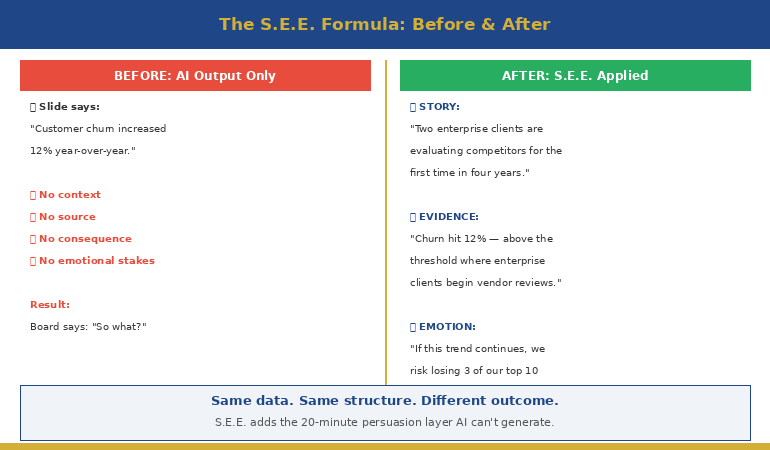

Side by side comparison of AI output before and after applying the S.E.E. formula showing transformation from facts to persuasion

Layer 1: Story — The Context AI Doesn’t Know

Story in a business presentation doesn’t mean “once upon a time.” It means context — the specific situation that makes your recommendation relevant, urgent, and grounded in reality.

AI output typically starts with the general: “Market conditions have shifted.” “Customer satisfaction has declined.” “Revenue targets are at risk.” These statements are accurate but they don’t anchor to anything your audience can feel. They’re abstract. And abstract doesn’t persuade.

The S.E.E. Story layer asks you to add one specific, concrete example to each major section of your deck. Not fiction — a real situation from your organisation that illustrates the point.

For example, instead of AI’s “Customer churn has increased 12% year-over-year,” the Story layer adds: “When I spoke with three of our enterprise clients last month, two mentioned they’re evaluating competitors for the first time in four years. One said — and I’m quoting directly — ‘Your platform used to be ahead. Now it’s keeping pace.’ That’s the shift the 12% represents.”

Now the board isn’t processing a number. They’re processing a threat. The data hasn’t changed. But the context makes it matter.

This is something AI fundamentally cannot generate — because it doesn’t know which clients you spoke to, what they said, or which anecdote will land with this particular audience. It’s human intelligence applied to AI structure.

📋 The S.E.E. formula is one of six frameworks inside the course.

AI-Enhanced Presentation Mastery includes the complete system: AVP structure, 132 Rule, S.E.E. formula, data storytelling frameworks, plus AI prompt templates for each. Study at your own pace — modules releasing through April 2026.

Get All 6 Frameworks + AI Prompt Packs →

Layer 2: Evidence — Turning Data Into Proof

AI is very good at including data. It’s surprisingly bad at turning data into proof. There’s a crucial difference.

Data is a number. Proof is a number plus its implication. AI will give you “NPS declined from 72 to 61.” That’s data. Proof sounds like: “NPS declined from 72 to 61 — a drop below the threshold where enterprise clients typically begin vendor reviews, based on our last three contract cycles.”

The Evidence layer in S.E.E. asks you to do three things with every data point AI generates:

First, contextualise it. What does this number mean relative to a benchmark your audience recognises? Industry average, last quarter, a target they set, a competitor’s performance. Data without context is just a number. Data with context is a signal.

Second, source it credibly. AI often presents data without attribution. Executives discount unsourced numbers. Add where the data came from — even “based on our Q3 finance review” adds credibility. If it’s external data, name the source. If it’s your own analysis, say so.

Third, connect it to consequence. What happens if this number continues? What happens if it reverses? The consequence is what transforms data from interesting to actionable. The Insight-Implication-Action framework from the course formalises this — every data point needs an insight (what it means), an implication (why it matters), and an action (what to do about it).

This evidence layer is where AI-enhanced presentations diverge from AI-generated ones. The AI handles the organisation. You handle the meaning.

Layer 3: Emotion — The Decision Trigger

This is the layer most professionals skip, and it’s the one that matters most for executive decisions.

Executives don’t make decisions based on logic alone. Research in decision science consistently shows that emotion drives action — logic justifies it afterward. A presentation that’s logically perfect but emotionally flat produces “let me think about it.” A presentation that creates the right emotional response — urgency, opportunity, risk — produces “let’s move on this.”

The Emotion layer isn’t about manipulation. It’s about connecting your recommendation to something your audience genuinely cares about. Every executive in every meeting has emotional stakes: protecting their team, delivering on promises they’ve made, avoiding the embarrassment of backing the wrong initiative, capitalising on an opportunity before a competitor does.

AI can’t identify these emotional stakes because they’re not in any dataset. They’re in the politics, relationships, and pressures of your specific organisation. Only you know that the VP of Operations is under pressure to show efficiency gains. Only you know that the CEO mentioned supply chain risk at the last all-hands meeting. Only you know that this proposal’s biggest blocker lost a similar bet two years ago and is risk-averse as a result.

The Emotion layer asks one question for each key slide: “What does my audience feel about this — and what do I need them to feel instead?” If the current state is complacency, you need urgency. If the current state is fear, you need confidence. If the current state is scepticism, you need proof that reduces perceived risk.

This is the layer that took my client’s deck from “so what?” to a follow-up meeting where the board asked her to accelerate the initiative. Same data. Same structure. Different emotional framing.

📊 The Full Persuasion System — Not Just One Formula

AI-Enhanced Presentation Mastery teaches S.E.E. alongside five other frameworks that work together: AVP for slide structure, 132 Rule for information sequencing, Insight-Implication-Action for data storytelling, plus customised AI prompt templates that make each framework faster to apply. 8 self-study modules + 2 live Q&A sessions.

Turn AI Slides Into Executive Decisions →

Presale pricing: £249 — moves to £499 full price soon. Join anytime — get all released modules immediately.

Applying S.E.E. to Any AI Deck in 20 Minutes

Here’s the practical workflow. You’ve used AI to build your deck — structure is solid, data is in place, flow makes sense. Now apply S.E.E. in three passes:

Pass 1: Story scan (5 minutes). Review each major section. For each one, ask: “Is there a specific, concrete example from our organisation that illustrates this point?” Write one sentence per section — a client conversation, an internal metric, a project outcome, a competitor move. You’re adding the anchor that makes abstract data feel real. If you can’t find a story, the section may be filler.

Your AI workflow handled the structure. This pass handles the meaning.

Pass 2: Evidence upgrade (5–10 minutes). Review every data point. For each one, add: context (vs what benchmark?), source (where did this come from?), and consequence (what happens if this continues?). Delete any data that doesn’t have a clear implication. More data with no context is worse than less data with clear meaning. Senior leaders don’t need all the information — they need the right information, framed so the conclusion is obvious.

Pass 3: Emotion check (5 minutes). For each key decision slide — recommendations, proposals, asks — answer: “What does my audience currently feel about this topic? What do I need them to feel? What one change to this slide creates that emotional shift?” Sometimes it’s reframing the opening line. Sometimes it’s adding a consequence slide. Sometimes it’s removing a defensive caveat that signals your own uncertainty.

Total time: roughly 20 minutes on top of whatever the AI took to generate the deck. That 20 minutes is the difference between “good presentation” and “approved.”

🔍 Want the complete workflow — AI structure + S.E.E. persuasion + templates?

The course includes before/after deck transformations, S.E.E. wording templates, and AI prompt packs designed to make each pass faster. Study at your own pace.

Get the Complete AI → Executive Workflow →

How do I make AI presentations more persuasive?

Apply the S.E.E. formula after AI handles structure: add Story (specific examples from your organisation), upgrade Evidence (contextualise every data point with benchmarks and consequences), and layer in Emotion (connect your recommendation to what your audience cares about). This 20-minute review transforms AI output from informative to actionable.

Why do AI-generated presentations feel flat?

AI excels at logical organisation but lacks access to three persuasion inputs: the specific context your audience operates in, the emotional stakes attached to the decision, and the proof points this particular group will find credible. Without these, AI produces structured reports rather than persuasive arguments.

What is the S.E.E. formula for presentations?

S.E.E. stands for Story-Evidence-Emotion. Story provides concrete, real-world context that makes abstract data feel tangible. Evidence transforms raw numbers into proof by adding benchmarks, sources, and consequences. Emotion connects your recommendation to what your audience fears, wants, or needs — the trigger that turns understanding into action.

🏆 AI-Enhanced Presentation Mastery: The Complete System

S.E.E. is one framework inside a complete course that transforms how you build presentations with AI. What’s included:

  • AVP framework — Action-Value-Proof slide structure
  • 132 Rule — information sequencing for how brains process
  • S.E.E. formula — Story-Evidence-Emotion persuasion layer
  • Insight-Implication-Action — data storytelling framework
  • AI prompt templates — customised for each framework
  • Before/after deck transformations — real examples
  • 8 self-study modules — releasing through April 2026
  • 2 live Q&A sessions — April 2026
  • Lifetime access — all recordings, templates, and future updates

Designed for busy professionals who create presentations regularly and want to save hours while dramatically improving impact.

Get the Complete AI Presentation System →

Presale pricing: £249 — moves to £499 full price soon. 60-seat cap. Join anytime — get all released modules immediately.

Frequently Asked Questions

Can I use the S.E.E. formula with any AI tool?

Yes. S.E.E. is a human review layer applied after AI generates the initial structure. It works with ChatGPT, Copilot, Claude, Gemini, or any other AI tool. The formula is tool-agnostic — it addresses the persuasion gap that all AI tools share.

How is S.E.E. different from general storytelling advice?

General storytelling advice tells you to “add stories” without specifying where, what kind, or how they interact with data and emotional framing. S.E.E. is a systematic three-pass review designed specifically for AI-generated business presentations, with each layer serving a distinct persuasion function.

Do I need presentation design skills for this?

No. S.E.E. operates at the messaging and content level, not the design level. You’re changing what the slides say and how the argument is framed — not formatting or layout. The AI handles structure and design; you handle persuasion.

How long does the full AI-Enhanced Presentation Mastery course take?

The course is 8 self-study modules released between January and April 2026, designed for busy professionals. Each module takes 60–90 minutes. You study at your own pace, with 2 live Q&A sessions in April for questions and feedback. Lifetime access means you can revisit any material whenever needed.

📬 The Winning Edge Newsletter

Weekly strategies for AI-enhanced presentations, executive communication, and confident delivery. No filler.

Subscribe Free →

📥 Free: Executive Presentation Checklist

A quick-reference checklist for reviewing any executive presentation before delivery — including a simplified S.E.E. review prompt.

Download Free Checklist →

Related reading: The presentation was perfect — the Q&A lost the deal — once your deck has the persuasion layer, prepare for the decision-making conversation that follows.

Your next step: Take the last AI-generated deck you built. Run the three S.E.E. passes: Story scan (add one concrete example per section), Evidence upgrade (contextualise every data point), Emotion check (connect each recommendation to what your audience cares about). Twenty minutes. And if you want the complete system — S.E.E. plus AVP, 132 Rule, data storytelling, and AI prompt templates for each — AI-Enhanced Presentation Mastery (£249) gives you everything in one self-study programme.

About the Author

Mary Beth Hazeldine is the Owner & Managing Director of Winning Presentations. With 24 years of corporate banking experience at JPMorgan Chase, PwC, Royal Bank of Scotland, and Commerzbank, she has delivered high-stakes presentations in boardrooms across three continents.

A certified hypnotherapist and NLP practitioner, Mary Beth combines executive communication expertise with practical techniques for managing presentation nerves. She has trained senior professionals and executive audiences over many years.

Book a discovery call | View services

07 Feb 2026
Professional man at desk with laptop focused on high-impact AI presentation tasks

AI Presentation 80/20 Rule: What Actually Moves the Needle

I spent three months mastering every AI presentation tool. Then I realized I was optimizing the wrong things.

Like most people who discover AI for presentations, I went deep. Prompt engineering courses. Every Copilot feature. Claude, ChatGPT, Gamma, Beautiful.ai — I tested them all. I built elaborate workflows with multiple tools chained together.

My presentations got faster to create. But they didn’t get better. And the executives I was presenting to couldn’t tell the difference between my AI-optimized decks and the ones I’d built the old way.

That’s when I started tracking where AI actually moved the needle — and where I was just playing with shiny tools.

The Pareto Principle applies to AI presentations just like everything else: roughly 20% of AI applications deliver 80% of the value. The rest is optimization theatre.

This guide shows you where to focus.

Quick answer: The highest-impact uses of AI in presentations are: (1) structuring your argument before you touch slides, (2) pressure-testing your logic against likely objections, and (3) transforming dense content into clear, scannable formats. The lowest-impact uses — where most people spend their time — are generating slides from scratch, finding “the perfect prompt,” and automating visual design. Focus on thinking assistance, not production assistance.

⚡ Need to use AI effectively right now?

If you only have 30 minutes to improve your presentation with AI, do these three things:

  1. Ask AI to find holes in your argument. Paste your key points and ask: “What would a skeptical CFO challenge here?”
  2. Ask AI to simplify your densest slide. Paste the content and ask: “Rewrite this so a busy executive can absorb it in 10 seconds.”
  3. Ask AI for your opening line. Describe your audience and goal, then ask: “Give me 5 opening sentences that would make this audience lean in.”

These three uses take 30 minutes total and improve your presentation more than hours of prompt engineering.

📋 Copy/Paste These 3 High-Impact Prompts:

PROMPT 1: Find holes

I need to convince [AUDIENCE] to [ACTION]. Here are my key points: [PASTE POINTS]. What would a skeptical executive challenge? What’s the weakest part of this argument?

PROMPT 2: Simplify

Here’s my densest slide: [PASTE CONTENT]. Rewrite this so a busy executive can absorb it in 10 seconds. Maximum 3 bullet points, 8 words each.

PROMPT 3: Opening options

I’m presenting to [AUDIENCE] about [TOPIC]. My goal is [OUTCOME]. Give me 5 opening sentences that would make this audience lean in. Range from conservative to bold.

The High-Impact 20% (Where AI Actually Helps)

After tracking my own AI usage — and observing how executives I train actually benefit from these tools — I’ve identified five high-impact applications. These are where AI genuinely improves outcomes, not just speeds up production.

1. Structuring your argument BEFORE slides

This is the single highest-value use of AI in presentations. Before you open PowerPoint, before you think about design, use AI to pressure-test your structure.

The prompt that works: “I need to convince [audience] to [action]. Here’s my current thinking: [your key points]. What’s the most persuasive order for these points? What’s missing? What would make a skeptic say no?”

Why it matters: Most weak presentations fail at the structure level, not the slide level. Getting your argument right first means everything downstream improves. AI is genuinely good at identifying logical gaps and suggesting better sequences.

2. Pressure-testing against objections

AI can simulate a hostile audience faster than you can anticipate objections yourself. This is where the technology excels — generating variations and edge cases.

The prompt that works: “You are a skeptical [CFO/board member/client]. Here’s the presentation I’m about to give you: [paste your structure or key points]. What questions would you ask? What would make you say no? What’s the weakest part of this argument?”

Why it matters: The questions that derail presentations are usually predictable. AI helps you find them before the room does.

3. Transforming dense content into clear formats

If you have a wall of text, a complex data set, or a technical explanation that needs to become executive-friendly, AI does this transformation well.

The prompt that works: “Here’s [technical content/data/dense text]. Transform this into [a 3-point executive summary / a comparison table / a timeline / a decision tree]. A busy executive should be able to absorb this in [10 seconds / one glance].”

Why it matters: This is genuine cognitive work that AI handles well — restructuring information for a different audience. It saves time AND improves clarity.

4. Generating opening and closing options

The first 30 seconds and last 30 seconds of a presentation carry disproportionate weight. AI can generate multiple options quickly, letting you pick and refine rather than starting from scratch.

The prompt that works: “I’m presenting to [audience] about [topic]. My goal is [specific outcome]. Give me 5 different opening lines that would make this audience want to keep listening. Range from conservative to bold.”

Why it matters: Most people default to their first idea for openings. Having options improves the final choice significantly.

5. Creating speaker notes and talking points

Once your slides are structured, AI can help you prepare what to actually say — creating natural talking points that expand on slide content without reading it verbatim.

The prompt that works: “Here’s my slide: [paste content]. Write speaker notes that: expand on the key point without repeating the slide text, include one concrete example, and transition naturally to [next topic].”

Why it matters: Good speaker notes are tedious to write. AI handles this well, and strong notes dramatically improve delivery.

For more on effective AI workflows, see my guide on AI presentation workflow.

Master the AI Techniques That Actually Matter

AI-Enhanced Presentation Mastery focuses on the high-impact 20% — the specific prompts, workflows, and techniques that improve presentation outcomes, not just production speed. Self-paced modules with live Q&A calls.

Join AI-Enhanced Presentation Mastery →

Join anytime — get instant access to all released modules.

The Low-Impact 80% (Where Most People Waste Time)

These are the AI applications that feel productive but don’t meaningfully improve your presentations. Most people spend most of their AI time here.

1. Generating slides from scratch

This is where everyone starts — and where AI consistently disappoints. “Create a presentation about Q3 results” produces generic slides that require so much editing you’d have been faster starting manually.

Why it’s low-impact: AI doesn’t know your audience, your politics, your specific situation. Generated slides are starting points at best, and often worse than templates you already have.

2. Obsessing over “the perfect prompt”

Prompt engineering has become its own hobby. People spend hours refining prompts to get slightly better outputs, when the real issue is what they’re asking AI to do in the first place.

Why it’s low-impact: A mediocre prompt for a high-value task beats a perfect prompt for a low-value task. Focus on WHAT you’re asking, not HOW you’re asking it.

3. Automating visual design

AI can suggest layouts, generate images, and format slides. But design that impresses other people rarely impresses executives. They care about clarity, not aesthetics.

Why it’s low-impact: Visual polish is the last 5% of presentation effectiveness. Getting it perfect while your argument is weak is optimization theatre.

4. Building elaborate multi-tool workflows

Using ChatGPT for structure, then Claude for refinement, then Copilot for formatting, then Midjourney for images… these workflows are intellectually satisfying but time-consuming.

Why it’s low-impact: The productivity gains from tool-chaining rarely exceed the time spent building and maintaining the workflow. Simple beats complex.

5. Generating content you should be thinking through

AI can write your executive summary, your recommendation, your conclusion. But if you’re outsourcing the thinking, you’re outsourcing the value.

Why it’s low-impact: The presentations that get approvals contain thinking that couldn’t have come from a generic AI. Your judgment, your context, your insight — that’s what matters.

For more on avoiding generic AI output, see my guide on why AI-generated slides look generic.

The AI Presentation Matrix

Here’s how to think about where AI fits in your presentation workflow:

The AI Presentation 80/20 Matrix showing high-impact versus low-impact AI use cases

High Impact + Low Time Investment (DO FIRST)

  • Structure pressure-testing
  • Objection anticipation
  • Opening/closing generation
  • Content simplification

High Impact + High Time Investment (DO SELECTIVELY)

  • Speaker notes for complex presentations
  • Data visualization suggestions
  • Audience-specific customization

Low Impact + Low Time Investment (SKIP OR AUTOMATE)

  • Basic formatting
  • Spell/grammar checking
  • Simple template application

Low Impact + High Time Investment (AVOID)

  • Full slide generation
  • Complex prompt optimization
  • Multi-tool workflows
  • AI-generated visuals for executive audiences

For a complete AI presentation approach, see my guide on how to make a presentation with AI.

The Focused Workflow

Here’s the AI workflow I now use — and teach — that focuses only on high-impact applications:

Step 1: Clarify before you create (15 minutes)

Before touching any tool, answer these questions (use AI to help if needed):

  • What decision am I asking for?
  • What does this audience already believe?
  • What would make them say no?
  • What’s the one thing they must remember?

Step 2: Structure with AI assistance (20 minutes)

Use AI to pressure-test your argument structure. Share your key points. Ask for logical gaps. Ask for better sequencing. Ask what a skeptic would challenge.

Output: A clear outline with your argument in the right order.

Step 3: Build slides manually (your normal process)

Yes, manually. Your existing process for creating slides is probably fine. The structure work you did in Step 2 is what matters. Don’t let AI slow you down with generated slides you’ll need to heavily edit anyway.

Step 4: AI refinement on specific elements (15 minutes)

Use AI surgically:

  • Simplify your densest slide
  • Generate 5 opening options
  • Create speaker notes for your 3 most complex slides
  • Anticipate questions for your Q&A

Step 5: Human review (always)

Every AI output gets human review. Check for: accuracy, tone match, context appropriateness, anything that sounds generic or could have come from anyone.

Total AI time: ~50 minutes, focused entirely on high-impact applications.

Learn the Focused AI Approach

AI-Enhanced Presentation Mastery teaches you exactly where AI helps and where it doesn’t — with specific prompts, real examples, and the workflow that senior professionals actually use. No fluff, no tool obsession, just results.

Join AI-Enhanced Presentation Mastery →

Self-paced learning with live Q&A calls. Join anytime.

Frequently Asked Questions

Isn’t using AI for slides the whole point?

It’s the obvious application, but not the valuable one. AI-generated slides require so much human editing that the time savings are minimal. The real value is using AI for thinking assistance — pressure-testing arguments, anticipating objections, simplifying complex content. These improve your presentation regardless of how you build the slides.

What about Copilot in PowerPoint — isn’t that high-impact?

Copilot is useful for specific tasks: reformatting existing content, suggesting layouts, generating speaker notes. It’s not useful for creating presentations from scratch. Think of it as an assistant for production tasks, not a replacement for thinking. Use it selectively, not comprehensively.

How do I know if I’m wasting time on low-impact AI use?

Ask yourself: “Is this helping me think more clearly, or just produce faster?” If you’re spending time refining prompts, chaining tools, or generating content you’ll heavily edit anyway, you’re in the low-impact zone. If AI is helping you see gaps in your logic or simplify your message, you’re in the high-impact zone.

Should I use multiple AI tools or just one?

One tool, used well, beats three tools used superficially. Pick the AI you’re most comfortable with (ChatGPT, Claude, Copilot) and learn to use it effectively for the high-impact applications. Tool-switching creates friction that usually exceeds any capability gains.

Your Next Step

The 80/20 rule works for AI presentations just like everything else. Most of the value comes from a small number of applications — and most of the time waste comes from chasing the wrong optimizations.

Focus on structure, objection-testing, and content transformation. Skip the elaborate workflows and slide generation. Use AI as a thinking partner, not a production tool.

That’s where the needle actually moves.

Ready to master AI presentations the right way?

Join AI-Enhanced Presentation Mastery →

📧 Get the Winning Edge Newsletter

Weekly insights on AI-enhanced presentations, executive communication, and high-stakes delivery — practical techniques you can use immediately.

Subscribe free →

Related reading: One of the highest-stakes presentations you might face is a restructuring announcement. Read Restructuring Announcement Presentation: What HR Won’t Tell You for the structure that preserves trust when delivering difficult news — an example where human judgment matters more than AI assistance.

About the Author

Mary Beth Hazeldine is the Owner & Managing Director of Winning Presentations. With 24 years of corporate banking experience at JPMorgan Chase, PwC, Royal Bank of Scotland, and Commerzbank, she has seen firsthand which presentation approaches actually influence executive decisions — and which are optimization theatre.

She now teaches senior professionals how to use AI tools strategically, focusing on the applications that improve outcomes rather than just production speed.

28 Jan 2026
Professional woman working efficiently on laptop with focused, calm expression in modern office

How to Build Presentations Faster: The System That Cut My Build Time by 75%

Six hours. That’s what a client presentation used to cost me.

Two hours researching and outlining. Two hours building slides. Two hours tweaking formatting, adjusting layouts, and second-guessing every design choice. By the end, I was exhausted — and the presentation still felt like it could be better.

Then I discovered something that changed everything: the problem wasn’t my speed. It was my process.

Today, I create presentations in 90 minutes that are better than what I used to produce in six hours. Not because I found a magic AI tool. Because I found a system for faster presentation creation that puts thinking first and production second.

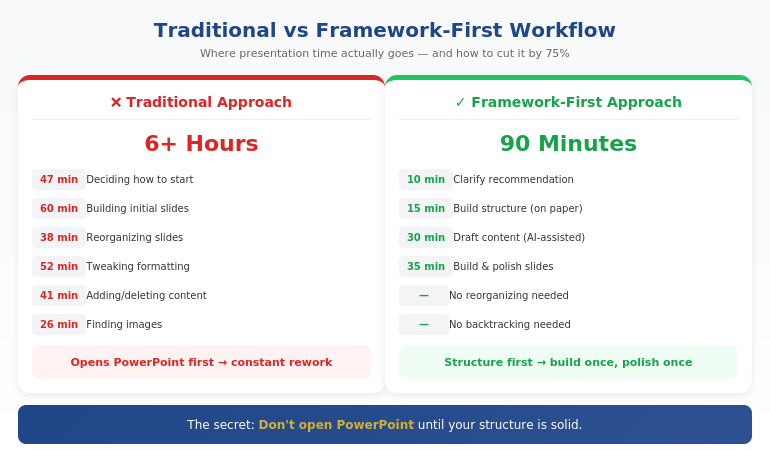
Quick Answer: Faster presentation creation comes from working framework-first, not slide-first. Most time waste happens when you open PowerPoint before you’ve decided your core message, structure, and key proof points. The fastest workflow is: clarify your recommendation (10 min) → build your structure (15 min) → draft content with AI assistance (30 min) → refine and design (35 min). Total: 90 minutes for a presentation that used to take 6 hours.

If you’re building for a steering committee, CFO, or board — speed isn’t the only goal. Decision clarity is. That’s why this workflow starts with Recommendation → Proof → Decision, not slides.

⚡ Need to Build a Presentation Today? The 90-Minute Framework:

  1. Minutes 1-10: Write your recommendation in one sentence. What do you want them to decide/do/believe?
  2. Minutes 11-25: Build your structure: Recommendation → Stakes → Their concern → Proof → Decision
  3. Minutes 26-55: Draft slide content (use AI to expand bullet points into full slides)
  4. Minutes 56-90: Refine language, add visuals, polish design

The key: Don’t open PowerPoint until step 3. Structure first, slides second.

Where Presentation Time Actually Goes

A few years ago, I tracked exactly how I spent time on a board presentation. The results were embarrassing:

  • 47 minutes deciding how to start
  • 38 minutes reorganizing slides I’d already built
  • 52 minutes adjusting fonts, colors, and alignments
  • 41 minutes adding content, then deleting it, then adding it back
  • 26 minutes looking for the “right” image

Less than an hour of that time was actual thinking — deciding what to say and how to structure it. The rest was production busywork and decision fatigue.

That’s when I realized: I wasn’t slow at building presentations. I was building them in the wrong order.

Opening PowerPoint first meant making design decisions before content decisions. Starting with slides meant restructuring constantly as my thinking evolved. Working without a framework meant reinventing my approach every single time.

The fix wasn’t working faster. It was working in a different sequence.

The Framework-First Approach

Here’s the principle that changed everything: structure before slides, thinking before production.

Most professionals open PowerPoint and start building. They think in slides, not in messages. They make dozens of micro-decisions about layout and formatting before they’ve made the one macro-decision that matters: what’s the point?

The framework-first approach flips this:

  1. Decide your recommendation before you touch any tool
  2. Build your logical structure on paper or in a simple doc
  3. Draft content in whatever format is fastest (often with AI help)
  4. Then — and only then — build slides

This sounds obvious, but almost nobody does it. The temptation to “just start building” is strong. And it’s exactly what makes presentations take 6 hours instead of 90 minutes.

For the executive-focused structure I use, see our guide to executive presentation structure.

How can I make presentations faster?

Make presentations faster by working framework-first: decide your core message and structure before opening PowerPoint. Most time waste comes from building slides before you’ve clarified your thinking — which leads to constant reorganizing and second-guessing. Use a repeatable structure (recommendation → stakes → proof → decision), then use AI to help draft content once your framework is solid.

Comparison of traditional vs framework-first presentation workflow showing time savings at each stage

⭐ Master the Framework-First System

AI-Enhanced Presentation Mastery teaches you the complete system: how to structure your thinking before you build, where AI accelerates production, and how to create executive-quality presentations in a fraction of the time.

What you’ll learn:

  • The framework-first workflow that cuts creation time by 50-75%
  • Where AI helps (drafting, iteration) and where it doesn’t (strategy, structure)
  • Prompt patterns that produce usable content, not generic filler
  • The quality checks that ensure AI-assisted work meets executive standards

Cut Your Build Time (See Maven) →

Live cohort-based course. 70% frameworks, 30% AI implementation. Check Maven for current dates and pricing.

The 90-Minute System Step by Step

Here’s exactly how I build presentations now:

Phase 1: Clarify (10 minutes)

Before anything else, I answer three questions in writing:

  1. What do I want them to decide, do, or believe after this presentation?
  2. What’s the ONE thing they need to understand for that to happen?
  3. What’s their biggest concern or objection likely to be?

This takes 10 minutes. It saves hours. Because every slide decision that follows becomes obvious when you know your destination.

Phase 2: Structure (15 minutes)

I use a consistent structure for executive presentations:

  • Slide 1: Recommendation (the answer, upfront)
  • Slide 2: Stakes (why this matters now)
  • Slide 3: Their concern (name the objection)
  • Slides 4-5: Proof (evidence that addresses the concern)
  • Slide 6: Decision (the specific ask)

I sketch this out in a simple document or even on paper. No PowerPoint yet. Just the logic flow.

Phase 3: Draft Content (30 minutes)

Now I draft the actual content — slide titles, key points, supporting data. This is where AI becomes genuinely useful.

I don’t ask AI to “create a presentation about X.” That produces generic garbage. Instead, I give it my structure and ask it to help me expand specific sections:

  • “Here’s my recommendation and three proof points. Help me articulate the stakes in language a CFO would respond to.”
  • “I need to address this objection: [objection]. Give me three ways to frame the response.”
  • “Turn these bullet points into a clear slide narrative: [bullets]”

AI drafts. I direct and edit. The quality stays high because I’m driving the strategy.

For more on AI-assisted presentation creation, see our detailed guide on how to make a presentation with AI.

Phase 4: Build and Polish (35 minutes)

Only now do I open PowerPoint. And because my content is already drafted, this phase is pure execution:

  • Paste content into slides
  • Apply consistent formatting
  • Add simple visuals where they help
  • Review flow and make final adjustments

No more agonizing over structure. No more rewriting slides three times. The thinking is done. I’m just packaging it.

How do you speed up PowerPoint creation?

Speed up PowerPoint by doing your thinking before you open it. Draft your structure and content in a simple document first, then use PowerPoint only for final assembly. Also: use a consistent template, master keyboard shortcuts, and resist the urge to perfect every slide before moving forward. Build rough, then polish once at the end.

Want the complete framework-first system?

See AI-Enhanced Presentation Mastery →

Where AI Helps (And Where It Doesn’t)

Let me be direct about AI’s role in this system: it’s an accelerator, not a replacement.

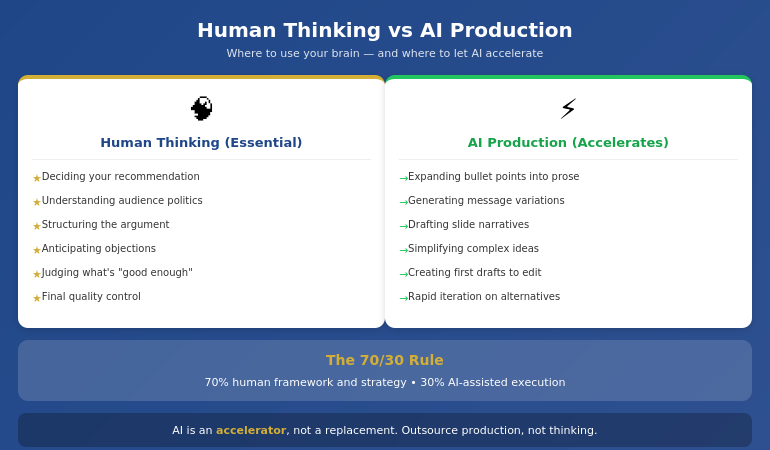
AI is excellent at:

  • Drafting content from your bullet points
  • Generating variations of your messaging
  • Suggesting ways to phrase complex ideas simply
  • Creating first drafts you can edit and improve
  • Iterating quickly when you need to try different approaches

AI is poor at:

  • Knowing what your audience cares about
  • Understanding the politics of your organization
  • Deciding what to recommend
  • Structuring an argument strategically
  • Judging what’s “good enough” for your specific context

The professionals who get burned by AI are the ones who outsource the thinking. They ask AI to “create a presentation” and get something that looks polished but says nothing. The slides are pretty. The logic is hollow.

The professionals who save hours are the ones who use AI for production while retaining control of strategy. They know what they want to say. AI helps them say it faster.

Diagram showing where human thinking is essential vs where AI accelerates production in presentation creation

⭐ Learn the Human + AI Balance

AI-Enhanced Presentation Mastery teaches you exactly where to use AI and where to trust your judgment — so you get speed without sacrificing quality or strategic thinking.

The course covers:

  • The 70/30 rule: 70% human framework, 30% AI execution
  • Prompt patterns that produce executive-quality content

See Course Details on Maven →

Live sessions with real feedback. Check Maven for current cohort dates.

Mistakes That Kill Your Speed

After coaching hundreds of professionals on presentation efficiency, I see the same speed-killers repeatedly:

Mistake #1: Opening PowerPoint first

The moment you open PowerPoint, you start thinking in slides instead of messages. You make formatting decisions before content decisions. You build, then restructure, then rebuild. This single habit can double your creation time.

Mistake #2: Perfecting slides as you go

Adjusting fonts while you’re still figuring out your argument is a form of productive procrastination. You feel busy, but you’re avoiding the hard thinking. Build rough first. Polish once at the end.

Mistake #3: Starting from scratch every time

If you don’t have a repeatable structure, you reinvent your approach with every presentation. That’s exhausting and slow. Develop a go-to framework. Adapt it for each situation. Don’t rebuild from zero.

Mistake #4: Using AI without a framework

Asking AI to “create a presentation about Q3 results” produces garbage. AI needs constraints to be useful. Give it your structure, your key points, your audience context. Then let it draft within those boundaries.

Mistake #5: Treating every presentation as equally important

A 15-minute team update doesn’t need the same polish as a board presentation. Calibrate your effort to the stakes. Some presentations deserve 90 minutes. Some deserve 30. Know the difference.

For more workflow optimization, see our complete guide to AI presentation workflow.

What is the fastest way to create a professional presentation?

The fastest way to create a professional presentation is: (1) clarify your recommendation in one sentence, (2) build your structure on paper first, (3) draft content with AI assistance using specific prompts, (4) only then open PowerPoint to assemble and polish. This framework-first approach can cut creation time by 50-75% compared to building slides from scratch.

Ready to cut your presentation time in half?

See AI-Enhanced Presentation Mastery →

The Compound Effect of a System

Here’s what most people miss: the real value of a system isn’t just time saved on one presentation. It’s the compound effect across your career.

If you create two presentations per week and save 4 hours each, that’s 8 hours per week. Over a year, that’s more than 400 hours — ten full work weeks returned to you.

But the benefit goes beyond hours. When presentations stop being a time drain, you:

  • Approach them with less dread
  • Have energy left to rehearse properly
  • Can take on more opportunities without burning out
  • Actually improve over time instead of just surviving

A system for building presentations faster isn’t about cutting corners. It’s about creating space for what actually matters: clear thinking, confident delivery, and results.

⭐ Build the System That Lasts

AI-Enhanced Presentation Mastery gives you the complete framework-first system — from initial thinking to final polish — so you can create executive-quality presentations in a fraction of the time, consistently.

What’s included:

  • The 90-minute presentation workflow
  • Framework templates for different presentation types
  • Prompt library for AI-assisted content creation
  • Quality checks that ensure AI work meets executive standards
  • Live sessions with direct feedback on your work

See Course Details on Maven →

Live cohort-based course on Maven. Check the page for current dates, pricing, and syllabus.

Frequently Asked Questions

Will AI-generated content look generic?

Only if you use AI wrong. Generic content comes from generic prompts like “create a presentation about X.” When you give AI your specific framework, key points, and audience context, it produces drafts you can actually use. The framework-first approach ensures AI is expanding your thinking, not replacing it with filler.

How much time can I realistically save?

Most professionals report saving 50-75% once they’ve internalized the system. A presentation that took 6 hours typically drops to 90 minutes to 2 hours. The biggest savings come in the first phase (no more agonizing over how to start) and the third phase (AI-assisted drafting instead of writing from scratch).

Does this work for highly technical or specialized presentations?

Yes — in some ways, better. Technical presentations often suffer from too much detail and unclear structure. The framework-first approach forces you to identify your core message and structure your argument logically before diving into technical content. AI is less useful for specialized terminology, but still helps with structuring explanations and drafting transitions.

What if I’m not technical with AI tools?

You don’t need to be technical. The AI-assisted portions use simple prompts in conversational language — you’re telling AI what you need the same way you’d brief a junior colleague. The course teaches exact prompts that work, so you don’t need to figure out “prompt engineering” on your own.

Get Weekly Presentation Efficiency Insights

Frameworks, workflows, and AI strategies for creating better presentations in less time — from 24 years of corporate experience.

Subscribe to The Winning Edge →

📋 Not ready for the course? Take the checklist.

A quick-reference guide showing which tasks benefit from AI assistance and which require human judgment. Use it to speed up your next presentation without sacrificing quality.

Download Free Checklist →

Your Next Step

The next time you need to create a presentation, try this:

  1. Don’t open PowerPoint
  2. Write your recommendation in one sentence
  3. Sketch your structure on paper
  4. Then start building

You’ll be surprised how much faster the whole process becomes when you know where you’re going before you start.

P.S. Speed matters, but so does getting the decision. If you’re presenting for approval, I wrote about pre-meeting alignment — the strategy that gets “yes” before you open your slides.

P.P.S. And if nerves are affecting your delivery, check out how to project your voice — it’s more about releasing tension than speaking louder.

About Mary Beth Hazeldine
Owner & Managing Director of Winning Presentations. After 24 years in corporate banking building hundreds of presentations under deadline pressure, I became obsessed with efficiency. The framework-first approach I teach now is the system I wish I’d had in year one.

21 Dec 2025
How to use AI for presentations - complete guide to saving hours and creating better slides with AI tools

How to Use AI for Presentations: Save Hours and Create Better Slides

A practical guide to using AI for presentations — with 50+ prompts, proven frameworks, and a complete workflow from a presentation skills trainer

If you want to learn how to use AI for presentations effectively, you’re in the right place. Most professionals are either ignoring AI completely or using it badly — getting generic content that sounds like a robot wrote it.

There’s a better way.

Last month, I watched a senior consultant spend an entire Sunday preparing a 20-minute client presentation. Research. Structure. Slides. Rewrites. More rewrites. Eight hours for twenty minutes of content.

The following week, I helped another consultant prepare a similar presentation. We used AI strategically throughout the process.

Total time: 90 minutes. And honestly? The second presentation was better.

This isn’t about AI replacing your skills. It’s about AI amplifying them — so you create better presentations in a fraction of the time. After 24 years of corporate presenting and training over 5,000 executives, I’ve developed a systematic approach to using AI for presentations that actually works.

🎁 Free Download: Get my Executive Presentation Checklist — includes the AI prompts I use for rapid presentation preparation.

Why Most People Use AI for Presentations Wrong

Here’s what traditional presentation preparation looks like:

  1. Stare at blank slides
  2. Write too much content
  3. Reorganize everything
  4. Cut half of it
  5. Redesign slides
  6. Practice and realize the structure doesn’t flow
  7. Reorganize again
  8. Run out of time
  9. Deliver something “good enough”

Sound familiar?

Now here’s what most people do when they try using AI for presentations: they ask ChatGPT to “write a presentation about X” and get generic, bloated content that sounds nothing like them.

The problem isn’t AI. It’s how they’re using it.

AI works when you use it for specific tasks within a proven framework — not as a magic button that does everything.

Related: Microsoft Copilot for Presentations: What Works and What Doesn’t

AI presentation tools workflow showing how to use AI for research, structure, content, and Q&A preparation

The Right Way to Use AI for Presentations

AI changes presentation preparation completely — but not by doing the work for you. It accelerates every step of a proven process:

  • Research that took 2 hours now takes 15 minutes
  • First drafts that took an afternoon now take 20 minutes
  • Anticipating questions becomes systematic, not guesswork
  • Structure emerges quickly instead of through painful iteration

The result? Better presentations in less time. And when you’re well-prepared with a solid structure, you naturally feel more confident delivering it.

Here’s the framework I teach:

Step 1: Start With Structure (Before You Touch AI)

Before you use any AI tool, you need to know what you’re building. I use a simple 3-part framework that works for any presentation:

  • Opening: Hook them in 30 seconds with a problem, question, or surprising fact
  • Body: 3-5 key points maximum (one idea per slide)
  • Close: Clear call to action or key takeaway

This takes 5 minutes to sketch out — and it transforms how you use AI because now you have specific sections to fill, not a blank page.

Related: Presentation Structure: The 3-Part Framework That Works Every Time

Step 2: Use AI for Research and Content Generation

Now AI becomes powerful. Instead of “write me a presentation,” you prompt:

  • “Give me 5 compelling statistics about [topic] that would surprise a senior executive”
  • “What are the 3 strongest counterarguments to [my recommendation] and how would I address them?”
  • “Write a 2-sentence opening hook for a presentation about [topic] to [audience]”

Specific prompts = useful outputs. Generic prompts = generic garbage.

Step 3: Use AI for Q&A Preparation

This is where AI saves the most stress. Prompt:

“I’m presenting [topic] to [audience]. What are the 10 toughest questions they might ask, and give me a 2-sentence answer for each.”

You’ll walk in prepared for questions you never would have anticipated.

Step 4: Refine (Don’t Use Raw AI Output)

Raw AI content sounds like AI. Your job is to:

  • Add your stories and examples
  • Cut the filler words AI loves
  • Adjust the tone to sound like you
  • Verify any facts or statistics

AI does the heavy lifting. You add the human elements that make presentations land.

Related: 10 ChatGPT Prompts for Better Presentations

AI for presentations time savings - preparation reduced from 6-8 hours to 90 minutes with AI workflow

Want the Complete AI Presentation System?

My AI-Enhanced Presentation Mastery course gives you the full framework — 50+ tested prompts, proven structures for any presentation type, and live coaching to apply it to your specific work.

What’s included:

  • 4 weeks of structured curriculum (frameworks + AI tools)
  • 50+ copy-paste AI prompts for research, structure, content, and Q&A
  • 2 live coaching sessions with personalized feedback
  • Community access for peer support
  • Lifetime access and all future updates

January cohort: £249 (increases to £499 in April)

Only 60 seats. Early bird ends December 31st.

See the full curriculum →

Best AI Tools for Presentations in 2025

You don’t need expensive tools to use AI for presentations effectively. Here’s what actually works:

For Research and Content

ChatGPT (Free or Plus): Best for brainstorming, research synthesis, and generating first drafts. The free version works fine for most tasks.

Claude: Better for longer, more nuanced content. Excellent for refining messaging and anticipating objections.

Perplexity: Best for research with sources. Use when you need verified facts and statistics.

For Slides

Microsoft Copilot for PowerPoint: Creates slides from prompts or documents. Good for first drafts, but requires heavy editing. Best if you’re already in the Microsoft ecosystem.

Gamma: Creates beautiful presentations from prompts. Better design than Copilot, but less control over structure.

Your existing tools + AI-generated content: Often the best approach. Use AI to create the content, then build slides in whatever tool you already know.

Related: Microsoft Copilot for PowerPoint: Complete Guide

My Recommendation

Start with ChatGPT or Claude for content, and your existing slide tool. Don’t add complexity until you’ve mastered the fundamentals. The prompts matter more than the tools.

Complete AI Presentation Workflow: Step by Step

Here’s exactly how I use AI for presentations — the same workflow I teach in my course:

Phase 1: Preparation (15 minutes)

  1. Define your audience and their key concerns
  2. Clarify your one main message (if they remember one thing, what is it?)
  3. Sketch the 3-part structure: hook, 3-5 key points, close

Phase 2: AI-Assisted Content Creation (30-45 minutes)

  1. Use AI for research: statistics, examples, counterarguments
  2. Generate first draft content for each section
  3. Create your opening hook (test 3-5 options)
  4. Prepare Q&A responses for tough questions

Phase 3: Refinement (30 minutes)

  1. Add your personal stories and examples
  2. Cut anything that doesn’t serve your main message
  3. Adjust tone to sound like you
  4. Verify facts and statistics

Phase 4: Slides (20-30 minutes)

  1. One idea per slide
  2. Minimal text (your words, not the slides, do the work)
  3. Use AI-generated content as speaker notes, not slide text

Total time: 90 minutes to 2 hours for a presentation that used to take 6-8 hours.

“The AI workflow alone was worth the course fee. I used to spend entire weekends preparing for Monday presentations. Now I do it in a couple of hours on Friday afternoon. The prompts are incredibly specific and practical.”

— James T., Product Manager

Common Mistakes When Using AI for Presentations

Avoid these errors that make AI-generated presentations sound robotic:

Mistake 1: Using AI output without editing. Raw AI content is generic. Always add your voice, stories, and specific examples.

Mistake 2: Prompting too broadly. “Write me a presentation” gives you garbage. “Write a 2-sentence hook for [specific audience] about [specific topic]” gives you gold.

Mistake 3: Skipping the structure step. AI can’t read your mind about what the presentation needs to accomplish. Define structure first, then use AI to fill sections.

Mistake 4: Trusting AI facts without verification. AI makes things up. Always verify statistics, quotes, and specific claims.

Mistake 5: Putting AI text directly on slides. AI-generated text belongs in your speaker notes or script, not on the slides your audience sees.

Related: The 10 Presentation Mistakes That Kill Your Credibility

“I was skeptical about AI for presentations — I thought it would make everything sound generic. But Mary Beth’s approach is different. The AI accelerates the slow parts (research, first drafts, Q&A prep) while you keep control of what matters (story, strategy, voice). My presentations are better AND faster now.”

— Rachel K., Strategy Consultant

AI Presentation Prompts That Actually Work

Here are 10 prompts from my collection of 50+ that I use regularly:

For Research

1. “Give me 5 surprising statistics about [topic] that would make a [job title] pay attention. Include sources.”

2. “What are the 3 biggest misconceptions about [topic] that my audience of [description] probably believes?”

For Structure

3. “I need to present [topic] to [audience] in [X] minutes. Give me a structured outline with timing for each section.”

4. “What’s the most compelling order to present these 5 points: [list points]? Explain your reasoning.”

For Opening Hooks

5. “Write 5 different opening hooks for a presentation about [topic] to [audience]. Include: a surprising statistic, a provocative question, a brief story, a counterintuitive statement, and a vivid scenario.”

For Q&A Preparation

6. “I’m presenting [recommendation] to [audience]. What are the 10 toughest questions they might ask? Give me a confident 2-sentence response for each.”

7. “What are the strongest objections to [my proposal] and how would I address each one?”

For Storytelling

8. “Help me turn this data point [insert data] into a brief story that illustrates why it matters to [audience].”

For Slides

9. “Reduce this paragraph to a 6-word slide headline that captures the key message: [paste paragraph]”

10. “What visual or diagram would best illustrate this concept: [describe concept]?”

The full course includes 50+ prompts across research, structure, storytelling, slides, and Q&A — plus the context for when and how to use each one.

Frequently Asked Questions About Using AI for Presentations

Can AI create an entire presentation for me?

Technically yes, but you shouldn’t let it. AI-generated presentations without human refinement sound generic and miss the nuances of your specific audience and message. Use AI for the time-consuming parts (research, first drafts, Q&A prep) and add the human elements yourself (stories, insights, your voice).

What’s the best AI tool for presentations?

For content creation, ChatGPT and Claude are both excellent — and free tiers work fine. For slides, Microsoft Copilot works if you’re already in PowerPoint; Gamma creates better-looking slides but with less control. Start with AI for content + your existing slide tool before adding new platforms.

How do I make AI-generated content sound like me?

Three techniques: First, give AI examples of your previous writing and ask it to match the tone. Second, always edit AI output to add your specific stories and examples. Third, read the content aloud — if it doesn’t sound like something you’d say, rewrite it until it does.

Will my audience know I used AI?

Not if you use it correctly. When you use AI for research and first drafts, then add your own stories, examples, and voice, the result is distinctly yours. The only presentations that “sound like AI” are ones where someone used raw AI output without refinement.

How much time can AI really save on presentations?

In my experience and my students’ experience: 60-70%. A presentation that took 6-8 hours typically takes 2-3 hours with a proper AI workflow. The biggest time savings come from research (AI synthesizes information faster), first drafts (no more staring at blank pages), and Q&A prep (systematic instead of guesswork).

“I was preparing a board presentation and dreading the usual weekend of work. Used the Week 3 prompts and had a solid draft in 45 minutes. The frameworks from Week 1 meant I knew exactly what to include. Game changer.”

— David L., Finance Director

AI-Enhanced Presentation Mastery course overview - 4 weeks covering structure, storytelling, AI tools, and delivery

Learn the Complete AI Presentation System

This article covers the fundamentals — but there’s much more to master.

My AI-Enhanced Presentation Mastery course gives you the complete system:

Week 1: Structure That Works Every Time

Proven frameworks for client pitches, board updates, team meetings, and keynotes. The foundation that makes AI useful (instead of a source of generic content).

Week 2: Storytelling That Connects

How to turn data into compelling narratives. Finding stories in “boring” business content. The emotional arc that keeps audiences engaged.

Week 3: AI-Powered Preparation

50+ prompts for research, structure, storytelling, and slides. My complete workflow for client presentations. How to refine AI output so it sounds like you.

Week 4: Delivery and Executive Presence

Present your well-prepared content with confidence. Handle Q&A (including “I don’t know”). Virtual and in-person techniques.


Your Next Step: Master AI for Presentations

You now have a complete framework for using AI to create better presentations in less time. But knowledge isn’t transformation — implementation is.

Choose your path:

🎁 START FREE: Download the Executive Presentation Checklist — includes AI prompts for rapid preparation.

📘 GO DEEPER (£39): Get Presentations with AI: The Complete Prompt Collection — 50+ prompts with examples and use cases.

🎓 GET THE FULL SYSTEM (£249): Join AI-Enhanced Presentation Mastery — 4 weeks of curriculum, live coaching, community, and personalized feedback. Early bird ends December 31st.

AI is changing how presentations get made. The professionals who master this now will have a significant advantage over those still spending weekends on slide decks.

AI-Enhanced Presentation Mastery

Proven frameworks + 50+ AI prompts + Live coaching

£249 £499

Early bird ends December 31st • 60 seats • Full refund guarantee

Enroll Now →


Mary Beth Hazeldine is Managing Director of Winning Presentations, with 24 years of corporate banking experience at JPMorgan, PwC, Royal Bank of Scotland, and Commerzbank. She’s trained over 5,000 executives in presentation skills and specializes in AI-powered presentation techniques — testing every method on real client work before teaching it.