
How to End a Presentation: 7 Closing Techniques I Teach C-Suite Executives
The difference between polite nods and signed approvals
I’ve trained executives at JPMorgan, PwC, and Royal Bank of Scotland. I’ve helped biotech founders raise £250M+ in funding. And after 24 years in corporate banking and thousands of presentations coached, I can tell you this:
Most presentations die in the last 60 seconds.
Everything else can be perfect — compelling data, clean slides, confident delivery — but a weak close kills the deal. The audience leaves nodding politely and then… nothing happens.
Here are 7 closing techniques I teach senior executives. I’m sharing 3 in full today. The other 4? Those are part of the deep-dive in my AI-Enhanced Presentation Mastery course launching in January.
Why Presentation Closings Fail
Before the techniques, let’s diagnose the problem.
Bad closings usually fall into three traps:
The Fizzle: “So… that’s it. Any questions?” You just handed control to the room and signalled uncertainty.
The Repeat: Summarising every slide again. Your audience isn’t stupid. They were there.
The Vague Ask: “Let me know what you think.” Think about what? Do what? By when?
Great presentation endings do the opposite. They create momentum, clarity, and commitment.
Technique 1: The Single Ask
This is the most important closing technique, and the one executives resist most.
The rule: End with ONE specific request. Not three options. Not “a few things to consider.” One thing.
Here’s why it works: Decision fatigue is real. When you give people multiple options at the end of a presentation, you’re asking them to do more cognitive work. Most will default to “I’ll think about it” — which means nothing happens.
Weak close: “So we could either proceed with the pilot, or do more research, or schedule a follow-up discussion to align stakeholders.”
Strong close: “I’m asking for approval to start the pilot on January 15th. That requires your sign-off today.”
One ask. Specific. Time-bound.
When I coach executives on investor pitches, this is often where we spend the most time. They want to hedge, offer alternatives, seem flexible. But flexibility at the close reads as uncertainty.
Your call to action should answer: What do you want them to do, and by when?
Technique 2: The Forward Story
This technique works brilliantly for strategic presentations, board meetings, and any situation where you’re proposing change.
Instead of ending with what you’ve covered, end with what happens next — told as a story.
Structure:
- “Imagine it’s [specific future date]…”
- Describe the outcome as if it’s already happened
- Make the audience the hero of that story
Example:
“Imagine it’s July 2026. We’ve completed the integration, and your team is running both systems from a single dashboard. The CFO just told you the efficiency savings hit £2.3 million — £800K more than we projected. That’s the future we’re building. The first step is approving the Phase 1 budget today.”
This works because it:
- Creates emotional connection to the outcome
- Makes the decision feel smaller (it’s just “the first step”)
- Positions the audience as the one who made it happen
I use this technique constantly with biotech founders pitching investors. Investors aren’t buying your science — they’re buying a future where your science changed something. Show them that future.
Technique 3: The Silence Close
This one takes nerve. Most people can’t do it without practice.
After you make your ask, stop talking.
Don’t fill the silence. Don’t add qualifiers. Don’t say “so yeah” or “if that makes sense” or “let me know what you think.”
Just ask, then wait.
Example:
“I’m recommending we proceed with Vendor A. The cost is £340,000, and I need your approval today to meet the Q2 deadline.”
[Silence]
Here’s what happens in that silence: the other person has to respond. They can’t just let your words hang there. And whatever they say next tells you exactly where you stand.
If they object, you’ve surfaced the real issue. If they agree, you’ve closed. If they ask a question, you’ve identified what’s actually blocking the decision.
Most presenters panic in silence and start backpedaling: “Of course, we could also look at other options…” You just undermined your own recommendation.
The silence close requires confidence. It requires believing your recommendation is sound. That’s why we practice it extensively in my course — it’s a skill, not a personality trait.
→ Learn all 7 techniques in the January course (early bird: £249)
The Other 4 Techniques
I’ve shared three. Here’s what’s in the full system:
Technique 4: The Callback Close — Referencing your opening to create narrative closure
Technique 5: The Objection Preempt — Addressing the unspoken concern before they raise it
Technique 6: The Social Proof Stack — Using specific evidence at the close to overcome last-second doubt
Technique 7: The Next Yes — For situations where you can’t get the final decision today
Each of these has specific language patterns, practice exercises, and real examples from executive presentations I’ve coached.
Where to Learn the Full System
I’m running AI-Enhanced Presentation Mastery on Maven starting January 2026.
It’s not just closing techniques. It’s the complete system:
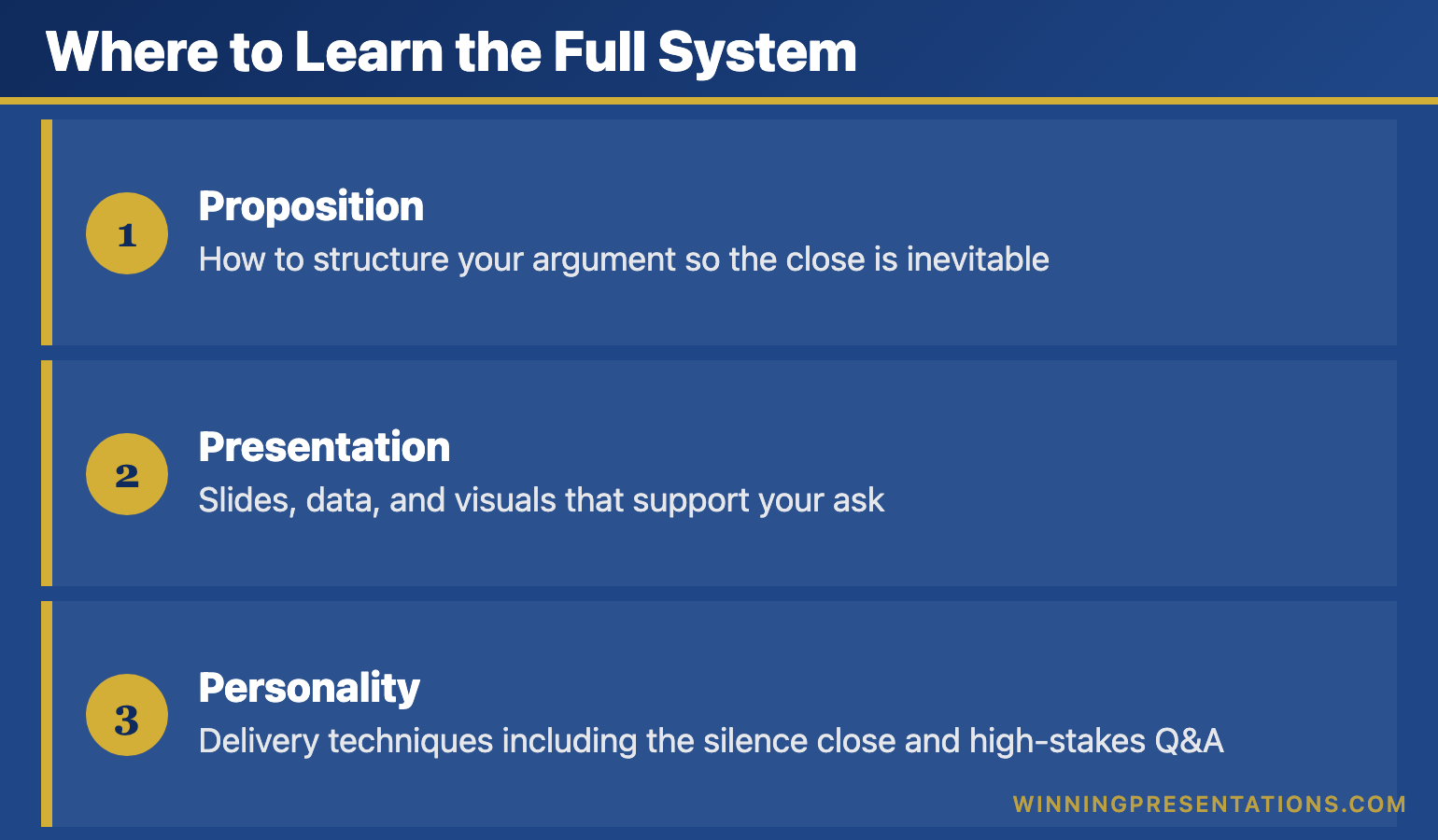
- Proposition: How to structure your argument so the close is inevitable
- Presentation: Slides, data, and visuals that support your ask
- Personality: Delivery techniques including the silence close and high-stakes Q&A
This is the same methodology that’s helped my clients raise over £250 million in funding and get budgets approved at Fortune 500 companies.
Early bird pricing closes December 31st.
→ Join the January cohort for £249 (save £50)
Try This Today
You probably have a presentation coming up. Before you finalise your final slide, ask yourself:
- What is my ONE ask?
- Can I paint a forward story of what success looks like?
- Am I prepared to stop talking after I make the ask?
If you can answer yes to all three, your presentation ending is already stronger than 90% of presenters.
Frequently Asked Questions
How long should a presentation closing be?
60-90 seconds maximum. Your close should be the most focused part of your presentation — not a second summary. State your ask, paint the forward story if appropriate, then stop.
What’s the best way to end a presentation to executives?
Lead with your recommendation, not your reasoning. Executives want the answer first, then the supporting evidence. Use the Single Ask technique: one specific request with a deadline.
How do I end a presentation without saying “any questions?”
Replace it with a specific call to action. Instead of “Any questions?” try “I’m asking for your approval on the pilot budget. What concerns would you need addressed before signing off today?”
Mary Beth Hazeldine is the Managing Director of Winning Presentations, where she trains executives at investment banks, biotech companies, and SaaS firms to present with impact. Her clients have raised over £250M using her methodology.
Her AI-Enhanced Presentation Mastery course launches January 2026. Early bird enrollment (£249) closes December 31st.