
📅 Updated: January 2026
Quick Answer
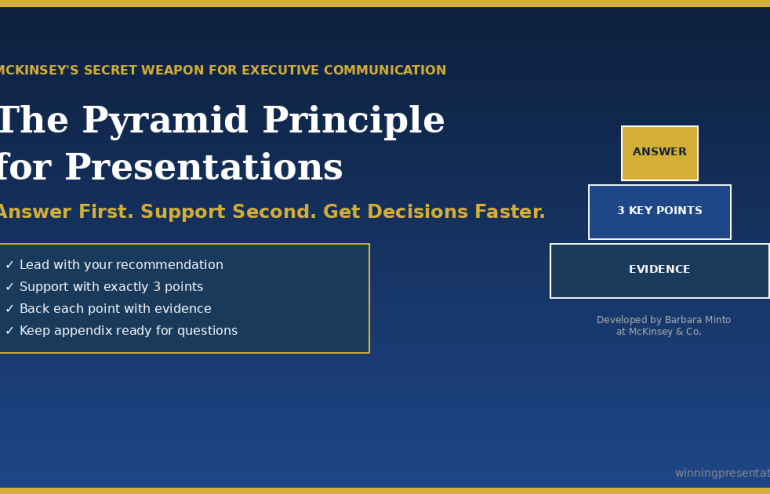
The Pyramid Principle is a communication framework developed by Barbara Minto at McKinsey that structures presentations top-down: lead with your answer first, then support it with 3 key points, each backed by evidence. It’s the opposite of how most people present (building to a conclusion) and dramatically more effective for executive audiences who want your recommendation, not your thought process.
Contents
- What Is the Pyramid Principle?
- Why It Works for Executive Presentations
- The Pyramid Structure (Slide by Slide)
- The MECE Rule: Mutually Exclusive, Collectively Exhaustive
- Before and After: A Real Example
- 3 Common Mistakes (And How to Fix Them)
- Frequently Asked Questions
What Is the Pyramid Principle?
The Pyramid Principle was developed by Barbara Minto at McKinsey in the 1960s and has since become the standard for executive communication at consulting firms, investment banks, and Fortune 500 companies worldwide.
The core idea is simple: start with the answer.
Most people present bottom-up — they walk through their analysis, build the case piece by piece, and finally reveal their conclusion. This feels logical to the presenter. It mirrors how they did the work.
But it’s torture for the audience.
Executives don’t want to follow your journey. They want your destination. They want to know what you recommend, then decide whether they need the supporting detail.
The Pyramid Principle flips the structure:
- Start with the answer — your main recommendation or finding
- Group supporting arguments — 3 key points that prove your answer
- Order logically — each point supported by evidence
It’s called a “pyramid” because the structure looks like one: single point at the top, broader supporting base below.
Related: Presentation Structure: 7 Frameworks That Actually Work
Why It Works for Executive Presentations
I’ve trained executives at JPMorgan, PwC, and dozens of other firms. The Pyramid Principle works because it aligns with how senior leaders actually process information.
Executives are time-poor. A CEO might have 15 minutes between meetings. If your conclusion is on slide 12, they’ll never see it. If it’s on slide 1, they can engage immediately — and choose whether to dig deeper.
Executives are decision-makers. They don’t need to understand every detail of your analysis. They need to know: What do you recommend? Why? What do you need from me? The Pyramid answers all three in the first 2 minutes.
Executives will interrupt. If you’re building to a conclusion, every question derails you. If you’ve already stated your answer, questions become productive exploration of supporting points.
A client of mine — a director at a major consulting firm — used to get interrupted constantly in partner meetings. His presentations were thorough but bottom-up. We restructured using the Pyramid Principle. The interruptions didn’t stop, but they changed: instead of “get to the point,” partners started asking “tell me more about point 2.” He made partner 8 months later.
⭐ Skip the Framework Struggle — Get Ready-to-Use Slides
The Executive Slide System includes a complete Pyramid Principle deck with placeholder text for every slide. Just fill in your content and present.
Includes:
- 6-slide Pyramid Principle template
- 51 AI prompts for each section
- Scripts for what to say when presenting
Get the Executive Slide System → £39
Used by consultants, investment bankers, and executives at Fortune 500 companies.
The Pyramid Structure (Slide by Slide)
Here’s how to apply the Pyramid Principle to a typical executive presentation:
Slide 1: The Answer
State your recommendation or key finding in one sentence. Be direct. Be specific.
- ❌ “We’ve been analysing the market opportunity…”
- ✅ “We should acquire Company X for £15M — it will generate £4M annual savings within 18 months.”
Slide 2: Supporting Point 1
Your strongest argument. Lead with the point, then provide evidence.
- Point: “The acquisition eliminates our largest cost centre”
- Evidence: Current outsourcing costs, projected in-house costs, timeline to realise savings
Slide 3: Supporting Point 2
Second strongest argument, same structure.
- Point: “Company X has technology we’d need 2 years to build”
- Evidence: Capability comparison, build vs. buy analysis
Slide 4: Supporting Point 3
Third argument. Never more than 3 — if you need more, you haven’t synthesised enough.
- Point: “The asking price is below market value”
- Evidence: Comparable transactions, valuation methodology
Slide 5: Implications
What this means for the business. Risks, dependencies, timeline.
Slide 6: Next Steps
What you need from the audience. One clear ask.
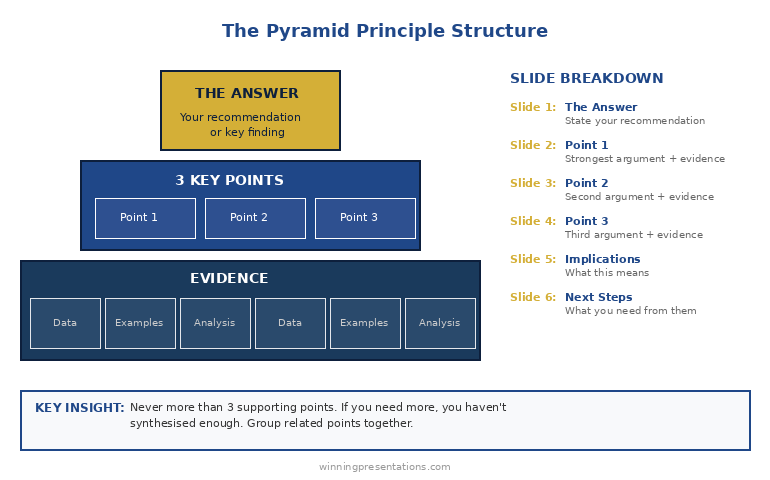
The Rule of Three: Why exactly 3 supporting points? Because humans can hold 3-4 items in working memory. More than 3 points and your audience starts forgetting the first one. Fewer than 3 and your argument feels thin. Three is the magic number.
The consulting director I mentioned earlier? He’d known the Pyramid Principle for years — but still struggled to execute it. The Executive Slide System gave him ready-to-use templates that forced him to structure properly. Eight months later, he made partner.
The MECE Rule: Mutually Exclusive, Collectively Exhaustive
The Pyramid Principle has a companion concept: MECE (pronounced “me-see”). Your supporting points should be:
Mutually Exclusive: No overlap between points. Each argument is distinct.
- ❌ “It saves money” and “It reduces costs” (these overlap)
- ✅ “It saves money” and “It saves time” and “It reduces risk” (distinct)
Collectively Exhaustive: Together, they cover all the important ground. No major gaps.
MECE matters because overlap confuses your audience (“wait, didn’t you already say that?”) and gaps invite objections (“but what about…?”).
Before you finalise your 3 supporting points, ask:
- Is there any overlap between these points?
- If someone accepted all 3 points, would they accept my answer?
- What’s the strongest objection — and is it addressed?
⭐ Present Like McKinsey — Without the Consulting Fee
17 PowerPoint templates including the complete Pyramid Principle deck. Instant download, lifetime access.
Includes:
- Pyramid Principle 6-slide deck
- MECE validation checklist
- Before/after real examples
Get the Executive Slide System → £39
30-day money-back guarantee. Used to close £250M+ in deals.
Before and After: A Real Example
Here’s how the Pyramid Principle transforms an actual presentation:
BEFORE (Bottom-Up):
- Slide 1: Agenda
- Slide 2: Background on the project
- Slide 3: Methodology we used
- Slide 4: Data we collected
- Slide 5: Analysis of Option A
- Slide 6: Analysis of Option B
- Slide 7: Analysis of Option C
- Slide 8: Comparison matrix
- Slide 9: Risks and considerations
- Slide 10: Our recommendation
Problem: The CEO checked out by slide 4. The recommendation never landed.
AFTER (Pyramid Principle):
- Slide 1: “We recommend Option B — it delivers 40% higher ROI with acceptable risk”
- Slide 2: Point 1 — ROI comparison (Option B wins on financial returns)
- Slide 3: Point 2 — Implementation timeline (Option B is fastest)
- Slide 4: Point 3 — Risk profile (Option B risks are manageable)
- Slide 5: What we need to proceed
- Appendix: Methodology, detailed analysis, data (available if asked)
Result: CEO approved in the meeting. Total presentation time: 8 minutes.
Want ready-made before/after examples for your own presentations? The Executive Slide System includes real transformation examples you can use as models.
3 Common Mistakes (And How to Fix Them)
Mistake 1: Burying the answer in context
❌ “Given the market conditions and our strategic priorities and the competitive landscape… we recommend X.”
✅ “We recommend X.” Full stop. Context comes after, if needed.
Mistake 2: More than 3 supporting points
If you have 5 points, you haven’t synthesised. Group related points together. “Financial benefits” can cover cost savings, revenue increase, and working capital improvement — that’s one point, not three.
Mistake 3: Supporting points that don’t actually support
Every point must directly answer “why should I accept your recommendation?” If a point is interesting but doesn’t support your answer, cut it or move it to the appendix.
Related: Executive Presentation Template: 12 Slides That Command the Room
From Framework to Finished Presentation
The Pyramid Principle tells you how to structure your thinking. But there’s a gap between knowing the structure and having slides ready for Monday’s board meeting.
That’s where most people struggle. They understand “answer first, 3 supporting points” — but what exactly goes on each slide? How do you phrase the opening? What evidence is compelling vs. overwhelming?
I’ve spent 24 years closing that gap.
The Executive Slide System gives you the complete Pyramid Principle deck — not just a framework, but ready-to-use slides with placeholders you fill in. Plus AI prompts to generate content for each section and scripts for what to say when you present.
What’s Included: Free vs. Paid
| What You Get | Free Checklist | Executive Slide System (£39) |
|---|---|---|
| Pyramid Principle overview | ✓ | ✓ |
| 7 frameworks reference card | ✓ | ✓ |
| Ready-to-use PowerPoint templates | — | ✓ 17 templates |
| Pyramid Principle slide deck | — | ✓ 6-slide template |
| AI prompts for each slide | — | ✓ 51 prompts |
| Before/after examples | — | ✓ Real transformations |
| Result | Understand the principle | Present like McKinsey |
🎯 Stop Struggling With Structure — Present With Confidence
The Executive Slide System has helped executives close over £250M in deals using these exact templates. Your next presentation could be the one that gets you promoted.
Everything you need:
- 17 PowerPoint templates (Pyramid, SCQA, Problem-Solution + more)
- 51 AI prompts to generate content fast
- Slide-by-slide scripts for confident delivery
Get the Executive Slide System → £39
Instant download. Lifetime access. 30-day money-back guarantee.
Frequently Asked Questions
What is the Pyramid Principle in simple terms?
The Pyramid Principle means starting with your answer or recommendation first, then supporting it with 3 key points, each backed by evidence. It’s the opposite of building to a conclusion — you state the conclusion immediately and let your audience decide how much supporting detail they need.
Who invented the Pyramid Principle?
Barbara Minto developed the Pyramid Principle while working at McKinsey & Company in the 1960s. She later wrote “The Pyramid Principle: Logic in Writing and Thinking,” which became the standard text for business communication at consulting firms worldwide.
When should you NOT use the Pyramid Principle?
Avoid the Pyramid Principle when your audience needs to be emotionally engaged before hearing your conclusion (use the Hero’s Journey instead), when you’re delivering bad news that requires context first, or when you genuinely don’t have a recommendation yet. It’s designed for situations where you have a clear answer and a decision-making audience.
What is MECE and how does it relate to the Pyramid Principle?
MECE stands for Mutually Exclusive, Collectively Exhaustive. It’s a test for your supporting points: they should have no overlap (mutually exclusive) and together cover all the important ground (collectively exhaustive). MECE ensures your argument is logically airtight.
How many supporting points should I have?
Exactly 3. Human working memory can hold 3-4 items comfortably. More than 3 points and your audience starts forgetting earlier ones. If you have 5 points, you haven’t synthesised enough — group related points together.
📧 The Winning Edge Newsletter
Weekly insights on presentations that close deals, win budgets, and advance careers. Join 2,000+ executives.
🎁 Not Ready to Buy? Start Here.
Get the free checklist with the Pyramid Principle template and 6 other frameworks. You can upgrade to full templates later.
Related Resources
- Presentation Structure: 7 Frameworks That Actually Work (Hub)
- Executive Presentation Template: 12 Slides That Command the Room
- Board Presentation Template: The Executive’s Guide
- Budget Presentation Template: CFO-Approved Structure
Struggling with nerves when presenting to executives? The Pyramid Principle helps you sound confident because you lead with your answer. But if physical anxiety is holding you back, see: Stage Fright Before Presentations: The First 60 Seconds Protocol
About the Author
Mary Beth Hazeldine has trained executives on high-stakes presentations for over 15 years. With 24 years in corporate banking at JPMorgan Chase, PwC, Royal Bank of Scotland, and Commerzbank, she’s used the Pyramid Principle in hundreds of board presentations and client pitches. Her clients have closed over £250 million using her presentation frameworks.

