

When AI Makes You Faster But the Anxiety Doesn’t Fade: Why Confidence Lags Capability
Quick Answer Confidence lags capability because confidence is built on felt-mastery — the embodied sense that you wrote the material, walked through the data, and earned the recommendation. AI shortens the time to a polished draft but does not produce felt-mastery. The fix is not less AI. It is a deliberate practice that rebuilds felt-mastery […]

ChatGPT + Copilot Workflow: The 2-Tool Stack That Builds Boardroom Decks Faster Than Either Alone
Quick Answer The two-tool stack works because each model does something the other does poorly. ChatGPT handles the structural and narrative drafting — situation analysis, recommendation framing, story arcs — without access to your private files. Copilot handles the document-grounded work — pulling specific numbers, integrating with your file system, building the slide layout in […]
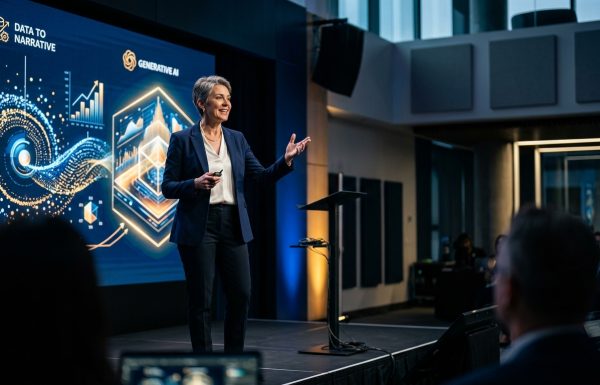
Generative AI Presentation Storytelling: 3 Prompts That Turn Dry Data Into a Narrative
Quick Answer Generative AI presentation storytelling works when the prompt forces the model into a narrative structure rather than a summary. The three prompts that consistently produce usable drafts are: the situation-complication-resolution prompt, the character-stake-shift prompt, and the data-to-decision prompt. Each forces the model to choose a narrative shape before it generates copy. Without that, […]

Executive Buy-In Training Programme Online: What Senior Leaders Need From a Modern Course
Quick Answer A modern executive buy-in training programme online needs to teach four capability areas: stakeholder analysis, case construction, board-paper structure, and recovery moves under pressure. Generic presentation training does not cover these — it teaches delivery and slide design without addressing the psychology of senior decision-making. The right training is structured around how boards […]

Using AI to Build Executive Slide Decks: The Workflow Senior Leaders Need to Learn
Quick Answer Using AI to build executive slide decks works when you follow a structured five-stage workflow: brief, draft, edit, pressure-test, decide. Each stage has a specific output and a specific decision the senior leader makes before moving on. The workflow takes around 90 minutes for a 12–15 slide board pack — significantly faster than […]

Speaking Anxiety Before AI-Augmented Presentations: When the Tools Add to the Pressure
Quick Answer Speaking anxiety before AI-drafted presentations has a distinct shape: the deck looks polished, the voice in your head says you do not deserve to present it, and the body responds with the same physical signs as ordinary nerves but at higher intensity. The fix is not to hand-write the deck. It is to […]

Quarterly Review Slide Structure: The 4-Section Framework Senior Leaders Trust
Quick Answer A quarterly review slide structure works when it follows a four-section frame: position, performance, pivot, provision. Each section maps to one or two slides. The frame turns a quarterly review from a status report into a decision conversation — what changed, what worked, what needs to change next, and what the executive committee […]

Generative AI for Executive Presentation Decks: The Editorial Pass That Removes the AI Tells
Quick Answer Generative AI produces fast first drafts of executive presentations. It does not produce board-ready decks. The drafts carry signature patterns — even bullet lengths, abstract verbs, unsourced claims — that a board reads as opinion, not analysis. The fix is a structured editorial pass: six moves applied to every AI-drafted deck before it […]

Board-Ready Executive Slide Templates: The 5-Section Structure Senior Leaders Use
Quick Answer Board-ready slide templates work when they enforce a five-section decision flow: context, options, recommendation, risk, decision. Each section maps to one slide. Anything beyond those five lives in the appendix. Templates without that structure look polished but read as opinion. Templates with it read as a board paper that happens to be a […]

“Is This Your Own Work?” — How to Answer When the Slide is Templated
Quick answer: When an executive asks “is this your own work?” about a templated slide, the question is almost never about provenance. It is about whether you can defend the slide’s substance. The decision-safe answer separates form from content: “The layout is from a senior template library I use. The analysis and the recommendation are […]