

If you are searching for an investor pitch deck review service, the most useful version of that work is structural, not stylistic — does the deck open with a clear recommendation, does it size the market defensibly, does the traction frame survive a question. The Executive Slide System is a structured set of 26 templates, 93 AI prompts, and 16 scenario playbooks designed for senior decision-makers. It gives you the same review framework against which an experienced reader pressure-tests an investor deck — applied to your own. £39, instant download, single payment.
This page explains what a structural review actually checks, what the System contains, and how to apply it to your deck before a partner meeting. If you are deciding whether to pay for an outside review or run a structured self-review, the detail below is written to help you decide.

Short on time? If you would rather skip the analysis and see the review framework directly, view The Executive Slide System on Gumroad — instant download, single payment, designed for senior decision-makers including investors and the founders presenting to them. The remainder of this page is for founders who want context first.
What an Investor Pitch Deck Review Actually Checks
Most pitch deck review services advertise themselves on visual polish — alignment, font choice, the cover slide. That is the easy part. A useful review starts somewhere else: within the first ten seconds, the partner is checking whether they understand what is being asked, why now, and what the founder believes. Visual polish does not rescue a deck whose recommendation is buried on slide twelve.
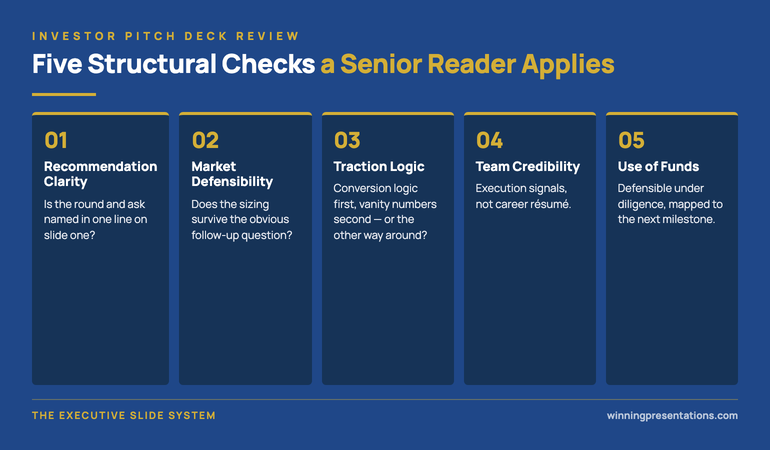
A structural review checks whether the deck is built around how a senior reader takes in information: recommendation first, evidence second, implications third. It tests whether the market sizing is defensible under a follow-up, whether the traction frame leads with conversion logic rather than vanity numbers, whether the team slide signals execution credibility, and whether the financial slide names the use of funds in a way that survives diligence. These are the questions an experienced reviewer applies — and the same questions a founder can apply to their own work, given the framework.
A Self-Review System That Mirrors Investor Logic
The Executive Slide System is structured around how senior decision-makers — investors among them — read a deck: recommendation and ask first, supporting evidence second, implications and decision frame third. The 16 scenario playbooks adapt that core architecture to specific situations including investor pitches, capital requests, and board approvals. Where a paid review service gives you a one-time mark-up of one deck, the System gives you the framework to apply across every fund conversation, every refinement cycle, and every adjacent senior audience.
It was built by Mary Beth Hazeldine, who spent 24 years in corporate banking at JPMorgan Chase, PwC, Royal Bank of Scotland, and Commerzbank before taking over Winning Presentations in 2023. The slide structures draw on the presentations she designed and advised on for capital allocators, investment committees, and senior executives — the same audiences who read founder decks for a living. The deliverables are practical: editable slide files, scenario walkthroughs, and AI prompts for ChatGPT and Microsoft Copilot to populate templates and stress-test your existing deck. The executive slide templates overview shows how the System covers other senior scenarios.
What the Review Framework Includes
- 26 slide templates — covering recommendation slides, market and evidence frames, traction summaries, financial slides, risk slides, and decision-asks designed for senior audiences including investors
- 93 AI prompts — for ChatGPT and Microsoft Copilot, mapped to each template and scenario; several prompts are written specifically to pressure-test an existing deck against the structural questions investors ask
- 16 scenario playbooks — including investor pitches, capital requests, and board approvals, so you can compare your existing deck against the architecture each scenario calls for
- Master checklist — pre-meeting review of structure, evidence, and Q&A readiness before you walk into the partner meeting
- Framework reference — the underlying structure principle behind the templates, so you can adapt the review when an unusual investor situation does not fit a playbook exactly
- Three-file delivery — instant download, no subscription, no recurring charge
Price: £39 — instant download, single payment.
Review Your Own Deck the Way an Experienced Reader Would
The Executive Slide System gives you the senior-level structure, the scenario playbooks, the master checklist, and the AI prompts to pressure-test your investor pitch against the same structural questions an experienced reviewer asks — without paying for a one-off mark-up that ages the moment you change a slide.
- 26 templates and 16 scenario playbooks for investor pitches, capital requests, and senior reviews
- 93 AI prompts for ChatGPT and Microsoft Copilot, mapped to each template and review task
- Master checklist covering recommendation, market, traction, team, and Q&A readiness
- £39, instant download, single payment, no subscription
Get The Executive Slide System → £39
Designed for senior professionals, including founders presenting to investment committees and partners
Why a Structural Self-Review Outlasts a One-Off Mark-Up
A paid review of one deck is fixed in time. The reviewer reads version twelve and sends comments. Two weeks later the narrative has shifted, a new fund has signalled with different priorities, the market frame has been challenged in a partner meeting, and the deck has been reworked. The mark-up no longer matches the current version. A structural framework is the same instrument applied repeatedly: every time the deck changes, the founder runs the checklist, applies the AI prompts to the new draft, and refines. The skill compounds inside the team rather than living in someone else’s inbox.
Founders raising across multiple rounds eventually make this trade explicitly: they want the framework, not a perpetual review subscription. The architecture of a strong investor deck does not change between seed and Series B — what changes is the substance and the depth of evidence on each slide. The pitch deck template for startups overview walks through the same architecture from a download-and-build angle.
Stop paying for a one-off review every time the deck changes.
The Executive Slide System gives you the templates, scenario playbooks, master checklist, and AI prompts to pressure-test your deck yourself — every iteration, every fund, every refinement. £39, instant download, yours to keep.
Is This the Right Approach for You?
The Executive Slide System is designed for you if:
- You are preparing for seed, Series A, or growth-round investor meetings and want a structural framework you can apply repeatedly
- You want a self-review system that adapts across investor conversations, not a one-time mark-up that ages quickly
- You face multiple senior audiences — investors, your own board, strategic partners — and need the same review architecture across them
- You use ChatGPT or Microsoft Copilot and want AI prompts mapped to specific review tasks
It is probably not the right fit if:
- You want a bespoke 1:1 review with line-by-line written comments — that is a different service offering
- You need pre-designed brand graphics rather than a structural review framework
- Your primary need is delivery confidence or anxiety management rather than slide structure
If the fit looks right and you want context on how the templates work in a related senior scenario, the board presentation course overview walks through one of the playbook scenarios in more detail.
One payment, instant download, yours to keep.
No subscription, no recurring charge, no expiry. Download today, run the master checklist against your current deck, and use the same review framework across every iteration. The Executive Slide System — 26 templates, 93 AI prompts, 16 scenario playbooks. £39, single payment.
Frequently Asked Questions
Is this an investor pitch deck review service or a self-review framework?
It is a self-review framework, delivered as a structured set of templates, scenario playbooks, AI prompts, and a master checklist. You apply the same questions to your own deck that an experienced reviewer would. There is no 1:1 written mark-up of a specific deck included in the £39 single payment. The advantage of the framework is that it works across every iteration and every fund conversation, not only the version a reviewer reads once.
What does the master checklist actually check?
The master checklist works through the structural questions a senior reader asks: does the recommendation slide name the round and the ask in one line, is the market sizing defensible under follow-up, does the traction slide lead with conversion logic, does the team slide signal execution credibility, does the financial slide name the use of funds defensibly, and is the deck Q&A-ready. The checklist mirrors the architecture of the templates so you are running the same instrument across review and rebuild.
How are the AI prompts used to review an existing deck?
There are 93 AI prompts for ChatGPT and Microsoft Copilot, mapped to specific templates and scenarios. Several are designed to pressure-test an existing deck — drafting follow-up questions a partner might ask on your market slide, stress-testing the conversion logic on your traction frame, or generating a Q&A bank against your current narrative. You paste the prompt into your AI tool, add context from your deck, and use the output to refine. Instructions assume no prior AI experience.
Can I use it for board approvals as well as investor pitches?
Yes. The 16 scenario playbooks cover investor pitches, capital requests, board approvals, and other senior situations. The structural architecture is consistent across these audiences — recommendation first, evidence second, implications third — and the playbooks adjust the specifics. A founder who learns the framework once can apply the same review across every senior conversation, including internal board reviews and quarterly stakeholder updates.
Will the templates work in PowerPoint, Keynote, and Google Slides?
Yes. The templates are delivered in editable formats designed to work with PowerPoint and equivalent slide software including Keynote and Google Slides. Structure carries the System, not visual styling — so if your startup has a brand design, the templates give you the architecture and you dress it in your own visual language.
The Winning Edge — weekly newsletter for senior professionals
Short, practical essays on executive slides, investor and boardroom communication, and AI-assisted preparation. One email a week.
About the Author
Mary Beth Hazeldine is the Owner & Managing Director of Winning Presentations. With 24 years of corporate banking experience at JPMorgan Chase, PwC, Royal Bank of Scotland, and Commerzbank, she advises senior professionals across financial services, healthcare, technology, and government on structuring presentations for investor meetings, board approvals, executive committees, and capital requests.